Species · Amphibians
Limestone Salamander Hydromantes brunus
The scientific name of the Limestone Salamander is Hydromantes brunus. It is a species of amphibian in the family Plethodontidae (lungless salamanders), order Caudata. The name dates from 1954.
- Scientific name
- Hydromantes brunus Gorman, 1954
- Common name
- Limestone Salamander
- Genus
- Hydromantes
- Family
- Plethodontidae (Lungless Salamanders)
- Order
- Caudata
- Class
- Amphibia
- Red List category
- NT Near Threatened
- Recorded in
- 1 country
- Name status
- accepted in the Catalogue of Life

Overview
The Limestone Salamander (Hydromantes brunus Gorman, 1954) is an amphibian in the family Plethodontidae, order Caudata, and class Amphibia. It is endemic to a portion of the Merced River Canyon in Mariposa County, California, and occurs at elevations ranging from 300 to 760 m. It has a flattened body, webbed toes, a short tail, and a flattened head.
Written 27 November 2026 from the sources listed below. Each statement was checked against the passage it cites; statements that could not be supported were removed.
Appearance
The Limestone Salamander has a flattened body, head, and webbed toes, along with a short tail. Adult individuals are brownish with a pale underside.[1][2]
Males possess an oval-shaped mental gland. Newly emerged individuals are yellowish-green and become darker as they age.[3][4]
The species typically measures between 5.0 and 7.5 cm in length.[5]
Habitat
The Limestone Salamander inhabits canyon slopes with gradients greater than 35 degrees. Its habitats include moss-covered limestone outcrops.[6][7]
It shelters beneath rocks and logs in moist environments. During dry weather, individuals remain underground in caves and rock crevices.[8][9]
The species is endemic to a portion of the Merced River Canyon in Mariposa County, California. Its known distribution is restricted to the Lower Merced River drainage and includes several geographically separated localities.[10][11][12]
It occurs at elevations ranging from 300 to 760 m.[13]
Behaviour
During dry weather, the Limestone Salamander remains underground in caves and rock crevices.[14]
Reproduction and life cycle
The Limestone Salamander reproduces by laying eggs rather than giving birth to live young. Young individuals hatch inside their eggs and emerge fully formed without a larval stage.[15][16]
Conservation
The Limestone Salamander is classified as Near Threatened by the IUCN, mainly because it occurs at fewer than five locations. It is considered uncommon but not rare at its known locations.[17][18][19]
Its federal listing status is under review by the US Fish and Wildlife Service. It is listed as Threatened under California's State Endangered Species Act.[20][21]
A proposed gold mining operation in Hell Hollow is considered the most immediate threat to the species. Habitat loss associated with highway, quarry, and dam construction is an additional threat.[22][23]
Part of the Merced River Canyon is protected as the Limestone Salamander Ecological Reserve, covering approximately 120 acres. An additional 1,600 acres have been designated as the Limestone Salamander Area of Critical Environmental Concern.[24][25]
Classification of the Limestone Salamander
| Kingdom | Animalia |
|---|---|
| Phylum | Chordata |
| Subphylum | Vertebrata |
| Infraphylum | Gnathostomata |
| Parvphylum | Osteichthyes |
| Megaclass | Tetrapoda |
| Class | Amphibia (Amphibians) |
| Order | Caudata (Salamanders) |
| Family | Plethodontidae (Lungless Salamanders) |
| Subfamily | Plethodontinae (Plethodontine Salamanders) |
| Genus | Hydromantes (Web-toed Salamanders) |
| Species | Hydromantes brunus Gorman, 1954 |
Where the Limestone Salamander is found
Checklists and occurrence records place Hydromantes brunus in 1 country across North America. GBIF holds 252 georeferenced records of it.
Countries
Regions and cities with the most records
Range as the checklists state it
North America
A number beside a place is its count of GBIF occurrence records. A place without a number comes from a checklist alone. Records show where a species has been observed or collected, which can include escapes and vagrants.
Common names
English
- Limestone Salamander
Names in 4 other languages
- Czech
- mločík krasový
- French
- Hydromante brun
- Russian
- Известковая саламандра, Карстовая саламандра
- Spanish
- Salamandra de la Caliza
Synonyms
One other scientific name has been used for this species and is now treated as a synonym of Hydromantes brunus.
- Hydromantoides brunus (Gorman, 1954)
Related species
-
 Mount Lyell SalamanderHydromantes platycephalus
- Shasta SalamanderHydromantes shastae
- Samwel Shasta SalamanderHydromantes samweli
- Wintu Shasta SalamanderHydromantes wintu
-
 Red-backed SalamanderPlethodon cinereus
-
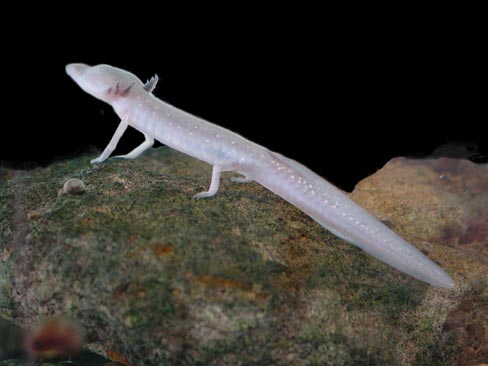 Texas Blind SalamanderEurycea rathbuni
-
 Red SalamanderPseudotriton ruber
- Blanco Blind SalamanderEurycea robusta
Compare
Questions and answers
What is the scientific name of the Limestone Salamander?
The scientific name of the Limestone Salamander is Hydromantes brunus. Written with its author, the full name is Hydromantes brunus Gorman, 1954.
Which family does the Limestone Salamander belong to?
Hydromantes brunus belongs to the family Plethodontidae, in the order Caudata and the class Amphibia.
Where is the Limestone Salamander found?
Checklists and occurrence records place Hydromantes brunus in 1 country: United States.
What is the conservation status of the Limestone Salamander?
The IUCN Red List category recorded for Hydromantes brunus is Near Threatened (NT).
What is the scientific name of a salamander?
The scientific name of the Limestone Salamander is Hydromantes brunus Gorman, 1954.[10]
What kind of habitat do salamanders need?
The Limestone Salamander inhabits canyon slopes with gradients greater than 35 degrees, including moss-covered limestone outcrops. It shelters beneath rocks and logs in moist environments and remains underground in caves and rock crevices during dry weather.[6][7][8][9]
Sources
Passages the profile rests on
- The species has a flattened body, head, webbed toes, and a short tail. Source passage: “The limestone salamander has a flattened body, head, webbed toes, and a short tail.” — English Wikipedia
- Adult individuals are brownish with a pale underside. Source passage: “Adults are brownish with a pale ventral surface” — English Wikipedia
- Males possess an oval-shaped mental gland. Source passage: “the male has oval-shaped mental gland.” — English Wikipedia
- Newly emerged individuals are yellowish-green and become darker as they age. Source passage: “They are yellowish greenish, darkening with age.” — English Wikipedia
- The species typically measures between 5.0 and 7.5 cm in length. Source passage: “It is typically 5.0-7.5 cm in length.” — English Wikipedia
- The species inhabits canyon slopes with gradients greater than 35 degrees. Source passage: “at elevations of 300–760 m in inhabits canyon slopes that are greater than 35 degrees.” — English Wikipedia
- Its habitats include moss-covered limestone outcrops. Source passage: “Habitats include moss-covered limestones outcroppings” — English Wikipedia
- The species shelters beneath rocks and logs in moist environments. Source passage: “under rocks and logs in moist environments.” — English Wikipedia
- During dry weather, individuals remain underground in caves and rock crevices. Source passage: “During dry weather it stays underground in caves and rock crevices.” — English Wikipedia
- The species is endemic to a portion of the Merced River Canyon in Mariposa County, California. Source passage: “It is endemic to a portion of the Merced River Canyon in Mariposa County, California.” — English Wikipedia
- Its known distribution is restricted to the Lower Merced River drainage. Source passage: “The limestone salamander occurs only in the Lower Merced River drainage” — English Wikipedia
- The species occurs at several geographically separated localities. Source passage: “in several disparate localities” — English Wikipedia
- The species occurs at elevations ranging from 300 to 760 m. Source passage: “at elevations of 300–760 m” — English Wikipedia
- The species remains underground in caves and rock crevices during dry weather. Source passage: “During dry weather it stays underground in caves and rock crevices.” — English Wikipedia
- The species reproduces by laying eggs rather than giving birth to live young. Source passage: “The species was originally thought to be life-birthing, but is now known to lay eggs.” — English Wikipedia
- Young individuals hatch inside their eggs and emerge fully formed without a larval stage. Source passage: “Young hatch in the egg and emerge fully formed, with no larval stage.” — English Wikipedia
- The species is classified as Near Threatened by the IUCN. Source passage: “The limestone salamander is classified as near threatened by the IUCN” — English Wikipedia
- Its Near Threatened classification is attributed mainly to its occurrence at fewer than five locations. Source passage: “mostly because it is known from fewer than five locations” — English Wikipedia
- The species is considered uncommon but not rare at its known locations. Source passage: “where the species appears to be uncommon but not rare” — English Wikipedia
- Its federal listing status is under review by the US Fish and Wildlife Service. Source passage: “its Federal listing status is currently under review.” — English Wikipedia
- The species is listed as Threatened under California's State Endangered Species Act. Source passage: “The species is listed as Threatened by the California Department of Fish and Wildlife under the State Endangered Species Act.” — English Wikipedia
- A proposed gold mining operation in Hell Hollow is considered the most immediate threat to the species. Source passage: “A proposed gold operation mine in Hell Hollow is thought to be the most immediate threat” — English Wikipedia
- Habitat loss associated with highway, quarry, and dam construction is an additional threat. Source passage: “general habitat loss due to construction of highways, quarries and dams.” — English Wikipedia
- Part of the Merced River Canyon is protected as the Limestone Salamander Ecological Reserve, covering approximately 120 acres. Source passage: “a portion of the Merced River Canyon is protected by the State of California and managed by the State Department of Fish and Wildlife as the Limestone Salamander Ecological Reserve (~120 acres)” — English Wikipedia
- An additional 1,600 acres have been designated as the Limestone Salamander Area of Critical Environmental Concern. Source passage: “a further 1,600 acres have been designated as the Limestone Salamander Area of Critical Environmental Concern.” — English Wikipedia
Data
- Catalogue of Life, 2026-10-16 XR cc by
- Global Biodiversity Information Facility CC BY 4.0
- Wikidata CC0
- GeoNames CC BY 4.0
- Wikimedia Commons per image; credit shown with each image
- Within the Catalogue of Life, this name comes from The Integrated Taxonomic Information System cc0
References
- A new species of sala-mander from Central California. (1954). Herpetologica, 10, 153–158. https://bionames.org/references/3117f31e919bd1748f29e0e1b4cfc62f Link where the name was published
- Crother, Brian I., Jeff Boundy, Jonathan A. Campbell, et al. / Moriarty, John J., ed. (2000). Scientific and Standard English Names of Amphibians and Reptiles of North America North of Mexico, with Comments Regarding Confidence in Our Understanding. Herpetological Circular, No. 29.
- Crother, Brian I., Jeff Boundy, Frank T. Burbrink, et al. / Moriarty, John J., ed. (2008). Scientific and Standard English Names of Amphibians and Reptiles of North America North of Mexico, With Comments Regarding Confidence in Our Understanding, Sixth Ed. Herpetological Circular No. 37.
This species in other databases
Page built on 29 November 2026. See how the catalog is made and all sources and licences.
Cite this page
ScientificNames.org. (2026). Hydromantes brunus (Limestone Salamander). Retrieved November 29, 2026, from https://scientificnames.org/species/hydromantes-brunus
“Hydromantes brunus (Limestone Salamander).” ScientificNames.org, 2026, scientificnames.org/species/hydromantes-brunus. Accessed 29 Nov. 2026.
ScientificNames.org. “Hydromantes brunus (Limestone Salamander).” Accessed November 29, 2026. https://scientificnames.org/species/hydromantes-brunus.
@misc{scientificnames_hydromantes_brunus_limestone_salamander,
  author = {{ScientificNames.org}},
  title = {Hydromantes brunus (Limestone Salamander)},
  year = {2026},
  url = {https://scientificnames.org/species/hydromantes-brunus},
  note = {Accessed 2026-11-29}
}