Species · Flowering plants
Hawai'i Holly Ilex anomala
The scientific name of the Hawai'i Holly is Ilex anomala. It is a species of flowering plant in the family Aquifoliaceae (holly), order Aquifoliales.
- Scientific name
- Ilex anomala Hook. & Arn.
- Common name
- Hawai'i Holly
- Genus
- Ilex
- Family
- Aquifoliaceae (Holly)
- Order
- Aquifoliales
- Class
- Magnoliopsida
- Recorded in
- 1 country
- Name status
- accepted in the Catalogue of Life

Overview
Ilex anomala is native to the Hawaiian Islands, the Marquesas Islands, and the Society Islands of French Polynesia. It is the only indigenous member of the holly family native to the Hawaiian Islands and is completely thornless.
Written 26 November 2026 from the sources listed below. Each statement was checked against the passage it cites; statements that could not be supported were removed.
Appearance
Hawai'i Holly produces clusters of white flowers with greenish centers. Its leaves are blunt-tipped and have distinctive webbing on both sides of the yellowish midrib.[1][2]
The upper surfaces of its leaves are glossy and medium to dark green, while the undersides are lighter or paler green and non-glossy. The species is completely thornless.[3][4]
The species produces numerous small, blackish-purple fruits classified as drupes.[5]
Hawai'i Holly grows as a tree or shrub approximately 15 to 40 feet tall. The largest specimens can reach approximately 40 feet in height.[6][7]
Habitat
In Hawaiʻi, Hawai'i Holly inhabits mixed mesic and wet forests. In the Hawaiian Islands, it also occurs in open bogs.[8][9]
In the Marquesas Islands, it is a characteristic canopy tree in low-canopied cloud forests above 1,000 meters elevation.[10]
The species can be cultivated at elevations as low as approximately 300 feet.[11]
Uses
Early Hawaiians used the whitish or grayish-yellow hardwood of Hawai'i Holly to make anvils for the second stage of kapa production.[12]
The wood was also used for canoe trimmings and to make saddle trees in post-contact Hawaiʻi.[13][14]
Reproduction and life cycle
Hawai'i Holly produces fruits after flowering.[15]
Diet
The fruits of Hawai'i Holly are an important food source for the Hawaiian thrush.[16]
Behaviour
The undersides of Hawai'i Holly leaves provide a place where endemic happy face spiders can be found.[17]
Conservation
Hawai'i Holly is relatively common in its natural habitat.[18]
Similar species
The Marquesan and Tahitian trees are nearly indistinguishable from the Hawaiian form of Hawai'i Holly. The species is variable.[19][20]
Classification of the Hawai'i Holly
| Kingdom | Plantae |
|---|---|
| Subkingdom | Pteridobiotina |
| Phylum | Tracheophyta |
| Class | Magnoliopsida |
| Order | Aquifoliales |
| Family | Aquifoliaceae (Holly) |
| Genus | Ilex (Holly) |
| Species | Ilex anomala Hook. & Arn. |
Where the Hawai'i Holly is found
Checklists and occurrence records place Ilex anomala in 1 country across North America. GBIF holds 2,315 georeferenced records of it.
Countries
Regions and cities with the most records
- Hawaii, United States 748
- Kaneohe, United States 154
- Manoa, United States 152
- Aliamanu / Salt Lakes / Foster Village, United States 149
- Kalihi Valley, United States 149
- Makiki / Lower Punchbowl / Tantalus, United States 149
- Honolulu, United States 146
- Kailua, United States 145
- Kuliouou - Kalani Iki, United States 141
- Waikīkī, United States 141
- Niu Valley, United States 140
- Diamond Head / Kapahulu / Saint Louis Heights, United States 138
- East Honolulu, United States 136
- Joint Base Pearl Harbor Hickam, United States 113
- Mililani Mauka / Launani Valley, United States 107
- Mililani Mauka, United States 106
- Mililani Town, United States 105
- Wahiawā, United States 100
- Wahiawā-Whitmore, United States 98
- Waipahu, United States 98
- Schofield-Wheeler, United States 91
- Schofield Barracks, United States 83
- Pearl City, United States 78
- Makakilo-Makaīwa Hills-Kunia, United States 61
- Makakilo, United States 59
- Makakilo City, United States 59
- Makakilo / Kapolei / Honokai Hale, United States 55
- ʻEwa Gentry-West Loch, United States 53
- Koolauloa, United States 50
- ʻEwa Beach-Iroquois Point, United States 50
- ‘Ewa Gentry, United States 43
- ‘Ewa Beach, United States 42
- Kapolei, United States 33
- Kapolei Villages, United States 32
- Wailuku, United States 19
- Kahului, United States 18
4 more countries have a few records outside this range
These countries hold a few records of Ilex anomala but lie outside the range the checklists give for it. Such records are often zoo or garden specimens, museum material or vagrants, so the species is not counted as occurring there.
Range as the checklists state it
Marquesas Isl. (Nuku Hiva); Society Isl. (Tahiti, Raiatea); Hawaii (Kauai, Oahu, Molokai, Lanai, Maui, Hawaii Isl.)
A number beside a place is its count of GBIF occurrence records. A place without a number comes from a checklist alone. Records show where a species has been observed or collected, which can include escapes and vagrants.
Common names
English
- Hawai'i Holly
- Hawaii Holly
- Hawaiian Holly
Names in 2 other languages
- Chinese
- 夏威夷冬青
- Hawaiian
- Kāwaʻu, kāwa, kāwa‘u
Synonyms
12 other scientific names have been used for this species and are now treated as synonyms of Ilex anomala.
- Byronia anomala (Hook. & Arn.) A.Heller
- Byronia helleri H.Lév.
- Byronia hookeri Steud.
- Byronia sandwicensis Endl.
- Byronia taitensis A.Gray
- Ilex anomala f. sandwicensis (Endl.) Loes.
- Ilex anomala f. taitensis (A.Gray) Nadeaud
- Ilex hawaiensis S.Y.Hu
- Ilex marquesensis F.Br.
- Ilex sandwicensis (Endl.) Loes.
- Ilex taitensis (A.Gray) J.W.Moore
- Polystigma hookeri Meisn.
Related species
-
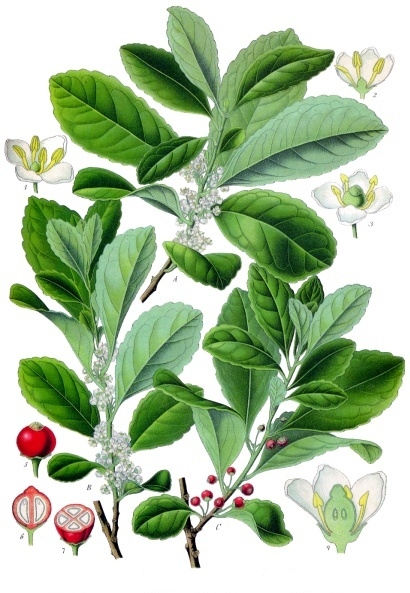 Yerba MateIlex paraguariensis
-
 Yaupon HollyIlex vomitoria
-
 WinterberryIlex verticillata
-
 English HollyIlex aquifolium
-
 Japanese HollyIlex crenata
- GuayusaIlex guayusa
-
 Christmas HollyIlex opaca
-
 Possum-hawIlex decidua
Compare
Questions and answers
What is the scientific name of the Hawai'i Holly?
The scientific name of the Hawai'i Holly is Ilex anomala. Written with its author, the full name is Ilex anomala Hook. & Arn..
Which family does the Hawai'i Holly belong to?
Ilex anomala belongs to the family Aquifoliaceae, in the order Aquifoliales and the class Magnoliopsida.
Where is the Hawai'i Holly found?
Checklists and occurrence records place Ilex anomala in 1 country: United States.
What other names does the Hawai'i Holly have?
Ilex anomala is also known in English as Hawaii Holly and Hawaiian Holly.
Sources
Passages the profile rests on
- The species produces clusters of white flowers with greenish centers. Source passage: “Clusters of white flowers with greenish centers.” — nativeplants.hawaii.edu
- Its leaves are blunt-tipped and have distinctive webbing on both sides of the yellowish midrib. Source passage: “The 2 to 6 inch blunt-tipped leaves have distinctive webbing on either side of the yellowish midrib.” — nativeplants.hawaii.edu
- The upper surfaces of its leaves are glossy and medium to dark green, while the undersides are lighter or paler green and non-glossy. Source passage: “The upper side of leaves are glossy medium to dark green while underside are lighter green or paler and not glossy.” — nativeplants.hawaii.edu
- This holly species is completely thornless. Source passage: “This holly, like many of Hawaiʻiʻs native plants, is completely thornless.” — nativeplants.hawaii.edu
- The species produces numerous small, blackish-purple fruits classified as drupes. Source passage: “Numerous small blackish purple drupes (fruits) appear after flowering.” — nativeplants.hawaii.edu
- The species grows as a tree or shrub approximately 15 to 40 feet tall. Source passage: “These rather common trees or shrubs in their natural habitat can grow from 15 to about 40 feet tall.” — nativeplants.hawaii.edu
- The largest specimens can reach approximately 40 feet in height. Source passage: “To about 40 feet in the largest specimens.” — nativeplants.hawaii.edu
- In Hawaiʻi, the species inhabits mixed mesic and wet forests. Source passage: “On Hawaii it inhabits mixed mesic and wet forests at elevations of 600–1,400 m (2,000–4,600 ft) on all main islands.” — English Wikipedia
- In the Hawaiian Islands, the species occurs in mesic to wet forests and sometimes in open bogs. Source passage: “Kāwaʻu is generally found from about 1970 to over 4600 feet in mesic to wet forests, sometimes in open bogs in the Hawaiian Islands.” — nativeplants.hawaii.edu
- In the Marquesas Islands, the species is a characteristic canopy tree in low-canopied cloud forests above 1,000 meters elevation. Source passage: “In the Marquesas Islands it is a characteristic canopy tree in low-canopied cloud forests above 1000 meters elevation” — English Wikipedia
- The species can be cultivated at elevations as low as approximately 300 feet. Source passage: “Kāwaʻu, rarely seen in cultivation, can be grown at low elevations to at least 300 feet.” — nativeplants.hawaii.edu
- Early Hawaiians used the species' whitish or grayish-yellow hardwood to make anvils for the second stage of kapa production. Source passage: “Early Hawaiians used the whitish or grayish-yellow hard wood for kapa (tapa) anvils called kua kuku, on which the second-stage kapa making process was done on.” — nativeplants.hawaii.edu
- The wood of this species was used for canoe trimmings. Source passage: “The wood was also used for trimmings canoes (waʻa) and for saddle trees.” — nativeplants.hawaii.edu
- The wood of this species was used to make saddle trees in post-contact Hawaiʻi. Source passage: “In post-contact times, some saddle trees were made from the wood of kāwaʻu.” — nativeplants.hawaii.edu
- The species produces fruits after flowering. Source passage: “Numerous small blackish purple drupes (fruits) appear after flowering.” — nativeplants.hawaii.edu
- The fruits of this species are an important food source for the Hawaiian thrush. Source passage: “The fruit is an important food for ʻōmaʻo or Hawaiian thrush ( Myadestes obscurus ).” — nativeplants.hawaii.edu
- The undersides of the species' leaves provide a place where endemic happy face spiders can be found. Source passage: “In its natural habitat, the underside leaves of kāwaʻu is a great place to look for the tiny endemic Happy face spiders or nananana makakiʻi ( Theridion grallator ).” — nativeplants.hawaii.edu
- The species is described as relatively common in its natural habitat. Source passage: “These rather common trees or shrubs in their natural habitat can grow from 15 to about 40 feet tall.” — nativeplants.hawaii.edu
- The species is described as variable. Source passage: “This is a varaible species.” — nativeplants.hawaii.edu
- The Marquesan and Tahitian trees are nearly indistinguishable from the Hawaiian form of the species. Source passage: “The Marquesan and Tahitian trees are nearly indistinguishable form kāwau ( I. anomala ).” — nativeplants.hawaii.edu
- The Hawaiian name kāwaʻu means to scrape or to detain, delay, or keep back. Source passage: “Kāwaʻu means “to scrape” or “to detain, delay, keep back.”” — nativeplants.hawaii.edu
- The association between the meaning of kāwaʻu and the tree is unclear. Source passage: “The affiliation with the tree is obscure.” — nativeplants.hawaii.edu
- The Hawaiian name ʻAiea originates from Kauaʻi. Source passage: “The name ʻAiea , of Kauaʻi origin,” — nativeplants.hawaii.edu
- The species is native to the Hawaiian Islands, the Marquesas Islands, and the Society Islands of French Polynesia. Source passage: “It is native to the Hawaiian Islands and the Marquesas Islands and Society Islands of French Polynesia.” — English Wikipedia
- The species is the only indigenous member of the holly family native to the Hawaiian Islands. Source passage: “Kāwaʻu ( Ilex anomala ) is the only indigenous member of the Holly family (Aquifoliaceae) native to the Hawaiian Islands.” — nativeplants.hawaii.edu
Data
- Catalogue of Life, 2026-10-16 XR cc by
- Global Biodiversity Information Facility CC BY 4.0
- Wikidata CC0
- GeoNames CC BY 4.0
- Wikimedia Commons per image; credit shown with each image
- Within the Catalogue of Life, this name comes from Synonymic Checklists of the Vascular Plants of the World cc by
References
- Hook. & Arn. Bot. Beechey Voy. [Hooker & Arnott] 111 (1832). where the name was published
This species in other databases
- Catalogue of Life 3PF6M
- Wikidata Q12199748
- iNaturalist 123617
- World Flora Online wfo-0000729196
- GRIN 450835
Page built on 27 November 2026. See how the catalog is made and all sources and licences.
Cite this page
ScientificNames.org. (2026). Ilex anomala (Hawai'i Holly). Retrieved November 27, 2026, from https://scientificnames.org/species/ilex-anomala
“Ilex anomala (Hawai'i Holly).” ScientificNames.org, 2026, scientificnames.org/species/ilex-anomala. Accessed 27 Nov. 2026.
ScientificNames.org. “Ilex anomala (Hawai'i Holly).” Accessed November 27, 2026. https://scientificnames.org/species/ilex-anomala.
@misc{scientificnames_ilex_anomala_hawaii_holly,
  author = {{ScientificNames.org}},
  title = {Ilex anomala (Hawai'i Holly)},
  year = {2026},
  url = {https://scientificnames.org/species/ilex-anomala},
  note = {Accessed 2026-11-27}
}