Species · Flowering plants
Northern Holly Ilex arnhemensis
The scientific name of the Northern Holly is Ilex arnhemensis. It is a species of flowering plant in the family Aquifoliaceae (holly), order Aquifoliales.
- Scientific name
- Ilex arnhemensis (F.Muell.) Loes.
- Common name
- Northern Holly
- Genus
- Ilex
- Family
- Aquifoliaceae (Holly)
- Order
- Aquifoliales
- Class
- Magnoliopsida
- Red List category
- LC Least Concern
- Recorded in
- 2 countries
- Name status
- accepted in the Catalogue of Life
Overview
Ilex arnhemensis is the only species of Ilex (holly) native to Australia. Native to coastal and riverine habitats in the tropical north of Western Australia, the Northern Territory and Queensland, it grows as a tree up to 25 metres high.
Classification of the Northern Holly
| Kingdom | Plantae |
|---|---|
| Subkingdom | Pteridobiotina |
| Phylum | Tracheophyta |
| Class | Magnoliopsida |
| Order | Aquifoliales |
| Family | Aquifoliaceae (Holly) |
| Genus | Ilex (Holly) |
| Species | Ilex arnhemensis (F.Muell.) Loes. |
Where the Northern Holly is found
Checklists and occurrence records place Ilex arnhemensis in 2 countries across Oceania. GBIF holds 1,334 georeferenced records of it.
Countries
Regions and cities with the most records
- Northern Territory, Australia 672
- Queensland, Australia 307
- Western Australia, Australia 73
- Morobe Province, Papua New Guinea 38
- Cairns, Australia 29
- Lae, Papua New Guinea 13
- Central Province, Papua New Guinea 12
- Western Province, Papua New Guinea 12
- Oro Province, Papua New Guinea 7
- Milne Bay Province, Papua New Guinea 6
- Southern Highlands Province, Papua New Guinea 3
1 more country has a few records outside this range
These countries hold a few records of Ilex arnhemensis but lie outside the range the checklists give for it. Such records are often zoo or garden specimens, museum material or vagrants, so the species is not counted as occurring there.
A number beside a place is its count of GBIF occurrence records. A place without a number comes from a checklist alone. Records show where a species has been observed or collected, which can include escapes and vagrants.
Common names
English
- Northern Holly
Subspecies and varieties
- Ilex arnhemensis subsp. arnhemensis subspecies
- Ilex arnhemensis subsp. ferdinandi subspecies
Related species
-
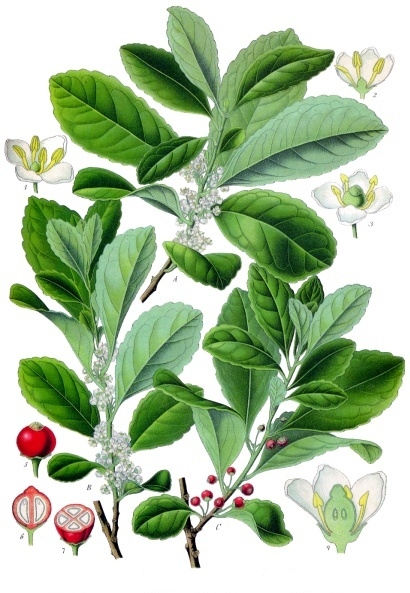 Yerba MateIlex paraguariensis
-
 Yaupon HollyIlex vomitoria
-
 Black HollyIlex verticillata
-
 HollyIlex aquifolium
-
 Box-leaf HollyIlex crenata
- GuayusaIlex guayusa
-
 Christmas HollyIlex opaca
- Possum-hawIlex decidua
Compare
Questions and answers
What is the scientific name of the Northern Holly?
The scientific name of the Northern Holly is Ilex arnhemensis. Written with its author, the full name is Ilex arnhemensis (F.Muell.) Loes..
Which family does the Northern Holly belong to?
Ilex arnhemensis belongs to the family Aquifoliaceae, in the order Aquifoliales and the class Magnoliopsida.
Where is the Northern Holly found?
Checklists and occurrence records place Ilex arnhemensis in 2 countries: Australia and Papua New Guinea.
What is the conservation status of the Northern Holly?
The IUCN Red List category recorded for Ilex arnhemensis is Least Concern (LC).
Sources
Data
- Catalogue of Life, 2026-10-16 XR cc by
- Global Biodiversity Information Facility CC BY 4.0
- Wikidata CC0
- English Wikipedia CC BY-SA 4.0
- GeoNames CC BY 4.0
- Within the Catalogue of Life, this name comes from Synonymic Checklists of the Vascular Plants of the World cc by
References
- (F.Muell.) Loes. where the name was published
This species in other databases
Page built on 25 November 2026. See how the catalog is made and all sources and licences.
Cite this page
ScientificNames.org. (2026). Ilex arnhemensis (Northern Holly). Retrieved November 25, 2026, from https://scientificnames.org/species/ilex-arnhemensis
“Ilex arnhemensis (Northern Holly).” ScientificNames.org, 2026, scientificnames.org/species/ilex-arnhemensis. Accessed 25 Nov. 2026.
ScientificNames.org. “Ilex arnhemensis (Northern Holly).” Accessed November 25, 2026. https://scientificnames.org/species/ilex-arnhemensis.
@misc{scientificnames_ilex_arnhemensis_northern_holly,
  author = {{ScientificNames.org}},
  title = {Ilex arnhemensis (Northern Holly)},
  year = {2026},
  url = {https://scientificnames.org/species/ilex-arnhemensis},
  note = {Accessed 2026-11-25}
}