Species · Flowering plants
Dahoon Holly Ilex cassine
The scientific name of the Dahoon Holly is Ilex cassine. It is a species of flowering plant in the family Aquifoliaceae (holly), order Aquifoliales.
- Scientific name
- Ilex cassine L.
- Common name
- Dahoon Holly
- Genus
- Ilex
- Family
- Aquifoliaceae (Holly)
- Order
- Aquifoliales
- Class
- Magnoliopsida
- Red List category
- LC Least Concern
- Recorded in
- 6 countries
- Name status
- accepted in the Catalogue of Life

Overview
Dahoon Holly is a flowering plant in the family Aquifoliaceae, order Aquifoliales, and class Magnoliopsida. It occurs along the Atlantic coast from Virginia south to Florida, west along the Gulf Coast to the Colorado River in Texas, and on the coasts of Cuba, the Bahamas, and Puerto Rico. It is an evergreen shrub or small tree with white flowers and red fruits, and its leaves contain caffeine and theobromine.
Written 26 November 2026 from the sources listed below. Each statement was checked against the passage it cites; statements that could not be supported were removed.
Appearance
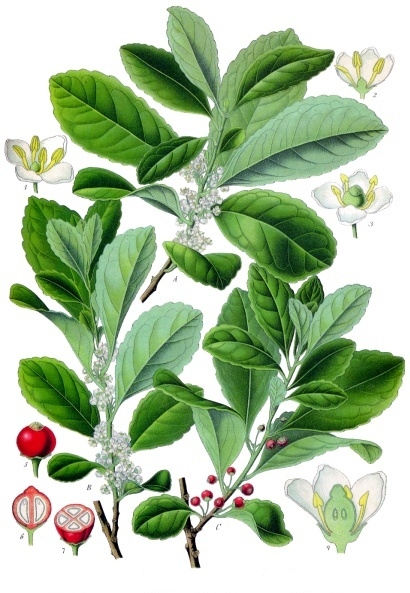
Dahoon Holly grows as a large shrub or small tree reaching up to 12 meters tall. Its evergreen leaves measure 6–15 cm long and 2–4 cm wide, with entire margins or a few small spines near the apex.[1][2][3]
The flowers are white and have a four-lobed corolla. The fruit is a red drupe measuring 5–6 mm in diameter, with four seeds in each fruit.[4][5][6]
Habitat
Dahoon Holly grows along the margins of waterways and swamps.[7]
The species is native to the southeastern coast of North America and the Caribbean. It occurs along the Atlantic coast from Virginia south to Florida and west along the Gulf Coast to the Colorado River in Texas, with subspecies extending south to Veracruz, Mexico.[8][9][10]
The species also occurs on the coasts of Cuba, the Bahamas, and Puerto Rico.[11]
Reproduction and life cycle
Dahoon Holly has separate male and female plants. Only female plants produce berries.[12][13]
A male pollenizer must be within range for bees to pollinate female plants.[14]
Uses
Dahoon Holly is cultivated as an ornamental plant in warmer climates for its red berries and glossy green leaves.[15]
Its leaves contain measurable amounts of caffeine and theobromine. They may have been used in the Native American cassena, or Black drink.[16][17]
The caffeine content of Dahoon Holly leaves is approximately 20% of that found in Ilex vomitoria leaves by dry weight, approximately 8% of that found in Coffea arabica leaves, and approximately 3% of that found in Camellia sinensis leaves.[18][19][20]
Dahoon Holly leaves contain twice as much theobromine as Ilex vomitoria leaves. The common name cassena is derived from the Timucua name for Ilex vomitoria.[21][22]
Similar species
Ilex × attenuata is a naturally occurring hybrid between Ilex cassine and Ilex opaca.[23]
Classification of the Dahoon Holly
| Kingdom | Plantae |
|---|---|
| Subkingdom | Pteridobiotina |
| Phylum | Tracheophyta |
| Class | Magnoliopsida |
| Order | Aquifoliales |
| Family | Aquifoliaceae (Holly) |
| Genus | Ilex (Holly) |
| Species | Ilex cassine L. |
Where the Dahoon Holly is found
Checklists and occurrence records place Ilex cassine in 6 countries across Asia and North America. GBIF holds 7,456 georeferenced records of it.
Countries where it is native or its origin is not stated
Countries where it has been introduced
Regions and cities with the most records
- Florida, United States 4,857
- Alafaya, United States 486
- Maitland, United States 475
- Casselberry, United States 474
- Orlando, United States 472
- Winter Springs, United States 470
- Winter Park, United States 468
- Oviedo, United States 461
- Altamonte Springs, United States 453
- Bonita Springs, United States 299
- San Carlos Park, United States 257
- Estero, United States 252
- Fort Myers, United States 246
- Palm Beach Gardens, United States 245
- Riviera Beach, United States 207
- Jupiter, United States 202
- Wellington, United States 197
- West Palm Beach, United States 186
- Palm City, United States 185
- Stuart, United States 183
- The Acreage, United States 182
- Royal Palm Beach, United States 174
- Iona, United States 170
- Greater Northdale, United States 163
- Pine Hills, United States 163
- Citrus Park, United States 158
- Northdale, United States 151
- Carrollwood Village, United States 150
- North Fort Myers, United States 147
- Cape Coral, United States 146
- Davie, United States 146
- Keystone, United States 145
- Cooper City, United States 142
- Lauderdale Lakes, United States 141
- Tamarac, United States 141
- Greenacres City, United States 140
8 more countries have a few records outside this range
These countries hold a few records of Ilex cassine but lie outside the range the checklists give for it. Such records are often zoo or garden specimens, museum material or vagrants, so the species is not counted as occurring there.
A number beside a place is its count of GBIF occurrence records. A place without a number comes from a checklist alone. Records show where a species has been observed or collected, which can include escapes and vagrants.
Common names
English
- Dahoon Holly
- Cassena Holly
- Cassine
- Dahoon
Names in 6 other languages
- Chinese
- 達宏冬青
- Dutch
- Cassena
- Estonian
- dahoon-iileks
- French
- Houx Cassine
- Lithuanian
- Pilkšvasis bugienis
- Russian
- Падуб кассине
Synonyms
4 other scientific names have been used for this species and are now treated as synonyms of Ilex cassine.
- Cassine corymbosa Mill.
- Ilex cassine var. cassine
- Ilex dahoon var. parvifolia Koch
- Ilex phyllyreaefolia hort. ex Decne.
Subspecies and varieties
- Ilex cassine subsp. cassine subspecies
- Ilex cassine subsp. mexicana subspecies
Related species
-
 Yerba MateIlex paraguariensis
-
 Yaupon HollyIlex vomitoria
-
 WinterberryIlex verticillata
-
 English HollyIlex aquifolium
-
 Japanese HollyIlex crenata
- GuayusaIlex guayusa
-
 Christmas HollyIlex opaca
-
 Possum-hawIlex decidua
Compare
Questions and answers
What is the scientific name of the Dahoon Holly?
The scientific name of the Dahoon Holly is Ilex cassine. Written with its author, the full name is Ilex cassine L..
Which family does the Dahoon Holly belong to?
Ilex cassine belongs to the family Aquifoliaceae, in the order Aquifoliales and the class Magnoliopsida.
Where is the Dahoon Holly found?
Checklists and occurrence records place Ilex cassine in 6 countries, including Bahamas, Cuba, Mexico and Honduras.
What is the conservation status of the Dahoon Holly?
The IUCN Red List category recorded for Ilex cassine is Least Concern (LC).
What other names does the Dahoon Holly have?
Ilex cassine is also known in English as Cassena Holly, Cassine and Dahoon.
How big do dahoon hollies get?
Dahoon Holly grows as a large shrub or small tree reaching up to 12 meters tall.[1]
Sources
Passages the profile rests on
- Ilex cassine grows as a large shrub or small tree reaching up to 12 meters tall. Source passage: “It is a large shrub or small tree growing to 12 meters (39 ft).” — English Wikipedia
- The leaves are evergreen and measure 6–15 cm long and 2–4 cm wide. Source passage: “The leaves are evergreen, 6–15 cm long and 2–4 cm broad” — English Wikipedia
- The leaf margins are entire or have a few small spines near the apex. Source passage: “entire or with a few small spines near the apex of the leaf.” — English Wikipedia
- The flowers are white and have a four-lobed corolla. Source passage: “The flowers are white, with a four-lobed corolla.” — English Wikipedia
- The fruit is a red drupe measuring 5–6 mm in diameter. Source passage: “The fruit is a red drupe, 5–6 mm in diameter” — English Wikipedia
- Each fruit contains four seeds. Source passage: “containing four seeds.” — English Wikipedia
- Ilex cassine grows along the margins of waterways and swamps. Source passage: “growing along the margins of waterways and swamps” — English Wikipedia
- Ilex cassine is native to the southeastern coast of North America and the Caribbean. Source passage: “Ilex cassine is indigenous to the southeastern coast of North America and the Caribbean” — English Wikipedia
- The species occurs along the Atlantic coast from Virginia south to Florida and west along the Gulf Coast to the Colorado River in Texas. Source passage: “from Virginia southward down the Atlantic coastline to Florida and west along the Gulf coast to the Colorado River in Texas” — English Wikipedia
- Subspecies of Ilex cassine extend south to Veracruz, Mexico. Source passage: “with subspecies growing southward as far as Veracruz on the Gulf Coast” — English Wikipedia
- The species occurs on the coasts of Cuba, the Bahamas, and Puerto Rico. Source passage: “in the Caribbean on the coasts of Cuba, the Bahamas, and Puerto Rico.” — English Wikipedia
- Ilex cassine has separate male and female plants. Source passage: “it is dioecious with separate male and female plants.” — English Wikipedia
- Only female plants produce berries. Source passage: “Only the females have berries” — English Wikipedia
- A male pollenizer must be within range for bees to pollinate female plants. Source passage: “a male pollenizer must be within range for bees to pollinate them.” — English Wikipedia
- Ilex cassine is cultivated as an ornamental plant in warmer climates for its red berries and glossy green leaves. Source passage: “It is cultivated in warmer climates as an ornamental plant for the attractive bright red berries set against the glossy green leaves.” — English Wikipedia
- The leaves of Ilex cassine contain measurable amounts of caffeine and theobromine. Source passage: “Ilex cassine leaves, like those of its sister species I. vomitoria, contain measurable amounts of the stimulants caffeine and theobromine.” — English Wikipedia
- Ilex cassine leaves may have been used in the Native American cassena, or Black drink. Source passage: “The leaves of both species may have been used in the Native American cassena (the Black drink)” — English Wikipedia
- The caffeine content of Ilex cassine leaves is approximately 20% of that found in Ilex vomitoria leaves by dry weight. Source passage: “I. cassine leaves have about 20% (by dry weight) of the amount of caffeine found in I. vomitoria” — English Wikipedia
- Ilex cassine leaves contain approximately 8% of the caffeine found in Coffea arabica leaves. Source passage: “8% of that in Coffea arabica” — English Wikipedia
- Ilex cassine leaves contain approximately 3% of the caffeine found in Camellia sinensis leaves. Source passage: “and about 3% of the caffeine in Camellia sinensis Kunze.” — English Wikipedia
- Ilex cassine leaves contain twice as much theobromine as Ilex vomitoria leaves. Source passage: “I. cassine has twice as much theobromine as I. vomitoria” — English Wikipedia
- The common name cassena is derived from the Timucua name for Ilex vomitoria. Source passage: “the latter derived from the Timucua name for I. vomitoria.” — English Wikipedia
- Ilex × attenuata is a naturally occurring hybrid between Ilex cassine and Ilex opaca. Source passage: “Ilex × attenuata is a naturally occurring hybrid of Ilex cassine and Ilex opaca.” — English Wikipedia
Data
- Catalogue of Life, 2026-10-16 XR cc by
- Global Biodiversity Information Facility CC BY 4.0
- Wikidata CC0
- GeoNames CC BY 4.0
- Wikimedia Commons per image; credit shown with each image
- Within the Catalogue of Life, this name comes from Synonymic Checklists of the Vascular Plants of the World cc by
References
- L. where the name was published
This species in other databases
- Catalogue of Life 3PF9M
- Wikidata Q3141413
- iNaturalist 164035
- World Flora Online wfo-0000729281
- GRIN 19681
Page built on 26 November 2026. See how the catalog is made and all sources and licences.
Cite this page
ScientificNames.org. (2026). Ilex cassine (Dahoon Holly). Retrieved November 26, 2026, from https://scientificnames.org/species/ilex-cassine
“Ilex cassine (Dahoon Holly).” ScientificNames.org, 2026, scientificnames.org/species/ilex-cassine. Accessed 26 Nov. 2026.
ScientificNames.org. “Ilex cassine (Dahoon Holly).” Accessed November 26, 2026. https://scientificnames.org/species/ilex-cassine.
@misc{scientificnames_ilex_cassine_dahoon_holly,
  author = {{ScientificNames.org}},
  title = {Ilex cassine (Dahoon Holly)},
  year = {2026},
  url = {https://scientificnames.org/species/ilex-cassine},
  note = {Accessed 2026-11-26}
}