Species · Flowering plants
Kashi Holly Ilex chinensis
The scientific name of the Kashi Holly is Ilex chinensis. It is a species of flowering plant in the family Aquifoliaceae (holly), order Aquifoliales.
- Scientific name
- Ilex chinensis Sims
- Common name
- Kashi Holly
- Genus
- Ilex
- Family
- Aquifoliaceae (Holly)
- Order
- Aquifoliales
- Class
- Magnoliopsida
- Red List category
- LC Least Concern
- Recorded in
- 5 countries
- Name status
- accepted in the Catalogue of Life

Overview
Kashi holly is a shrub or small tree with dense branches. It is native to Vietnam, southern China, Taiwan, and central and southern Japan. Its evergreen leaves are shiny dark green above and paler below, and it produces round red, berry-like drupes.
Written 26 November 2026 from the sources listed below. Each statement was checked against the passage it cites; statements that could not be supported were removed.
Appearance
The leaves are simple, evergreen, thickened, somewhat leathery, and glabrous. They range from elliptical to lanceolate, with small teeth at the ends of the veins along their margins. The upper surfaces are shiny dark green, while the lower surfaces are paler.[1][2][3][4]
The flowers are purple-red, and the fruits are round, red, berry-like drupes measuring 1/4 to 1/3 inch across. The twigs are slender, grayish brown, and mostly glabrous, while the buds are very small and pointed.[5][6][7][8][9]
The bark is thin, dark gray, and smooth. The plant can reach a height of 50 feet.[10][11]
Habitat
The species is described as native to eastern China, Vietnam, and Japan. Its native distribution also includes southern China, Taiwan, and central and southern Japan.[12][13]
Reproduction and life cycle
Kashi holly is dioecious. Its flowers appear from late spring to early summer.[14][15]
Uses
Kashi holly is among the 50 fundamental herbs used in traditional Chinese medicine, where it is known as dōng qīng. Its uses include promoting circulation and removing stasis.[16][17][18]
The plant has been used as a street tree in Chinese and European cities.[19]
Similar species
Ilex purpurea is listed as a synonym of Ilex chinensis.[20]
Classification of the Kashi Holly
| Kingdom | Plantae |
|---|---|
| Subkingdom | Pteridobiotina |
| Phylum | Tracheophyta |
| Class | Magnoliopsida |
| Order | Aquifoliales |
| Family | Aquifoliaceae (Holly) |
| Genus | Ilex (Holly) |
| Species | Ilex chinensis Sims |
Where the Kashi Holly is found
Checklists and occurrence records place Ilex chinensis in 5 countries across Asia. GBIF holds 3,618 georeferenced records of it.
Countries
Regions and cities with the most records
- Sichuan, China 603
- Jiangxi, China 371
- Guizhou, China 158
- Hunan, China 155
- Chongqing, China 131
- Zhejiang, China 131
- Anhui, China 127
- Hubei, China 118
- Guangxi, China 108
- Guangdong, China 84
- Jiangsu, China 82
- Fujian, China 75
- Hyōgo, Japan 49
- Conglin, China 47
- Daguan, China 47
- Nanchuan, China 47
- Nanping, China 47
- Xinglong, China 47
- Anping, China 41
- Baidi, China 41
- Fenhe, China 41
- Kangle, China 41
- Shigang, China 41
- Xinmin, China 41
- Yamaguchi, Japan 41
- Yongle, China 41
- Yong’an, China 41
- Zhuyi, China 41
- Anlong, China 40
- Fukuoka, Japan 39
- Fuchū, Japan 38
- Kokubunji, Japan 38
- Tokyo, Japan 38
- Chikushino-shi, Japan 37
- Sasaguri, Japan 37
- Dazaifu, Japan 36
2 more countries have a few records outside this range
These countries hold a few records of Ilex chinensis but lie outside the range the checklists give for it. Such records are often zoo or garden specimens, museum material or vagrants, so the species is not counted as occurring there.
Range as the checklists state it
China (Anhui, Fujian, Guangdong, Guangxi, ?Guizhou, ?Hainan, Henan, Hubei, Hunan, Jiangsu, Jiangxi, ?Sichuan, Yunnan, Zhejiang); Japan (Honshu, Shikoku, Kyushu); Taiwan; Thailand; Vietnam
A number beside a place is its count of GBIF occurrence records. A place without a number comes from a checklist alone. Records show where a species has been observed or collected, which can include escapes and vagrants.
Common names
English
- Kashi Holly
Names in 4 other languages
- Chinese
- 冬青
- Japanese
- NanaminoKi, ナナミノキ
- Lithuanian
- Purpurinis bugienis
- Slovak
- cezmína čínska
Synonyms
15 other scientific names have been used for this species and are now treated as synonyms of Ilex chinensis.
- Callicarpa cavaleriei H.Lév.
- Celastrus bodinieri H.Lév.
- Embelia rubroviolacea H.Lév.
- Ilex chinensis f. angustifolia Sugim.
- Ilex jinggangshanensis C.J.Tseng
- Ilex myriadenia Hance
- Ilex oldhamii Miq.
- Ilex purpurea Hassk.
- Ilex purpurea f. oldhamii (Miq.) Loes.
- Ilex purpurea var. myriadenia (Hance) Loes.
- Ilex purpurea var. nervosa Loes.
- Ilex purpurea var. oldhamii (Miq.) Loes. ex Diels
- Ilex purpurea var. purpurea
- Symplocos courtoisii H.Lév.
- Ilex lucida Blume ex Miq. ambiguous synonym
Related species
-
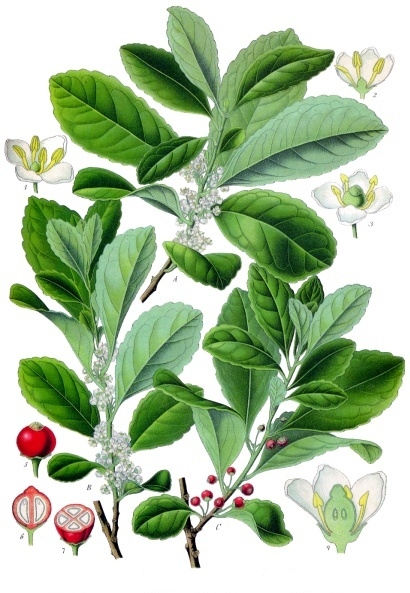 Yerba MateIlex paraguariensis
-
 Yaupon HollyIlex vomitoria
-
 WinterberryIlex verticillata
-
 English HollyIlex aquifolium
-
 Japanese HollyIlex crenata
- GuayusaIlex guayusa
-
 Christmas HollyIlex opaca
-
 Possum-hawIlex decidua
Compare
Questions and answers
What is the scientific name of the Kashi Holly?
The scientific name of the Kashi Holly is Ilex chinensis. Written with its author, the full name is Ilex chinensis Sims.
Which family does the Kashi Holly belong to?
Ilex chinensis belongs to the family Aquifoliaceae, in the order Aquifoliales and the class Magnoliopsida.
Where is the Kashi Holly found?
Checklists and occurrence records place Ilex chinensis in 5 countries: China, Japan, Vietnam, Taiwan and Thailand.
What is the conservation status of the Kashi Holly?
The IUCN Red List category recorded for Ilex chinensis is Least Concern (LC).
How tall can Chinese holly grow?
Kashi holly can reach a height of 50 feet.[11]
Sources
Passages the profile rests on
- The leaves are simple, evergreen, thickened, somewhat leathery, and glabrous. Source passage: “simple, evergreen, thickened and somewhat leathery, glabrous” — dendro.cnre.vt.edu
- The leaves range from elliptical to lanceolate in shape. Source passage: “elliptical to lanceolate” — dendro.cnre.vt.edu
- The leaf margins have small teeth at the ends of the veins. Source passage: “margins with small teeth at the end of each vein” — dendro.cnre.vt.edu
- The upper leaf surfaces are shiny dark green, while the lower surfaces are paler. Source passage: “shiny dark green above, paler below” — dendro.cnre.vt.edu
- The flowers are purple-red. Source passage: “Flower: Species is dioecious; purple-red” — dendro.cnre.vt.edu
- The fruits are round, red, berry-like drupes. Source passage: “Red berry-like round drupe” — dendro.cnre.vt.edu
- The twigs are slender, grayish brown, and mostly glabrous. Source passage: “Slender, grayish brown, mostly glabrous” — dendro.cnre.vt.edu
- The buds are very small and pointed. Source passage: “very small pointed buds” — dendro.cnre.vt.edu
- The fruits measure 1/4 to 1/3 inch across. Source passage: “1/4 to 1/3 inch across” — dendro.cnre.vt.edu
- The bark is thin, dark gray, and smooth. Source passage: “Thin, dark gray, smooth” — dendro.cnre.vt.edu
- The plant can reach a height of 50 feet. Source passage: “reaches heights of 50 feet” — dendro.cnre.vt.edu
- The species is described as native to eastern China, Vietnam, and Japan. Source passage: “native to eastern China, Vietnam and Japan” — plants.ces.ncsu.edu
- The species is native to Vietnam, southern China, Taiwan, and central and southern Japan. Source passage: “native to Vietnam, southern China, Taiwan, and central and southern Japan.” — English Wikipedia
- The species is dioecious. Source passage: “Species is dioecious” — dendro.cnre.vt.edu
- The flowers appear from late spring to early summer. Source passage: “appear in late spring to early summer” — dendro.cnre.vt.edu
- The species is among the 50 fundamental herbs used in traditional Chinese medicine. Source passage: “It is one of the 50 fundamental herbs used in traditional Chinese medicine” — English Wikipedia
- In traditional Chinese medicine, the species is known as dōng qīng. Source passage: “where it has the name dōng qīng (Chinese: 冬青).” — English Wikipedia
- The plant is used in traditional Chinese medicine for purposes that include promoting circulation and removing stasis. Source passage: “it is said to promote circulation, remove stasis, and clear heat and toxins.” — English Wikipedia
- The plant has been used as a street tree in Chinese and European cities. Source passage: “It has found use as a street tree in a number of Chinese and European cities.” — English Wikipedia
- Ilex purpurea is listed as a synonym of Ilex chinensis. Source passage: “Ilex chinensis (syn. Ilex purpurea)” — English Wikipedia
Data
- Catalogue of Life, 2026-10-16 XR cc by
- Global Biodiversity Information Facility CC BY 4.0
- Wikidata CC0
- GeoNames CC BY 4.0
- Wikimedia Commons per image; credit shown with each image
- Within the Catalogue of Life, this name comes from Synonymic Checklists of the Vascular Plants of the World cc by
References
- Sims. (1819). Bot. Mag. 46: pl. 2043 (1819). where the name was published
This species in other databases
- Catalogue of Life 6N6V9
- Wikidata Q5792888
- iNaturalist 447112
- World Flora Online wfo-0000729295
- GRIN 19683
Page built on 28 November 2026. See how the catalog is made and all sources and licences.
Cite this page
ScientificNames.org. (2026). Ilex chinensis (Kashi Holly). Retrieved November 28, 2026, from https://scientificnames.org/species/ilex-chinensis
“Ilex chinensis (Kashi Holly).” ScientificNames.org, 2026, scientificnames.org/species/ilex-chinensis. Accessed 28 Nov. 2026.
ScientificNames.org. “Ilex chinensis (Kashi Holly).” Accessed November 28, 2026. https://scientificnames.org/species/ilex-chinensis.
@misc{scientificnames_ilex_chinensis_kashi_holly,
  author = {{ScientificNames.org}},
  title = {Ilex chinensis (Kashi Holly)},
  year = {2026},
  url = {https://scientificnames.org/species/ilex-chinensis},
  note = {Accessed 2026-11-28}
}