Species · Flowering plants
Large Gallberry Ilex coriacea
The scientific name of the Large Gallberry is Ilex coriacea. It is a species of flowering plant in the family Aquifoliaceae (holly), order Aquifoliales.
- Scientific name
- Ilex coriacea (Pursh) Chapm.
- Common name
- Large Gallberry
- Genus
- Ilex
- Family
- Aquifoliaceae (Holly)
- Order
- Aquifoliales
- Class
- Magnoliopsida
- Red List category
- LC Least Concern
- Recorded in
- 1 country
- Name status
- accepted in the Catalogue of Life

Overview
Large gallberry is a shrub in the family Aquifoliaceae, order Aquifoliales, and class Magnoliopsida. It grows primarily as an understory plant in pine forests and occurs in bogs, along pond edges, and in seepage swamps known as baygalls.
Written 26 November 2026 from the sources listed below. Each statement was checked against the passage it cites; statements that could not be supported were removed.
Habitat
Large gallberry primarily grows as an understory plant in pine forests. It occurs in sandy, moist to wet soils in bogs, along pond edges, and in seepage swamps known as baygalls.[1][2][3][4]
The species is classified as a facultative wetland plant and prefers acidic soils.[5][6]
It is native to coastal areas of the United States extending from Virginia to Texas.[7]
Uses
Large gallberry is planted as an ornamental plant. It provides an important nectar source for beekeepers.[8][9]
Classification of the Large Gallberry
| Kingdom | Plantae |
|---|---|
| Subkingdom | Pteridobiotina |
| Phylum | Tracheophyta |
| Class | Magnoliopsida |
| Order | Aquifoliales |
| Family | Aquifoliaceae (Holly) |
| Genus | Ilex (Holly) |
| Species | Ilex coriacea (Pursh) Chapm. |
Where the Large Gallberry is found
Checklists and occurrence records place Ilex coriacea in 1 country across North America. GBIF holds 3,766 georeferenced records of it.
Countries
Regions and cities with the most records
- Florida, United States 399
- North Carolina, United States 382
- Mississippi, United States 351
- Texas, United States 169
- South Carolina, United States 137
- Ocean Springs, United States 121
- Alabama, United States 117
- Gautier, United States 113
- Georgia, United States 97
- Pascagoula, United States 97
- Biloxi, United States 83
- Louisiana, United States 54
- Brent, United States 51
- Pensacola, United States 49
- Wilmington, United States 48
- Havelock, United States 47
- Leland, United States 44
- Myrtle Grove, United States 41
- Bellview, United States 40
- West Pensacola, United States 40
- Ensley, United States 33
- Ferry Pass, United States 32
- West Gulfport, United States 31
- Foley, United States 28
- East Pensacola Heights, United States 27
- Gulfport, United States 24
- Pace, United States 24
- Pinehurst, United States 24
- Fayetteville, United States 22
- Fort Bragg, United States 22
- Long Beach, United States 20
- Midway, United States 20
- Columbia, United States 18
- Saint Andrews, United States 18
- West Columbia, United States 18
- Hope Mills, United States 17
Range as the checklists state it
USA (Alabama, Florida, Georgia, Louisiana, Mississippi, North Carolina, South Carolina, Texas, Virginia)
A number beside a place is its count of GBIF occurrence records. A place without a number comes from a checklist alone. Records show where a species has been observed or collected, which can include escapes and vagrants.
Common names
English
- Large Gallberry
- Bay Gallbush
Synonyms
10 other scientific names have been used for this species and are now treated as synonyms of Ilex coriacea.
- Ennepta atomaria (Nutt.) Raf.
- Ennepta coriacea (Pursh) Raf.
- Prinos atomarius Nutt.
- Prinos cariaceus Pursh
- Prinos coriaceus Pursh
- Prinos coriaceus var. angustifolius Pursh
- Prinos coriaceus var. latifolius Pursh
- Prinos lucidus Aiton
- Ilex lucida Torr. & A.Gray ex S.Watson ambiguous synonym
- Prinos glaber P.Watson ambiguous synonym
Related species
-
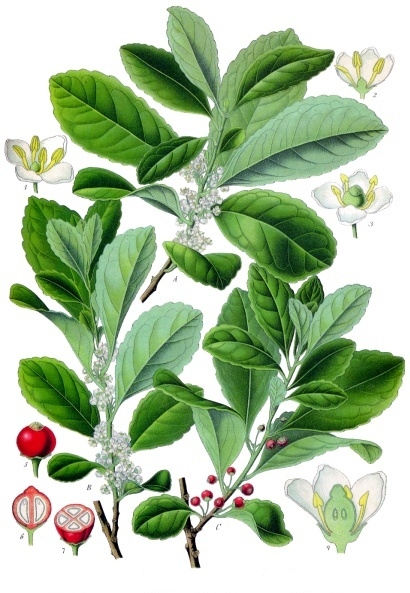 Yerba MateIlex paraguariensis
-
 Yaupon HollyIlex vomitoria
-
 WinterberryIlex verticillata
-
 English HollyIlex aquifolium
-
 Japanese HollyIlex crenata
- GuayusaIlex guayusa
-
 Christmas HollyIlex opaca
-
 Possum-hawIlex decidua
Compare
Questions and answers
What is the scientific name of the Large Gallberry?
The scientific name of the Large Gallberry is Ilex coriacea. Written with its author, the full name is Ilex coriacea (Pursh) Chapm..
Which family does the Large Gallberry belong to?
Ilex coriacea belongs to the family Aquifoliaceae, in the order Aquifoliales and the class Magnoliopsida.
Where is the Large Gallberry found?
Checklists and occurrence records place Ilex coriacea in 1 country: United States.
What is the conservation status of the Large Gallberry?
The IUCN Red List category recorded for Ilex coriacea is Least Concern (LC).
What other names does the Large Gallberry have?
Ilex coriacea is also known in English as Bay Gallbush.
Sources
Passages the profile rests on
- The species primarily grows as an understory plant in pine forests. Source passage: “It exists primarily as an understory plant in pine forests” — English Wikipedia
- The species occurs in sandy, moist to wet soils in bogs. Source passage: “in sandy, moist to wet soils in bogs” — English Wikipedia
- The species can grow along pond edges. Source passage: “at the edges of ponds” — English Wikipedia
- The species occurs in seepage swamps known as baygalls. Source passage: “in seepage swamps called baygalls” — English Wikipedia
- The species is classified as a facultative wetland plant. Source passage: “Ilex coriacea is a facultative wetland plant” — English Wikipedia
- The species prefers acidic soils. Source passage: “prefers acidic soils” — English Wikipedia
- The species is native to coastal areas of the United States extending from Virginia to Texas. Source passage: “native to coastal areas in the United States from Virginia to Texas” — English Wikipedia
- The species is planted as an ornamental plant. Source passage: “It is planted as an ornamental” — English Wikipedia
- The species provides an important nectar source for beekeepers. Source passage: “The plant is an important nectar source for beekeepers.” — English Wikipedia
Data
- Catalogue of Life, 2026-10-16 XR cc by
- Global Biodiversity Information Facility CC BY 4.0
- Wikidata CC0
- GeoNames CC BY 4.0
- Wikimedia Commons per image; credit shown with each image
- Within the Catalogue of Life, this name comes from Synonymic Checklists of the Vascular Plants of the World cc by
References
- Chapm. Fl. South. U.S. 270 (1860). where the name was published
This species in other databases
Page built on 27 November 2026. See how the catalog is made and all sources and licences.
Cite this page
ScientificNames.org. (2026). Ilex coriacea (Large Gallberry). Retrieved November 27, 2026, from https://scientificnames.org/species/ilex-coriacea
“Ilex coriacea (Large Gallberry).” ScientificNames.org, 2026, scientificnames.org/species/ilex-coriacea. Accessed 27 Nov. 2026.
ScientificNames.org. “Ilex coriacea (Large Gallberry).” Accessed November 27, 2026. https://scientificnames.org/species/ilex-coriacea.
@misc{scientificnames_ilex_coriacea_large_gallberry,
  author = {{ScientificNames.org}},
  title = {Ilex coriacea (Large Gallberry)},
  year = {2026},
  url = {https://scientificnames.org/species/ilex-coriacea},
  note = {Accessed 2026-11-27}
}