Species · Fishes
Least Chub Iotichthys phlegethontis
The scientific name of the Least Chub is Iotichthys phlegethontis. It is a species of fish in the family Cyprinidae (carps), order Cypriniformes. The name dates from 1874.
- Scientific name
- Iotichthys phlegethontis (Cope, 1874)
- Common name
- Least Chub
- Genus
- Iotichthys
- Family
- Cyprinidae (Carps)
- Order
- Cypriniformes
- Class
- Teleostei
- Red List category
- EN Endangered
- Environment
- freshwater
- Recorded in
- 1 country
- Name status
- accepted in the Catalogue of Life

Overview
The species historically occupied freshwater ponds and swamps near the Great Salt Lake, with populations also occurring in other parts of Utah and in Idaho. The Least Chub is the smallest of the seven chub species native to Utah, with a maximum recorded size of less than 64 mm (2.5 inches).
Written 27 November 2026 from the sources listed below. Each statement was checked against the passage it cites; statements that could not be supported were removed.
Appearance
The Least Chub has olive-green to black coloration, steel-blue upper sides, and a golden stripe extending from the upper end of the gill opening to the caudal fin. Its lower sides and belly are golden, and its fins are yellowish.[1][2]
Breeding males develop reddish coloration on their bellies and lower sides. The species has a large eye, an extremely oblique mouth extending to the front of the eye, and no barbels.[3][4]
The dorsal fin has 8–9 rays and originates just behind the pelvic fin insertion. The caudal fin is slightly forked.[5][6]
The species has large scales, with 34–38 scales in the lateral series. The lateral line is absent or has only 1–3 pored scales.[7][8]
Habitat
The Least Chub occupies still or slow-moving water bodies with few predators. Historically, its habitats included springs, lakes, ponds, marshes, streams, and rivers.[9][10]
Spawning occurs in seasonally flooded areas and along shallow spring and pond margins. Outside the breeding season, adults generally prefer deeper pools in springs and ponds.[11][12]
During dry periods, individuals move into deeper springs to survive. Submerged vegetation provides oxygen and food for the eggs and larvae.[13][14]
Diet
The Least Chub primarily consumes algae and small invertebrates, including mosquito larvae.[15]
Behaviour
The Least Chub has relatively low burst and sustained swimming speeds because it typically inhabits slow-moving waters. Both types of swimming speed tend to increase as individuals grow larger.[16][17]
Reproduction and life cycle
The breeding season generally extends from April through August, with peak spawning activity in May. Spawning occurs in spring when water temperatures reach approximately 16 °C.[18][19]
Changes in light rather than rising temperatures trigger spawning. The species reproduces in marshes when water temperature, alkalinity, pH, and conductivity are at their highest.[20][21]
The Least Chub is a polyandrous broadcast spawner that releases eggs over vegetation, primarily algae. Females release between 300 and 2,700 eggs at a time over extended periods.[22][23]
The species does not construct nests or provide parental care. Fertilized eggs hatch in approximately two days at a water temperature of 22 °C.[24][25]
Conservation
The Least Chub was historically endemic to the Bonneville Basin of Utah. Its distribution has contracted to a few isolated desert spring complexes because of invasive species, land-use practices, and groundwater pumping.[26][27]
Cattle grazing and trampling of streamside vegetation have contributed to habitat destruction. Water diversion, mineral and energy development, and non-native fishes are additional factors associated with population decline.[28][29]
The western mosquitofish is a significant threat because it preys on the eggs and young of other fish. From 2014 onward, ten stable populations were established in artificial ponds as a safeguard against environmental threats.[30][31]
In 2014, the U.S. Fish and Wildlife Service decided not to list the species under the Endangered Species Act, citing habitat redundancy and genetic diversity.[32]
The species was historically found in the Sevier River drainage, Utah Lake drainage, parts of the Great Salt Lake drainage, and isolated desert springs. Recently discovered populations occur in the upper Snake River drainage of Idaho and in the San Pitch River downstream of Gunnison Reservoir in Utah.[33][34][35]
Genetic analyses indicate that the Idaho Snake River and Utah Gunnison populations are natural and genetically distinct populations. The species' geographic range may be approximately twice the previously accepted range.[36][37]
The Gunnison population is the first documented occurrence of the species in a Utah riverine habitat in more than 50 years.[38]
Classification of the Least Chub
| Kingdom | Animalia |
|---|---|
| Phylum | Chordata |
| Subphylum | Vertebrata |
| Infraphylum | Gnathostomata |
| Parvphylum | Osteichthyes |
| Gigaclass | Actinopterygii |
| Superclass | Actinopteri |
| Class | Teleostei (Teleost) |
| Order | Cypriniformes |
| Family | Cyprinidae (Carps) |
| Subfamily | Leuciscinae |
| Genus | Iotichthys (Least Chubs) |
| Species | Iotichthys phlegethontis (Cope, 1874) |
Where the Least Chub is found
Checklists and occurrence records place Iotichthys phlegethontis in 1 country. GBIF holds 96 georeferenced records of it.
Countries
Regions and cities with the most records
- Utah, United States 33
- Idaho, United States 14
- Rexburg, United States 12
- North Salt Lake, United States 10
- Bountiful, United States 9
- Centerville, United States 9
- Kearns, United States 6
- Salt Lake City, United States 6
- Taylorsville, United States 6
- West Valley City, United States 6
- Cottonwood Heights, United States 5
- East Millcreek, United States 5
- Farmington, United States 5
- Holladay, United States 5
- Kaysville, United States 5
- Layton, United States 5
- Magna, United States 5
- Midvale, United States 5
- Millcreek, United States 5
- Murray, United States 5
- Orem, United States 5
- Provo, United States 5
- Sandy, United States 5
- South Salt Lake, United States 5
- Spanish Fork, United States 5
- Springville, United States 5
- West Jordan, United States 5
- American Fork, United States 3
- Pleasant Grove, United States 3
A number beside a place is its count of GBIF occurrence records. A place without a number comes from a checklist alone. Records show where a species has been observed or collected, which can include escapes and vagrants.
Common names
English
- Least Chub
Names in 5 other languages
- Czech
- jelčík utažský
- Estonian
- Pisiturbik
- German
- Zwerg-Wüstendöbel
- Mandarin Chinese
- 阴河鱼, 陰河魚
- Russian
- Американский елец
Synonyms
One other scientific name has been used for this species and is now treated as a synonym of Iotichthys phlegethontis.
- Clinostomus phlegethontis Cope, 1874
Related species
-
 GoldfishCarassius auratus
-
 Common CarpCyprinus carpio
- ZebrafishDanio rerio
-
 Grass CarpCtenopharyngodon idella
-
 Common RoachRutilus rutilus
-
 Silver CarpHypophthalmichthys molitrix
-
 Crucian CarpCarassius carassius
-
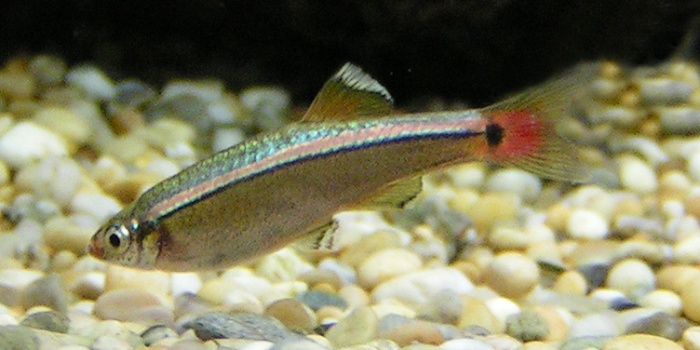 White Cloud Mountain MinnowTanichthys albonubes
Compare
Questions and answers
What is the scientific name of the Least Chub?
The scientific name of the Least Chub is Iotichthys phlegethontis. Written with its author, the full name is Iotichthys phlegethontis (Cope, 1874).
Which family does the Least Chub belong to?
Iotichthys phlegethontis belongs to the family Cyprinidae, in the order Cypriniformes and the class Teleostei.
Where is the Least Chub found?
Checklists and occurrence records place Iotichthys phlegethontis in 1 country: United States.
What is the conservation status of the Least Chub?
The IUCN Red List category recorded for Iotichthys phlegethontis is Endangered (EN).
Sources
Passages the profile rests on
- The least chub has an olive-green to black coloration with steel-blue upper sides and a golden stripe extending from the upper end of the gill opening to the caudal fin. Source passage: “They have an olive-green black with steel blue upper sides and a golden stripe running from the upper end of the gill opening to the base of the caudal fin.” — English Wikipedia
- The lower sides and belly are golden, and the fins are yellowish. Source passage: “Its lower sides and belly are golden, and they have yellowish fins.” — English Wikipedia
- Breeding males develop reddish coloration on their bellies and lower sides. Source passage: “While breeding, males develop a reddish hue on their belly and lower sides.” — English Wikipedia
- The species has a large eye, an extremely oblique mouth extending to the front of the eye, and no barbels. Source passage: “The mouth is very oblique, extending to the front of the eye, which is large, and the species lack barbels.” — English Wikipedia
- The dorsal fin has 8–9 rays and originates just behind the pelvic fin insertion. Source passage: “The dorsal fin contains 8-9 rays, with its origin just behind the pelvic fin insertion” — English Wikipedia
- The caudal fin is slightly forked. Source passage: “the caudal fin is slightly forked.” — English Wikipedia
- The lateral series contains 34–38 scales, while the lateral line is absent or has only 1–3 pored scales. Source passage: “There are 34-38 scales in the lateral series, and the lateral line is either absent or only features 1-3 pored scales.” — English Wikipedia
- The species is characterized by large scales and usually lacks a lateral line, although 1–2 pores may occasionally occur at the front. Source passage: “no lateral line (rarely 1-2 pores at front); large scales (34-38 lateral)” — fishbase.org
- The species occupies still or slow-moving water bodies with few predators. Source passage: “Least chub are small bodied fish that occupy still or slow-moving water bodies that have few predators.” — English Wikipedia
- Historically, its habitats included springs, lakes, ponds, marshes, streams, and rivers. Source passage: “Based on historic fish collections, the habitats of Least Chub included springs, lakes, ponds, marshes, streams, and rivers (Bailey et al. 2005).” — pmc.ncbi.nlm.nih.gov
- Spawning occurs in seasonally flooded areas and along shallow spring and pond margins. Source passage: “These fish usually spawn in seasonally flooded areas or the shallow edges of springs and ponds, mainly during the spring season.” — English Wikipedia
- Outside the breeding season, adults generally prefer deeper pools in springs and ponds. Source passage: “For the rest of the year, adults tend to prefer the deeper pools of springs and ponds.” — English Wikipedia
- During dry periods, individuals move into deeper springs to survive. Source passage: “but during dry periods, the fish move to deeper springs to survive.” — English Wikipedia
- Submerged vegetation provides oxygen and food for the eggs and larvae. Source passage: “Submerged vegetation provides essential oxygen and food for eggs and larvae.” — English Wikipedia
- The least chub primarily consumes algae and small invertebrates, including mosquito larvae. Source passage: “Least chub eat primarily algae and small invertebrates, including mosquito larvae.” — English Wikipedia
- The species has relatively low burst and sustained swimming speeds because it typically inhabits slow-moving waters. Source passage: “Given that least chub typically inhabit slow-moving waters, their burst and sustained swimming speeds are relatively low.” — English Wikipedia
- Burst and sustained swimming speeds tend to increase as individuals grow larger. Source passage: “However, these speeds tend to improve as the fish grow larger.” — English Wikipedia
- Spawning occurs in spring when water temperatures reach approximately 16 °C. Source passage: “Least chub spawn in the spring when the water temperatures reach 16 °C (61 °F).” — English Wikipedia
- The breeding season generally extends from April through August, with peak spawning activity in May. Source passage: “The breeding season typically lasts from April to August, with peak activity in May” — English Wikipedia
- Changes in light rather than rising temperatures trigger spawning. Source passage: “Rather than temperature increases, spawning is triggered by changes in light.” — English Wikipedia
- The species reproduces in marshes when water temperature, alkalinity, pH, and conductivity are at their highest. Source passage: “Least chub reproduce in marshes when water temperature, alkalinity, pH, and conductivity are highest.” — English Wikipedia
- The species is a polyandrous broadcast spawner that releases eggs over vegetation, primarily algae. Source passage: “They are polyandrous broadcast spawners, releasing their eggs over vegetation, mainly algae.” — English Wikipedia
- Females release between 300 and 2,700 eggs at a time over extended periods. Source passage: “Least chub is an intermittent spawner, with females releasing a small number of eggs over extended periods, ranging from 300 to 2,700 eggs at a time.” — English Wikipedia
- Least chub do not construct nests or provide parental care. Source passage: “They do not construct nests or provide any parental care for their young.” — English Wikipedia
- Fertilized eggs hatch in approximately two days at a water temperature of 22 °C. Source passage: “The fertilized eggs hatch in about two days at a water temperature of 22 °C (72 °F).” — English Wikipedia
- The species was historically endemic to the Bonneville Basin of Utah. Source passage: “They are endemic to the Bonneville Basin of Utah.” — English Wikipedia
- The species' distribution has contracted to a few isolated desert spring complexes because of invasive species, land-use practices, and groundwater pumping. Source passage: “However, the distribution of Least Chub has been reduced to a few isolated desert spring complexes due to the impacts of invasive species, land use practices, and ground water pumping” — pmc.ncbi.nlm.nih.gov
- Cattle grazing and trampling of streamside vegetation have contributed to habitat destruction affecting the species. Source passage: “habitat destruction from cattle grazing on and trampling streamside vegetation” — English Wikipedia
- Water diversion, mineral and energy development, and non-native fishes are additional factors associated with population decline. Source passage: “Reasons for the decline include habitat destruction from cattle grazing on and trampling streamside vegetation, water diversion, mineral and energy development, and non-native fishes.” — English Wikipedia
- The western mosquitofish is a significant threat because it preys on the eggs and young of other fish. Source passage: “One of the most significant impact that contributed to the decline of least chub was caused by the Western Mosquitofish (Gambusia affinis). These fish are commonly known to be aggressive and predate on eggs and young of other fish.” — English Wikipedia
- From 2014 onward, ten stable populations were established in artificial ponds as a safeguard against environmental threats. Source passage: “From 2014 onwards, ten stable populations were established in artificial ponds, providing a buffer against environmental threats such as drought and climate change.” — English Wikipedia
- The U.S. Fish and Wildlife Service decided in 2014 not to list the species under the Endangered Species Act, citing habitat redundancy and genetic diversity. Source passage: “These introduced populations were crucial in the U.S. Fish and Wildlife Service's 2014 decision not to list the least chub under the Endangered Species Act, citing that these populations offered sufficient habitat redundancy and genetic diversity to safeguard the species' future.” — English Wikipedia
- Historical populations occurred in the Sevier River drainage, Utah Lake drainage, parts of the Great Salt Lake drainage, and isolated desert springs. Source passage: “Historically, Least Chub was an abundant species in the Bonneville Basin with a wide distribution that included the Sevier River drainage, the Utah Lake drainage, portions of the Great Salt Lake drainage, and several isolated desert springs (Hanks and Belk 2004).” — pmc.ncbi.nlm.nih.gov
- Recently discovered populations occur in the upper Snake River drainage of Idaho. Source passage: “Least Chub have been recently discovered in off‐channel habitats of Henrys Fork Snake River in the upper Snake River drainage of Idaho” — pmc.ncbi.nlm.nih.gov
- A newly discovered population occurs in the San Pitch River downstream of Gunnison Reservoir in Utah. Source passage: “Least Chub have recently been discovered in the San Pitch River downstream of Gunnison Reservoir (hereafter referred to as the Gunnison population) in the Sevier River GMU” — pmc.ncbi.nlm.nih.gov
- Genetic analyses indicate that the Idaho Snake River and Utah Gunnison populations are natural and genetically distinct populations. Source passage: “Overall, our results provide evidence that the Idaho Snake River populations and the Utah Gunnison population represent natural, distinct populations of Least Chub.” — pmc.ncbi.nlm.nih.gov
- The species' geographic range may be approximately twice the previously accepted range. Source passage: “The landscape for Least Chub conservation will need to change, as we have provided evidence that the range of Least Chub is double the long‐accepted range for the species.” — pmc.ncbi.nlm.nih.gov
- The Gunnison population is the first documented occurrence of the species in a Utah riverine habitat in more than 50 years. Source passage: “This population is the first documentation of Least Chub in a riverine habitat in Utah in over 50 years (Bailey et al. 2005).” — pmc.ncbi.nlm.nih.gov
Data
- Catalogue of Life, 2026-10-16 XR cc by
- Global Biodiversity Information Facility CC BY 4.0
- Wikidata CC0
- GeoNames CC BY 4.0
- Wikimedia Commons per image; credit shown with each image
- Within the Catalogue of Life, this name comes from World Register of Marine Species cc by
This species in other databases
- Catalogue of Life 6N99K
- Wikidata Q305792
- iNaturalist 103456
- WoRMS urn:lsid:marinespecies.org:taxname:1020423
- ITIS 163567
Page built on 28 November 2026. See how the catalog is made and all sources and licences.
Cite this page
ScientificNames.org. (2026). Iotichthys phlegethontis (Least Chub). Retrieved November 28, 2026, from https://scientificnames.org/species/iotichthys-phlegethontis
“Iotichthys phlegethontis (Least Chub).” ScientificNames.org, 2026, scientificnames.org/species/iotichthys-phlegethontis. Accessed 28 Nov. 2026.
ScientificNames.org. “Iotichthys phlegethontis (Least Chub).” Accessed November 28, 2026. https://scientificnames.org/species/iotichthys-phlegethontis.
@misc{scientificnames_iotichthys_phlegethontis_least_chub,
  author = {{ScientificNames.org}},
  title = {Iotichthys phlegethontis (Least Chub)},
  year = {2026},
  url = {https://scientificnames.org/species/iotichthys-phlegethontis},
  note = {Accessed 2026-11-28}
}