Species · Other invertebrates
Brown Sea Cucumber Isostichopus fuscus
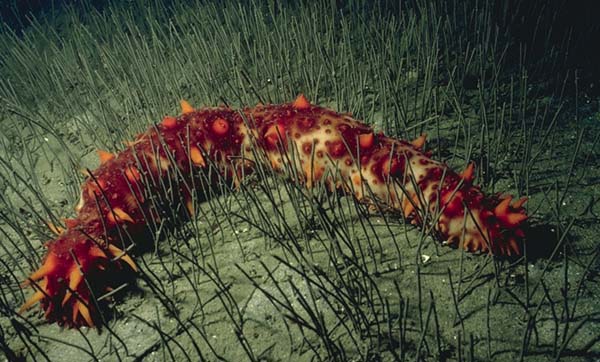
The scientific name of the Brown Sea Cucumber is Isostichopus fuscus. It is a species of animal in the family Stichopodidae, order Synallactida. The name dates from 1875.
- Scientific name
- Isostichopus fuscus (Ludwig, 1875)
- Common name
- Brown Sea Cucumber
- Genus
- Isostichopus
- Family
- Stichopodidae
- Order
- Synallactida
- Class
- Holothuroidea
- Red List category
- EN Endangered
- Environment
- marine
- Recorded in
- 6 countries
- Name status
- accepted in the Catalogue of Life
Overview
Isostichopus fuscus occurs along the Pacific coast of Mexico, including the Gulf of California, through Central America to the northern coast of Peru, and on eastern Pacific islands, including the Galápagos.
Written 26 November 2026 from the sources listed below. Each statement was checked against the passage it cites; statements that could not be supported were removed.
Appearance
Its dermis is thick and lacks spikes. Albinism was recorded in two individuals in 2013, one from Loreto, Mexico, and the other from Los Angeles Bay.[1][2]
Habitat
The Brown Sea Cucumber inhabits shallow waters at depths of approximately 0–40 m, with a preferred depth range of approximately 3–29 m. It occurs on rocky reefs, particularly those containing sandy patches.[3][4][5]
It tends to predominate in areas with high concentrations of Ulva species. Its survival tends to increase on soft substrates such as sand and clay.[6][7]
Diet
The Brown Sea Cucumber is a deposit feeder. A combination of P. durvillaei and S. ecuadoreanum seaweeds has been identified as an optimal diet, although the species can survive on other seaweed types.[8][9][10]
Behaviour
The Brown Sea Cucumber is generally more active at night than during the daytime. During daylight hours, individuals remain cryptic, reducing their visibility to predators.[11][12]
Reproduction and life cycle
The Brown Sea Cucumber is dioecious, with separate male and female individuals. Spawning occurs between July and September, and post-spawning gonads have been observed in October.[13][14]
Gametogenesis has been documented from January through July. Oogenesis occurs approximately one month before spermatogenesis, and spawning is episodic, with reproductive peaks followed by substantial declines.[15][16][17]
Experimental induced transverse fission has produced high survival rates and complete regeneration of anterior and posterior body parts within three months.[18]
Conservation
The Brown Sea Cucumber is classified as Critically Endangered globally. Unsustainable fishing and overexploitation have contributed to population declines.[19][20]
Population recovery in the Galápagos was considered unlikely following the particularly low population density recorded after the 2003 fishing season. The Galápagos Marine Reserve monitored the species' population twice annually between 1999 and 2003.[21][22]
Uses
The Brown Sea Cucumber is harvested for export to East Asia and consumed in Asian and South American cuisines. Dried specimens are processed into tablets and marketed as nutritional supplements.[23][24][25]
Classification of the Brown Sea Cucumber
| Kingdom | Animalia |
|---|---|
| Phylum | Echinodermata |
| Subphylum | Echinozoa |
| Class | Holothuroidea |
| Subclass | Actinopoda |
| Order | Synallactida |
| Family | Stichopodidae |
| Genus | Isostichopus |
| Species | Isostichopus fuscus (Ludwig, 1875) |
Where the Brown Sea Cucumber is found
Checklists and occurrence records place Isostichopus fuscus in 6 countries. GBIF holds 14,540 georeferenced records of it.
Countries
Regions and cities with the most records
- Galápagos, Ecuador 1,011
- Baja California Sur, Mexico 75
- Mazatlán, Mexico 60
- Crucecita, Mexico 44
- Ixtapa-Zihuatanejo, Mexico 38
- Manzanillo, Mexico 32
- Acapulco de Juárez, Mexico 31
- La Paz, Mexico 21
- Colima, Mexico 20
- Heroica Guaymas, Mexico 13
- Guanacaste Province, Costa Rica 11
- Puerto Peñasco, Mexico 11
- Sinaloa, Mexico 11
- Oaxaca, Mexico 9
- Puerto Vallarta, Mexico 9
- Cabo San Lucas, Mexico 8
- Colonia del Sol, Mexico 8
- Puerto Escondido, Mexico 8
- Sonora, Mexico 8
- Bucerías, Mexico 7
- Mezcales, Mexico 7
- Puntarenas Province, Costa Rica 7
- Veracruz, Panama 6
- Ancón, Panama 5
- Baja California, Mexico 5
- Curundú, Panama 5
- Panamá Oeste Province, Panama 5
- San José del Valle, Mexico 5
- Guerrero, Mexico 4
- Ixtapa, Mexico 4
- Nayarit, Mexico 4
- Salina Cruz, Mexico 4
- Santo Domingo Tehuantepec, Mexico 4
- Michoacán, Mexico 3
- Santa Elena, Ecuador 3
A number beside a place is its count of GBIF occurrence records. A place without a number comes from a checklist alone. Records show where a species has been observed or collected, which can include escapes and vagrants.
Common names
English
- Brown Sea Cucumber
- Giant Sea Cucumber
Names in 4 other languages
- Arabic
- خِيار البحر ضخم
- French
- Concombre de mer géant
- Italian
- Oloturia bruna gigante
- Spanish
- Pepino café gigante, Pepino de mar café, Pepino de mar gigante, Pepino de mar pardo
Synonyms
2 other scientific names have been used for this species and are now treated as synonyms of Isostichopus fuscus.
- Stichopus fuscus Ludwig, 1875
- Stichopus fusus Ludwig, 1875
Related species
-
 Chocolate Chip Sea CucumberIsostichopus badionotus
- Isostichopus macroparentheses
- Isostichopus maculatus
-
 Pineapple Sea CucumberThelenota ananas
-
 Japanese Sea CucumberApostichopus japonicus
-
 California Sea CucumberApostichopus californicus
-
 Greenfish Sea CucumberStichopus chloronotus
-
 AmberfishThelenota anax
Compare
Questions and answers
What is the scientific name of the Brown Sea Cucumber?
The scientific name of the Brown Sea Cucumber is Isostichopus fuscus. Written with its author, the full name is Isostichopus fuscus (Ludwig, 1875).
Which family does the Brown Sea Cucumber belong to?
Isostichopus fuscus belongs to the family Stichopodidae, in the order Synallactida and the class Holothuroidea.
Where is the Brown Sea Cucumber found?
Checklists and occurrence records place Isostichopus fuscus in 6 countries: Ecuador, Mexico, Costa Rica, Colombia, Panama and El Salvador.
What is the conservation status of the Brown Sea Cucumber?
The IUCN Red List category recorded for Isostichopus fuscus is Endangered (EN).
What other names does the Brown Sea Cucumber have?
Isostichopus fuscus is also known in English as Giant Sea Cucumber.
Can humans eat sea cucumbers?
The Brown Sea Cucumber is consumed in Asian and South American cuisines. It is also harvested for export to East Asia.[23][24]
What habitat do sea cucumbers live in?
The Brown Sea Cucumber inhabits shallow waters at depths of approximately 0–40 m, preferring approximately 3–29 m. It occurs on rocky reefs, particularly those containing sandy patches.[3][4][5]
What is a sea cucumbers diet?
The Brown Sea Cucumber is a deposit feeder. A combination of P. durvillaei and S. ecuadoreanum seaweeds has been identified as an optimal diet, although it can survive on other seaweed types.[8][9][10]
Is a sea cucumber a carnivore, herbivore, or omnivore?
The Brown Sea Cucumber is a deposit feeder.[8]
Sources
Passages the profile rests on
- Its dermis is thick and lacks spikes. Source passage: “It has a thick dermis without any spikes” — English Wikipedia
- Albinism was recorded in two individuals in 2013, one from Loreto, Mexico, and the other from Los Angeles Bay. Source passage: “Two albino individuals were found: one in Loreto, Mexico and the other in the Los Angeles Bay.” — English Wikipedia
- The species inhabits shallow waters at depths of approximately 0–40 m. Source passage: “They are found in shallow waters, roughly 0 to 40 m deep” — English Wikipedia
- Its preferred depth range is approximately 3–29 m. Source passage: “although 3 to 29 m are a preferred range.” — English Wikipedia
- The species occurs on rocky reefs, particularly those containing sandy patches. Source passage: “in rocky reefs, although 3 to 29 m are a preferred range. Additionally, reefs with sandy patches seem to be a preferred substrate.” — English Wikipedia
- The species tends to predominate in areas with high concentrations of Ulva species. Source passage: “Within these depths, I. fuscus has been found to predominate areas where high amounts of Ulva sp. are located.” — English Wikipedia
- Its survival tends to increase on soft substrates such as sand and clay. Source passage: “whose survival tends to increase with soft-substrates such as sand or clay.” — English Wikipedia
- The species is a deposit feeder. Source passage: “I. fuscus is a deposit feeder” — English Wikipedia
- A combination of P. durvillaei and S. ecuadoreanum seaweeds has been identified as an optimal diet. Source passage: “a blend of seaweed species such as P. durvillaei and S. ecuadoreanum are an optimal diet” — English Wikipedia
- The species can survive on seaweed types other than P. durvillaei and S. ecuadoreanum. Source passage: “although they can survive off of other types of seaweed.” — English Wikipedia
- The species is generally more active at night than during the daytime. Source passage: “The species tends to be more active at night” — English Wikipedia
- During daylight hours, individuals remain cryptic, reducing their visibility to predators. Source passage: “during the daytime they are cryptic and being active would make them more visible to predators.” — English Wikipedia
- The species is dioecious, with separate male and female individuals. Source passage: “Isostichopus fuscus is dioecious.” — English Wikipedia
- Spawning occurs between July and September, with post-spawning gonads observed in October. Source passage: “Spawning occurs in Isostichopus fuscus from July to September, with post-spawning gonads occurring in October.” — English Wikipedia
- Gametogenesis has been documented from January through July. Source passage: “Gametogenesis was documented between January and July” — English Wikipedia
- Oogenesis occurs approximately one month before spermatogenesis. Source passage: “with oogenesis occurring approximately one month before spermatogenesis.” — English Wikipedia
- The species exhibits episodic spawning, characterized by reproductive peaks followed by substantial declines. Source passage: “Peaks in reproduction followed by drastic declines have characterized I. fuscus as an episodic spawner” — English Wikipedia
- Experimental induced transverse fission has produced high survival rates and complete regeneration of anterior and posterior body parts within three months. Source passage: “The results were successful, showing a high survival rate, and a complete regeneration of anterior and posterior body parts in a maximum of three months.” — English Wikipedia
- The species is classified as Critically Endangered globally. Source passage: “The brown sea cucumber is classified by the IUCN as Critically Endangered.” — English Wikipedia
- Unsustainable fishing and overexploitation have contributed to population declines. Source passage: “The fishery is typically conducted in an unsustainable manner, mostly in North and South America, which has caused the populations to decline.” — English Wikipedia
- Population recovery in the Galápagos was considered unlikely following the particularly low population density recorded after the 2003 fishing season. Source passage: “The lowest total density of the population was seen following the 2003 fishing season, and due to this ultimate low, the recovery of the brown sea cucumber population is seen as unlikely” — English Wikipedia
- The Galápagos Marine Reserve monitored the species' population twice annually between 1999 and 2003. Source passage: “the Galápagos Marine Reserve and all major stakeholders took it upon themselves to monitor its population in the Galápagos twice a year between 1999 and 2003” — English Wikipedia
- The species is harvested for export to East Asia. Source passage: “it is harvested for export to East Asia” — English Wikipedia
- The species is consumed in Asian and South American cuisines. Source passage: “Sea cucumbers are typically used in traditional Chinese medicines as well as in many Asian and South American cuisines.” — English Wikipedia
- Dried specimens are processed into tablets and marketed as nutritional supplements. Source passage: “more recently, dried sea cucumber is made into tablets and has been marketed as a nutritional supplement” — English Wikipedia
Data
- Catalogue of Life, 2026-10-16 XR cc by
- Global Biodiversity Information Facility CC BY 4.0
- Wikidata CC0
- GeoNames CC BY 4.0
- Wikimedia Commons per image; credit shown with each image
- Within the Catalogue of Life, this name comes from World Register of Marine Species cc by
References
- Ludwig H. 1875. Beitrage zur Kenntniss der Holothurien. Arbeiten aus dem Zoologisch-Zootomischen Institut in Wurzburg 2: 77 - 118. Available from https: // www. biodiversitylibrary. org / page / 34381203 [accessed 16 Apr. 2024]. where the name was published
This species in other databases
- Catalogue of Life 3QC2D
- Wikidata Q2364105
- iNaturalist 195747
- WoRMS urn:lsid:marinespecies.org:taxname:529516
- ITIS 1079241
Page built on 28 November 2026. See how the catalog is made and all sources and licences.
Cite this page
ScientificNames.org. (2026). Isostichopus fuscus (Brown Sea Cucumber). Retrieved November 28, 2026, from https://scientificnames.org/species/isostichopus-fuscus
“Isostichopus fuscus (Brown Sea Cucumber).” ScientificNames.org, 2026, scientificnames.org/species/isostichopus-fuscus. Accessed 28 Nov. 2026.
ScientificNames.org. “Isostichopus fuscus (Brown Sea Cucumber).” Accessed November 28, 2026. https://scientificnames.org/species/isostichopus-fuscus.
@misc{scientificnames_isostichopus_fuscus_brown_sea_cucumber,
  author = {{ScientificNames.org}},
  title = {Isostichopus fuscus (Brown Sea Cucumber)},
  year = {2026},
  url = {https://scientificnames.org/species/isostichopus-fuscus},
  note = {Accessed 2026-11-28}
}