Species · Other invertebrates
Amberfish Thelenota anax
The scientific name of the Amberfish is Thelenota anax. It is a species of animal in the family Stichopodidae, order Synallactida. The name dates from 1921.
- Scientific name
- Thelenota anax Clark, 1921
- Common name
- Amberfish
- Genus
- Thelenota
- Family
- Stichopodidae
- Order
- Synallactida
- Class
- Holothuroidea
- Red List category
- DD Data Deficient
- Environment
- marine
- Recorded in
- 24 countries
- Name status
- accepted in the Catalogue of Life

Overview
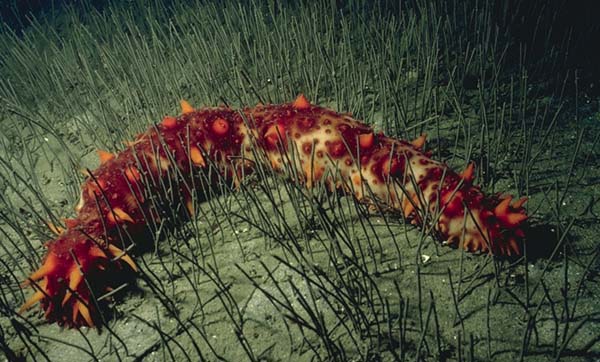
Thelenota anax inhabits soft, sandy areas of the ocean floor at depths exceeding 25 m and can also occur on the sides of reef slopes, primarily in the tropical South Pacific Ocean. It has a creamy beige to light brown body with dark brown or red spots, light-colored bumps on its upper surface, and large lateral papillae.
Written 26 November 2026 from the sources listed below. Each statement was checked against the passage it cites; statements that could not be supported were removed.
Appearance
The body coloration ranges from creamy beige to light brown and includes dark brown or red spots. The upper surface usually bears light-colored bumps, while large papillae are positioned laterally.[1][2][3]
The ventral surface bears long, white podia. The mouth is located on the ventral surface and has 18–20 peltate tentacles, while the anus is situated dorsally near the terminal end of the body.[4][5][6]
The average body length is approximately 69 cm, and the longest recorded individual measured 89 cm. Some individuals can weigh up to 5 kg.[7][8][9]
Habitat
Amberfish inhabits soft, sandy areas of the ocean floor at depths exceeding 25 m. It can also occur on the sides of reef slopes.[10][11]
The species is primarily found in the tropical South Pacific Ocean.[12]
Behaviour
Amberfish often has ectocommensal relationships with organisms living on its exterior. Scaleworms and gastropods are among the organisms commonly found living on its body.[13][14]
The ectocommensal organisms described do not appear to negatively affect the sea cucumber.[15]
Reproduction and life cycle
The species has two gonads measuring approximately 70–500 mm in length.[16]
Uses
The Solomon Islands are a location where the species is commonly harvested. Its reported commercial value there is approximately $6.66 per kilogram.[17][18]
The species is consumed in Asian and Middle Eastern countries for its purported medicinal benefits.[19]
Amberfish produces bioactive compounds including arachidonic acid, eicosapentaenoic acid, and docosahexaenoic acid. It also produces the glycosides Stichopside C and Stichoposide D.[20][21]
Classification of the Amberfish
| Kingdom | Animalia |
|---|---|
| Phylum | Echinodermata |
| Subphylum | Echinozoa |
| Class | Holothuroidea |
| Subclass | Actinopoda |
| Order | Synallactida |
| Family | Stichopodidae |
| Genus | Thelenota |
| Species | Thelenota anax Clark, 1921 |
Where the Amberfish is found
Checklists and occurrence records place Thelenota anax in 24 countries. GBIF holds 943 georeferenced records of it.
Countries
- Australia 111
- Cook Islands 4
- Fiji 52
- French Polynesia 12
- Indonesia 192
- Israel 4
- Japan 16
- Jordan 3
- Kiribati 11
- Malaysia 28
- Maldives 12
- Marshall Islands 87
- Micronesia 27
- New Caledonia 75
- Palau 71
- Papua New Guinea 39
- Philippines 71
- Solomon Islands 19
- Thailand 15
- Timor Leste 9
- Tonga 13
- Tuvalu 40
- Vanuatu 10
- Wallis and Futuna 22
Regions and cities with the most records
- Bitung, Indonesia 39
- Ngerulmud, Palau 27
- Funafuti, Tuvalu 25
- Amlapura, Indonesia 12
- Amlapura city, Indonesia 12
- Bedugul, Indonesia 12
- Daanbantayan, Philippines 9
- Dalap-Uliga-Dorrit, Marshall Islands 9
- Majuro, Marshall Islands 9
- Sabah, Malaysia 9
- Aqaba, Jordan 7
- Eilat, Israel 7
- Mata-Utu, Wallis and Futuna 7
- Taal, Philippines 7
- Bauan, Philippines 6
- Nuku‘alofa, Tonga 6
- Port-Vila, Vanuatu 6
- Bali, Indonesia 5
- Batangas, Philippines 5
- Lami, Fiji 5
- Mont-Dore, New Caledonia 5
- Nouméa, New Caledonia 5
- San Pascual, Philippines 5
- Suva, Fiji 5
- Male, Maldives 4
- Manado, Indonesia 4
- Nasinu, Fiji 4
- Romblon, Philippines 4
- Avarua, Cook Islands 3
- Dumaguete, Philippines 3
- Okinawa, Japan 3
- Palikir, Micronesia 3
- Southern District, Israel 3
- Ḩaql, Saudi Arabia 3
7 more countries have a few records outside this range
These countries hold a few records of Thelenota anax but lie outside the range the checklists give for it. Such records are often zoo or garden specimens, museum material or vagrants, so the species is not counted as occurring there.
A number beside a place is its count of GBIF occurrence records. A place without a number comes from a checklist alone. Records show where a species has been observed or collected, which can include escapes and vagrants.
Common names
English
- Amberfish
- Amberfish Sea Cucumber
- Giant Sea Cucumber
Names in 3 other languages
- Chinese
- 巨梅花參
- French
- Holothurie géante
- Japanese
- アデヤカバイカナマコ
Related species
-
 Pineapple Sea CucumberThelenota ananas
-
 LemonfishThelenota rubralineata
-
 Japanese Sea CucumberApostichopus japonicus
-
 California Sea CucumberApostichopus californicus
-
 Greenfish Sea CucumberStichopus chloronotus
-
 Brown Sea CucumberIsostichopus fuscus
-
 Sea PuddingIsostichopus badionotus
-
 CurryfishStichopus herrmanni
Compare
Questions and answers
What is the scientific name of the Amberfish?
The scientific name of the Amberfish is Thelenota anax. Written with its author, the full name is Thelenota anax Clark, 1921.
Which family does the Amberfish belong to?
Thelenota anax belongs to the family Stichopodidae, in the order Synallactida and the class Holothuroidea.
Where is the Amberfish found?
Checklists and occurrence records place Thelenota anax in 24 countries, including Indonesia, Australia, Marshall Islands, New Caledonia, Palau and Philippines.
What is the conservation status of the Amberfish?
The IUCN Red List category recorded for Thelenota anax is Data Deficient (DD).
What other names does the Amberfish have?
Thelenota anax is also known in English as Amberfish Sea Cucumber and Giant Sea Cucumber.
Sources
Passages the profile rests on
- The body coloration ranges from creamy beige to light brown and includes dark brown or red spots. Source passage: “The body of T. anax can be a creamy beige or light brown with dark brown or red spots.” — English Wikipedia
- The upper surface of the body usually bears light-colored bumps. Source passage: “It usually has light colored bumps on the top of its body.” — English Wikipedia
- The body has large papillae positioned laterally. Source passage: “T. anax also has large with papillae located laterally on its body.” — English Wikipedia
- The ventral surface bears long, white podia. Source passage: “On its ventral surface there is long white podia.” — English Wikipedia
- The mouth is located on the ventral surface and has 18–20 peltate tentacles. Source passage: “Its mouth is also located ventrally with 18–20 peltate tentacles.” — English Wikipedia
- The anus is situated dorsally near the terminal end of the body. Source passage: “The anus is located on the dorsal side of the animal towards the terminal end.” — English Wikipedia
- The species has an average body length of approximately 69 cm. Source passage: “Their average length is about 69 cm long” — English Wikipedia
- The longest recorded individual measured 89 cm in length. Source passage: “the longest recorded sea cucumber was 89 cm long.” — English Wikipedia
- Some individuals can weigh up to 5 kg. Source passage: “Some of the biggest sea cucumber can weigh up to 5 kg.” — English Wikipedia
- The species inhabits soft, sandy areas of the ocean floor at depths exceeding 25 m. Source passage: “Thelenota anax prefers to live on soft, sandy portions of the ocean floor at depths greater than 25 m.” — English Wikipedia
- The species can also occur on the sides of reef slopes. Source passage: “Some can be found on the sides of reef slopes.” — English Wikipedia
- The species is primarily found in the tropical South Pacific Ocean. Source passage: “Thelenota anax is a species of sea cucumber mostly found in the tropical, South Pacific Ocean.” — English Wikipedia
- The species often has ectocommensal relationships with organisms living on its exterior. Source passage: “It is also commonly known as the amber fish. Some other names for T. anax are black teatfish, blackfish, brownfish, chief sea cucumber, curryfish, elephant trunk cucumber, lollyfish, tripang, and white-teat sea cucumber. T. anax is found on sandy ocean bottoms and often have ectocommensal relationships.” — English Wikipedia
- Scaleworms and gastropods are among the organisms commonly found living on the exterior of this species. Source passage: “A few common species found on T.anax are scaleworms and gastropods.” — English Wikipedia
- The ectocommensal organisms described do not appear to negatively affect the sea cucumber. Source passage: “The sea cucumber does not appear to be negatively affected by these ectocommensal species.” — English Wikipedia
- The species has two gonads measuring approximately 70–500 mm in length. Source passage: “It also has two gonads that are approximately 70–500mm long.” — English Wikipedia
- The Solomon Islands are a location where this species is commonly harvested. Source passage: “In the Solomon Islands, where Thelenota anax is commonly harvested” — English Wikipedia
- In the Solomon Islands, the species has a reported commercial value of approximately $6.66 per kilogram. Source passage: “it has a commercial value of around $6.66 per kg” — English Wikipedia
- The species is consumed in Asian and Middle Eastern countries for its purported medicinal benefits. Source passage: “T. anax is commonly consumed in Asian and Middle Eastern countries for its purported medicinal benefits” — English Wikipedia
- The species produces bioactive compounds including arachidonic acid, eicosapentaenoic acid, and docosahexaenoic acid. Source passage: “T. anax produces many different bioactive compounds such as arachidonic acid, eicosapentaenoic acid, and docosahexaenoic acid.” — English Wikipedia
- The species produces the glycosides Stichopside C and Stichoposide D. Source passage: “Studies have also shown that T. anax produces glycosides Stichopside C (STC) and Stichoposide D (STD).” — English Wikipedia
Data
- Catalogue of Life, 2026-10-16 XR cc by
- Global Biodiversity Information Facility CC BY 4.0
- Wikidata CC0
- GeoNames CC BY 4.0
- Wikimedia Commons per image; credit shown with each image
- Within the Catalogue of Life, this name comes from World Register of Marine Species cc by
References
- Clark, H. L. (1921). The echinoderm fauna of Torres Strait: its composition and its origin. Department of Marine Biology of the Carnegie Institute, 10: vi + 223, 38 pls. where the name was published
This species in other databases
- Catalogue of Life 567QQ
- Wikidata Q301271
- iNaturalist 136414
- WoRMS urn:lsid:marinespecies.org:taxname:210915
- ITIS 1078945
Page built on 26 November 2026. See how the catalog is made and all sources and licences.
Cite this page
ScientificNames.org. (2026). Thelenota anax (Amberfish). Retrieved November 26, 2026, from https://scientificnames.org/species/thelenota-anax
“Thelenota anax (Amberfish).” ScientificNames.org, 2026, scientificnames.org/species/thelenota-anax. Accessed 26 Nov. 2026.
ScientificNames.org. “Thelenota anax (Amberfish).” Accessed November 26, 2026. https://scientificnames.org/species/thelenota-anax.
@misc{scientificnames_thelenota_anax_amberfish,
  author = {{ScientificNames.org}},
  title = {Thelenota anax (Amberfish)},
  year = {2026},
  url = {https://scientificnames.org/species/thelenota-anax},
  note = {Accessed 2026-11-26}
}