Species · Amphibians
Southern Giant Salamander Isthmura maxima
The scientific name of the Southern Giant Salamander is Isthmura maxima. It is a species of amphibian in the family Plethodontidae (lungless salamanders), order Caudata. The name dates from 2005.
- Scientific name
- Isthmura maxima (Parra-Olea, García-París, Papenfuss & Wake, 2005)
- Common name
- Southern Giant Salamander
- Genus
- Isthmura
- Family
- Plethodontidae (Lungless Salamanders)
- Order
- Caudata
- Class
- Amphibia
- Red List category
- EN Endangered
- Recorded in
- 1 country
- Name status
- accepted in the Catalogue of Life
Overview
The Southern Giant Salamander is described as the largest tropical salamander. It is endemic to Mexico and occurs in the Sierra Madre del Sur of western and southern Oaxaca and eastern Guerrero. It generally has black coloration with parallel rows of red-orange to pale orange spots on its head, body, and proximal tail.
Written 27 November 2026 from the sources listed below. Each statement was checked against the passage it cites; statements that could not be supported were removed.
Appearance
The salamander generally has uniformly black coloration with parallel rows of vivid red-orange to pale orange spots on its head, body, and proximal tail.[1]
Its body is robust, and its head is large and relatively broad with a short snout. The limbs are long and robust, while the well-developed fingers and toes are relatively short and lack appreciable webbing.[2][3][4]
Habitat
The species has been recorded in a banana field. Recorded elevations range from 750 to 2,000 metres above sea level.[5][6]
Behaviour
The species appears to inhabit permanent burrows.[7]
Conservation
The species appears to tolerate some habitat modification. Urbanization and changes in agricultural practices are identified as potential threats.[8][9][10]
The species has not been recorded from any protected areas.[11]
Classification of the Southern Giant Salamander
| Kingdom | Animalia |
|---|---|
| Phylum | Chordata |
| Subphylum | Vertebrata |
| Infraphylum | Gnathostomata |
| Parvphylum | Osteichthyes |
| Megaclass | Tetrapoda |
| Class | Amphibia (Amphibians) |
| Order | Caudata (Salamanders) |
| Family | Plethodontidae (Lungless Salamanders) |
| Subfamily | Hemidactyliinae |
| Genus | Isthmura (Giant False Brook Salamanders) |
| Species | Isthmura maxima (Parra-Olea, García-París, Papenfuss & Wake, 2005) |
Where the Southern Giant Salamander is found
Checklists and occurrence records place Isthmura maxima in 1 country. GBIF holds 33 georeferenced records of it.
Countries
Regions and cities with the most records
A number beside a place is its count of GBIF occurrence records. A place without a number comes from a checklist alone. Records show where a species has been observed or collected, which can include escapes and vagrants.
Common names
English
- Southern Giant Salamander
Names in 2 other languages
- Spanish
- Salamandra Gigante de Putla
- Turkish
- Dev Güney semenderi
Synonyms
One other scientific name has been used for this species and is now treated as a synonym of Isthmura maxima.
- Pseudoeurycea maxima Parra-Olea, García-París, Papenfuss & Wake, 2005
Related species
-
 Bell's False Brook SalamanderIsthmura bellii
- Giant False Brook SalamanderIsthmura gigantea
- Oaxacan False Brook SalamanderIsthmura boneti
- Corrugated SalamanderIsthmura corrugata
- Pine-Oak SalamanderIsthmura sierraoccidentalis
- Cofre de Perote SalamanderIsthmura naucampatepetl
-
 Red-backed SalamanderPlethodon cinereus
-
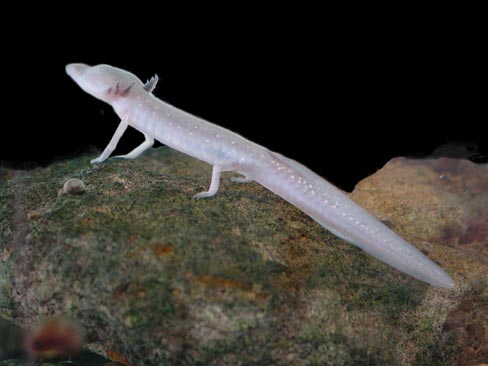 Texas Blind SalamanderEurycea rathbuni
Compare
Questions and answers
What is the scientific name of the Southern Giant Salamander?
The scientific name of the Southern Giant Salamander is Isthmura maxima. Written with its author, the full name is Isthmura maxima (Parra-Olea, García-París, Papenfuss & Wake, 2005).
Which family does the Southern Giant Salamander belong to?
Isthmura maxima belongs to the family Plethodontidae, in the order Caudata and the class Amphibia.
Where is the Southern Giant Salamander found?
Checklists and occurrence records place Isthmura maxima in 1 country: Mexico.
What is the conservation status of the Southern Giant Salamander?
The IUCN Red List category recorded for Isthmura maxima is Endangered (EN).
Sources
Passages the profile rests on
- The salamander generally has uniformly black coloration with parallel rows of vivid red-orange to pale orange spots on its head, body, and proximal tail. Source passage: “in general it is uniformly black, with markings consisting of parallel rows of vivid red-orange to pale orange spots on the head, body, and proximal part of the tail.” — English Wikipedia
- The body is robust, and the head is large and relatively broad with a short snout. Source passage: “The body is robust, and the head is large and relatively broad but with short snout.” — English Wikipedia
- The limbs are long and robust. Source passage: “The limbs are long and robust.” — English Wikipedia
- The fingers and toes are well developed but relatively short and lack appreciable webbing. Source passage: “The fingers and toes are well developed but relatively short and without appreciable webbing.” — English Wikipedia
- The species has been recorded in a banana field. Source passage: “This little-known salamander has been found in a banana field” — English Wikipedia
- Recorded elevations range from 750 to 2,000 metres above sea level. Source passage: “at elevations of 750–2,000 m (2,460–6,560 ft) above sea level.” — English Wikipedia
- The species appears to inhabit permanent burrows. Source passage: “It appears to live in permanent burrows.” — English Wikipedia
- The species appears to tolerate some habitat modification. Source passage: “Although it seems to tolerate some habitat modification,” — English Wikipedia
- Urbanization is identified as a potential threat to the species. Source passage: “urbanization and changed agricultural practices are potential threats.” — English Wikipedia
- Changes in agricultural practices are identified as a potential threat to the species. Source passage: “urbanization and changed agricultural practices are potential threats.” — English Wikipedia
- The species has not been recorded from any protected areas. Source passage: “It is not known from any protected areas.” — English Wikipedia
Data
- Catalogue of Life, 2026-10-16 XR cc by
- Global Biodiversity Information Facility CC BY 4.0
- Wikidata CC0
- GeoNames CC BY 4.0
- Within the Catalogue of Life, this name comes from The Integrated Taxonomic Information System cc0
This species in other databases
Page built on 29 November 2026. See how the catalog is made and all sources and licences.
Cite this page
ScientificNames.org. (2026). Isthmura maxima (Southern Giant Salamander). Retrieved November 29, 2026, from https://scientificnames.org/species/isthmura-maxima
“Isthmura maxima (Southern Giant Salamander).” ScientificNames.org, 2026, scientificnames.org/species/isthmura-maxima. Accessed 29 Nov. 2026.
ScientificNames.org. “Isthmura maxima (Southern Giant Salamander).” Accessed November 29, 2026. https://scientificnames.org/species/isthmura-maxima.
@misc{scientificnames_isthmura_maxima_southern_giant_salamander,
  author = {{ScientificNames.org}},
  title = {Isthmura maxima (Southern Giant Salamander)},
  year = {2026},
  url = {https://scientificnames.org/species/isthmura-maxima},
  note = {Accessed 2026-11-29}
}