Species · Fishes
Shortfin Mako Shark Isurus oxyrinchus
The scientific name of the Shortfin Mako Shark is Isurus oxyrinchus. It is a species of fish in the family Lamnidae (porbeagles), order Lamniformes. The name dates from 1810.
- Scientific name
- Isurus oxyrinchus Rafinesque, 1810
- Common name
- Shortfin Mako Shark
- Genus
- Isurus
- Family
- Lamnidae (Porbeagles)
- Order
- Lamniformes
- Class
- Elasmobranchii
- Red List category
- EN Endangered
- Environment
- marine
- Recorded in
- 15 countries
- Name status
- accepted in the Catalogue of Life

Overview
Isurus oxyrinchus inhabits offshore temperate and tropical marine waters worldwide.
Written 24 November 2026 from the sources listed below. Each statement was checked against the passage it cites; statements that could not be supported were removed.
Appearance
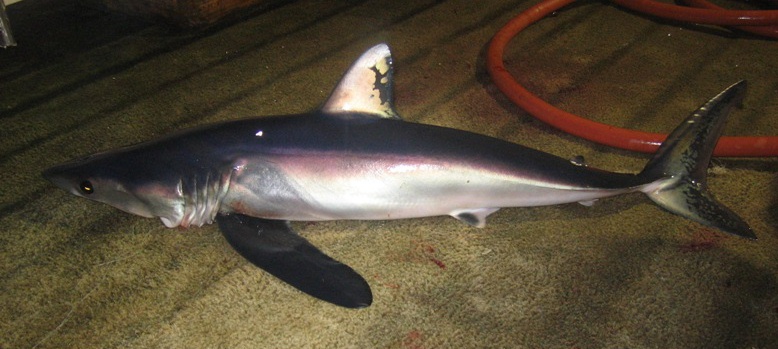
The Shortfin mako shark has a streamlined, spindle-shaped body with blunt triangular dorsal and pectoral fins and a vertically elongated tail fin. A pronounced lateral keel runs along the base of its tail.[1][2]
Adults have metallic blue upper surfaces and white undersides. Juveniles have a distinctive blackish mark at the tip of their snout.[3][4]
Habitat
The species inhabits offshore temperate and tropical marine waters worldwide. It is pelagic and occurs from the sea surface to depths of approximately 150 m.[5][6][7]
It is normally found far from land but sometimes occurs near shores, islands, and inlets. It is seldom found in water colder than 16 °C.[8][9]
In the western Atlantic, the species occurs from Argentina and the Gulf of Mexico northward to Browns Bank off Nova Scotia. It is among the most commonly encountered shark species in New Zealand waters.[10][11]
Diet
Its principal foods include squid, other cephalopods, and bony fishes. Recorded bony fish prey include bluefish, mackerel, herring, tuna, bonito, saury, and billfish.[12][13]
Its diet can also include other sharks, porpoises, dolphins, sea turtles, seabirds, and crustaceans. Individuals longer than 3 m have teeth adapted for capturing larger prey, including dolphins, billfish, and other sharks.[14][15]
Shortfin mako sharks consume approximately 3% of their body weight in food daily.[16]
Behaviour
The Shortfin mako shark can reach burst swimming speeds of approximately 74 km/h. Its heat-exchange circulatory system allows its body temperature to remain 4–5.5 °C above the surrounding water.[17][18]
Shortfin makos travel long distances when searching for prey or mates. A tagged female travelled more than 2,776 km from California to the central Pacific.[19][20]
Shortfin makos hunt by lunging vertically and removing pieces of their prey's flanks and fins. They generally swim beneath their prey, using their upward field of vision to approach it.[21][22]
The species is highly athletic and commonly leaps into the air when caught on fishing gear.[23]
Reproduction and life cycle
The Shortfin mako shark is a yolk-sac ovoviviparous species that gives birth to live young. Embryos develop inside the uterus for approximately 15–18 months and feed on unfertilized eggs.[24][25]
Females typically give birth to between four and eighteen surviving young. Newborns measure approximately 70 cm in length.[26][27]
Females may take an 18-month resting period after giving birth before mating again. They produce young approximately once every three years on average.[28][29]
Multiple paternity has been documented as a mating strategy in this species.[30]
Conservation
The Shortfin mako shark is classified as Endangered by the IUCN. FishBase reports a very high vulnerability score of 79 out of 100 and a minimum population doubling time of 4.5–14 years.[31][32][33]
Uses
The Shortfin mako shark is sought after as a game fish.[34]
Similar species
The Shortfin mako closely resembles the longfin mako, which has larger pectoral fins, darker coloration around the mouth, and larger eyes.[35]
Classification of the Shortfin Mako Shark
| Kingdom | Animalia |
|---|---|
| Phylum | Chordata |
| Subphylum | Vertebrata |
| Infraphylum | Gnathostomata |
| Parvphylum | Chondrichthyes |
| Class | Elasmobranchii |
| Subclass | Neoselachii |
| Infraclass | Selachii |
| Superorder | Galeomorphi |
| Order | Lamniformes |
| Family | Lamnidae (Porbeagles) |
| Genus | Isurus (Mako Shark) |
| Species | Isurus oxyrinchus Rafinesque, 1810 |
Where the Shortfin Mako Shark is found
Checklists and occurrence records place Isurus oxyrinchus in 15 countries. GBIF holds 53,888 georeferenced records of it.
Countries
- Australia 1,653
- Brazil 90
- Chile 48,199
- Fiji 22
- French Guiana 3
- French Polynesia 4
- New Caledonia 11
- New Zealand 3,525
- Norfolk Island 3
- Papua New Guinea 9
- Peru 46
- Solomon Islands 3
- United States 313
- Vanuatu 4
- Wallis and Futuna 3
Regions and cities with the most records
- New Plymouth, New Zealand 303
- Northland, New Zealand 111
- New South Wales, Australia 109
- Antofagasta, Chile 91
- Sydney, Australia 58
- Bay of Plenty, New Zealand 21
- California, United States 21
- Napier, New Zealand 18
- Tauranga, New Zealand 18
- Dunedin, New Zealand 15
- Ucayali, Peru 14
- Hastings, New Zealand 12
- Florida, United States 11
- Tasmania, Australia 11
- Long Beach, United States 7
- Redondo Beach, United States 7
- Santa Catarina, Brazil 7
- Whangarei, New Zealand 7
- Alto Hospicio, Chile 6
- Carson, United States 6
- Coffs Harbour, Australia 6
- Costa Mesa, United States 6
- Huntington Beach, United States 6
- Iquique, Chile 6
- Santa Monica, United States 6
- Torrance, United States 6
- Victoria, Australia 6
- Encinitas, United States 5
- Western Australia, Australia 5
- Auckland, New Zealand 4
- Camboriú, Brazil 4
- Fountain Valley, United States 4
- Gardena, United States 4
- Hawthorne, United States 4
- Inglewood, United States 4
- Newport Beach, United States 4
56 more countries have a few records outside this range
These countries hold a few records of Isurus oxyrinchus but lie outside the range the checklists give for it. Such records are often zoo or garden specimens, museum material or vagrants, so the species is not counted as occurring there.
- Albania 9
- Austria 17
- Bahamas 5
- Belgium 3
- Benin 10
- Canada 33
- China 7
- Cuba 5
- Czechia 9
- Denmark 22
- Egypt 3
- Estonia 9
- Faroe Islands 229
- Finland 24
- France 84
- French Southern Territories 7
- Gabon 5
- Germany 97
- Greece 18
- Greenland 10
- Grenada 4
- Guadeloupe 3
- Iceland 10
- India 18
- Indonesia 44
- Ireland 16
- Israel 11
- Italy 52
- Ivory Coast 5
- Japan 56
- Libya 5
- Malta 16
- Martinique 4
- Mauritania 11
- Mayotte 5
- Mexico 141
- Montenegro 3
- Morocco 5
- Mozambique 17
- Norway 98
- Oman 79
- Philippines 4
- Portugal 62
- Reunion 18
- Saint Barthelemy 3
- Saint Martin 3
- South Africa 58
- South Korea 8
- Spain 58
- Svalbard and Jan Mayen 8
- Sweden 11
- Switzerland 3
- Taiwan 13
- The Netherlands 54
- Turkey 9
- United Kingdom 223
A number beside a place is its count of GBIF occurrence records. A place without a number comes from a checklist alone. Records show where a species has been observed or collected, which can include escapes and vagrants.
Common names
English
- Shortfin Mako Shark
- Atlantic Mako Shark
- Mediterranean Mackerel Shark
- Pacific Bonito Shark
- Pacific Mako Shark
- Blue Pointer
- Blue Porpoise Shark
- Blue Shark
- Bonito Shark
- Mackerel Porbeagle
- Mackerel Shark
- Mako
- Mako Shark
- Porpoise Shark
- Sharp Nosed
- Sharp-nosed Mackerel Shark
- Sharpnose Mako
- Short Finned Mako Shark
- Shortfin Mako
- Snapper Shark
Names in 28 other languages
- Afrikaans
- mambone, moro
- Albanian
- peshkaqen tonil, peshkaqen turishkurtër
- Arabic
- (قرش ماكو قصير الزعانف (الذيبة
- Asturian
- marraxu azul
- Catalan
- solraig
- Chinese
- 尖吻鯖鯊, 灰鯖鮫, 煙仔沙, 煙仔鯊, 馬加, 馬加鯊
- Danish
- makrelhaj
- Dutch
- kortvin makreelhaai, kortvinmakreelhaai, makreelhaai, spitsneushaai
- French
- Requin taupe bleu, mako à nageoires courtes, requin-taupe bleu, taupe bleu, taupe bleue
- German
- Kurzflossen-Mako, Makrelenhai
- Greek
- Οξύρρυγχος καρχαρίας, Ρυγχοκαρχαρίας
- Hebrew
- עמלץ כחול
- Italian
- cagnia, cane di mare di Messina, cani di mari, meanto, ossirina dello spallanzani, pisci tunnu, piscicani, squalo mako
- Japanese
- aozame, awozame, morozame, アオザメ
- Lithuanian
- atlantinis pilkšvasis ryklys
- Māori
- mako
- Norwegian
- makrellhai
- Norwegian Bokmål
- makrellhai
- Norwegian Nynorsk
- makrellhai
- Papiamento
- Tribon blou, Tribon mulá
- Polish
- ostronos atlantycki, rekin ostronosy
- Portuguese
- anequin, anequin barbatana curta, marracho, marrajo criollo, rinquim
- Russian
- Короткоперый мако, акула мако, макрелевая акула, серо-голубая акула, чёрнорылая акула
- Spanish
- alecrín, dentudo, dientuso azul, ludia marraco, mako, marrajo, marrajo dientuso, marraquet
- Swedish
- makrillhaj
- Tamil
- ganumu sorrah
- Turkish
- dikburun canavar, mako kopekbaligi
- Ukrainian
- Акула сіро-блакитна, Акула-мако, сіро-блакитна акула
Synonyms
25 other scientific names have been used for this species and are now treated as synonyms of Isurus oxyrinchus.
- Carcharias tigris Atwood, 1869
- Isuropsis dekayi Gill, 1862
- Isuropsis glaucus (Müller & Henle, 1839)
- Isuropsis mako (Whitley, 1929)
- Isurus africanus Smith, 1957
- Isurus bideni Phillipps, 1932
- Isurus cepedii (Lesson, 1831)
- Isurus guentheri (Murray, 1884)
- Isurus mako Whitley, 1929
- Isurus oxyrhinchus Rafinesque, 1810
- Isurus oxyrhincus Rafinesque, 1810
- Isurus oxyrhynchus Rafinesque, 1810
- Isurus oxyrinchus Rafinesque-Schmaltz, 1810
- Isurus spallanzani Rafinesque, 1810
- Isurus tigris (Atwood, 1869)
- Isurus tigris africanus Smith, 1957
- Lamna glauca (Müller & Henle, 1839)
- Lamna guentheri Murray, 1884
- Lamna huidobrii Philippi, 1887
- Lamna latro Owen, 1853
- Lamna oxyrhina Cuvier & Valenciennes, 1835
- Oxyrhina glauca Müller & Henle, 1839
- Oxyrhina gomphodon Müller & Henle, 1839
- Squalus cepedii Lesson, 1831
- Isurus glaucus (Müller & Henle, 1839) ambiguous synonym
Related species
-
 Longfin Mako SharkIsurus paucus
-
 Great White SharkCarcharodon carcharias
-
 Salmon SharkLamna ditropis
-
 PorbeagleLamna nasus
- Carcharodon hubbelli
- Cosmopolitodus planus
Compare
Questions and answers
What is the scientific name of the Shortfin Mako Shark?
The scientific name of the Shortfin Mako Shark is Isurus oxyrinchus. Written with its author, the full name is Isurus oxyrinchus Rafinesque, 1810.
Which family does the Shortfin Mako Shark belong to?
Isurus oxyrinchus belongs to the family Lamnidae, in the order Lamniformes and the class Elasmobranchii.
Where is the Shortfin Mako Shark found?
Checklists and occurrence records place Isurus oxyrinchus in 15 countries, including Chile, New Zealand, Australia, United States, Brazil and Peru.
What is the conservation status of the Shortfin Mako Shark?
The IUCN Red List category recorded for Isurus oxyrinchus is Endangered (EN).
What other names does the Shortfin Mako Shark have?
Isurus oxyrinchus is also known in English as Atlantic Mako Shark, Mediterranean Mackerel Shark, Pacific Bonito Shark, Pacific Mako Shark, Blue Pointer and Blue Porpoise Shark.
Sources
Passages the profile rests on
- The shortfin mako has a streamlined, spindle-shaped body with blunt triangular dorsal and pectoral fins and a vertically elongated tail fin. Source passage: “The shortfin mako shark is fusiform in shape, with blunt triangular dorsal and pectoral fins and a vertically elongated caudal fin with two lobes of roughly equal size.” — English Wikipedia
- The species has a pronounced lateral keel along the base of its tail. Source passage: “A single, highly pronounced caudal keel runs laterally along the base of the tail.” — English Wikipedia
- Adults have metallic blue upper surfaces and white undersides. Source passage: “This species exhibits countershading, with brilliant metallic blue coloration dorsally and white ventrally.” — English Wikipedia
- Juveniles have a distinctive blackish mark at the tip of their snout. Source passage: “The juvenile mako differs in that it has a conspicuous blackish stain on the tip of the snout.” — English Wikipedia
- The species inhabits offshore temperate and tropical marine waters worldwide. Source passage: “The shortfin mako shark is a cosmopolitan species, inhabiting offshore temperate and tropical seas worldwide.” — English Wikipedia
- It is pelagic and occurs from the sea surface to depths of approximately 150 m. Source passage: “It is a pelagic species that can be found from the surface to depths of 150 m (490 ft)” — English Wikipedia
- The species occurs in tropical and temperate seas worldwide. Source passage: “The shortfin mako (Isurus oxyrinchus) is found in all tropical and temperate seas” — britannica.com
- The species is normally found far from land but sometimes occurs near shores, islands, and inlets. Source passage: “normally far from land, though occasionally closer to shore, around islands or inlets.” — English Wikipedia
- It is seldom found in water colder than 16 °C. Source passage: “although it is seldom found in waters colder than 16 °C (61 °F).” — English Wikipedia
- In the western Atlantic, the species occurs from Argentina and the Gulf of Mexico northward to Browns Bank off Nova Scotia. Source passage: “In the western Atlantic, it can be found from Argentina and the Gulf of Mexico to Browns Bank off of Nova Scotia.” — English Wikipedia
- The shortfin mako is among the most commonly encountered shark species in New Zealand waters. Source passage: “The shark is one of the most commonly found in the waters of New Zealand.” — English Wikipedia
- Its principal foods include squid, other cephalopods, and bony fishes. Source passage: “The shortfin mako shark primarily feeds upon squid (such as Loligo pealeii and Illex illecebrosus), other cephalopods, and bony fish” — English Wikipedia
- Recorded bony fish prey include bluefish, mackerel, herring, tuna, bonito, saury, and billfish. Source passage: “including bluefish, mackerel, herring, tuna, bonito, saury, and billfish” — English Wikipedia
- Its diet can also include other sharks, porpoises, dolphins, sea turtles, seabirds, and crustaceans. Source passage: “but may also eat other sharks (such as blue and grey reef), porpoises, dolphins, sea turtles, seabirds, and crustaceans.” — English Wikipedia
- Individuals longer than 3 m have teeth adapted for capturing larger prey, including dolphins, billfish, and other sharks. Source passage: “Shortfin mako sharks over 3 m (9.8 ft) have interior teeth considerably wider and flatter than smaller mako, which enables them to prey effectively upon larger prey such as dolphins, billfish, and other sharks.” — English Wikipedia
- Shortfin mako sharks consume approximately 3% of their body weight in food daily. Source passage: “Shortfin mako sharks consume 3% of their weight each day” — English Wikipedia
- The shortfin mako can reach burst swimming speeds of approximately 74 km/h. Source passage: “The fastest known shark species, able to reach speeds of 74 km/h (46 mph) in bursts” — English Wikipedia
- Its heat-exchange circulatory system allows its body temperature to remain 4–5.5 °C above the surrounding water. Source passage: “the shortfin mako shark has a heat-exchange circulatory system that allows the shark to be 4–5.5 °C (7–10 °F) warmer than the surrounding water.” — English Wikipedia
- Shortfin makos travel long distances when searching for prey or mates. Source passage: “Shortfin mako sharks travel long distances to seek prey or mates.” — English Wikipedia
- A tagged female travelled more than 2,776 km from California to the central Pacific. Source passage: “a female tagged off California was captured in the central Pacific by a Japanese research vessel, meaning this fish traveled over 2,776 km (1,725 mi).” — English Wikipedia
- Shortfin makos hunt by lunging vertically and removing pieces of their prey's flanks and fins. Source passage: “They hunt by lunging vertically up and tearing off chunks of their preys' flanks and fins.” — English Wikipedia
- They generally swim beneath their prey, using their upward field of vision to approach it. Source passage: “Mako swim below their prey, so they can see what is above and have a high probability of reaching prey before it notices them.” — English Wikipedia
- The species is highly athletic and commonly leaps into the air when caught on fishing gear. Source passage: “The shortfin mako is a fast, athletic species and is highly sought after as a game fish, particularly notable for its tendency to leap high into the air when hooked.” — English Wikipedia
- The shortfin mako is a yolk-sac ovoviviparous species that gives birth to live young. Source passage: “The shortfin mako shark is a yolk-sac ovoviviparous shark that gives birth to live young.” — English Wikipedia
- Embryos develop inside the uterus for approximately 15–18 months and feed on unfertilized eggs. Source passage: “Developing embryos feed on unfertilized eggs within the uterus during the 15 to 18 month long gestation period.” — English Wikipedia
- Females typically give birth to between four and eighteen surviving young. Source passage: “The four to 18 surviving young are born in the late winter and early spring” — English Wikipedia
- Newborns measure approximately 70 cm in length. Source passage: “The four to 18 surviving young are born in the late winter and early spring at a length of about 70 cm (28 in).” — English Wikipedia
- Females may take an 18-month resting period after giving birth before mating again. Source passage: “Females may rest for 18 months after giving birth before mating again.” — English Wikipedia
- Females produce young approximately once every three years on average. Source passage: “On average, shortfin mako sharks bear young every three years.” — English Wikipedia
- Multiple paternity has been documented as a mating strategy in this species. Source passage: “A common mating strategy of shortfin mako sharks has been documented as using multiple paternity as a mating strategy” — English Wikipedia
- The shortfin mako is classified as Endangered by the IUCN. Source passage: “The species is classified as Endangered by the IUCN.” — English Wikipedia
- FishBase reports a very high vulnerability score of 79 out of 100. Source passage: “Very high vulnerability (79 of 100).” — fishbase.se
- FishBase reports a minimum population doubling time of 4.5–14 years. Source passage: “Low, minimum population doubling time 4.5 - 14 years” — fishbase.se
- The species is sought after as a game fish. Source passage: “The shortfin mako is a fast, athletic species and is highly sought after as a game fish” — English Wikipedia
- The shortfin mako closely resembles the longfin mako, which has larger pectoral fins, darker coloration around the mouth, and larger eyes. Source passage: “The shortfin mako shark bears a strong resemblance to the closely related longfin mako shark, but the latter species possesses considerably larger pectoral fins, darker coloration around the mouth, and larger eyes.” — English Wikipedia
Data
- Catalogue of Life, 2026-10-16 XR cc by
- Global Biodiversity Information Facility CC BY 4.0
- Wikidata CC0
- GeoNames CC BY 4.0
- Wikimedia Commons per image; credit shown with each image
- Within the Catalogue of Life, this name comes from World Register of Marine Species cc by
References
- Rafinesque, C. S. (1810). Caratteri di alcuni nuovi generi e nuove specie di animali e piante della sicilia, con varie osservazioni sopra i medisimi. Per Le Stampe Di Sanfilippo: Palermo, Italy, Part 1 involves fishes, pp. [i–iv] 3–69 [70 blank], Part 2 with slightly different title, pp. ia–iva + 71–105 [106 blank]). Pls. 1–20. https://doi.org/10.5962/bhl.title.104418 Link where the name was published
This species in other databases
Page built on 24 November 2026. See how the catalog is made and all sources and licences.
Cite this page
ScientificNames.org. (2026). Isurus oxyrinchus (Shortfin Mako Shark). Retrieved November 24, 2026, from https://scientificnames.org/species/isurus-oxyrinchus
“Isurus oxyrinchus (Shortfin Mako Shark).” ScientificNames.org, 2026, scientificnames.org/species/isurus-oxyrinchus. Accessed 24 Nov. 2026.
ScientificNames.org. “Isurus oxyrinchus (Shortfin Mako Shark).” Accessed November 24, 2026. https://scientificnames.org/species/isurus-oxyrinchus.
@misc{scientificnames_isurus_oxyrinchus_shortfin_mako_shark,
  author = {{ScientificNames.org}},
  title = {Isurus oxyrinchus (Shortfin Mako Shark)},
  year = {2026},
  url = {https://scientificnames.org/species/isurus-oxyrinchus},
  note = {Accessed 2026-11-24}
}