Species · Flowering plants
Leatherwood Jatropha dioica
The scientific name of the Leatherwood is Jatropha dioica. It is a species of flowering plant in the family Euphorbiaceae (spurge family), order Malpighiales.
- Scientific name
- Jatropha dioica Sessé
- Common name
- Leatherwood
- Genus
- Jatropha
- Family
- Euphorbiaceae (Spurge Family)
- Order
- Malpighiales
- Class
- Magnoliopsida
- Red List category
- LC Least Concern
- Recorded in
- 2 countries
- Name status
- accepted in the Catalogue of Life

Overview
The nominate variety occurs in southern and western Texas in the United States and in several parts of Mexico, while Jatropha dioica var. graminea occurs in Mexico and the Trans-Pecos region of Texas. The species has flexible, arching succulent stems and latex that changes from clear yellow to blood red when exposed to air.
Written 26 November 2026 from the sources listed below. Each statement was checked against the passage it cites; statements that could not be supported were removed.
Appearance
Leatherwood has arching, succulent stems with few branches that reach heights of 20–60 cm. The stems are flexible enough to be tied into overhand knots without breaking, and its orange rootstock spreads approximately 1 metre in length.[1][2][3][4]
Its leaves are simple, alternately or fascicularly arranged, and clustered on short shoots. They have entire margins and are subsessile.[5][6]
Leaves of the nominate variety measure up to 6 cm long and 1 cm wide. Leaves of Jatropha dioica var. graminea can have two or three lobes and measure up to 6.5 cm long and 0.5 cm wide.[7][8][9]
Male flowers occur in clustered cymes and contain ten stamens. Their sepals measure 3.5 mm and their petals measure 5 mm.[10][11][12]
Female flowers are urn-shaped and have recurved petal tips. The fruit is a capsule divided into one or two cells, measuring 5 × 12 mm.[13][14][15]
The seeds are approximately spherical and measure approximately 1 × 1 cm. Its latex changes from clear yellow to blood red when exposed to air.[16][17][18]
The latex is produced by a non-articulated laticifer network consisting of five to seven cells.[19]
Habitat
Leatherwood forms colonies from underground rhizomes.[20]
Uses
Leatherwood is traditionally used to treat gingivitis, loose teeth, bleeding gums, and toothache. Its latex is used as an astringent and can also be used as a red dye.[21][22][23]
The species is sometimes cultivated as an ornamental plant in xeriscapes and rock gardens.[24]
Its roots contain the diterpene riolozatrione (C20H26O3), which has antimicrobial properties.[25]
Diet
White-winged doves consume the seeds of leatherwood.[26]
Reproduction and life cycle
Leatherwood has separate male and female plants. It produces flowers during spring and early summer.[27][28]
Classification of the Leatherwood
| Kingdom | Plantae |
|---|---|
| Subkingdom | Pteridobiotina |
| Phylum | Tracheophyta |
| Class | Magnoliopsida |
| Order | Malpighiales |
| Family | Euphorbiaceae (Spurge Family) |
| Subfamily | Crotonoideae |
| Tribe | Jatropheae |
| Genus | Jatropha (Physic Nuts) |
| Species | Jatropha dioica Sessé |
Where the Leatherwood is found
Checklists and occurrence records place Jatropha dioica in 2 countries across North America. GBIF holds 5,078 georeferenced records of it.
Countries
Regions and cities with the most records
- Texas, United States 1,651
- Zacatecas, Mexico 739
- Coahuila, Mexico 288
- Nuevo León, Mexico 251
- Durango, Mexico 240
- Querétaro, Mexico 233
- San Luis Potosí, Mexico 221
- Guanajuato, Mexico 208
- Hidalgo, Mexico 141
- Laredo, United States 113
- Nuevo Laredo, Mexico 113
- Chihuahua, Mexico 104
- Parque Industrial Ciudad Mitras, Mexico 103
- Tamaulipas, Mexico 98
- Mitras Poniente, Mexico 95
- San Pedro Garza García, Mexico 93
- Monterrey, Mexico 89
- Santa Catarina, Mexico 85
- San Nicolás de los Garza, Mexico 81
- Santiago de Querétaro, Mexico 67
- San José de los Olvera, Mexico 65
- Ciudad General Escobedo, Mexico 63
- El Pueblito, Mexico 63
- Venceremos, Mexico 63
- Santa Rosa Jáuregui, Mexico 62
- Guadalupe, Mexico 59
- Alton, United States 56
- San Luis Potosí, Mexico 55
- Pharr, United States 52
- McAllen, United States 51
- Ciudad Apodaca, Mexico 50
- San Juan, United States 50
- Mission, United States 48
- Ciudad Miguel Alemán, Mexico 46
- García, Mexico 45
- Edinburg, United States 44
1 more country has a few records outside this range
These countries hold a few records of Jatropha dioica but lie outside the range the checklists give for it. Such records are often zoo or garden specimens, museum material or vagrants, so the species is not counted as occurring there.
Range as the checklists state it
USA (Texas); Mexico (Aguascalientes, Baja California Sur, Chihuahua, Coahuila, Ciudad de Mexico, Durango, Guanajuato, Hidalgo, Jalisco, Mexico State, Michoacán, Morelos, Nuevo León, Oaxaca, Puebla, Querétaro, San Luis Potosí, Sinaloa, Sonora, Tamaulipas, Veracruz, Zacatecas)
A number beside a place is its count of GBIF occurrence records. A place without a number comes from a checklist alone. Records show where a species has been observed or collected, which can include escapes and vagrants.
Common names
English
- Leatherwood
Names in 1 other language
- Spanish
- Sangre de grado, Sangregrada, Sangregrao, Telondilla, sangre de drago
Synonyms
10 other scientific names have been used for this species and are now treated as synonyms of Jatropha dioica.
- Curcas cuneifolia Baill.
- Jatropha cuneifolia (Cav.) Sessé & Moc.
- Jatropha dioica var. sessiliflora (Hook.) McVaugh
- Jatropha spathulata (Ortega) Müll.Arg.
- Jatropha spathulata var. sessiliflora (Hook.) Müll.Arg.
- Loureira cuneifolia Cav.
- Mozinna sessiliflora (Hook.) Small
- Mozinna spathulata Ortega
- Mozinna spathulata var. sessiliflora Hook.
- Zimapania schiedeanum Engl. & Pax
Subspecies and varieties
- Jatropha dioica var. dioica variety
- Jatropha dioica var. graminea variety
Related species
-
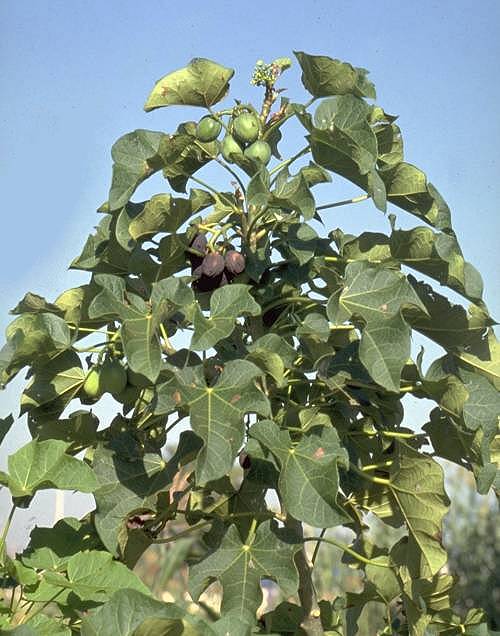 PurgenutJatropha curcas
-
 PeregrinaJatropha integerrima
-
 Bellyache-bushJatropha gossypiifolia
-
 Guatemalan RhubarbJatropha podagrica
-
 French PhysicnutJatropha multifida
-
 Berlander's NettlespurgeJatropha cathartica
- Moran’s LomboyJatropha moranii
-
 SibruJatropha unicostata
Compare
Questions and answers
What is the scientific name of the Leatherwood?
The scientific name of the Leatherwood is Jatropha dioica. Written with its author, the full name is Jatropha dioica Sessé.
Which family does the Leatherwood belong to?
Jatropha dioica belongs to the family Euphorbiaceae, in the order Malpighiales and the class Magnoliopsida.
Where is the Leatherwood found?
Checklists and occurrence records place Jatropha dioica in 2 countries: Mexico and United States.
What is the conservation status of the Leatherwood?
The IUCN Red List category recorded for Jatropha dioica is Least Concern (LC).
What is leatherwood?
Leatherwood is a flowering plant in the family Euphorbiaceae. It has arching, succulent stems, flexible enough to be tied into overhand knots without breaking.[1][3]
Where to plant leatherwood?
Leatherwood is sometimes cultivated as an ornamental plant in xeriscapes and rock gardens.[24]
Sources
Passages the profile rests on
- Jatropha dioica has arching, succulent stems with few branches. Source passage: “The arching, succulent stems reach a height of 20–60 cm and have few branches.” — English Wikipedia
- Its stems reach heights of 20–60 cm. Source passage: “The arching, succulent stems reach a height of 20–60 cm” — English Wikipedia
- Its stems are flexible enough to be tied into overhand knots without breaking. Source passage: “They are tough and sufficiently flexible to be tied into overhand knots without breaking.” — English Wikipedia
- Its orange rootstock spreads approximately 1 metre in length. Source passage: “The orange rootstock spreads to a length of around 1 m.” — English Wikipedia
- Its leaves are simple, alternately or fascicularly arranged, and clustered on short shoots. Source passage: “Leaves are arranged simply, alternately, or fascicularly and are clustered on short shoots extending from the stems.” — English Wikipedia
- The leaves have entire margins and are subsessile. Source passage: “They are subsessile and have entire margins.” — English Wikipedia
- Leaves of the nominate variety measure up to 6 cm long and 1 cm wide. Source passage: “The leaves of the nominate variety are linear and measure up to 6 × 1 cm” — English Wikipedia
- Leaves of Jatropha dioica var. graminea can have two or three lobes. Source passage: “whereas the leaves of J. dioica var. graminea may be 2 to 3-lobed” — English Wikipedia
- Leaves of Jatropha dioica var. graminea measure up to 6.5 cm long and 0.5 cm wide. Source passage: “measure up to 6.5 × 0.5 cm.” — English Wikipedia
- Male flowers occur in clustered cymes. Source passage: “Male inflorescences are clustered cymes.” — English Wikipedia
- Male flowers have sepals measuring 3.5 mm and petals measuring 5 mm. Source passage: “Their flowers possess 3.5 mm sepals, 5 mm petals, and 10 stamens.” — English Wikipedia
- Male flowers contain ten stamens. Source passage: “Their flowers possess 3.5 mm sepals, 5 mm petals, and 10 stamens.” — English Wikipedia
- Female flowers are urn-shaped and have recurved petal tips. Source passage: “Female flowers are urceolate with 5 mm petals that are recurved at the tips.” — English Wikipedia
- Its fruit is a capsule divided into one or two cells. Source passage: “The fruit is a 5 × 12 mm capsule divided into 1 to 2 cells.” — English Wikipedia
- Its capsules measure 5 × 12 mm. Source passage: “The fruit is a 5 × 12 mm capsule” — English Wikipedia
- Its seeds are approximately spherical. Source passage: “Seeds are subglobose” — English Wikipedia
- Its seeds measure approximately 1 × 1 cm. Source passage: “Seeds are subglobose and measure 1 × 1 cm.” — English Wikipedia
- Its latex changes from clear yellow to blood red when exposed to air. Source passage: “It changes from clear-yellow to blood red as it is exposed to air” — English Wikipedia
- Its latex is produced by a non-articulated laticifer network consisting of five to seven cells. Source passage: “Latex is produced by a non-articulated laticifer network composed of 5 to 7 cells.” — English Wikipedia
- The species forms colonies from underground rhizomes. Source passage: “Jatropha dioica forms colonies from subterranean rhizomes.” — English Wikipedia
- The species is traditionally used to treat gingivitis, loose teeth, bleeding gums, and toothache. Source passage: “Jatropha dioica is traditionally used in the treatment of dental issues such as gingivitis, loose teeth, bleeding gums, and toothache.” — English Wikipedia
- Its latex is used as an astringent. Source passage: “The latex is an astringent” — English Wikipedia
- Its latex can be used as a red dye. Source passage: “may also be used as a red dye.” — English Wikipedia
- The species is sometimes cultivated as an ornamental plant in xeriscapes and rock gardens. Source passage: “Leatherstem is sometimes cultivated as an ornamental in xeriscapes or rock gardens.” — English Wikipedia
- Its roots contain the diterpene riolozatrione (C20H26O3), which has antimicrobial properties. Source passage: “The roots contain riolozatrione (C20H26O3), a diterpene with antimicrobial properties.” — English Wikipedia
- White-winged doves consume the seeds of this species. Source passage: “The seeds are eaten by white-winged doves (Zenaida asiatica).” — English Wikipedia
- The species has separate male and female plants. Source passage: “The specific name refers to the dioecious nature of the plants.” — English Wikipedia
- The species produces flowers during spring and early summer. Source passage: “Blooming takes place during the spring and early summer.” — English Wikipedia
Data
- Catalogue of Life, 2026-10-16 XR cc by
- Global Biodiversity Information Facility CC BY 4.0
- Wikidata CC0
- GeoNames CC BY 4.0
- Wikimedia Commons per image; credit shown with each image
- Within the Catalogue of Life, this name comes from Synonymic Checklists of the Vascular Plants of the World cc by
References
- Sessé. (1794). Gaz. Lit. México 3(Suppl.): 4 (2 July 1794). where the name was published
This species in other databases
- Catalogue of Life 3QN8F
- Wikidata Q12060859
- iNaturalist 164239
- World Flora Online wfo-0000219593
- GRIN 400552
Page built on 27 November 2026. See how the catalog is made and all sources and licences.
Cite this page
ScientificNames.org. (2026). Jatropha dioica (Leatherwood). Retrieved November 27, 2026, from https://scientificnames.org/species/jatropha-dioica
“Jatropha dioica (Leatherwood).” ScientificNames.org, 2026, scientificnames.org/species/jatropha-dioica. Accessed 27 Nov. 2026.
ScientificNames.org. “Jatropha dioica (Leatherwood).” Accessed November 27, 2026. https://scientificnames.org/species/jatropha-dioica.
@misc{scientificnames_jatropha_dioica_leatherwood,
  author = {{ScientificNames.org}},
  title = {Jatropha dioica (Leatherwood)},
  year = {2026},
  url = {https://scientificnames.org/species/jatropha-dioica},
  note = {Accessed 2026-11-27}
}