Species · Reptiles
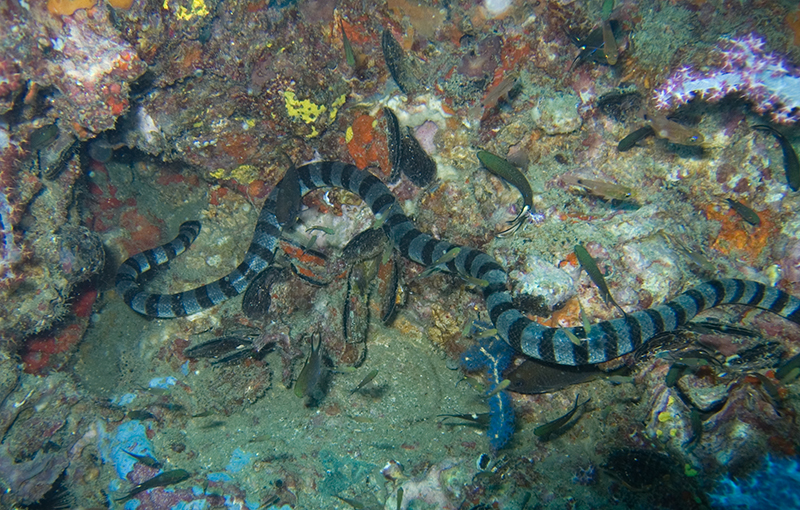
Black-banded Sea Krait Laticauda semifasciata
The scientific name of the Black-banded Sea Krait is Laticauda semifasciata. It is a species of reptile in the family Elapidae (cobras), order Squamata. The name dates from 1837.
- Scientific name
- Laticauda semifasciata (Reinwardt, 1837)
- Common name
- Black-banded Sea Krait
- Genus
- Laticauda
- Family
- Elapidae (Cobras)
- Order
- Squamata
- Class
- Reptilia
- Red List category
- NT Near Threatened
- Environment
- marine
- Recorded in
- 11 countries
- Name status
- accepted in the Catalogue of Life

Overview
The black-banded sea krait (Laticauda semifasciata), also known commonly as the Chinese sea snake or erabu, is a largely amphibious species of extremely venomous marine reptile in the subfamily Laticaudinae, family Elapidae (cobras, mambas, coralsnakes and their kin). It is found in much of the western Pacific Ocean and some of the Sea of Japan.
Classification of the Black-banded Sea Krait
| Kingdom | Animalia |
|---|---|
| Phylum | Chordata |
| Subphylum | Vertebrata |
| Infraphylum | Gnathostomata |
| Parvphylum | Osteichthyes |
| Megaclass | Tetrapoda |
| Class | Reptilia (Reptile) |
| Order | Squamata (Snakes) |
| Suborder | Serpentes (Snakes) |
| Infraorder | Alethinophidia |
| Family | Elapidae (Cobras) |
| Subfamily | Hydrophiinae |
| Genus | Laticauda (Sea Krait) |
| Species | Laticauda semifasciata (Reinwardt, 1837) |
Where the Black-banded Sea Krait is found
Checklists and occurrence records place Laticauda semifasciata in 11 countries across Asia. GBIF holds 1,076 georeferenced records of it.
Countries
- China 3
- India 8
- Indonesia 51
- Japan 348
- Pakistan 8
- Panama 423
- Philippines 131
- South Korea 8
- Sri Lanka 6
- Taiwan 81
- Thailand 9
Regions and cities with the most records
- Ishigaki, Japan 30
- Okinawa, Japan 21
- Gushikawa, Japan 15
- Uruma, Japan 15
- Okinawa, Japan 14
- Urasoe, Japan 14
- Ginowan, Japan 13
- Naha, Japan 13
- Tomigusuku, Japan 12
- Veraguas Province, Panama 12
- Itoman, Japan 10
- Kagoshima, Japan 10
- Nago, Japan 10
- Chiriquí Province, Panama 7
- Dumaguete, Philippines 6
- Miyakojima, Japan 6
- Taiwan, Taiwan 6
- Chennai, India 3
- Madhavaram, India 3
- Seogwipo, South Korea 3
- Tamil Nadu, India 3
- Tiruvottiyūr, India 3
11 more countries have a few records outside this range
These countries hold a few records of Laticauda semifasciata but lie outside the range the checklists give for it. Such records are often zoo or garden specimens, museum material or vagrants, so the species is not counted as occurring there.
Range as the checklists state it
South Chinese Sea (coasts of Fujian, Liaoning, Taiwan; China), South Korea,
A number beside a place is its count of GBIF occurrence records. A place without a number comes from a checklist alone. Records show where a species has been observed or collected, which can include escapes and vagrants.
Common names
English
- Black-banded Sea Krait
- Chinese Sea Krait
- Chinese Sea Snake
Names in 9 other languages
- Chinese
- 半环扁尾海蛇, 半環扁尾海蛇, 闊帶青斑海蛇
- Czech
- vlnožil velký
- French
- Erabu, Plature semi-annelé, Serpent de mer de Chine, Tricot rayé asiatique
- German
- Halbgebänderter Plattschwanz
- Italian
- Krait di mare cinese, Krait di mare fasciato, Serpente di mare cinese, Serpente di mare fasciato
- Japanese
- エラブウミヘビ
- Korean
- 넓은띠큰바다뱀
- Polish
- wiosłogon prążkowany
- Russian
- Большой морской крайт, Большой плоскохвост, Морской крайт
Synonyms
5 other scientific names have been used for this species and are now treated as synonyms of Laticauda semifasciata.
- Pelamis platurus , Leviton, Brown, and Siler, 2014
- Platurus fasciatus var. semifasciata Fischer, 1856:30
- Platurus semifasciatus Reinwardt ex Schlegel, 1837
- Pseudolaticauda semifasciata Reinwardt, 1837
- Pseudolaticauda semifasciata Kharin, 1984
Related species
-
 Yellow-lipped Sea KraitLaticauda colubrina
-
 Blue-lipped Sea KraitLaticauda laticaudata
-
 New Caledonian Sea KraitLaticauda saintgironsi
- Flat-tail Sea SnakeLaticauda guineai
- Yellow-lipped Sea SnakeLaticauda frontalis
- Crocker's Sea SnakeLaticauda crockeri
- Flat-tail Sea SnakeLaticauda schistorhyncha
-
 King CobraOphiophagus hannah
Compare
Questions and answers
What is the scientific name of the Black-banded Sea Krait?
The scientific name of the Black-banded Sea Krait is Laticauda semifasciata. Written with its author, the full name is Laticauda semifasciata (Reinwardt, 1837).
Which family does the Black-banded Sea Krait belong to?
Laticauda semifasciata belongs to the family Elapidae, in the order Squamata and the class Reptilia.
Where is the Black-banded Sea Krait found?
Checklists and occurrence records place Laticauda semifasciata in 11 countries, including Panama, Japan, Philippines, Taiwan, Indonesia and Thailand.
What is the conservation status of the Black-banded Sea Krait?
The IUCN Red List category recorded for Laticauda semifasciata is Near Threatened (NT).
What other names does the Black-banded Sea Krait have?
Laticauda semifasciata is also known in English as Chinese Sea Krait and Chinese Sea Snake.
Sources
Data
- Catalogue of Life, 2026-10-16 XR cc by
- Global Biodiversity Information Facility CC BY 4.0
- Wikidata CC0
- English Wikipedia CC BY-SA 4.0
- GeoNames CC BY 4.0
- Wikimedia Commons per image; credit shown with each image
- Within the Catalogue of Life, this name comes from The Reptile Database cc by
References
- Schlegel, 1837 where the name was published
- Schlegel, H. (1837). Essai sur la physionomie des serpens. Partie Descriptive. La Haye (J. Kips, J. HZ. Et W. P. Van Stockum), 606 S. + Xvi.
- Fischer, J. G. (1856). Die Familie der Seeschlangen. Abhandl. Nat. Ver. Hamburg 3: 1-78.
- Hallowell, E. (1861). Report upon the Reptilia of the North Pacific Exploring Expedition, under command of Capt. John Rogers, U. S. N. Proc. Acad. Nat. Sci. Philadelphia 12 [1860]: 480 - 510.
- Stejneger, LEONHARD H. (1907). Herpetology of Japan and adjacent territory. Bull. US Natl. Mus. 58: Xx, 1-577.
- Stejneger, L. (1910). The batrachians and reptiles of Formosa. Proc. US Natl. Mus. 38: 91-114.
- Van Denburgh, & John. (1924). On Laticauda schistorhynchus and Laticauda semifasciata. Proc. Cal. Acad. Sci. 13 (16): 247-248.
- Mertens, R. (1930). Die Amphibien und Reptilien der Inseln Bali, Lombok, Sumbawa und Flores. Senck. Naturf. Gesell., Frankfurt Am Main, Abhandl. 42(3): 117-344.
- Maki, M. (1931). Monograph of the Snakes of Japan. Dai-Ichi Shobo, Tokyo. (1), 7, 240 Pages (Expanded Edition 1933).
- Okada, Y. (1933). (Book review) Trimeresurus tokarensis and Laticauda semifasciata. Copeia 1933 (4): 227.
- Herre, Albert W. C. T. (1942). Notes on Philippine sea-snakes. Copeia 1942 (1): 7-9.
- Herre, Albert W. C. T.;Rabor, D. S. (1949). Notes on Philippine sea snakes of the genus Laticauda. Copeia 1949 (4): 282-284.
- Mays, C.E. & M.A. Nickerson. (1968). Notes on Shedding in the Sea Snake. Laticauda semifasciata (Reinwardt), in Captivity. Copeia 1968 (3): 619.
- Dunson, William A.;Minton, Sherman A. (1978). Diversity, distribution, and Ecology of Philippine Marine Snakes (Reptilia, Serpentes). Journal of Herpetology 12 (3): 281-286.
- Cadle, John E.;Gorman, George C. (1981). Albumin immunological evidence and the relationships of sea snakes. Journal of Herpetology 15 (3): 329-334.
- Mori, M. (1982). Japans Schlangen, Vols. 1-3 (80, 102, 123 pp.). Tokyo (Igaku-Shoin Ltd.) [Bilingual Edition in German and Japanese].
- Kharin V E. (1984). Revision of sea snakes of subfamily Laticaudinae Cope, 1879 sensu lato (Serpentes, Hydrophiidae). Trudy Zoologicheskogo Instituta 124: 128-139.
- Buth, D.G., R.W. Murphy, M.M. Miyamoto & C.S. Lieb. (1985). Creatine kinases of amphibians and reptiles: evolutionary and systematic aspects of gene expression. Copeia 1985 (2): 279-284.
- Tu, M.C., S.C. Fong & K.Y. Lue. (1990). Reproductive Biology of the Sea Snake, Laticauda semifasciata, in Taiwan. Journal of Herpetology 24 (2): 119-126.
- Goris, R. C., & Maeda, N. (2004). Guide to the Amphibians and Reptiles of Japan. Krieger, Malabar, 285 Pp.
- Zhao, E. M. (2006). The snakes of China [in Chinese]. Hefei, China, Anhui Sience & Technology Publ. House, Vol. I, 372 Pp., Vol. II (Color Plates), 280 Pp.
- Kharin, Vladimir E. and Vladimir P. Czeblukov. (2006). A New Revision of Sea Kraits of Family Laticaudidae Cope, 1879 (Serpentes: Colubroidea). Russ. J. Herpetol. 13 (3): 227-241.
- Kharin, V. E. (2008). Biota of the Russian Waters of the Sea of Japan Vol. 7 - Reptilians [in English and Russian]. Vladivostok, Dalnauka, 170 Pp.
- Kharin, Vladimir E.; Jakob Hallermann. (2009). Annotated catalogue of sea kraits (Laticaudidae) and sea snakes (Hydrophiidae) of the herpetological collection of the Zoological Museum, University of Hamburg. Mitt. Hamb. Zool. Mus. Inst. 106: 51-67.
- Kharin, V. E., & Hallermann, J. (2009). Distribution of a Little-Known Sea Krait Pseudolaticauda schistorhynchus (Günther, 1874) (Serpentes: Laticaudidae). Russian Journal of Marine Biology 35 (5): 437–440.
This species in other databases
- Catalogue of Life 3SLB3
- Wikidata Q2372555
- iNaturalist 35237
- WoRMS urn:lsid:marinespecies.org:taxname:1393155
- ITIS 700566
Page built on 25 November 2026. See how the catalog is made and all sources and licences.
Cite this page
ScientificNames.org. (2026). Laticauda semifasciata (Black-banded Sea Krait). Retrieved November 25, 2026, from https://scientificnames.org/species/laticauda-semifasciata
“Laticauda semifasciata (Black-banded Sea Krait).” ScientificNames.org, 2026, scientificnames.org/species/laticauda-semifasciata. Accessed 25 Nov. 2026.
ScientificNames.org. “Laticauda semifasciata (Black-banded Sea Krait).” Accessed November 25, 2026. https://scientificnames.org/species/laticauda-semifasciata.
@misc{scientificnames_laticauda_semifasciata_black_banded_sea_krait,
  author = {{ScientificNames.org}},
  title = {Laticauda semifasciata (Black-banded Sea Krait)},
  year = {2026},
  url = {https://scientificnames.org/species/laticauda-semifasciata},
  note = {Accessed 2026-11-25}
}