Species · Reptiles
King Cobra Ophiophagus hannah
The scientific name of the King Cobra is Ophiophagus hannah. It is a species of reptile in the family Elapidae (cobras), order Squamata. The name dates from 1836.
- Scientific name
- Ophiophagus hannah (Cantor, 1836)
- Common name
- King Cobra
- Genus
- Ophiophagus
- Family
- Elapidae (Cobras)
- Order
- Squamata
- Class
- Reptilia
- Red List category
- VU Vulnerable
- Recorded in
- 15 countries
- Name status
- accepted in the Catalogue of Life

Overview
Ophiophagus hannah primarily preys on other snakes and lizards.
Written 24 November 2026 from the sources listed below. Each statement was checked against the passage it cites; statements that could not be supported were removed.
Appearance
The head has 15 drab-coloured shields edged in black. The muzzle is rounded, the tongue is black, and the eyes have golden irises and round pupils.[1][2][3]
The oval hood has olive-green smooth scales and two black spots between the lowest scales.[4]
Juveniles are black with white, yellow, or buff chevron-shaped bars pointing toward the head.[5]
Adults typically measure 3.18–4 metres in length. The longest recorded King Cobra measured 5.85 metres.[6][7]
Hatchlings measure between 37.5 and 58.5 centimetres in length.[8]
Male King Cobras captured in Kerala measured up to 3.75 metres and weighed up to 10 kilograms. Females captured in Kerala measured up to 2.75 metres and weighed up to 5 kilograms.[9][10]
Habitat
The species occurs in tropical Asian habitats at elevations reaching 2,000 metres.[11]
King Cobras occur in India, southern Nepal, Bhutan, Bangladesh, Myanmar, China, Cambodia, Thailand, Laos, and Vietnam. Their documented maritime Southeast Asian range includes Malaysia, Singapore, Indonesia, and the Philippines.[12][13]
King Cobras have also been recorded on Baratang Island in the Great Andaman chain.[14]
Diet
King Cobras primarily prey on other snakes and lizards. Recorded snake prey includes Indian cobras, banded kraits, Oriental rat snakes, and reticulated pythons.[15][16]
They also consume eggs and small mammals. Birds and other small vertebrates are sometimes eaten when food is scarce.[17][18]
King Cobras have been documented eating other King Cobras.[19]
Behaviour
King Cobras are primarily active during daylight hours. They generally avoid humans and retreat when disturbed.[20][21]
When threatened, they raise their front bodies, spread their hoods, display their fangs, and hiss. They can move forward and strike while keeping their bodies raised.[22][23]
King Cobras can deliver multiple bites during a single attack.[24]
After consuming a large prey animal, they may remain without another meal for several months.[25]
Male King Cobras fight one another for access to females during breeding season.[26]
Reproduction and life cycle
King Cobras usually breed between January and April. Females remain gravid for 50–59 days.[27][28]
They construct nests from dry leaf litter between late March and late May. Nests can reach 55 centimetres in central height and 140 centimetres in basal width.[29][30]
Clutch sizes range from 7 to 43 eggs. Eggs hatch after an incubation period of 66–105 days.[31][32]
Female King Cobras guard their eggs while males remain close to the nest. Females remain near their nests for 2–77 days.[33][34]
King Cobras can reproduce through facultative parthenogenesis.[35]
Conservation
The King Cobra has been classified as Vulnerable on the IUCN Red List since 2010.[36]
Habitat destruction and persecution by humans threaten King Cobra populations. They are harvested for their skins, meat, and medicinal uses and collected for the international pet trade.[37][38]
Uses
King Cobras are displayed as attractions in large zoo terrariums. They have historically been used by snake charmers in South Asia.[39][40]
The common name hamadryad was particularly used for the King Cobra in older literature.[41]
The genus name Ophiophagus refers to the King Cobra's tendency to eat snakes.[42]
The King Cobra is regarded as India's national reptile.[43]
Similar species
The King Cobra is not phylogenetically a true cobra despite its common name and physical resemblance.[44]
Classification of the King Cobra
| Kingdom | Animalia |
|---|---|
| Phylum | Chordata |
| Subphylum | Vertebrata |
| Infraphylum | Gnathostomata |
| Parvphylum | Osteichthyes |
| Megaclass | Tetrapoda |
| Class | Reptilia (Reptile) |
| Order | Squamata (Snakes) |
| Suborder | Serpentes (Snakes) |
| Infraorder | Alethinophidia |
| Family | Elapidae (Cobras) |
| Genus | Ophiophagus (King Cobra) |
| Species | Ophiophagus hannah (Cantor, 1836) |
Origin of the name. Etymology The source of the epithet hannah was not mentioned by Cantor (1836, 1838). More recently, Adler (2016) argued the same to be an eponym for Hannah Sarah Wallich (1820 - 1893), eldest daughter of Cantor's host and uncle, the celebrated botanist (and physician), Nathaniel Wallich (1786 - 1854), during his time in Calcutta, and at the time of description of the species.
Where the King Cobra is found
Checklists and occurrence records place Ophiophagus hannah in 15 countries across Asia. GBIF holds 1,172 georeferenced records of it.
Countries
- Bangladesh 10
- Bhutan 16
- Cambodia 10
- China 103
- Hong Kong 55
- India 560
- Indonesia 55
- Laos 6
- Malaysia 39
- Myanmar 27
- Nepal 25
- Philippines 44
- Singapore 8
- Thailand 154
- Vietnam 60
Regions and cities with the most records
- Karnataka, India 398
- Guangdong, China 40
- Tsing Yi Town, Hong Kong 36
- Pok Fu Lam, Hong Kong 35
- Tai Po, Hong Kong 34
- Tuen Mun, Hong Kong 34
- Tsuen Wan, Hong Kong 33
- Victoria, Hong Kong 33
- Kwai Chung, Hong Kong 32
- Mei Foo, Hong Kong 32
- Nam Cheong, Hong Kong 32
- Sham Shui Po, Hong Kong 32
- Sha Tin, Hong Kong 31
- Wong Tai Sin, Hong Kong 31
- Hong Kong, Hong Kong 30
- Kowloon City, Hong Kong 30
- Ma On Shan, Hong Kong 30
- Mong Kok, Hong Kong 30
- Sha Tin Wai, Hong Kong 30
- Wan Chai, Hong Kong 30
- Fanling, Hong Kong 29
- Sau Mau Ping, Hong Kong 29
- Siu Lek Yuen, Hong Kong 29
- Tseung Kwan O, Hong Kong 29
- Shap Pat Heung, Hong Kong 28
- Yuen Long San Hui, Hong Kong 27
- Tiu Keng Leng, Hong Kong 25
- Yuen Long, Hong Kong 25
- Yuen Long Kau Hui, Hong Kong 25
- Aberdeen, Hong Kong 24
- Phetchaburi, Thailand 24
- San Tung Chung Hang, Hong Kong 24
- Tung Chung, Hong Kong 24
- Ping Shan, Hong Kong 23
- Tin Shui Wai, Hong Kong 22
- Shenzhen City Centre, China 21
2 more countries have a few records outside this range
These countries hold a few records of Ophiophagus hannah but lie outside the range the checklists give for it. Such records are often zoo or garden specimens, museum material or vagrants, so the species is not counted as occurring there.
Range as the checklists state it
Bangladesh, Myanmar (= Burma), Cambodia, China (Fukien, Kwangtung, Hong Kong, Kwangsi, Hainan, Yunnan, SW Sichuan, SE Xizang = Tibet, Fujian, Hunan), India (Assam, Tripura, Meghalaya, Arunachal Pradesh [A. Captain, pers. Comm.], Sikkim, West Bengal, Bihar, Orissa = Odisha, Andhra Pradesh, Madhya Pradesh, Mizoram, Andaman Islands), Nepal, Bhutan, Laos, Thailand, Vietnam (Hoa Binh, Yen Bai etc.).
A number beside a place is its count of GBIF occurrence records. A place without a number comes from a checklist alone. Records show where a species has been observed or collected, which can include escapes and vagrants.
Common names
English
- King Cobra
- Hamadryad
- Northern King Cobra
- Tu Mama E Maraka
Names in 62 other languages
- Afrikaans
- Koningkobra
- Arabic
- ملك الكوبرا
- Azerbaijani
- Kral kobrası
- Basque
- Errege-kobra
- Belarusian
- Каралеўская кобра
- Bengali
- কিং কোবরা, পদ্ম গোখরা, রাজ গোখরা, শঙ্খচূড়, ৰাজফেঁটী সাপ
- Bulgarian
- кралска кобра
- Burmese
- Gnan Gnan Bȏk
- Catalan
- cobra reial
- Chinese
- 眼鏡王蛇屬, 眼镜王蛇
- Croatian
- Kraljevska kobra
- Czech
- kobra královská
- Dutch
- koningscobra
- Estonian
- Kuningkobra
- Finnish
- Kuningaskobra
- French
- Cobra royal
- Georgian
- სამეფო კობრა
- German
- Königskobra, Nördliche Königskobra
- Hebrew
- קוברה מלכותית, רב-פתן מלכותי
- Hungarian
- királykobra
- Icelandic
- Konungskóbra
- Indonesian
- Ular anang, Ular lanang
- Irish
- Rí-chobra
- Italian
- Cobra reale
- Japanese
- キングコブラ
- Kannada
- ಕಾಳಿಂಗ ಸರ್ಪ, ಕಾಳಿಂಗ ಸರ್ಪೆ
- Kazakh
- Кеңалқым патша жылан, Патша кеңалқым жылан
- Khmer
- ពស់វែករនាម
- Korean
- 킹코브라
- Latvian
- karaliskā kobra
- Lithuanian
- Karališkoji kobra, Karališkosios kobros
- Malay
- Ular Tedung Selar
- Malayalam
- രാജവെമ്പാല
- Marathi
- गिम, दिवड नागीण, नागराज, वडलो
- Mongolian
- Хаан кобра, Хаан наж могой
- Nepali
- Kenwata, राज गोमन
- Norwegian Bokmål
- Kongekobra
- Persian
- شاه کبرا
- Polish
- Kobra królewska
- Portuguese
- Cobra-real
- Romanian
- Cobra regală
- Russian
- Гамадриад, Королевская кобра, Королевские кобры
- Serbian
- Краљевска кобра
- Slovak
- Kobra kráľovská, Okuliarnik kráľovský
- Slovenian
- Kraljeva kobra
- Spanish
- Cobra real
- Swedish
- Kungskobra, Kungskobran
- Tamil
- இராச நாகம், இராஜ நாகம், கருநாகம்
- Telugu
- కింగ్ కోబ్రా, నల్ల త్రాచు, రాచనాగు
- Thai
- งูจงอาง, จงอาง
- Turkish
- Kral kobra
- Ukrainian
- Королівська кобра
- Vietnamese
- Rắn hổ chúa, Rắn hổ chúa phương Bắc, Rắn hổ mang chúa, Rắn hổ mây
- jav
- Lanang, Ula anang
- ory
- ଅହିରାଜ
- pnb
- کنگ کوبرا
- san
- काळिङ्गसर्प
- snd
- جھوڙ نانگ
- srn
- Kownukronsneki
- sun
- Totog
- war
- Banakon
- yue
- 眼鏡王蛇, 过山峰(過山峰)、过山风(過山風)
Synonyms
17 other scientific names have been used for this species and are now treated as synonyms of Ophiophagus hannah.
- Dendraspis hannah (Cantor, 1836)
- Dendraspis hannah borneensis Deraniyagala, 1960
- Dendraspis hannah brunnea Deraniyagala, 1961
- Dendraspis hannah bungarus Deraniyagala, 1960
- Dendraspis hannah elaps Deraniyagala, 1960
- Dendraspis hannah nordicus Deraniyagala, 1961
- Dendraspis hannah sinensis Deraniyagala, 1960
- Dendraspis hannah vittata Deraniyagala, 1960
- Hamadryas elaps Günther, 1858
- Hamadryas hannah Cantor, 1836
- Hamadryas ophiophagus Cantor, 1838
- Naia vittata Elliot, 1840
- Naja hannah Taylor, 1922
- Naja hannah (Cantor, 1836)
- Naja vittata Elliott, 1840
- Ophiophagus elaps (Günther, 1858)
- Dendraspis bungarus Fitzinger, 1843 ambiguous synonym
Related species
- Sunda King CobraOphiophagus bungarus
- Western Ghats King CobraOphiophagus kaalinga
- Luzon King CobraOphiophagus salvatana
-
 Inland TaipanOxyuranus microlepidotus
-
 Black MambaDendroaspis polylepis
-
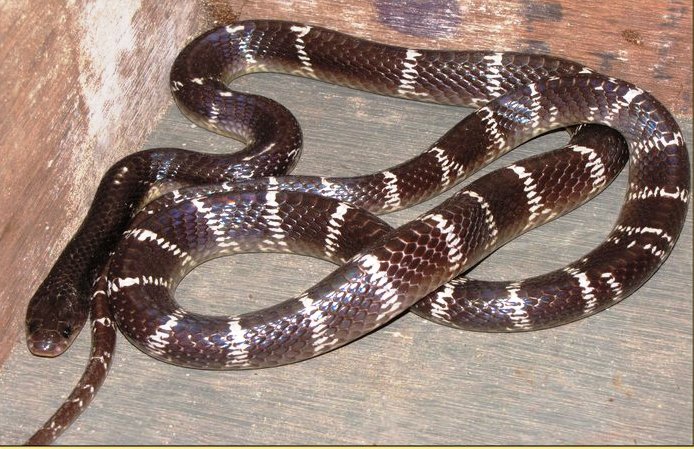 Common KraitBungarus caeruleus
-
 Eastern Brown SnakePseudonaja textilis
-
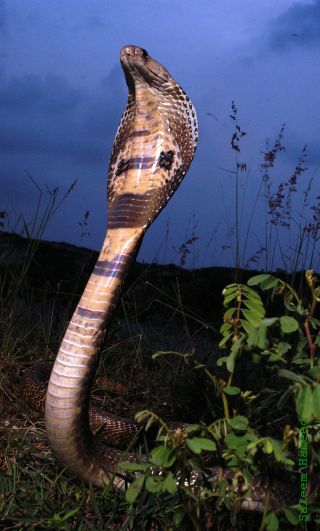 Indian CobraNaja naja
Compare
Questions and answers
What is the scientific name of the King Cobra?
The scientific name of the King Cobra is Ophiophagus hannah. Written with its author, the full name is Ophiophagus hannah (Cantor, 1836).
Which family does the King Cobra belong to?
Ophiophagus hannah belongs to the family Elapidae, in the order Squamata and the class Reptilia.
Where is the King Cobra found?
Checklists and occurrence records place Ophiophagus hannah in 15 countries, including India, Thailand, China, Vietnam, Hong Kong and Indonesia.
What is the conservation status of the King Cobra?
The IUCN Red List category recorded for Ophiophagus hannah is Vulnerable (VU).
What other names does the King Cobra have?
Ophiophagus hannah is also known in English as Hamadryad, Northern King Cobra and Tu Mama E Maraka.
Sources
Passages the profile rests on
- The head has 15 drab-coloured shields edged in black. Source passage: “The head is covered by 15 drab-coloured and black-edged shields” — English Wikipedia
- The king cobra has a rounded muzzle and a black tongue. Source passage: “The muzzle is rounded, and the tongue black.” — English Wikipedia
- Its eyes have golden irises and round pupils. Source passage: “The large eyes have a golden iris and round pupils.” — English Wikipedia
- Its oval hood has olive-green smooth scales and two black spots between the lowest scales. Source passage: “Its hood is oval shaped and covered with olive green smooth scales and two black spots between the two lowest scales.” — English Wikipedia
- Juveniles are black with white, yellow, or buff chevron-shaped bars pointing toward the head. Source passage: “Juveniles are black with chevron shaped white, yellow or buff bars that point towards the head.” — English Wikipedia
- Adult king cobras typically measure 3.18–4 metres in length. Source passage: “Adult king cobras are 3.18 to 4 m (10.4 to 13.1 ft) long.” — English Wikipedia
- The longest recorded king cobra measured 5.85 metres. Source passage: “The longest known individual measured 5.85 m (19.2 ft).” — English Wikipedia
- Hatchlings measure between 37.5 and 58.5 centimetres in length. Source passage: “Hatchlings are between 37.5 and 58.5 cm (14.8 and 23.0 in) long” — English Wikipedia
- Male king cobras captured in Kerala measured up to 3.75 metres and weighed up to 10 kilograms. Source passage: “Males captured in Kerala measured up to 3.75 m (12.3 ft) and weighed up to 10 kg (22 lb).” — English Wikipedia
- Female king cobras captured in Kerala measured up to 2.75 metres and weighed up to 5 kilograms. Source passage: “Females captured had a maximum length of 2.75 m (9 ft 0 in) and a weight of 5 kg (11 lb).” — English Wikipedia
- The species occurs in tropical Asian habitats at elevations reaching 2,000 metres. Source passage: “It occurs in elevations of 2,000 m (6,600 ft)” — English Wikipedia
- The species has been recorded in India, southern Nepal, Bhutan, Bangladesh, Myanmar, China, Cambodia, Thailand, Laos, and Vietnam. Source passage: “from the Terai in India and southern Nepal to the Brahmaputra River basin in Bhutan and northeast India, down to Bangladesh, Myanmar, southern China, Cambodia, Thailand, Laos, Vietnam” — English Wikipedia
- Its documented maritime Southeast Asian range includes Malaysia, Singapore, Indonesia, and the Philippines. Source passage: “to the maritime Southeast Asian countries of Malaysia, Singapore, Indonesia and the Philippines.” — English Wikipedia
- King cobras have been recorded on Baratang Island in the Great Andaman chain. Source passage: “It also occurs on Baratang Island in the Great Andaman chain.” — English Wikipedia
- King cobras primarily prey on other snakes and lizards. Source passage: “Its diet consists primarily of other snakes and lizards” — English Wikipedia
- Recorded snake prey includes Indian cobras, banded kraits, Oriental rat snakes, and reticulated pythons. Source passage: “Indian cobra, banded krait, Oriental rat snake, reticulated pythons” — English Wikipedia
- King cobras sometimes eat birds and other small vertebrates when food is scarce. Source passage: “When food is scarce, it also feeds on other small vertebrates, such as birds” — English Wikipedia
- King cobras also consume eggs and small mammals. Source passage: “They will also eat lizards, eggs, and small mammals.” — nationalgeographic.com
- King cobras have been documented eating other king cobras. Source passage: “Some have even been documented eating other king cobras.” — nationalgeographic.com
- King cobras are primarily active during daylight hours. Source passage: “It is considered diurnal because it hunts during the day” — English Wikipedia
- King cobras generally avoid humans and retreat when disturbed. Source passage: “It usually avoids humans and slinks off when disturbed” — English Wikipedia
- When threatened, king cobras raise their front bodies, spread their hoods, display their fangs, and hiss. Source passage: “When alarmed, it raises the front part of its body, extends the hood, shows the fangs and hisses loudly.” — English Wikipedia
- King cobras can move forward and strike while keeping their bodies raised. Source passage: “When in a threat display, these snakes can raise the anterior part of their body about one meter off the ground and are able to follow their enemy in this position over considerable distances.” — animaldiversity.org
- King cobras can deliver multiple bites during a single attack. Source passage: “It can deliver multiple bites in a single attack.” — English Wikipedia
- King cobras may remain without another meal for several months after consuming a large prey animal. Source passage: “After a large meal, it may go for many months without another one because of its slow metabolic rate.” — English Wikipedia
- Male king cobras fight one another for access to females during breeding season. Source passage: “King cobras are known to fight other males to win the attention of females during breeding season.” — nationalgeographic.com
- Female king cobras remain gravid for 50–59 days. Source passage: “The female is gravid for 50 to 59 days.” — English Wikipedia
- King cobras usually breed between January and April. Source passage: “Breeding usually occurs from January through April.” — animaldiversity.org
- King cobras construct nests from dry leaf litter between late March and late May. Source passage: “The king cobra is the only snake that builds a nest using dry leaf litter, starting from late March to late May.” — English Wikipedia
- King cobra nests can reach 55 centimetres in central height and 140 centimetres in basal width. Source passage: “are up to 55 cm (22 in) high in the centre and 140 cm (55 in) wide at the base.” — English Wikipedia
- King cobra clutch sizes range from 7 to 43 eggs. Source passage: “Clutch size ranges from 7 to 43 eggs” — English Wikipedia
- King cobra eggs hatch after an incubation period of 66–105 days. Source passage: “after incubation periods of 66 to 105 days.” — English Wikipedia
- Female king cobras remain near their nests for 2–77 days. Source passage: “Females stay by their nests between two and 77 days.” — English Wikipedia
- Female king cobras guard their eggs while males remain close to the nest. Source passage: “The female remains on top of the nest to guard the eggs, and the male also remains close by.” — animaldiversity.org
- King cobras can reproduce through facultative parthenogenesis. Source passage: “The king cobra was shown to be capable of facultative parthenogenesis.” — English Wikipedia
- The king cobra has been classified as Vulnerable on the IUCN Red List since 2010. Source passage: “it has been listed as Vulnerable on the IUCN Red List since 2010.” — English Wikipedia
- Habitat destruction and persecution by humans threaten king cobra populations. Source passage: “King Cobras, as well as all snakes, are threatened from the destruction of their habitats, and by persecution by humans afraid of them” — animaldiversity.org
- King cobras are harvested for their skins, meat, and medicinal uses and are collected for the international pet trade. Source passage: “they are also harvested in large numbers for skin, food, and medicinal purposes. They are also collected for the international pet trade.” — nationalgeographic.com
- King cobras are displayed as attractions in large zoo terrariums. Source passage: “King Cobras are among the most attractive highlights in large display terrariums at zoos.” — animaldiversity.org
- King cobras have historically been used by snake charmers in South Asia. Source passage: “King cobras may be best known as the snake of choice for the snake charmers of South Asia.” — nationalgeographic.com
- The common name hamadryad was particularly used for the king cobra in older literature. Source passage: “The king cobra is also referred to by the common name "hamadryad", especially in older literature.” — English Wikipedia
- The genus name Ophiophagus refers to the king cobra's tendency to eat snakes. Source passage: “The name is derived from its propensity to eat snakes.” — English Wikipedia
- The king cobra is regarded as India's national reptile. Source passage: “Regarded as the national reptile of India” — English Wikipedia
- The king cobra is not phylogenetically a true cobra despite its common name and physical resemblance. Source passage: “it is not phylogenetically a true cobra despite its common name and some resemblance.” — English Wikipedia
Data
- Catalogue of Life, 2026-10-16 XR cc by
- Global Biodiversity Information Facility CC BY 4.0
- Wikidata CC0
- GeoNames CC BY 4.0
- Wikimedia Commons per image; credit shown with each image
- Within the Catalogue of Life, this name comes from The Reptile Database cc by
References
- CANTOR, THEODORE E. 1836. Sketch of an undescribed hooded serpent (Hamadryas hannah). Asiatic Researches 19: 87 - 93, 3 pls. [NB: Volume 19 of Asiatic Researches was published in 1836, and plates 1 through 9, associated with the pre-Cantor articles, bear imprint volume number XIX, yet the plates associated with Cantor's paper are imprinted " Vol. XX. " It is possible that Cantor's three plates were not printed with his article that appeared in vol. 19, and which likely appeared in the first half of 1836, but were included in vol. 20, which was opened later that same year. Asiatic Researches was first issued in 1788 as " Asiatic Researches; or, Transactions of the Society, instituted in Bengal, for enquiring into the History, the Antiquities, the Arts and Sciences, and Literature of Asia. Volume the First. " and printed in Calcutta by Manuel Cantopher. The first volume was reprinted in London and bears a date of 1798. Volume 19, part 1 was printed in Calcutta in 1836 by the Bengal Military Orphan Press, Calcutta under the name " Asiatic Researches ".] where the name was published
- Cantor, T. E. (1836). Sketch of undescribed hooded serpent with fangs and maxillar teeth. Asiat. Res., Calcutta, 19: 87-94.
- Cantor, T. E. (1838). A notice of the Hamadryas, a genus of hooded serpent with poisonous fangs and maxillary teeth. Proc. Zool. Soc. London 1838: 72-75.
- Theobald, & William. (1868). Catalogue of the reptiles of British Birma, embracing the provinces of Pegu, Martaban, and Tenasserim; with descriptions of new or little-known species. Zool. J. Linnean Soc. 10: 4-67.
- Anderson, J. (1871). On some Indian reptiles. Proc. Zool. Soc. London 1871: 149-211.
- Boulenger, George A. (1890). The Fauna of British India, Including Ceylon and Burma. Reptilia and Batrachia. Taylor & Francis, London, Xviii, 541 Pp.
- Boulenger, G. A. (1896). Catalogue of the snakes in the British Museum, Vol. 3. London (Taylor & Francis), Xiv + 727 Pp.
- Wall, F. (1906). The poisonous snakes of India and how to recognize them, Part II. J. Bombay Nat. Hist. Soc. 17: 299-334.
- Wall, F. (1908). Notes on a collection of snakes from the Khasi Hills, Assam. J. Bombay Nat. Hist. Soc. 18: 312-337.
- Wall, F. (1908). The poisonous terrestrial snakes of our British Indian dominions and how to recognise them, 2nd ed. Bombay, Bombay Natural History Society, 68 Pp.
- Parshad, B. (1913). Occurrence of a Naia bungarus (Schleg.) in the Punjab. J. Bombay Nat. Hist. Soc. 23: 585.
- Fenton, L. L. (1918). Note on the Hamadrayad or King Cobra (Naia bungarus) in North Kanara. J. Bombay Nat. Hist. Soc. 25: 151.
- Smith, M. A. (1923). The Poisonous Land Snakes of Siam. J. Nat. Hist. Soc. Siam 6: 55-64.
- Wall, & Frank. (1924). The hamadryad or king cobra, Naia hannah. (Cantor). J. Bombay Nat. Hist. Soc. 301: 189-195, 1 Plate.
- Mertens, R. (1930). Die Amphibien und Reptilien der Inseln Bali, Lombok, Sumbawa und Flores. Senck. Naturf. Gesell., Frankfurt Am Main, Abhandl. 42(3): 117-344.
- Smith, M. A. (1943). The Fauna of British India, Ceylon and Burma, Including the Whole of the Indo-Chinese Sub-Region. Reptilia and Amphibia. 3 (Serpentes). Taylor and Francis, London. 583 Pp.
- Tweedie, M. W. F. (1954). Notes on Malayan reptiles, No.3. Bull. Raffles Mus. No 25: 107-117.
- Deuve, J. (1961). Liste annotee des Serpents du Laos. Bull. Soc. Sci. Nat. Laos 1:5-32.
- Taylor, E. H. (1965). The serpents of Thailand and adjacent waters. Univ. Kansas Sci. Bull. 45 (9): 609-1096.
- Zhao, E., Liu, X., & Kang, S. (1986). Five snake species new to Sichuan [in Chinese]. Acta Herpetologica Sinica 5 (2): 157.
- Nanhoe, L.M.R., & Ouboter, P.E. (1987). The distribution of reptiles and amphibians in the Annapurna-Dhaulagiri region (Nepal). Zoologische Verhandelingen (240): 1-105.
- Bong Heang, & Kiew. (1987). An annotated checklist of the herpetofauna of Ulu Endau, Johore, Malaysia. Malayan Nature Journal 41 (2-3): 413-423.
- Dowling, H.G., & Jenner, J.V. (1988). Snakes of Burma: checklist of reported species and bibliography. Smithsonian Herp. Inf. Serv. (76): 19 Pp.
- Bauer A M, & Gunther R. (1992). A preliminary report on the reptile fauna of the Kingdom of Bhutan with the description of a new species of scincid lizard (Reptilia: Scincidae). Asiatic Herpetological Research 4: 23-36.
- Song, J.; Siong, Y.’ Wang, W. & Pu, X. (1993). A Study on the Purification and Pharmacological Properties of Two Neurotoxins from the Venom of the King Cobra (Ophiophagus Hannah). Asiatic Herpetological Research 5: 143-146.
This species in other databases
Page built on 24 November 2026. See how the catalog is made and all sources and licences.
Cite this page
ScientificNames.org. (2026). Ophiophagus hannah (King Cobra). Retrieved November 24, 2026, from https://scientificnames.org/species/ophiophagus-hannah
“Ophiophagus hannah (King Cobra).” ScientificNames.org, 2026, scientificnames.org/species/ophiophagus-hannah. Accessed 24 Nov. 2026.
ScientificNames.org. “Ophiophagus hannah (King Cobra).” Accessed November 24, 2026. https://scientificnames.org/species/ophiophagus-hannah.
@misc{scientificnames_ophiophagus_hannah_king_cobra,
  author = {{ScientificNames.org}},
  title = {Ophiophagus hannah (King Cobra)},
  year = {2026},
  url = {https://scientificnames.org/species/ophiophagus-hannah},
  note = {Accessed 2026-11-24}
}