Species · Flowering plants
Common Sunshine Conebush Leucadendron salignum
The scientific name of the Common Sunshine Conebush is Leucadendron salignum. It is a species of flowering plant in the family Proteaceae (protea family), order Proteales.
- Scientific name
- Leucadendron salignum P.J.Bergius
- Common name
- Common Sunshine Conebush
- Genus
- Leucadendron
- Family
- Proteaceae (Protea Family)
- Order
- Proteales
- Class
- Magnoliopsida
- Red List category
- LC Least Concern
- Recorded in
- 2 countries
- Name status
- accepted in the Catalogue of Life

Overview
Common Sunshine Conebush is an evergreen, stiff and upright shrub in the family Proteaceae. It occurs in the fynbos vegetation of South Africa, from sea level to approximately 2,000 metres. It survives wildfires by regrowing from an underground rootstock, and its winged seeds are released after fire.
Written 26 November 2026 from the sources listed below. Each statement was checked against the passage it cites; statements that could not be supported were removed.
Appearance
Common Sunshine Conebush is an evergreen, stiff and upright shrub with soft, silky hairs pressed against its branches. Its leathery leaves are oblong-linear or lance-shaped linear, with soft, silky hairs pressed against their surfaces.[1][2][3][4]
The shrub can reach a height of 2 metres. Its leaves measure 2.5–7.5 cm in length and approximately 3.25–6.5 mm in width.[5][6][7]
Male flower heads can be yellow or burgundy red and measure 8–19 cm in length. Inflorescences can be yellow or red.[8][9][10]
Young female flower heads are oblong to cylinder-shaped, and their involucral leaves are often ivory-coloured. Mature female flower heads are egg-shaped, measure approximately 2.5–3.25 cm in length and have bracts covered externally with densely matted woolly hairs.[11][12][13][14][15]
The fruits are elliptic, compressed and have a hairless, wrinkled surface. They are approximately 4 mm long.[16][17]
Habitat
Common Sunshine Conebush occurs in the fynbos vegetation of South Africa. It tolerates a wide range of soil types and occurs at elevations from sea level to approximately 2,000 metres.[18][19][20]
Behaviour
Common Sunshine Conebush survives wildfires by regrowing from an underground rootstock. Mature plants usually survive fires rather than dying.[21][22]
Winged seeds remain in the female plant's cones for many years. They are released after fire kills the above-ground biomass and are then dispersed by wind.[23][24][25]
Reproduction and life cycle
Common Sunshine Conebush is dioecious, with male and female flowers occurring on separate plants. Small beetles pollinate the flowers, including the sap beetle Pria cinerascens and the Adonis ladybird, Hippodamia variegata.[26][27][28][29]
The flowering season is reported as extending from April to November. A flowering season from May to December is also reported.[30][31]
Conservation
Common Sunshine Conebush has a conservation status of Least Concern.[32]
Uses
Common Sunshine Conebush is widely used for cut foliage production. It can adapt to different soil types when grown in gardens.[33][34]
The species tolerates frost down to −9 °C and regrows well after deep pruning.[35][36]
Similar species
DNA comparisons suggest that Leucadendron lanigerum may be the closest relative of Common Sunshine Conebush. Leucadendron flexuosum and Leucadendron discolor are also identified as relatives in a subsequent DNA-based grouping.[37][38]
Classification of the Common Sunshine Conebush
| Kingdom | Plantae |
|---|---|
| Subkingdom | Pteridobiotina |
| Phylum | Tracheophyta |
| Class | Magnoliopsida |
| Order | Proteales |
| Family | Proteaceae (Protea Family) |
| Subfamily | Proteoideae |
| Tribe | Leucadendreae |
| Subtribe | Leucadendrinae |
| Genus | Leucadendron |
| Species | Leucadendron salignum P.J.Bergius |
Where the Common Sunshine Conebush is found
Checklists and occurrence records place Leucadendron salignum in 2 countries across Africa and South America. GBIF holds 11,704 georeferenced records of it.
Countries where it is native or its origin is not stated
Countries where it has been introduced
Regions and cities with the most records
- Western Cape, South Africa 9,660
- Muizenberg, South Africa 1,993
- Retreat, South Africa 1,947
- Rondebosch, South Africa 1,633
- Cape Town, South Africa 1,605
- Eastern Cape, South Africa 1,044
- Grabouw, South Africa 915
- Stellenbosch, South Africa 913
- Somerset West, South Africa 855
- Paarl, South Africa 660
- Le Roux, South Africa 637
- Gqeberha, South Africa 605
- Franschhoek, South Africa 590
- Despatch, South Africa 589
- Hermanus, South Africa 566
- Wellington, South Africa 535
- Kuils River, South Africa 401
- Kraaifontein, South Africa 319
- George, South Africa 247
- Durbanville, South Africa 232
- Groot-Brakrivier, South Africa 229
- Knysna, South Africa 223
- Mossel Bay, South Africa 215
- Ceres, South Africa 195
- Motherwell, South Africa 154
- Bredasdorp, South Africa 151
- Atlantis, South Africa 149
- Caledon, South Africa 147
- Gansbaai, South Africa 147
- Plettenberg Bay, South Africa 127
- Swellendam, South Africa 127
- Malmesbury, South Africa 76
- Worcester, South Africa 76
- Kruisfontein, South Africa 67
- Northern Cape, South Africa 64
- Humansdorp, South Africa 62
2 more countries have a few records outside this range
These countries hold a few records of Leucadendron salignum but lie outside the range the checklists give for it. Such records are often zoo or garden specimens, museum material or vagrants, so the species is not counted as occurring there.
Range as the checklists state it
South Africa (W-Cape Prov., E-Cape Prov.); Colombia [I]
A number beside a place is its count of GBIF occurrence records. A place without a number comes from a checklist alone. Records show where a species has been observed or collected, which can include escapes and vagrants.
Common names
English
- Common Sunshine Conebush
- Kleinmond Spiderhead
Names in 1 other language
- Afrikaans
- Knoppiesgeelbos, geelbos
Synonyms
20 other scientific names have been used for this species and are now treated as synonyms of Leucadendron salignum.
- Euryspermum frondosum Knight
- Euryspermum humifusum Knight
- Euryspermum salignum (P.J.Bergius) Knight
- Leucadendron adscendens R.Br.
- Leucadendron cuspidatum Klotzsch ex Meisn.
- Leucadendron eriocladum Gand. & Schinz
- Leucadendron involucratum Meisn.
- Leucadendron salignum R.Br.
- Protea inflexa Willd.
- Protea involucrata Willd. ex Meisn.
- Protea stricta Don ex Steud.
- Serruria adscendens R.Br.
- Serruria adscendens var. adscendens
- Serruria frondosa Knight
- Leucadendron inflexum Link ambiguous synonym
- Leucadendron virgatum Drège ex Meisn. ambiguous synonym
- Protea conifera L. ambiguous synonym
- Protea diversifolia Willd. ambiguous synonym
- Protea pallens L. ambiguous synonym
- Protea saligna L. ambiguous synonym
Related species
-
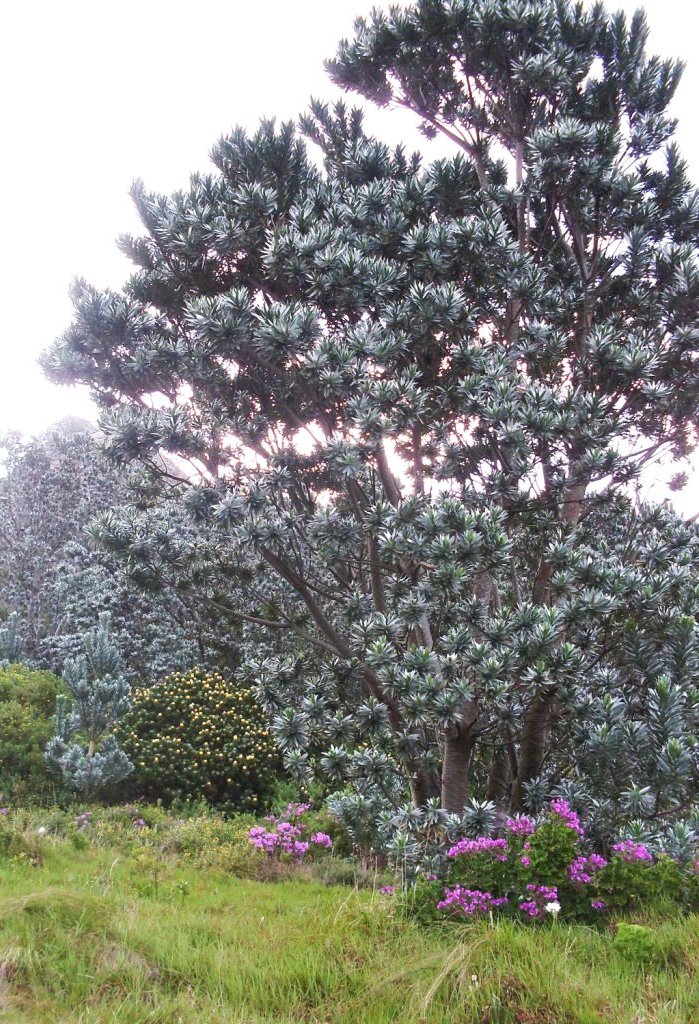 Silver TreeLeucadendron argenteum
-
 Piketberg ConebushLeucadendron discolor
-
 Spinning-top ConebushLeucadendron rubrum
-
 Golden SunshinebushLeucadendron laureolum
-
 Woolly ConebushLeucadendron sorocephalodes
-
 Mountain RoseLeucadendron strobilinum
-
 Grey ConebushLeucadendron pubescens
- Hairless ConebushLeucadendron galpinii
Compare
Questions and answers
What is the scientific name of the Common Sunshine Conebush?
The scientific name of the Common Sunshine Conebush is Leucadendron salignum. Written with its author, the full name is Leucadendron salignum P.J.Bergius.
Which family does the Common Sunshine Conebush belong to?
Leucadendron salignum belongs to the family Proteaceae, in the order Proteales and the class Magnoliopsida.
Where is the Common Sunshine Conebush found?
Checklists and occurrence records place Leucadendron salignum in 2 countries, including South Africa.
What is the conservation status of the Common Sunshine Conebush?
The IUCN Red List category recorded for Leucadendron salignum is Least Concern (LC).
What other names does the Common Sunshine Conebush have?
Leucadendron salignum is also known in English as Kleinmond Spiderhead.
Sources
Passages the profile rests on
- Leucadendron salignum is an evergreen, stiff and upright shrub. Source passage: “Leucadendron salignum is an evergreen, stiff, upright shrub” — English Wikipedia
- The shrub has soft, silky hairs pressed against its branches. Source passage: “with soft, silky hairs pressed against the branches” — English Wikipedia
- Its leathery leaves are oblong-linear or lance-shaped linear. Source passage: “Its rigid but rather thin leathery leaves are oblong linear or lance-shaped linear” — English Wikipedia
- The leaves have soft, silky hairs pressed against their surfaces. Source passage: “with soft, silky hairs pressed against the leaf surface” — English Wikipedia
- The shrub can reach a height of 2 metres. Source passage: “of up to 2 metres (6 ft 7 in) high” — English Wikipedia
- Its leaves measure 2.5–7.5 cm in length. Source passage: “2+1⁄2–7+1⁄2 cm (0.98–2.95 in) long” — English Wikipedia
- Its leaves measure approximately 3.25–6.5 mm in width. Source passage: “3+1⁄4–6+1⁄2 mm (0.13–0.26 in) wide” — English Wikipedia
- The male flower heads can be yellow or burgundy red. Source passage: “The male flower head may be yellow or burgundy red” — English Wikipedia
- The inflorescences can be yellow or red. Source passage: “Inflorescences can be either yellow or red.” — English Wikipedia
- Male flower heads measure 8–19 cm in length. Source passage: “8–19 cm (3.1–7.5 in) long” — English Wikipedia
- The young female flower head is oblong to cylinder-shaped. Source passage: “The young female flower head is oblong to cylinder-shaped” — English Wikipedia
- The involucral leaves of young female flower heads are often ivory-coloured. Source passage: “The involucral leaves are often ivory in colour” — English Wikipedia
- The mature female flower head is egg-shaped. Source passage: “The mature female head is egg-shaped” — English Wikipedia
- The mature female flower head has bracts covered externally with densely matted woolly hairs. Source passage: “The mature bracts are covered with densely matted woolly hairs on the outside.” — English Wikipedia
- The mature female flower head measures approximately 2.5–3.25 cm in length. Source passage: “2+1⁄2–3+1⁄4 cm (0.98–1.28 in) long” — English Wikipedia
- Its fruits are elliptic, compressed and have a hairless, wrinkled surface. Source passage: “The fruits are elliptic, about 4 mm (0.16 in) long, compressed, with a hairless and wrinkled surface.” — English Wikipedia
- The fruits are approximately 4 mm long. Source passage: “The fruits are elliptic, about 4 mm (0.16 in) long” — English Wikipedia
- The species occurs in the fynbos vegetation of South Africa. Source passage: “in the fynbos, where it occurs” — English Wikipedia
- It tolerates a wide range of soil types. Source passage: “It copes with a wide range of soil types” — English Wikipedia
- The species occurs at elevations ranging from sea level to approximately 2,000 metres. Source passage: “can be found from sea level to about 2,000 metres (6,600 ft) altitude.” — English Wikipedia
- The species survives wildfires by regrowing from an underground rootstock. Source passage: “It survives the wildfires that occur every one or two decades in the fynbos, where it occurs, by regrowing from an underground rootstock.” — English Wikipedia
- Mature plants usually survive fires rather than dying. Source passage: “The mature plants usually do not die, but regrow from the underground rootstock.” — English Wikipedia
- The winged seeds remain in the female plant's cones for many years. Source passage: “The winged seeds remain in the cone on the female plant for many years on end” — English Wikipedia
- The seeds are released after fire kills the above-ground biomass. Source passage: “until they are released after a fire kills the above ground biomass.” — English Wikipedia
- The seeds are dispersed by wind after their release. Source passage: “and are distributed by the wind.” — English Wikipedia
- The species is dioecious, with male and female flowers occurring on separate plants. Source passage: “Like in all species of Leucadendron, the male and female flower heads are on different plants.” — English Wikipedia
- Small beetles pollinate the flowers. Source passage: “This species is pollinated by small beetles” — English Wikipedia
- The sap beetle Pria cinerascens is among the species recorded as a pollinator. Source passage: “including the sap beetle species Pria cinerascens” — English Wikipedia
- The Adonis ladybird, Hippodamia variegata, is recorded as a pollinator. Source passage: “and the Adonis ladybird (Hippodamia variegata).” — English Wikipedia
- The flowering season is reported as extending from April to November. Source passage: “Pollinated by beetles, it flowers from April to November.” — English Wikipedia
- A flowering season from May to December is also reported for the species. Source passage: “It has a very long flowering season, that stretches from May to December” — English Wikipedia
- The species has a conservation status of Least Concern. Source passage: “Its current conservation status is Least Concern.” — English Wikipedia
- The species is widely used for cut foliage production. Source passage: “this species and several of its hybrids and cultivars are widely used for cut foliage production.” — English Wikipedia
- The species can adapt to different soil types when grown in gardens. Source passage: “Leucadendron salignum can readily adapt to different soil types in gardens” — English Wikipedia
- The species tolerates frost down to −9 °C. Source passage: “is frost tolerant to −9 °C (16 °F).” — English Wikipedia
- The species regrows well after deep pruning. Source passage: “It also regrows well in response to deep pruning” — English Wikipedia
- DNA comparisons suggest that Leucadendron lanigerum may be the species' closest relative. Source passage: “L. salignum may be most closely related to L. lanigerum” — English Wikipedia
- Leucadendron flexuosum and Leucadendron discolor are also identified as relatives in a subsequent DNA-based grouping. Source passage: “followed by a clade consisting of L. flexuosum and L. discolor.” — English Wikipedia
Data
- Catalogue of Life, 2026-10-16 XR cc by
- Global Biodiversity Information Facility CC BY 4.0
- Wikidata CC0
- GeoNames CC BY 4.0
- Wikimedia Commons per image; credit shown with each image
- Within the Catalogue of Life, this name comes from Synonymic Checklists of the Vascular Plants of the World cc by
References
- Bergius, P. J. (1766). Kongl. Vetensk. Acad. Handl. 1766: 323 (1766). where the name was published
This species in other databases
Page built on 27 November 2026. See how the catalog is made and all sources and licences.
Cite this page
ScientificNames.org. (2026). Leucadendron salignum (Common Sunshine Conebush). Retrieved November 27, 2026, from https://scientificnames.org/species/leucadendron-salignum
“Leucadendron salignum (Common Sunshine Conebush).” ScientificNames.org, 2026, scientificnames.org/species/leucadendron-salignum. Accessed 27 Nov. 2026.
ScientificNames.org. “Leucadendron salignum (Common Sunshine Conebush).” Accessed November 27, 2026. https://scientificnames.org/species/leucadendron-salignum.
@misc{scientificnames_leucadendron_salignum_common_sunshine_conebush,
  author = {{ScientificNames.org}},
  title = {Leucadendron salignum (Common Sunshine Conebush)},
  year = {2026},
  url = {https://scientificnames.org/species/leucadendron-salignum},
  note = {Accessed 2026-11-27}
}