Species · Amphibians
Giant Banjo Frog Limnodynastes interioris
The scientific name of the Giant Banjo Frog is Limnodynastes interioris. It is a species of amphibian in the family Limnodynastidae (australian ground frogs), order Anura. The name dates from 1913.
- Scientific name
- Limnodynastes interioris Fry, 1913
- Common name
- Giant Banjo Frog
- Genus
- Limnodynastes
- Family
- Limnodynastidae (Australian Ground Frogs)
- Order
- Anura
- Class
- Amphibia
- Red List category
- LC Least Concern
- Recorded in
- 1 country
- Name status
- accepted in the Catalogue of Life

Overview
The Giant Banjo Frog is endemic to Australia, with a distribution largely restricted to the Murray-Darling Basin and Murray River floodplains. It has mostly brown, bumpy dorsal skin with irregular black markings and strong, burrowing-adapted toes.
Written 26 November 2026 from the sources listed below. Each statement was checked against the passage it cites; statements that could not be supported were removed.
Similar species
The Southern or Eastern banjo frog (Limnodynastes dumerilii) is identified as a similar species.[1]
The Giant Banjo Frog is one of four closely related banjo frog species.[2]
Appearance
The frog has mostly brown dorsal skin with irregular black markings and a bumpy texture. Its underside is pale to bright yellow and smooth.[3][4]
Its sides range from red-brown to fawn and have black and grey flecks. A black stripe extends from its snout along its sides.[5][6]
Its iris is dark-speckled gold and its pupil is horizontal. Its front feet are unwebbed, while its hind feet are semi-webbed.[7][8]
Each foot has a large, shovel-shaped metatarsal tubercle on its underside. Its strong toes lack discs and are adapted for burrowing.[9][10]
Adults grow to an average length of 7–9 cm. Its tadpoles can grow to 9.5 cm in length and are dark brown or black, with gold clusters and dark grey fins.[11][12][13]
Its eggs are pigmented.[14]
Habitat
The species usually inhabits areas close to freshwater floodplains, marshes, swamps and ponds. It also occurs in dry temperate forests, grasslands and dry savannas.[15][16]
The species spends most of its time underground. Its occurrence is higher in permanent wetlands away from the Murray River's main channel where vegetation is more structurally complex.[17][18]
Its tadpoles inhabit still or slow-moving water.[19]
The species is endemic to Australia. Its distribution includes the arid region of central New South Wales and northern Victoria and is largely restricted to the Murray-Darling Basin and Murray River floodplains.[20][21][22]
Its area of occurrence is approximately 214,800 square kilometres.[23]
Diet
The species is carnivorous. Adults feed on insects, worms and spiders.[24][25]
Behaviour
The species generally emerges from underground after rainfall to feed and reproduce. It undergoes prolonged periods of aestivation during hotter and drier months.[26][27]
During drought, it can burrow deeper to maintain sufficient moisture.[28]
Males call from vegetation or flooded burrows. The peak calling period occurs between September and November.[29][30]
Male calls consist of short, deep notes with a lower dominant frequency than those of the Southern or Eastern banjo frog. Males frequently synchronise their calls with those of nearby frogs.[31][32]
Reproduction and life cycle
Breeding generally occurs during spring and summer and can extend into autumn when rainfall is adequate. Each female can lay up to 4,000 eggs.[33][34]
The eggs hatch within a few days after spawning. Tadpole development into frogs takes approximately two and a half months.[35][36]
Conservation
The species is classified as Least Concern under the EPBC Act 1999. Its population is described as large and stable.[37][38]
Hydrological modifications in the Murray-Darling Basin threaten its habitat through habitat loss. Retreating water tables and increased groundwater salinity may restrict its survival during extended dry periods.[39][40]
Classification of the Giant Banjo Frog
| Kingdom | Animalia |
|---|---|
| Phylum | Chordata |
| Subphylum | Vertebrata |
| Infraphylum | Gnathostomata |
| Parvphylum | Osteichthyes |
| Megaclass | Tetrapoda |
| Class | Amphibia (Amphibians) |
| Order | Anura (Frogs) |
| Superfamily | Myobatrachoidea |
| Family | Limnodynastidae (Australian Ground Frogs) |
| Genus | Limnodynastes (Australian Swamp Frogs) |
| Species | Limnodynastes interioris Fry, 1913 |
Where the Giant Banjo Frog is found
Checklists and occurrence records place Limnodynastes interioris in 1 country. GBIF holds 2,351 georeferenced records of it.
Countries
Regions and cities with the most records
- New South Wales, Australia 2,317
- Wodonga, Australia 97
- Griffith, Australia 32
- Victoria, Australia 24
- Orange, Australia 4
- Dubbo, Australia 3
A number beside a place is its count of GBIF occurrence records. A place without a number comes from a checklist alone. Records show where a species has been observed or collected, which can include escapes and vagrants.
Common names
English
- Giant Banjo Frog
- Giant Bullfrog
- Great Bullfrog
Names in 3 other languages
- Czech
- paropucha pestrá
- French
- Crapaud-bœuf géant
- Polish
- Bagnica interiorowa
Synonyms
2 other scientific names have been used for this species and are now treated as synonyms of Limnodynastes interioris.
- Limnodynastes dorsalis interioris Fry, 1913
- Platyplectrum interioris (Fry, 1913)
Related species
-
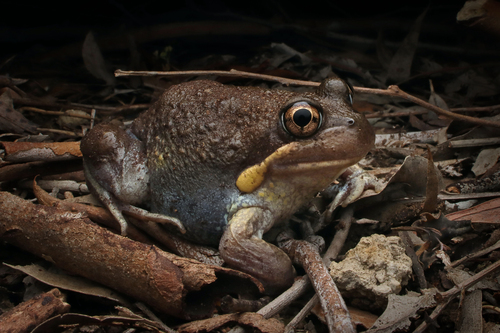 Eastern Banjo FrogLimnodynastes dumerilii
-
 Striped Marsh FrogLimnodynastes peronii
-
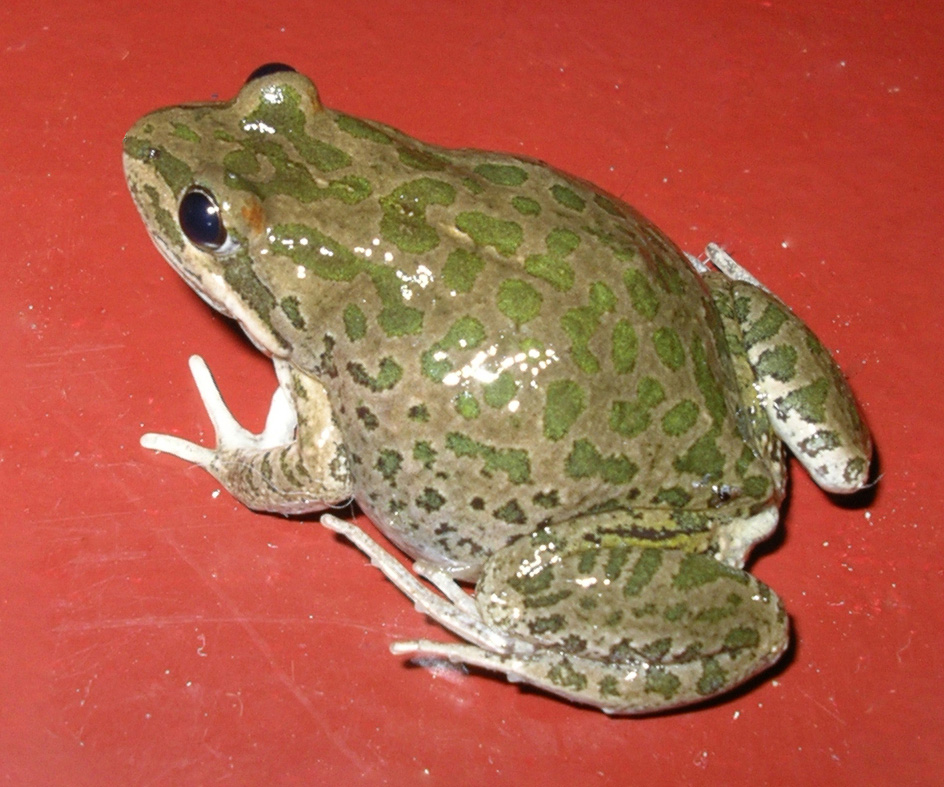 Spotted Grass FrogLimnodynastes tasmaniensis
-
 Western Banjo FrogLimnodynastes dorsalis
-
 Marbled FrogLimnodynastes convexiusculus
-
 Salmon-striped FrogLimnodynastes salmini
-
 Long-thumbed FrogLimnodynastes fletcheri
-
 Scarlet-sided Banjo FrogLimnodynastes grayi
Compare
Questions and answers
What is the scientific name of the Giant Banjo Frog?
The scientific name of the Giant Banjo Frog is Limnodynastes interioris. Written with its author, the full name is Limnodynastes interioris Fry, 1913.
Which family does the Giant Banjo Frog belong to?
Limnodynastes interioris belongs to the family Limnodynastidae, in the order Anura and the class Amphibia.
Where is the Giant Banjo Frog found?
Checklists and occurrence records place Limnodynastes interioris in 1 country: Australia.
What is the conservation status of the Giant Banjo Frog?
The IUCN Red List category recorded for Limnodynastes interioris is Least Concern (LC).
What other names does the Giant Banjo Frog have?
Limnodynastes interioris is also known in English as Giant Bullfrog and Great Bullfrog.
Sources
Passages the profile rests on
- The Southern or Eastern banjo frog (Limnodynastes dumerilii) is identified as a similar species. Source passage: “differing from the similar Southern or Eastern banjo frogs (Limnodynastes dumerilii)” — English Wikipedia
- The Australian Museum article identifies the Giant Banjo Frog as one of four closely related banjo frog species. Source passage: “The Eastern Banjo Frog (Limnodynastes dumerilii), Western Banjo Frog (Limnodynastes dorsalis), Northern Banjo Frog (Limnodynastes terraereginae), and Giant Banjo Frog (Limnodynastes interioris) are a group of four closely related species” — australian.museum
- The frog has mostly brown dorsal skin with irregular black markings and a bumpy texture. Source passage: “The skin on its back is mostly brown with irregular black markings and a bumpy texture” — English Wikipedia
- Its underside is pale to bright yellow and smooth. Source passage: “its underside is pale to bright yellow and smooth.” — English Wikipedia
- Its sides range in colour from red-brown to fawn and have black and grey flecks. Source passage: “Along the sides of the body, the coloring ranges from red-brown to fawn with black and grey flecks” — English Wikipedia
- A black stripe extends from its snout along its sides. Source passage: “with a black stripe from its snout down to its sides.” — English Wikipedia
- Its iris is dark-speckled gold and its pupil is horizontal. Source passage: “The iris is a dark specked gold and the pupil is horizontal.” — English Wikipedia
- Its front feet are unwebbed, while its hind feet are semi-webbed. Source passage: “Front feet are unwebbed and back feet are semi-webbed” — English Wikipedia
- Each foot has a large, shovel-shaped metatarsal tubercle on its underside. Source passage: “with a large, shovel-shaped metatarsal tubercle on the under-surface of each foot.” — English Wikipedia
- Its toes are strong, lack discs and are adapted for burrowing. Source passage: “The toes are strong, without discs and are predominantly for burrowing beneath the surface of soil.” — English Wikipedia
- Adults grow to an average length of 7–9 cm. Source passage: “The giant banjo frog grows to an average length of between 7 and 9 cm” — English Wikipedia
- Its tadpoles can grow to 9.5 cm in length. Source passage: “growing up to 9.5 cm (3.7 in) in length” — English Wikipedia
- Its tadpoles are dark brown or black, with gold clusters and dark grey fins. Source passage: “are dark brown, or black in color with gold clusters and dark grey fins.” — English Wikipedia
- Its eggs are pigmented. Source passage: “The eggs appear pigmented” — English Wikipedia
- The species usually inhabits areas close to freshwater floodplains, marshes, swamps and ponds. Source passage: “Their natural habitat is usually close to freshwater floodplains, marshes, swamps and ponds” — English Wikipedia
- It also occurs in dry temperate forests, grasslands and dry savannas. Source passage: “but can also be found in dry temperate forests, grassland and dry savanna.” — English Wikipedia
- The species spends most of its time underground. Source passage: “The giant banjo frog spends the majority of its time underground” — English Wikipedia
- Its occurrence is higher in permanent wetlands away from the Murray River's main channel where vegetation is more structurally complex. Source passage: “The giant banjo frog occurrence was found to be higher at permanent wetlands away from the main river channel of the Murray River and with more complex vegetation structure.” — English Wikipedia
- Its tadpoles inhabit still or slow-moving water. Source passage: “tadpoles live in either slow moving or still water.” — English Wikipedia
- The species is endemic to Australia. Source passage: “The giant banjo frog is endemic to Australia” — English Wikipedia
- Its distribution includes the arid region of central New South Wales and northern Victoria. Source passage: “inhabits the arid region of central New South Wales and northern Victoria.” — English Wikipedia
- Its distribution is largely restricted to the Murray-Darling Basin and Murray River floodplains. Source passage: “It is largely restricted to Murray-Darling Basin and the floodplains of the Murray River.” — English Wikipedia
- Its area of occurrence is approximately 214,800 square kilometres. Source passage: “The area of occurrence of the Giant Banjo Frog covers an area of approximately 214,800 km2” — English Wikipedia
- The species is carnivorous. Source passage: “The giant banjo frog is a carnivore.” — English Wikipedia
- Adults feed on insects, worms and spiders. Source passage: “Adults feed on a wide variety of insects, worms and spiders.” — English Wikipedia
- The species generally emerges from underground after rainfall to feed and reproduce. Source passage: “tends to only emerge after rain to feed and lay eggs.” — English Wikipedia
- It undergoes prolonged periods of aestivation during hotter and drier months. Source passage: “During hotter and drier months, the frog spends prolonged periods aestivating where they are in a state of dormancy.” — English Wikipedia
- It can burrow deeper during drought to maintain sufficient moisture. Source passage: “therefore tends to dig deeper during periods of drought to maintain adequate moisture.” — English Wikipedia
- Males call from vegetation or flooded burrows. Source passage: “Males call from vegetation or flooded burrows.” — English Wikipedia
- Its peak calling period occurs between September and November. Source passage: “The peak calling period of the giant banjo frog is between September and November.” — English Wikipedia
- Male calls are short, deep notes with a lower dominant frequency than those of the Southern or Eastern banjo frog. Source passage: “having a short deep note with a similar, but lower dominant frequency, to that of the Southern or Eastern banjo frog” — English Wikipedia
- Males frequently synchronise their calls with those of nearby frogs. Source passage: “Males often synchronise their calls with surrounding frogs” — English Wikipedia
- Breeding generally occurs during spring and summer, and can extend into autumn when rainfall is adequate. Source passage: “Giant banjo frogs breeds during spring and summer and occasionally autumn if rainfall is adequate.” — English Wikipedia
- Each female can lay up to 4,000 eggs. Source passage: “where each female can lay up to 4000 eggs.” — English Wikipedia
- The eggs hatch within a few days after spawning. Source passage: “After the spawning phase eggs will hatch within a few days” — English Wikipedia
- Tadpole development into frogs takes approximately two and a half months. Source passage: “The next stage of larval development where tadpoles mature into frogs takes around two and a half months.” — English Wikipedia
- The species is classified as Least Concern under the EPBC Act 1999. Source passage: “The giant banjo frog is currently listed as species of Least Concern under the EPBC Act 1999.” — English Wikipedia
- Its population is described as large and stable. Source passage: “The giant banjo frog has a large and stable population” — English Wikipedia
- Hydrological modifications in the Murray-Darling Basin threaten its habitat through habitat loss. Source passage: “their habitat is threatened by habitat loss due to hydrological modifications of the Murray-Darling Basin” — English Wikipedia
- Retreating water tables and increased groundwater salinity may restrict its survival during extended dry periods. Source passage: “retreating water tables or an increase in groundwater salinity has the potential to limit their ability to thrive throughout extended dry periods.” — English Wikipedia
Data
- Catalogue of Life, 2026-10-16 XR cc by
- Global Biodiversity Information Facility CC BY 4.0
- Wikidata CC0
- GeoNames CC BY 4.0
- Wikimedia Commons per image; credit shown with each image
- Within the Catalogue of Life, this name comes from The Integrated Taxonomic Information System cc0
This species in other databases
Page built on 29 November 2026. See how the catalog is made and all sources and licences.
Cite this page
ScientificNames.org. (2026). Limnodynastes interioris (Giant Banjo Frog). Retrieved November 29, 2026, from https://scientificnames.org/species/limnodynastes-interioris
“Limnodynastes interioris (Giant Banjo Frog).” ScientificNames.org, 2026, scientificnames.org/species/limnodynastes-interioris. Accessed 29 Nov. 2026.
ScientificNames.org. “Limnodynastes interioris (Giant Banjo Frog).” Accessed November 29, 2026. https://scientificnames.org/species/limnodynastes-interioris.
@misc{scientificnames_limnodynastes_interioris_giant_banjo_frog,
  author = {{ScientificNames.org}},
  title = {Limnodynastes interioris (Giant Banjo Frog)},
  year = {2026},
  url = {https://scientificnames.org/species/limnodynastes-interioris},
  note = {Accessed 2026-11-29}
}