Species · Amphibians
Salmon-striped Frog Limnodynastes salmini
The scientific name of the Salmon-striped Frog is Limnodynastes salmini. It is a species of amphibian in the family Limnodynastidae (australian ground frogs), order Anura. The name dates from 1867.
- Scientific name
- Limnodynastes salmini Steindachner, 1867
- Common name
- Salmon-striped Frog
- Genus
- Limnodynastes
- Family
- Limnodynastidae (Australian Ground Frogs)
- Order
- Anura
- Class
- Amphibia
- Red List category
- LC Least Concern
- Recorded in
- 1 country
- Name status
- accepted in the Catalogue of Life

Overview
The species is native to southeastern Queensland and northern New South Wales, Australia. It is marked by three pink, orange, or red-brown longitudinal stripes on its back and sides.
Written 27 November 2026 from the sources listed below. Each statement was checked against the passage it cites; statements that could not be supported were removed.
Appearance
The frog has a brown upper surface marked with darker brown spots and blotches. Three pink, orange, or red-brown longitudinal stripes run along its back and sides.[1][2]
An orange raised bar extends from beneath the eye to the shoulder, and the armpit is orange. The thighs have black-and-white mottling.[3][4][5]
Adults can reach approximately 75 mm in length.[6]
Habitat
The species is associated with dams, flooded areas, and ditches in open landscapes or woodland.[7]
Behaviour
The species frequently burrows and shelters underground or beneath logs and rocks during drought.[8]
Males call from vegetation in water after heavy rainfall during spring, summer, and autumn.[9]
Reproduction and life cycle
Females lay approximately 1,500 eggs in floating foamy masses. Tadpoles hatch approximately three to four days after the eggs are laid.[10][11]
The tadpoles are very dark brown. Their development takes approximately 43 days at a water temperature of 30 °C.[12][13]
Metamorphs measure between 13 and 20 mm. They resemble adults but have paler stripes.[14][15]
Similar species
The Salmon-striped Frog resembles the Striped Marsh Frog but can be distinguished by its orange or red stripes. The Striped Marsh Frog lacks the distinct salmon-pink or orange stripes of Limnodynastes salmini.[16][17]
Classification of the Salmon-striped Frog
| Kingdom | Animalia |
|---|---|
| Phylum | Chordata |
| Subphylum | Vertebrata |
| Infraphylum | Gnathostomata |
| Parvphylum | Osteichthyes |
| Megaclass | Tetrapoda |
| Class | Amphibia (Amphibians) |
| Order | Anura (Frogs) |
| Superfamily | Myobatrachoidea |
| Family | Limnodynastidae (Australian Ground Frogs) |
| Genus | Limnodynastes (Australian Swamp Frogs) |
| Species | Limnodynastes salmini Steindachner, 1867 |
Where the Salmon-striped Frog is found
Checklists and occurrence records place Limnodynastes salmini in 1 country. GBIF holds 4,191 georeferenced records of it.
Countries
Regions and cities with the most records
- Queensland, Australia 2,851
- New South Wales, Australia 1,260
- Rockhampton, Australia 648
- Bundaberg, Australia 269
- Gladstone, Australia 53
- Toowoomba, Australia 24
- Warwick, Australia 13
- Brisbane, Australia 11
- Narangba, Australia 5
- Tamworth, Australia 3
A number beside a place is its count of GBIF occurrence records. A place without a number comes from a checklist alone. Records show where a species has been observed or collected, which can include escapes and vagrants.
Common names
English
- Salmon-striped Frog
- Salmon-striped Swamp Frog
- Steindachneras Frog
- Steindachner’s Frog
Names in 3 other languages
- Czech
- paropucha růžovopruhá
- French
- Grenouille à rayures saumon
- Japanese
- キスジヌマチガエル
Related species
-
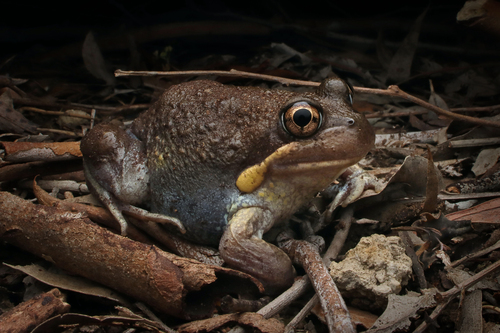 Eastern Banjo FrogLimnodynastes dumerilii
-
 Striped Marsh FrogLimnodynastes peronii
-
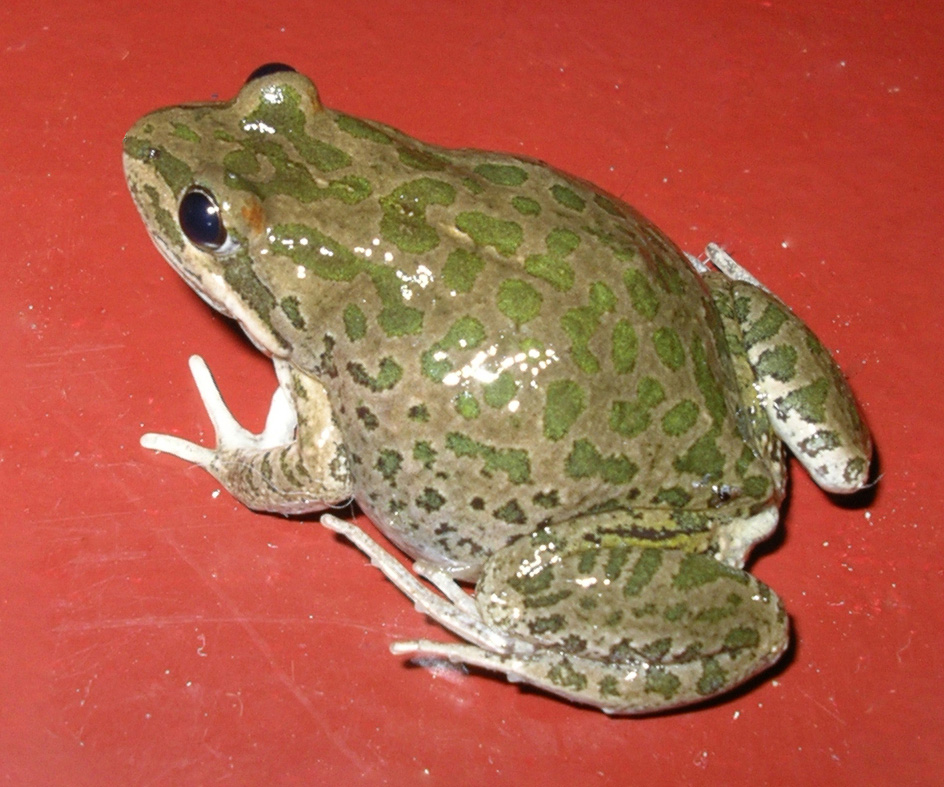 Spotted Grass FrogLimnodynastes tasmaniensis
-
 Giant Banjo FrogLimnodynastes interioris
-
 Western Banjo FrogLimnodynastes dorsalis
-
 Marbled FrogLimnodynastes convexiusculus
-
 Long-thumbed FrogLimnodynastes fletcheri
-
 Scarlet-sided Banjo FrogLimnodynastes grayi
Compare
Questions and answers
What is the scientific name of the Salmon-striped Frog?
The scientific name of the Salmon-striped Frog is Limnodynastes salmini. Written with its author, the full name is Limnodynastes salmini Steindachner, 1867.
Which family does the Salmon-striped Frog belong to?
Limnodynastes salmini belongs to the family Limnodynastidae, in the order Anura and the class Amphibia.
Where is the Salmon-striped Frog found?
Checklists and occurrence records place Limnodynastes salmini in 1 country: Australia.
What is the conservation status of the Salmon-striped Frog?
The IUCN Red List category recorded for Limnodynastes salmini is Least Concern (LC).
What other names does the Salmon-striped Frog have?
Limnodynastes salmini is also known in English as Salmon-striped Swamp Frog, Steindachneras Frog and Steindachner’s Frog.
Sources
Passages the profile rests on
- The frog has a brown upper surface marked with darker brown spots and blotches. Source passage: “It is brown above with spots and blotches of darker brown.” — English Wikipedia
- The frog has three pink, orange, or red-brown longitudinal stripes, including one along its back and two on its sides. Source passage: “The predominant feature of this species is the 3 pink, orange or red-brown stripes running down the dorsal surface, with two on each side and one down the back.” — English Wikipedia
- An orange raised bar extends from beneath the eye to the shoulder. Source passage: “There is also an orange raised bar running from under the eye to the shoulder.” — English Wikipedia
- The armpit is orange. Source passage: “The armpit is orange.” — English Wikipedia
- The thighs have black-and-white mottling. Source passage: “the thighs are mottled black and white.” — English Wikipedia
- Adults can reach approximately 75 mm in length. Source passage: “It is a large species of frog reaching about 75 mm (3.0 in) in length.” — English Wikipedia
- The species is associated with dams, flooded areas, and ditches in open landscapes or woodland. Source passage: “It is associated with dams, flooded areas, and ditches in open areas or woodland.” — English Wikipedia
- The species frequently burrows and shelters underground or beneath logs and rocks during drought. Source passage: “It is often a burrowing species and will spend time underground or under logs and rocks to avoid drought.” — English Wikipedia
- Males call from vegetation in water after heavy rainfall during spring, summer, and autumn. Source passage: “Males make an "unk-unk-unk" call from vegetation in water after heavy rains in spring, summer, and autumn.” — English Wikipedia
- Females lay approximately 1,500 eggs in floating foamy masses. Source passage: “About 1500 eggs are laid in floating foamy masses.” — English Wikipedia
- Tadpoles hatch approximately three to four days after the eggs are laid. Source passage: “Tadpoles hatch about 3 to 4 days after laying.” — English Wikipedia
- Tadpoles are very dark brown. Source passage: “Tadpoles are very dark brown” — English Wikipedia
- Tadpole development takes approximately 43 days at a water temperature of 30 °C. Source passage: “Tadpole development takes about 43 days at a water temperature of 30 °C (86 °F).” — English Wikipedia
- Metamorphs measure between 13 and 20 mm. Source passage: “Metamorphs measure 13–20 mm (0.51–0.79 in)” — English Wikipedia
- Metamorphs resemble adults but have paler stripes. Source passage: “resemble the adult; however, their stripes are paler.” — English Wikipedia
- The Salmon-striped Frog resembles the Striped Marsh Frog but can be distinguished by its orange or red stripes. Source passage: “It is similar to the striped marsh frog, from which it can be distinguished by the orange or red stripes.” — English Wikipedia
- The Striped Marsh Frog has been identified as similar in appearance to Limnodynastes salmini, but lacks its distinct salmon-pink or orange stripes. Source passage: “except for Limnodynastes salmini, which has distinct salmon-pink or orange stripes that are lacking in Limnodynastes peronii.” — australian.museum
Data
- Catalogue of Life, 2026-10-16 XR cc by
- Global Biodiversity Information Facility CC BY 4.0
- Wikidata CC0
- GeoNames CC BY 4.0
- Wikimedia Commons per image; credit shown with each image
- Within the Catalogue of Life, this name comes from The Integrated Taxonomic Information System cc0
This species in other databases
Page built on 29 November 2026. See how the catalog is made and all sources and licences.
Cite this page
ScientificNames.org. (2026). Limnodynastes salmini (Salmon-striped Frog). Retrieved November 29, 2026, from https://scientificnames.org/species/limnodynastes-salmini
“Limnodynastes salmini (Salmon-striped Frog).” ScientificNames.org, 2026, scientificnames.org/species/limnodynastes-salmini. Accessed 29 Nov. 2026.
ScientificNames.org. “Limnodynastes salmini (Salmon-striped Frog).” Accessed November 29, 2026. https://scientificnames.org/species/limnodynastes-salmini.
@misc{scientificnames_limnodynastes_salmini_salmon_striped_frog,
  author = {{ScientificNames.org}},
  title = {Limnodynastes salmini (Salmon-striped Frog)},
  year = {2026},
  url = {https://scientificnames.org/species/limnodynastes-salmini},
  note = {Accessed 2026-11-29}
}