Species · Amphibians
Sulawesi Wart Frog Limnonectes larvaepartus
The scientific name of the Sulawesi Wart Frog is Limnonectes larvaepartus. It is a species of amphibian in the family Dicroglossidae (forked tongued frogs), order Anura. The name dates from 2014.
- Scientific name
- Limnonectes larvaepartus Iskandar, Evans & McGuire, 2014
- Common name
- Sulawesi Wart Frog
- Genus
- Limnonectes
- Family
- Dicroglossidae (Forked Tongued Frogs)
- Order
- Anura
- Class
- Amphibia
- Red List category
- LC Least Concern
- Recorded in
- 1 country
- Name status
- accepted in the Catalogue of Life

Overview
The species is endemic to northern and western Sulawesi, Indonesia, where it has been recorded on the Northern Peninsula and the western edge of the central core. The species exhibits internal fertilization and gives birth to live tadpoles.
Written 26 November 2026 from the sources listed below. Each statement was checked against the passage it cites; statements that could not be supported were removed.
Appearance
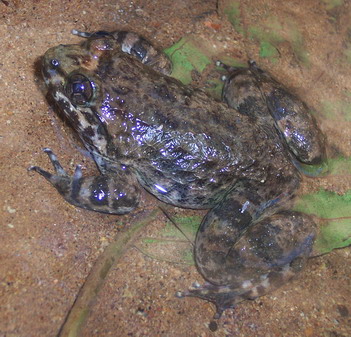
The frog typically has a brownish-grey back, although reddish-brown and golden-tan coloration also occurs. Its underside can be yellowish or cream, often with a dark spot near the upper end of the tibia.[1][2]
Adult males have an average snout-to-cloaca length of 37.4 millimetres. Adult females have an average snout-to-cloaca length of 40.2 millimetres.[3][4]
Habitat
Newborn tadpoles are delivered into slow-moving streams. Free-living tadpoles have been observed in puddles alongside streams.[5][6]
Diet
Tadpoles developing inside the oviducts may consume feces and dead siblings in addition to yolk.[7]
Behaviour
Tadpoles probably begin feeding independently before completing metamorphosis into froglets.[8]
Reproduction and life cycle
The species exhibits internal fertilization and gives birth to live tadpoles. Females produce approximately 100 eggs, which hatch into tadpoles inside the female's oviducts.[9][10][11]
Developing tadpoles are probably retained in the oviducts until their yolk supply is exhausted. They are delivered with well-developed tails, mouthparts and pigmentation.[12][13]
The mechanism of internal fertilization remains unknown because males lack an obvious intromittent organ. The reproductive mode may have arisen through a behavioral change in the fertilization method rather than specialized oviduct anatomy.[14][15]
Classification of the Sulawesi Wart Frog
| Kingdom | Animalia |
|---|---|
| Phylum | Chordata |
| Subphylum | Vertebrata |
| Infraphylum | Gnathostomata |
| Parvphylum | Osteichthyes |
| Megaclass | Tetrapoda |
| Class | Amphibia (Amphibians) |
| Order | Anura (Frogs) |
| Family | Dicroglossidae (Forked Tongued Frogs) |
| Subfamily | Dicroglossinae |
| Genus | Limnonectes (Fanged Frogs) |
| Species | Limnonectes larvaepartus Iskandar, Evans & McGuire, 2014 |
Origin of the name. Etymology The species name larvaepartus (from ' larvae', plural of larva, the early form of an animal, and ' partus', to give birth to) reflects the unique reproductive mode of this tadpole-bearing species.
Where the Sulawesi Wart Frog is found
Checklists and occurrence records place Limnonectes larvaepartus in 1 country. GBIF holds 157 georeferenced records of it.
Countries
Regions and cities with the most records
- Gorontalo, Indonesia 28
- Polewali, Indonesia 12
- Gorontalo, Indonesia 7
- Palu, Indonesia 5
- Kotamobagu, Indonesia 4
- Rantepao, Indonesia 4
- Bitung, Indonesia 3
A number beside a place is its count of GBIF occurrence records. A place without a number comes from a checklist alone. Records show where a species has been observed or collected, which can include escapes and vagrants.
Common names
English
- Sulawesi Wart Frog
Names in 2 other languages
- Chinese
- 長尖牙青蛙
- Indonesian
- Bangkong beranak
Related species
-
 Blyth's River FrogLimnonectes blythii
-
 Giant Philippine FrogLimnonectes magnus
-
 Luzon Fanged FrogLimnonectes macrocephalus
-
 Fanged River FrogLimnonectes macrodon
-
 Kuhl's Creek FrogLimnonectes kuhlii
-
 Masked Swamp FrogLimnonectes paramacrodon
-
 Giant River FrogLimnonectes leporinus
- Giant Visayan FrogLimnonectes visayanus
Compare
Questions and answers
What is the scientific name of the Sulawesi Wart Frog?
The scientific name of the Sulawesi Wart Frog is Limnonectes larvaepartus. Written with its author, the full name is Limnonectes larvaepartus Iskandar, Evans & McGuire, 2014.
Which family does the Sulawesi Wart Frog belong to?
Limnonectes larvaepartus belongs to the family Dicroglossidae, in the order Anura and the class Amphibia.
Where is the Sulawesi Wart Frog found?
Checklists and occurrence records place Limnonectes larvaepartus in 1 country: Indonesia.
What is the conservation status of the Sulawesi Wart Frog?
The IUCN Red List category recorded for Limnonectes larvaepartus is Least Concern (LC).
Sources
Passages the profile rests on
- The frog typically has a brownish-grey back, although reddish-brown and golden-tan coloration also occurs. Source passage: “The dorsum is typically brownish-grey, but can also be reddish-brown or golden-tan.” — English Wikipedia
- The underside can be yellowish or cream, often with a dark spot near the upper end of the tibia. Source passage: “The underside may be yellowish or cream, with a dark spot often marking the upper end of the tibia.” — English Wikipedia
- Adult males have an average snout-to-cloaca length of 37.4 millimetres. Source passage: “The average male size (from tip of snout to cloaca) is 37.4 millimetres” — English Wikipedia
- Adult females have an average snout-to-cloaca length of 40.2 millimetres. Source passage: “the average female size is 40.2 mm” — English Wikipedia
- Free-living tadpoles have been observed in puddles alongside streams. Source passage: “They also observed free-living tadpoles in stream-side puddles.” — English Wikipedia
- Newborn tadpoles are delivered into slow-moving streams. Source passage: “The tadpoles are born into slow-moving streams.” — English Wikipedia
- Tadpoles developing inside the oviducts may consume feces and dead siblings in addition to yolk. Source passage: “Apart from yolk, the oviductal tadpoles may also feed on feces and dead siblings.” — English Wikipedia
- Tadpoles probably begin feeding independently before completing metamorphosis into froglets. Source passage: “After birth, tadpoles likely self-feed even before metamorphosis into froglets.” — English Wikipedia
- The species exhibits internal fertilization and gives birth to live tadpoles. Source passage: “It is unique in that it has internal fertilization and gives live birth to tadpoles.” — English Wikipedia
- Females produce approximately 100 eggs. Source passage: “Females produce approximately 100 eggs” — English Wikipedia
- The eggs hatch into tadpoles inside the female's oviducts. Source passage: “which hatch as tadpoles in the oviducts” — English Wikipedia
- Developing tadpoles are probably retained in the oviducts until their yolk supply is exhausted. Source passage: “are probably retained there until exhausting their supply of yolk.” — English Wikipedia
- The tadpoles are delivered with well-developed tails, mouthparts and pigmentation. Source passage: “They feature well-developed tails, mouthparts and pigmentation at birth.” — English Wikipedia
- The species' reproductive mode may have arisen through a behavioral change in the fertilization method rather than specialized oviduct anatomy. Source passage: “raising the possibility that the unique breeding mode is the result of a simple behavioral change in fertilization method.” — English Wikipedia
- The mechanism of internal fertilization remains unknown because males lack an obvious intromittent organ. Source passage: “It is not known how internal fertilization occurs, as the male frog has no obvious intromittent organ.” — English Wikipedia
Data
- Catalogue of Life, 2026-10-16 XR cc by
- Global Biodiversity Information Facility CC BY 4.0
- Wikidata CC0
- GeoNames CC BY 4.0
- Wikimedia Commons per image; credit shown with each image
- Within the Catalogue of Life, this name comes from The Integrated Taxonomic Information System cc0
References
- Iskandar, Djoko T., Ben J. Evans & Jimmy A. McGuire. 2014. A novel reproductive mode in frogs: A new species of fanged frog with internal fertilization and birth of tadpoles. Public Library of Science, ONE 10(3): e0119988. Link where the name was published
This species in other databases
Page built on 29 November 2026. See how the catalog is made and all sources and licences.
Cite this page
ScientificNames.org. (2026). Limnonectes larvaepartus (Sulawesi Wart Frog). Retrieved November 29, 2026, from https://scientificnames.org/species/limnonectes-larvaepartus
“Limnonectes larvaepartus (Sulawesi Wart Frog).” ScientificNames.org, 2026, scientificnames.org/species/limnonectes-larvaepartus. Accessed 29 Nov. 2026.
ScientificNames.org. “Limnonectes larvaepartus (Sulawesi Wart Frog).” Accessed November 29, 2026. https://scientificnames.org/species/limnonectes-larvaepartus.
@misc{scientificnames_limnonectes_larvaepartus_sulawesi_wart_frog,
  author = {{ScientificNames.org}},
  title = {Limnonectes larvaepartus (Sulawesi Wart Frog)},
  year = {2026},
  url = {https://scientificnames.org/species/limnonectes-larvaepartus},
  note = {Accessed 2026-11-29}
}