Species · Amphibians
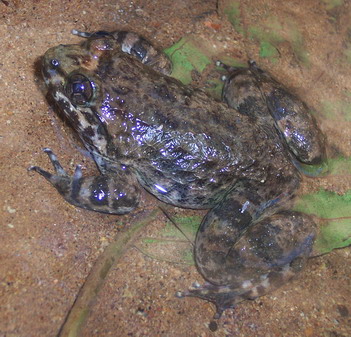
Giant Philippine Frog Limnonectes magnus
The scientific name of the Giant Philippine Frog is Limnonectes magnus. It is a species of amphibian in the family Dicroglossidae (forked tongued frogs), order Anura. The name dates from 1910.
- Scientific name
- Limnonectes magnus (Stejneger, 1910)
- Common name
- Giant Philippine Frog
- Genus
- Limnonectes
- Family
- Dicroglossidae (Forked Tongued Frogs)
- Order
- Anura
- Class
- Amphibia
- Red List category
- NT Near Threatened
- Environment
- freshwater, terrestrial
- Recorded in
- 2 countries
- Name status
- accepted in the Catalogue of Life

Overview
Limnonectes magnus inhabits tropical moist lowland forests, subtropical or tropical moist montane forests, rivers, and intermittent freshwater marshes in the Philippines. It was discovered on Mount Apo in Mindanao, Philippines, in 1910, and is distributed throughout Mindanao.
Written 26 November 2026 from the sources listed below. Each statement was checked against the passage it cites; statements that could not be supported were removed.
Habitat
The Giant Philippine Frog inhabits tropical moist lowland forests and subtropical or tropical moist montane forests. It also occurs in rivers and intermittent freshwater marshes.[1][2][3][4]
The species is endemic to the Philippines and is distributed throughout Mindanao. It was discovered on Mount Apo in Mindanao, Philippines, in 1910.[5][6][7]
Conservation
The Giant Philippine Frog is becoming rare because of habitat loss.[8]
Classification of the Giant Philippine Frog
| Kingdom | Animalia |
|---|---|
| Phylum | Chordata |
| Subphylum | Vertebrata |
| Infraphylum | Gnathostomata |
| Parvphylum | Osteichthyes |
| Megaclass | Tetrapoda |
| Class | Amphibia (Amphibians) |
| Order | Anura (Frogs) |
| Family | Dicroglossidae (Forked Tongued Frogs) |
| Subfamily | Dicroglossinae |
| Genus | Limnonectes (Fanged Frogs) |
| Species | Limnonectes magnus (Stejneger, 1910) |
Where the Giant Philippine Frog is found
Checklists and occurrence records place Limnonectes magnus in 2 countries. GBIF holds 1,833 georeferenced records of it.
Countries
Regions and cities with the most records
- Cabadbaran, Philippines 96
- Gingoog, Philippines 92
- Mariano, Philippines 92
- Recodo, Philippines 88
- Jagna, Philippines 71
- Zamboanga, Philippines 63
- Butuan, Philippines 61
- Estancia, Philippines 32
- Davao, Philippines 29
- Baybay, Philippines 21
- San Jose, Philippines 21
- San Francisco, Philippines 20
- Bah-Bah, Philippines 18
- Prosperidad, Philippines 18
- Loboc, Philippines 15
- Apas, Philippines 13
- Cebu City, Philippines 13
- Mandaue City, Philippines 13
- Minglanilla, Philippines 13
- Naga, Philippines 13
- Talisay, Philippines 13
- Burauen, Philippines 10
- Consolacion, Philippines 10
- Lapu-Lapu City, Philippines 10
- Liloan, Philippines 10
- Abuyog, Philippines 9
- Iloilo, Philippines 9
- Dumaguete, Philippines 8
- Masbate, Philippines 8
- Sibulan, Philippines 8
- Baguio, Philippines 6
- Itogon, Philippines 6
- La Trinidad, Philippines 6
- Pinamalayan, Philippines 6
- Santa Catalina, Philippines 6
- Sipalay, Philippines 6
A number beside a place is its count of GBIF occurrence records. A place without a number comes from a checklist alone. Records show where a species has been observed or collected, which can include escapes and vagrants.
Common names
English
- Giant Philippine Frog
- Mindanao Fanged Frog
- Mount Apo Wart Frog
- Philippine Giant Frog
- Large Swamp Frog
Names in 4 other languages
- Czech
- skokan velký
- Russian
- Минданаоская лягушка
- Tagalog
- Palakang Kabkab
- mis
- Bakbak (higaonon)
Synonyms
5 other scientific names have been used for this species and are now treated as synonyms of Limnonectes magnus.
- Euphlyctis magna (Stejneger, 1910)
- Rana macrodon magna Stejneger, 1910
- Rana magna Stejneger, 1910
- Rana magna magna Stejneger, 1910
- Rana modesta magna Stejneger, 1910
Related species
-
 Sulawesi Wart FrogLimnonectes larvaepartus
-
 Blyth's River FrogLimnonectes blythii
-
 Luzon Fanged FrogLimnonectes macrocephalus
-
 Fanged River FrogLimnonectes macrodon
-
 Kuhl's Creek FrogLimnonectes kuhlii
-
 Masked Swamp FrogLimnonectes paramacrodon
-
 Giant River FrogLimnonectes leporinus
- Giant Visayan FrogLimnonectes visayanus
Compare
Questions and answers
What is the scientific name of the Giant Philippine Frog?
The scientific name of the Giant Philippine Frog is Limnonectes magnus. Written with its author, the full name is Limnonectes magnus (Stejneger, 1910).
Which family does the Giant Philippine Frog belong to?
Limnonectes magnus belongs to the family Dicroglossidae, in the order Anura and the class Amphibia.
Where is the Giant Philippine Frog found?
Checklists and occurrence records place Limnonectes magnus in 2 countries: Philippines and Indonesia.
What is the conservation status of the Giant Philippine Frog?
The IUCN Red List category recorded for Limnonectes magnus is Near Threatened (NT).
What other names does the Giant Philippine Frog have?
Limnonectes magnus is also known in English as Mindanao Fanged Frog, Mount Apo Wart Frog, Philippine Giant Frog and Large Swamp Frog.
Sources
Passages the profile rests on
- The species inhabits tropical moist lowland forests. Source passage: “Its natural habitats are tropical moist lowland forests” — English Wikipedia
- The species inhabits subtropical or tropical moist montane forests. Source passage: “subtropical or tropical moist montane forests” — English Wikipedia
- The species occurs in rivers. Source passage: “rivers, intermittent rivers” — English Wikipedia
- The species inhabits intermittent freshwater marshes. Source passage: “intermittent freshwater marshes” — English Wikipedia
- The species is endemic to the Philippines. Source passage: “It is endemic to the Philippines.” — English Wikipedia
- The species was discovered on Mount Apo in Mindanao, Philippines, in 1910. Source passage: “Limnonectes magnus was found by Stejneger and associates on Mount Apo in Mindanao, Philippines, in 1910.” — amphibiaweb.org
- The species is distributed throughout Mindanao. Source passage: “This frog is also distributed throughout the Mindanao” — amphibiaweb.org
- The species is becoming rare because of habitat loss. Source passage: “It is becoming rare due to habitat loss.” — English Wikipedia
Data
- Catalogue of Life, 2026-10-16 XR cc by
- Global Biodiversity Information Facility CC BY 4.0
- Wikidata CC0
- GeoNames CC BY 4.0
- Wikimedia Commons per image; credit shown with each image
- Within the Catalogue of Life, this name comes from The Integrated Taxonomic Information System cc0
This species in other databases
- Catalogue of Life 72DKH
- Wikidata Q2274891
- iNaturalist 25914
- WoRMS urn:lsid:marinespecies.org:taxname:1433709
Page built on 29 November 2026. See how the catalog is made and all sources and licences.
Cite this page
ScientificNames.org. (2026). Limnonectes magnus (Giant Philippine Frog). Retrieved November 29, 2026, from https://scientificnames.org/species/limnonectes-magnus
“Limnonectes magnus (Giant Philippine Frog).” ScientificNames.org, 2026, scientificnames.org/species/limnonectes-magnus. Accessed 29 Nov. 2026.
ScientificNames.org. “Limnonectes magnus (Giant Philippine Frog).” Accessed November 29, 2026. https://scientificnames.org/species/limnonectes-magnus.
@misc{scientificnames_limnonectes_magnus_giant_philippine_frog,
  author = {{ScientificNames.org}},
  title = {Limnonectes magnus (Giant Philippine Frog)},
  year = {2026},
  url = {https://scientificnames.org/species/limnonectes-magnus},
  note = {Accessed 2026-11-29}
}