Comparison
Bullet Ant vs Argentine Ant
Bullet Ant (Paraponera clavata) and Argentine Ant (Linepithema humile) both belong to the family Formicidae (ant) and part ways below it.

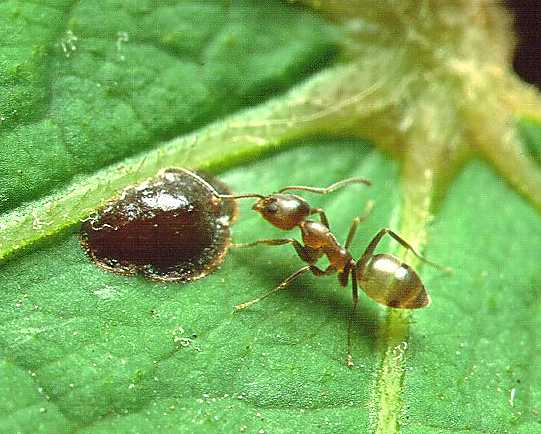


How they differ
The Bullet Ant uses its sting defensively and can cause severe pain lasting up to 24 hours, while introduced Argentine ant colonies commonly form supercolonies in which individuals from different nests generally do not attack one another.
| Bullet Ant | Argentine Ant | |
|---|---|---|
| Worker caste | Bullet Ant workers do not exhibit polymorphism within the worker caste. | Argentine ant colonies may contain as many as one reproductive queen per 125 workers. |
| Habitat | The Bullet Ant inhabits humid lowland rainforests in Central and South America, with colonies generally established at the bases of trees. | The Argentine ant establishes nests in forests, agricultural fields, shrublands, and areas near rivers, as well as beneath wood, debris, and rocks, in sandy soil, and inside pavement cracks and buildings. |
| Nesting depth | Bullet Ant colonies are generally established at the bases of trees. | Argentine ant nests are generally shallow, typically extending no more than 1–2 inches into the soil. |
| Mating | Bullet Ant reproductive males and virgin queens leave their nests to seek mates during a nuptial phase that occurs once or twice annually. | Argentine ants generally mate inside their nests during late spring and summer. |
| Conservation | Paraponera clavata is the only living species in its subfamily. | Argentine ants are ranked among the world's 100 worst invasive animal species. |
Written from the checked facts listed further down. Statements that the sources did not support were removed.
Side by side
| Bullet Ant | Argentine Ant | |
|---|---|---|
| Scientific name | Paraponera clavata (Fabricius, 1775) | Linepithema humile (Mayr, 1868) |
| English name | Bullet Ant | Argentine Ant |
| Group | Insects | Insects |
| Class | Insecta Insect | Insecta Insect |
| Order | Hymenoptera Ants | Hymenoptera Ants |
| Family | Formicidae Ant | Formicidae Ant |
| Genus | Paraponera | Linepithema |
| Named in | 1775 | 1868 |
| Environment | Not recorded | terrestrial |
| Countries on record | 13 countries | 24 countries |
| GBIF occurrence records | 6,209 records | 21,817 records |
Rows where the two agree are shown in grey.
Where each is found
Only Bullet Ant (13)
- Bolivia
- Brazil
- Colombia
- Costa Rica
- Ecuador
- French Guiana
- Guyana
- Honduras
- Nicaragua
- Panama
- Peru
- Suriname
- Venezuela
Only Argentine Ant (24)
- Argentina
- Australia
- Bahamas
- Belgium
- Bermuda
- Canada
- Chile
- Croatia
- France
- Germany
- Greece
- Guam
- Italy
- Malta
- Mexico
- New Zealand
- Norfolk Island
- Portugal
- South Africa
- Spain
- Switzerland
- The Netherlands
- United Kingdom
- United States
From Catalogue of Life checklists and GBIF occurrence records. A country missing from a list means no record is held, which is not proof of absence.
Checked facts
| Bullet Ant | Argentine Ant | |
|---|---|---|
| Appearance |
|
|
| Size |
|
|
| Habitat |
|
|
| Diet |
|
|
| Behaviour |
|
|
| Reproduction |
|
|
| Distribution |
|
|
| Conservation |
|
|
| Uses |
| No checked fact yet |
| Other | No checked fact yet |
|
In brief
Bullet Ant
Paraponera clavata inhabits humid lowland rainforests in Central and South America. Its sting causes severe pain lasting up to 24 hours. Full profile
Argentine Ant
Linepithema humile naturally inhabits riparian floodplain environments in the lowland Paraná River drainage and establishes nests in forests, agricultural fields, shrublands, and areas near rivers. Introduced colonies commonly form supercolonies in which ants from different nests generally do not attack one another. Full profile
Compare something else
Page built on 24 November 2026 from the data on the two species pages, where every source is listed.
Cite this page
ScientificNames.org. (2026). Bullet Ant vs Argentine Ant. Retrieved November 24, 2026, from https://scientificnames.org/compare/bullet-ant-vs-argentine-ant
“Bullet Ant vs Argentine Ant.” ScientificNames.org, 2026, scientificnames.org/compare/bullet-ant-vs-argentine-ant. Accessed 24 Nov. 2026.
ScientificNames.org. “Bullet Ant vs Argentine Ant.” Accessed November 24, 2026. https://scientificnames.org/compare/bullet-ant-vs-argentine-ant.
@misc{scientificnames_bullet_ant_vs_argentine_ant,
  author = {{ScientificNames.org}},
  title = {Bullet Ant vs Argentine Ant},
  year = {2026},
  url = {https://scientificnames.org/compare/bullet-ant-vs-argentine-ant},
  note = {Accessed 2026-11-24}
}