Species · Reptiles
White-lipped Forest Skink Lioscincus steindachneri
The scientific name of the White-lipped Forest Skink is Lioscincus steindachneri. It is a species of reptile in the family Scincidae (skink), order Squamata. The name dates from 1873.
- Scientific name
- Lioscincus steindachneri Bocage, 1873
- Common name
- White-lipped Forest Skink
- Genus
- Lioscincus
- Family
- Scincidae (Skink)
- Order
- Squamata
- Class
- Reptilia
- Red List category
- EN Endangered
- Recorded in
- 1 country
- Name status
- accepted in the Catalogue of Life
Overview
The White-lipped Forest Skink is a lizard belonging to the family Scincidae. It is endemic to New Caledonia and primarily inhabits moist forests at elevations between 200 and 1,110 metres. Its reproductive mode has not been established, and it may reproduce either by laying eggs or by giving birth to live young.
Written 27 November 2026 from the sources listed below. Each statement was checked against the passage it cites; statements that could not be supported were removed.
Habitat
The White-lipped Forest Skink primarily inhabits moist forests. It occurs at elevations between 200 and 1,110 metres.[1][2]
Reproduction and life cycle
The reproductive mode of the White-lipped Forest Skink has not been established. It may reproduce either by laying eggs or by giving birth to live young.[3][4]
Classification of the White-lipped Forest Skink
| Kingdom | Animalia |
|---|---|
| Phylum | Chordata |
| Subphylum | Vertebrata |
| Infraphylum | Gnathostomata |
| Parvphylum | Osteichthyes |
| Megaclass | Tetrapoda |
| Class | Reptilia (Reptile) |
| Order | Squamata (Snakes) |
| Suborder | Autarchoglossa |
| Family | Scincidae (Skink) |
| Subfamily | Eugongylinae |
| Genus | Lioscincus (New Caledonian Smooth Skinks) |
| Species | Lioscincus steindachneri Bocage, 1873 |
Where the White-lipped Forest Skink is found
Checklists and occurrence records place Lioscincus steindachneri in 1 country across Oceania. GBIF holds 20 georeferenced records of it.
Countries
Range as the checklists state it
New Caledonia
A number beside a place is its count of GBIF occurrence records. A place without a number comes from a checklist alone. Records show where a species has been observed or collected, which can include escapes and vagrants.
Common names
English
- White-lipped Forest Skink
- White-Lipped Foret Skink
Names in 2 other languages
- Danish
- Hvidlæbet Silkeskink
- French
- Scinque des forêts à lèvre blanches
Synonyms
2 other scientific names have been used for this species and are now treated as synonyms of Lioscincus steindachneri.
- Leiolopisma steindachneri (Bocage, 1873)
- Lygosoma steindachneri (Bocage, 1873)
Related species
- Kopéto Smooth SkinkLioscincus vivae
-
 ShinglebackTiliqua rugosa
-
 Five-lined SkinkPlestiodon fasciatus
- Common Garden SkinkLampropholis guichenoti
-
 Blue-tailed SkinkCryptoblepharus egeriae
-
 Red-eyed Crocodile SkinkTribolonotus gracilis
-
 Common Blue-tongued SkinkTiliqua scincoides
-
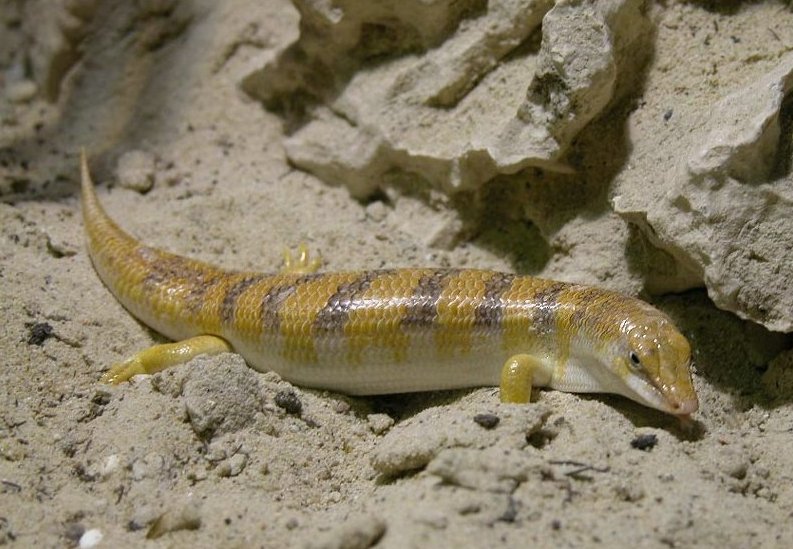 Sandfish SkinkScincus scincus
Compare
Questions and answers
What is the scientific name of the White-lipped Forest Skink?
The scientific name of the White-lipped Forest Skink is Lioscincus steindachneri. Written with its author, the full name is Lioscincus steindachneri Bocage, 1873.
Which family does the White-lipped Forest Skink belong to?
Lioscincus steindachneri belongs to the family Scincidae, in the order Squamata and the class Reptilia.
Where is the White-lipped Forest Skink found?
Checklists and occurrence records place Lioscincus steindachneri in 1 country: New Caledonia.
What is the conservation status of the White-lipped Forest Skink?
The IUCN Red List category recorded for Lioscincus steindachneri is Endangered (EN).
What other names does the White-lipped Forest Skink have?
Lioscincus steindachneri is also known in English as White-Lipped Foret Skink.
Sources
Passages the profile rests on
- The species primarily inhabits moist forests. Source passage: “The preferred natural habitat of L. steindachneri is moist forest” — English Wikipedia
- The species occurs at elevations between 200 and 1,110 metres. Source passage: “at altitudes of 200–1,110 m (660–3,640 ft).” — English Wikipedia
- The reproductive mode of this species has not been established. Source passage: “The mode of reproduction of L. steindachneri is unknown.” — English Wikipedia
- The species may reproduce either by laying eggs or by giving birth to live young. Source passage: “It may be oviparous or viviparous.” — English Wikipedia
Data
- Catalogue of Life, 2026-10-16 XR cc by
- Global Biodiversity Information Facility CC BY 4.0
- Wikidata CC0
- GeoNames CC BY 4.0
- Within the Catalogue of Life, this name comes from The Reptile Database cc by
References
- Bocage, J. V. Barboza du. (1873). 3. Sur quelques sauriens nouveaux de la Nouvelle Calédonie et de l’Australie. Jornal de Sciencias Mathematicas, Physicas E Naturaes, Lisboa, 4: 228—232.
- Pietschmann, V. (1919). Franz Steindachner. Annalen Des Naturhistorischen Museums in Wien 33: 47-48.
- Smith, M. A. (1937). A review of the genus Lygosoma (Scincidae: Reptilia) and its allies. Records of the Indian Museum 39 (3): 213-234.
- Zug, G. R. (1985). A new skink (Reptilia: Sauria: Leiolopisma) from Fiji. Proc. Biol. Soc. Washington 98 (1): 221-231.
- Sadlier R A. (1987). A review of the scincid lizards of New Caledonia. Rec. Austral. Mus. 39(1) 1987: 1-66 [1986].
- Bauer, Aaron M.;Vindum, Jens V. (1990). A checklist and key to the herpetofauna of New Caledonia, with remarks on biogeography. Proc. Cal. Acad. Sci. 47 (2): 17-45.
- Bauer, A. M., & Sadlier, R. A. (1993). Systematics, biogeography and conservation of the lizards of New Caledonia. Biodiv. Lett. 1: 107-122.
- Adler,G.H.; Austin,C.C. & Dudley,R. (1995). Dispersal and speciation of skinks among archipelagos in the tropical Pacific Ocean. Evolutionary Ecology 9: 529-541.
- Frank, Norman, Ramus, & Erica. (1995). A Complete Guide to Scientific and Common Names of Reptiles and Amphibians of the World. Pottsville: N G Publishing Inc., 377 Pp.
- Bauer, A. M., & SADLIER, R. A. (2000). The herpetofauna of New Caledonia. Contributions to Herpetology, 17; Society for Study Amphibians and Reptiles, Ithaca, New York.
- Beolens, B., & Michael Watkins, a. M. G. (2011). The Eponym Dictionary of Reptiles. Johns Hopkins University Press, Baltimore, USA.
- Sadlier, Ross A., A. M. BAueR, Glenn M. Shea, and S. A. SMith. (2015). Taxonomic resolution to the problem of polyphyly in the New Caledonian scincid lizard genus Lioscincus (Squamata: Scincidae). Records of the Australian Museum 67(7): 207–224.
- Zimin, A., Zimin, S. V., Shine, R., Avila, L., Bauer, A., Böhm, M., Brown, R., Barki, G., de Oliveira Caetano, G. H., Castro Herrera, F., Chapple, D. G., Chirio, L., Colli, G. R., Doan, T. M., Glaw, F., Grismer, L. L., Itescu, Y., Kraus, F., LeBreton, M.; [...] Uetz, P.; Wagner, P.; Roll, U. & Meiri, S. (2022). A global analysis of viviparity in squamates highlights its prevalence in cold climates. Global Ecology and Biogeography, 00, 1–16.
- Uetz, P. H., Patel, M., Gbadamosi, Z., Nguyen, A., & Shoope, S. (2024). A Reference Database of Reptile Images. Taxonomy 4: 723–732.
This species in other databases
Page built on 28 November 2026. See how the catalog is made and all sources and licences.
Cite this page
ScientificNames.org. (2026). Lioscincus steindachneri (White-lipped Forest Skink). Retrieved November 28, 2026, from https://scientificnames.org/species/lioscincus-steindachneri
“Lioscincus steindachneri (White-lipped Forest Skink).” ScientificNames.org, 2026, scientificnames.org/species/lioscincus-steindachneri. Accessed 28 Nov. 2026.
ScientificNames.org. “Lioscincus steindachneri (White-lipped Forest Skink).” Accessed November 28, 2026. https://scientificnames.org/species/lioscincus-steindachneri.
@misc{scientificnames_lioscincus_steindachneri_white_lipped_forest_skink,
  author = {{ScientificNames.org}},
  title = {Lioscincus steindachneri (White-lipped Forest Skink)},
  year = {2026},
  url = {https://scientificnames.org/species/lioscincus-steindachneri},
  note = {Accessed 2026-11-28}
}