Species · Reptiles
Indian Flapshell Turtle Lissemys punctata
The scientific name of the Indian Flapshell Turtle is Lissemys punctata. It is a species of reptile in the family Trionychidae (softshell turtles), order Testudines. The name dates from 1789.
- Scientific name
- Lissemys punctata (Bonnaterre, 1789)
- Common name
- Indian Flapshell Turtle
- Genus
- Lissemys
- Family
- Trionychidae (Softshell Turtles)
- Order
- Testudines
- Class
- Reptilia
- Red List category
- VU Vulnerable
- Environment
- freshwater
- Recorded in
- 6 countries
- Name status
- accepted in the Catalogue of Life

Overview
Lissemys punctata occurs in Pakistan, India, Sri Lanka, Nepal, Bangladesh, and Myanmar, and has been introduced to the Andaman and Nicobar Islands.
Written 26 November 2026 from the sources listed below. Each statement was checked against the passage it cites; statements that could not be supported were removed.
Appearance
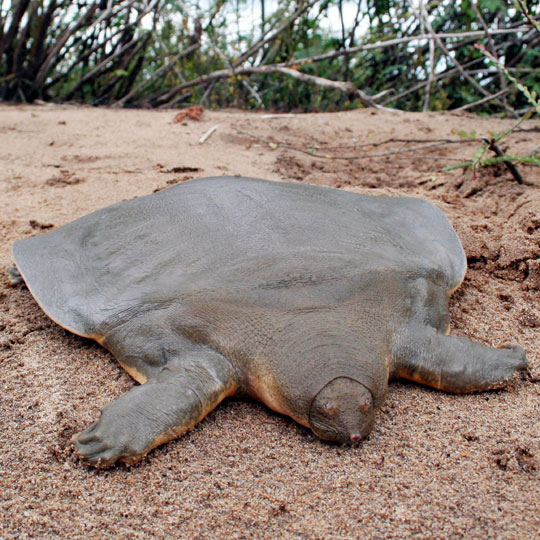
Adults have a broadly oval carapace, while juveniles have a more circular carapace. The carapace is moderately arched, with a smooth margin that flares slightly toward the rear.[1][2]
The carapace width measures 77–86% of its length, and its height measures 35.0–40.5% of its length. Recorded carapace lengths range from 240 to 370 mm.[3][4][5]
The plastron is large, mostly cartilaginous, and measures 88–97% of the carapace length. Seven plastral callosities are present.[6][7]
The head width measures 21–25% of the carapace width. The turtle has a short, stout nose, smooth jaw edges, large and heavy claws, and a very short tail in both sexes.[8][9][10]
Males can reach a maximum size of approximately 23 cm, while females can reach approximately 35 cm.[11][12]
Habitat
The species inhabits shallow, quiet, often stagnant freshwater environments. Its documented habitats include rivers, streams, marshes, ponds, lakes, irrigation canals, and tanks.[13][14]
It prefers aquatic habitats with sandy or muddy bottoms because it burrows.[15]
The species occurs in desert ponds in Rajasthan. Its type locality was restricted to Pondicherry on India's Coromandel Coast.[16][17]
Diet
The Indian Flapshell Turtle is omnivorous. Its documented animal foods include frogs, shrimp, and snails.[18][19]
Its documented plant foods include aquatic vegetation, leaves, flowers, fruits, grasses, and seeds.[20]
Behaviour
The turtle survives drought conditions partly by burrowing and moving between water holes. During droughts, it enters a period of estivation, and some individuals have been reported to survive drought conditions for up to 160 days.[21][22][23]
Reproduction and life cycle
The species becomes reproductively active at two or three years of age. Male courtship begins with the male stroking the female's carapace using his neck and extended limbs.[24][25]
Receptive females respond by extending their necks and bobbing their heads vertically three or four times. During mating, the male mounts the female after she settles on the bottom.[26][27]
Nesting generally occurs between June and November, from late summer through the monsoon season. Common nesting sites are swampy areas with soil and exposure to sunlight.[28][29]
Females generally lay two or three clutches annually, with two to sixteen eggs per clutch. The eggs are buried in soil for protection.[30][31]
Conservation
Habitat alteration, including dam and barrage construction, riverbank cultivation, and pollution, threatens the species. Commercial exploitation for profit is also identified as a threat.[32][33]
The species was removed from the endangered species list in 1983 and downgraded to CITES Appendix II in 1995.[34][35]
Uses
Its shell is sometimes ground into powder for use in traditional medicines based on beliefs about medicinal properties.[36]
Similar species
The species is described as an evolutionary morphological link between softshell and hardshell aquatic turtles.[37]
Fossils attributed to the species are known from Nepal dating to the Miocene.[38]
Classification of the Indian Flapshell Turtle
| Kingdom | Animalia |
|---|---|
| Phylum | Chordata |
| Subphylum | Vertebrata |
| Infraphylum | Gnathostomata |
| Parvphylum | Osteichthyes |
| Megaclass | Tetrapoda |
| Class | Reptilia (Reptile) |
| Order | Testudines (Turtle) |
| Suborder | Cryptodira |
| Superfamily | Trionychoidea |
| Family | Trionychidae (Softshell Turtles) |
| Genus | Lissemys (Indian Flapshell Turtles) |
| Species | Lissemys punctata (Bonnaterre, 1789) |
Where the Indian Flapshell Turtle is found
Checklists and occurrence records place Lissemys punctata in 6 countries across Asia. GBIF holds 1,534 georeferenced records of it.
Countries
Regions and cities with the most records
- Gujarat, India 187
- Kerala, India 149
- Maharashtra, India 123
- Tamil Nadu, India 117
- Vaikam, India 108
- Kokōtamangalam South, India 102
- Rajasthan, India 100
- Cherthala, India 98
- Shertallai, India 98
- Vayalār, India 98
- Pallipuram, India 97
- Srīkandamangalam, India 97
- Thaikkattussery, India 96
- Thanneermukkom, India 96
- Ezhupunna, India 94
- Kodamthuruth, India 94
- Kumbalam, India 94
- Kutiatodu, India 94
- Mulamthuruthy, India 94
- Aroor, India 93
- Arukutti, India 93
- Manakunnam, India 93
- Kochi, India 88
- Maradu, India 88
- Tripunittura, India 87
- Thiruvankulam, India 81
- Karnataka, India 80
- Madhya Pradesh, India 66
- Uttar Pradesh, India 63
- Kanayannur, India 59
- Andhra Pradesh, India 56
- West Bengal, India 53
- Vypīn, India 49
- Telangana, India 42
- Anekal, India 40
- Attibele, India 38
Range as the checklists state it
Pakistan, India (Tamil Nadu, Kerala, Sikkim, Gujarat, Maharashtra, Himachal Pradesh, Jammu and Kashmir, Madhya Pradesh, Assam, Punjab, Rajasthan), Sri Lanka, Nepal, Bangladesh (Indus and Ganges drainages), Burma (Irrawaddy and Salween rivers)
A number beside a place is its count of GBIF occurrence records. A place without a number comes from a checklist alone. Records show where a species has been observed or collected, which can include escapes and vagrants.
Common names
English
- Indian Flapshell Turtle
- Indian Flap-shelled Turtle
Names in 1 other language
- German
- Klappen-Weichschildkröte
Synonyms
12 other scientific names have been used for this species and are now treated as synonyms of Lissemys punctata.
- Emyda granosa Schoepff, 1801
- Emyda granosa intermedia Annandale, 1912
- Emydura dura Anderson, 1876
- Lissemys punctata (Lacépède, 1788)
- Lissemys punctata granosa Smith, 1931
- Testudo granosa Schoepff, 1801
- Testudo granulata Shaw, 1802
- Testudo granulosa Suckow, 1798
- Testudo punctata Bonnaterre, 1789
- Trionyx coromandelicus Geoffroy, 1809
- Emys vittata Peters, 1854 ambiguous synonym
- Testudo punctata Lacépède, 1788 ambiguous synonym
Subspecies and varieties
- Lissemys punctata andersoni (Spotted Northern Indian Flapshell Turtle) subspecies
- Lissemys punctata punctata (Southern Indian Flapshell Turtle) subspecies
- Lissemys punctata vittata (Central Indian Flapshell Turtle) subspecies
Related species
-
 Sri Lankan Flapshell TurtleLissemys ceylonensis
-
 Burmese Flapshell TurtleLissemys scutata
-
 Yangtze Giant Softshell TurtleRafetus swinhoei
-
 Florida Softshell TurtleApalone ferox
-
 Chinese Softshell TurtlePelodiscus sinensis
-
 Asian Giant Softshell TurtlePelochelys cantorii
-
 Spiny Softshell TurtleApalone spinifera
-
 Indian Softshell TurtleNilssonia gangetica
Compare
Questions and answers
What is the scientific name of the Indian Flapshell Turtle?
The scientific name of the Indian Flapshell Turtle is Lissemys punctata. Written with its author, the full name is Lissemys punctata (Bonnaterre, 1789).
Which family does the Indian Flapshell Turtle belong to?
Lissemys punctata belongs to the family Trionychidae, in the order Testudines and the class Reptilia.
Where is the Indian Flapshell Turtle found?
Checklists and occurrence records place Lissemys punctata in 6 countries: India, Pakistan, Sri Lanka, Bangladesh, Nepal and Myanmar.
What is the conservation status of the Indian Flapshell Turtle?
The IUCN Red List category recorded for Lissemys punctata is Vulnerable (VU).
What other names does the Indian Flapshell Turtle have?
Lissemys punctata is also known in English as Indian Flap-shelled Turtle.
What does the Indian flapshell turtle eat?
The Indian Flapshell Turtle is omnivorous. Its documented animal foods include frogs, shrimp, and snails, while its plant foods include aquatic vegetation, leaves, flowers, fruits, grasses, and seeds.[18][19][20]
What do turtles eat in their natural habitat?
The Indian Flapshell Turtle eats frogs, shrimp, snails, aquatic vegetation, leaves, flowers, fruits, grasses, and seeds.[19][20]
Where does the Indian flapshell turtle live?
It inhabits shallow, quiet, often stagnant freshwater environments, including rivers, streams, marshes, ponds, lakes, irrigation canals, and tanks. It occurs in Pakistan, India, Sri Lanka, Nepal, Bangladesh, and Myanmar, and has been introduced to the Andaman and Nicobar Islands.[13][14][39][40]
Sources
Passages the profile rests on
- Adults have a broadly oval carapace, while juveniles have a more circular carapace. Source passage: “The carapace of L. punctata viewed from above is broadly oval in adults, but more circular in young” — English Wikipedia
- The carapace is moderately arched, with a smooth margin that flares slightly toward the rear. Source passage: “the carapace is moderately arched, shell height is 35.0–40.5% of carapace length, the margin of the carapace is smooth and slightly flared posteriorly” — English Wikipedia
- The carapace width measures 77–86% of its length. Source passage: “The width of the disc is 77–86% of its length” — English Wikipedia
- The shell height measures 35.0–40.5% of the carapace length. Source passage: “shell height is 35.0–40.5% of carapace length” — English Wikipedia
- Recorded carapace lengths range from 240 to 370 mm. Source passage: “The carapace length of L. punctata has been known to range from 240 to 370 mm (9.4 to 14.6 in).” — English Wikipedia
- The plastron is large, mostly cartilaginous, and measures 88–97% of the carapace length. Source passage: “the plastron is large but mostly cartilaginous, and its length is 88–97% of the carapace length.” — English Wikipedia
- Seven plastral callosities are present. Source passage: “seven plastral callosities are present” — English Wikipedia
- The head width measures 21–25% of the carapace width. Source passage: “the head is large, its width is 21–25% of the carapace width.” — English Wikipedia
- The turtle has a short, stout nose and smooth jaw edges. Source passage: “The nose is short and stout; the nasal septum has no lateral ridge, the edges of the jaws are smooth” — English Wikipedia
- Its claws are large and heavy, and its tail is very short in both sexes. Source passage: “The claws are large and heavy; the penis is thick and oval, with deep dorsal cleft and four pointed, soft papillae; the tail is very short in both sexes.” — English Wikipedia
- Males can reach a maximum size of approximately 23 cm. Source passage: “The male's size can be up to 23 cm (9 in.)” — English Wikipedia
- Females can reach a maximum size of approximately 35 cm. Source passage: “while the female's size can be maximum of around 35 cm (14 in.)” — English Wikipedia
- The species inhabits shallow, quiet, often stagnant freshwater environments. Source passage: “L. punctata lives in the shallow, quiet, often stagnant waters” — English Wikipedia
- Its documented habitats include rivers, streams, marshes, ponds, lakes, irrigation canals, and tanks. Source passage: “of rivers, streams, marshes, ponds, lakes, irrigation canals, and tanks.” — English Wikipedia
- It prefers aquatic habitats with sandy or muddy bottoms because it burrows. Source passage: “Waters with sand or mud bottoms are preferred because of the turtle's tendency to burrow.” — English Wikipedia
- The species occurs in desert ponds in Rajasthan. Source passage: “It is also found in the desert ponds of Rajasthan” — English Wikipedia
- The type locality was restricted to Pondicherry on India's Coromandel Coast. Source passage: “restricted to "Pondicherry, Coromandel Coast, India"” — English Wikipedia
- The species is omnivorous. Source passage: “The Indian flapshell turtle is known to be omnivorous.” — English Wikipedia
- Its documented animal foods include frogs, shrimp, and snails. Source passage: “Its diet consists of frogs, shrimp, snails, aquatic vegetation” — English Wikipedia
- Its documented plant foods include aquatic vegetation, leaves, flowers, fruits, grasses, and seeds. Source passage: “aquatic vegetation, plant leaves, flowers, fruits, grasses, and seeds.” — English Wikipedia
- The turtle survives drought conditions partly by burrowing and moving between water holes. Source passage: “The turtle uses mainly burrowing and moving from water hole to water hole to avoid desiccation.” — English Wikipedia
- During droughts, the species enters a period of estivation. Source passage: “During a time of drought, the turtles enter a time of estivation in an attempt to survive the dry conditions.” — English Wikipedia
- Some individuals have been reported to survive drought conditions for up to 160 days. Source passage: “some turtles have been reported to survive up to 160 days.” — English Wikipedia
- The species becomes reproductively active at two or three years of age. Source passage: “L. punctata becomes reproductively active at age 2 or 3.” — English Wikipedia
- Male courtship begins with the male stroking the female's carapace using his neck and extended limbs. Source passage: “Courtship begins when the male begins stroking the female's carapace with his neck and limbs extended.” — English Wikipedia
- Receptive females respond by extending their necks and bobbing their heads vertically three or four times. Source passage: “When receptive, the female faces the male with her neck extended and they begin bobbing their heads vertically three or four times.” — English Wikipedia
- During mating, the male mounts the female after she settles on the bottom. Source passage: “mating begins when the female settles to the bottom and is mounted by the male.” — English Wikipedia
- Nesting generally occurs between June and November, from late summer through the monsoon season. Source passage: “Generally, they start during the late summer to the monsoon season, which is around June to November.” — English Wikipedia
- Common nesting sites are swampy areas with soil and exposure to sunlight. Source passage: “Swampy areas with soil and exposure to sunlight are common nesting sites.” — English Wikipedia
- Females generally lay two or three clutches annually, with two to sixteen eggs per clutch. Source passage: “Eggs are usually laid two or three times per year in clutches of two to 16.” — English Wikipedia
- The eggs are buried in soil for protection. Source passage: “These eggs are buried in soil for protection.” — English Wikipedia
- Habitat alteration, including dam and barrage construction, riverbank cultivation, and pollution, threatens the species. Source passage: “Changes to the turtle's natural habitat by the construction of dams and barrages, cultivation along river banks, and pollution are also major threats to the survival of this turtle.” — English Wikipedia
- Commercial exploitation for profit is identified as a threat to the species. Source passage: “Exploitation for profit and habitat change are threats to their survival.” — English Wikipedia
- The species was downgraded to CITES Appendix II in 1995. Source passage: “The species was downgraded to Appendix II in 1995.” — English Wikipedia
- The species was removed from the endangered species list in 1983. Source passage: “Consequently, the Indian flapshell turtle was removed from the endangered species list in 1983 (48 FR 52740).” — English Wikipedia
- Its shell is sometimes ground into powder for use in traditional medicines based on beliefs about medicinal properties. Source passage: “The shell of L. punctata is sometimes believed to have medicinal uses and ground into powder to make traditional medicines” — English Wikipedia
- The species is described as an evolutionary morphological link between softshell and hardshell aquatic turtles. Source passage: “It is morphologically an evolutionary link between the softshell and hardshell aquatic turtles.” — English Wikipedia
- Fossils attributed to the species are known from Nepal dating to the Miocene. Source passage: “Fossils of this species from as early as the Miocene are known from Nepal.” — English Wikipedia
- The species occurs in Pakistan, India, Sri Lanka, Nepal, Bangladesh, and Myanmar. Source passage: “The Indian flapshell turtle is found in Pakistan, India (common in lakes and rivers), Sri Lanka, Nepal, Bangladesh (Indus and Ganges drainages), and Myanmar (Irrawaddy and Salween Rivers).” — English Wikipedia
- The species has been introduced to the Andaman and Nicobar Islands. Source passage: “It has been introduced to the Andaman and Nicobar Islands.” — English Wikipedia
Data
- Catalogue of Life, 2026-10-16 XR cc by
- Global Biodiversity Information Facility CC BY 4.0
- Wikidata CC0
- GeoNames CC BY 4.0
- Wikimedia Commons per image; credit shown with each image
- Within the Catalogue of Life, this name comes from The Reptile Database cc by
References
- Bonnaterre, P. - J. (1789) Tableau Encyclopedique et Methodique des Trois Regnes de la Nature. Erpetologie. Panckoucke, Hotel de Thou, Paris, 70 pp. https: // doi. org / 10.5962 / bhl. title. 11660 where the name was published
- Lacépède, B. G. E. (1788). Histoire Naturelle des Quadrupe des Ovipares et des Serpens. Vol.1. Imprimerie Du Roi, Hôtel de Thou, Paris, Xvii + 651 Pp.
- Bonnaterre, P. J. (1789). Tableau encyclopédique et méthodique des trois règnes de la nature, . . . Erpétologie. Panckoucke, Paris, Xxviii+71 Pp. (+ Plates + Index).
- Geoffroy Saint-Hilaire, E. (1809). Sur les tortues molles, nouveau genre sous le nom de Trionyx, et sur la formation des carapaces. Ann. Mus. Hist. Nat. Paris 14: 1-20 [Published in July, Fide Smith 1963].
- Gray. J. E. (1834). Illustrations of Indian Zoology, chiefly selected from the collection of Major - General Hardwicke. Vol. 2. London (1833-1834): 263 Pp., 95 Plates.
- Duméril, A.M.C., and G. Bibron. (1835). Erpétologie Générale ou Histoire Naturelle Complète des Reptiles, Vol. 2. Librairie Encyclopédique de Roret, Paris, Iv + 680 P.
- Bell, T. (1836). A monograph of the Testudinata. London, 1836-1842 (Sometimes given as 1832-1836, Not Date given, Unnumbered Pages).
- Temminck, C. J., and H. Schlegel. (1838). Reptilia elaborantibus. Saurii et batrachii. in Ph. Fr. de Siebold: Pp. 85-144. Fauna Japonica auctore. L. Batavorum.
- Peters, W. C. H. (1854). Übersicht der auf seiner Reise nach Mossambique beobachteten Schildkröten. Monatsberichte Der Akademie Der Wissenschaften Zu Berlin 1854: 215-216.
- Gray, J. E. (1856). On some new species freshwater tortoises from North America, Ceylon and Australia. Ann. Mag. Nat. Hist. (2) 18: 263-268.
- Theobald, & William. (1868). Catalogue of the reptiles of British Birma, embracing the provinces of Pegu, Martaban, and Tenasserim; with descriptions of new or little-known species. Zool. J. Linnean Soc. 10: 4-67.
- Peters, W. C. H. (1868). Über eine neue Nagergattung, Chiropodomys penicullatus, sowie über einige neue oder weniger bekannte Amphibien und Fische. M. Ber. K. Preuss. Akad. Wiss. Berlin, 1868 : 448-461.
- Brühl, C. B. (1874). Zootomie aller Thierklassen für Lernende, nach Autopsien, skizzirt. Bd. 1-4. Alfred Hölder, Wien: Bd. 1, 86 Pp.; Bd. 2, 90 Pp.; Bd. 3, 114 Pp.; Bd. 4, 152 Pp. (Published in Parts from 1874 to 1888, See Bauer & Russell 2017 for Details).
- ANDERSON, J. (1876). Note on the plastron of the gangetic mud-turtle (Emyda dura of Buchanan-Hamilton). J. Linn. Soc., Zool., 12 : 514-516.
- Murray, James A. (1886). The reptiles of Sind : a systematic account, with descriptions of all the species inhabiting the province, and a table of their geographical distribution in Persia, Beloochistan, Afghanistan, Punjab, North-west Provinces and the peninsula of India generally. London : Richardson & Co.
- Siebenrock, Friedrich. (1897). Das Kopfskelet der Schildkröten. Sitzungsberichte Der Kaiserlichen Akademie Der Wissenschaften. Mathematisch-Naturwissenschaftliche Klasse. 106 (4): 245-328.
- Annandale, N. (1907). Reptiles and a Batrachian from an island in the Chilka Iake, Orissa. Records of the Indian Museum 1: 397-398.
- Siebenrock, F. (1913). Schildkröten aus Syrien und Mesopotamien. Ann. Naturhist. Mus. Wien 27: 171-225.
- Shah, R. V. (1960). The mechanisms of carapacial and plastral hinges in Chelonians. Breviora (130): 1-15.
- Smith, Hobart M.; Smith, Philip W. (1963). Amyda Fitzinger, 1843 (Reptilia, Testudines): proposed suppression under the Plenary powers. Z.N.(S.) 229. Bull. Zool. Nomenclature 20 (2): 121-127.
- Sharma, R. C. (1976). Records of the reptiles of Goa. Records Zool. Survey India 71 (1975): 149-167.
- Singh, D. P. (1977). Annual Sexual Rhythm in Relation to Environmental Factors in a Tropical Pond Turtle, Lissemys punctata Granosa. Herpetologica 33 (2): 190-194.
- Webb, R. G. (1980). Gray, Hardwicke, Buchanan-Hamilton, and drawings of Indian softshell turtles (Family Trionychidae). Amphibia-Reptilia 1: 61-74.
- Webb, R. G. (1980). The identity of Testudo punctata Lacépède, 1788 (Testudines, Trionychidae). Bulletin Du Muséum National d’Histoire Naturelle, Paris, (4) 2: 547-557.
- Webb, R. G. (1982). Taxonomic notes concerning the trionychid turtle Lissemys punctata (Lacepede). Amphibia-Reptilia 3 (2-3): 179-184.
This species in other databases
Page built on 26 November 2026. See how the catalog is made and all sources and licences.
Cite this page
ScientificNames.org. (2026). Lissemys punctata (Indian Flapshell Turtle). Retrieved November 26, 2026, from https://scientificnames.org/species/lissemys-punctata
“Lissemys punctata (Indian Flapshell Turtle).” ScientificNames.org, 2026, scientificnames.org/species/lissemys-punctata. Accessed 26 Nov. 2026.
ScientificNames.org. “Lissemys punctata (Indian Flapshell Turtle).” Accessed November 26, 2026. https://scientificnames.org/species/lissemys-punctata.
@misc{scientificnames_lissemys_punctata_indian_flapshell_turtle,
  author = {{ScientificNames.org}},
  title = {Lissemys punctata (Indian Flapshell Turtle)},
  year = {2026},
  url = {https://scientificnames.org/species/lissemys-punctata},
  note = {Accessed 2026-11-26}
}