Species · Reptiles
Yangtze Giant Softshell Turtle Rafetus swinhoei
The scientific name of the Yangtze Giant Softshell Turtle is Rafetus swinhoei. It is a species of reptile in the family Trionychidae (softshell turtles), order Testudines. The name dates from 1873.
- Scientific name
- Rafetus swinhoei (Gray, 1873)
- Common name
- Yangtze Giant Softshell Turtle
- Genus
- Rafetus
- Family
- Trionychidae (Softshell Turtles)
- Order
- Testudines
- Class
- Reptilia
- Red List category
- CR Critically Endangered
- Recorded in
- 1 country
- Name status
- accepted in the Catalogue of Life

Overview
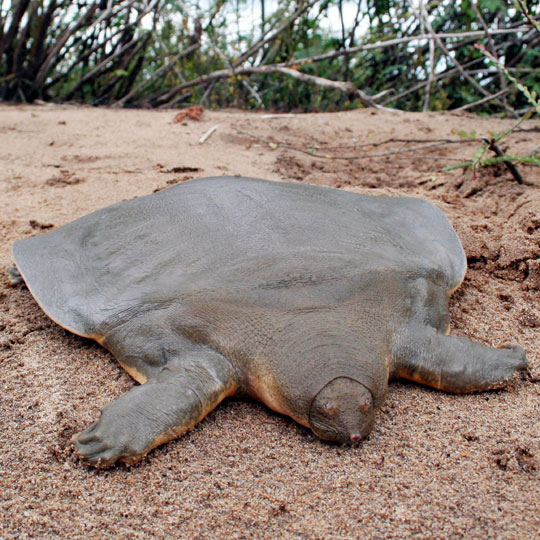
The species is native to eastern and southern China and northern Vietnam. It has a deep head, a pig-like snout, and eyes positioned dorsally.
Written 26 November 2026 from the sources listed below. Each statement was checked against the passage it cites; statements that could not be supported were removed.
Appearance
The Yangtze Giant Softshell Turtle has a deep head, a pig-like snout, and eyes positioned dorsally. Its head exceeds 20 cm in length and 10 cm in width.[1][2]
Adult individuals exceed 100 cm in length and 70 cm in width. Their carapace typically exceeds 50 cm in length, and the largest recorded straight carapace length is 86 cm.[3][4][5]
Adult individuals typically weigh between 70 and 100 kg. Males are generally smaller than females but have longer and more prominent tails.[6][7]
Habitat
The Yangtze Giant Softshell Turtle inhabits freshwater environments. Its historical range included the Yangtze River in China and Lake Tai on the border of Jiangsu and Zhejiang provinces in eastern China.[8][9][10]
The species historically occurred near the Red River in southern China and northern Vietnam. Historical localities in Yunnan Province included Gejiu, Yuanyang, Jianshui, and Honghe.[11][12]
The species has been recorded in Hoan Kiem Lake in Hanoi, Vietnam, and detected in Xuan Khanh Lake near Hanoi. A female individual was found in Dong Mo Lake west of Hanoi.[13][14][15]
Diet
The Yangtze Giant Softshell Turtle feeds primarily on fish, crabs, snails, frogs, and aquatic vegetation. Its aquatic plant foods include water hyacinths and green rice leaves.[16][17]
Behaviour
The species spends most of its time submerged in deep water and surfaces only briefly to breathe.[18][19]
The Yangtze Giant Softshell Turtle has a prolonged period of winter inactivity and exhibits summertime nesting activity.[20][21]
Reproduction and life cycle
Females typically lay between 20 and 80 eggs per clutch. Nesting typically occurs at night or during the early morning.[22][23]
Conservation
The Yangtze Giant Softshell Turtle is classified as critically endangered. Its IUCN Red List assessment was most recently conducted in 2018.[24][25]
The species' population has declined sharply in the Red River region since the 1990s. The last records from the Yangtze region date to the 1930s.[26][27]
Habitat loss caused by urbanization, pollution, and dam construction has reduced the species' natural range. Illegal wildlife trade also contributes to its decline.[28][29]
Uses
The species' carapaces and bones have been used in traditional medicine. The skulls of individuals have sometimes been kept as trophies.[30][31]
Similar species
The taxonomic status of Rafetus leloii as a separate species remains controversial.[32]
Classification of the Yangtze Giant Softshell Turtle
| Kingdom | Animalia |
|---|---|
| Phylum | Chordata |
| Subphylum | Vertebrata |
| Infraphylum | Gnathostomata |
| Parvphylum | Osteichthyes |
| Megaclass | Tetrapoda |
| Class | Reptilia (Reptile) |
| Order | Testudines (Turtle) |
| Suborder | Cryptodira |
| Superfamily | Trionychoidea |
| Family | Trionychidae (Softshell Turtles) |
| Genus | Rafetus (Bicallosite Softshell Turtles) |
| Species | Rafetus swinhoei (Gray, 1873) |
Where the Yangtze Giant Softshell Turtle is found
Checklists and occurrence records place Rafetus swinhoei in 1 country across Asia. GBIF holds 4 georeferenced records of it.
Countries
Regions and cities with the most records
- Ba Dinh, Vietnam 3
- Cầu Giấy, Vietnam 3
- Cổ Lóa, Vietnam 3
- Cửa Nam, Vietnam 3
- Dịch Vọng, Vietnam 3
- Giảng Võ, Vietnam 3
- Hanoi, Vietnam 3
- Hoàn Kiếm, Vietnam 3
- Liễu Giai, Vietnam 3
- Long Bien, Vietnam 3
- Nghĩa Đô, Vietnam 3
- Phú Thương, Vietnam 3
- Phúc Lợi, Vietnam 3
- Quang Minh, Vietnam 3
- Tây Hồ, Vietnam 3
- Từ Sơn, Vietnam 3
- Yên Phụ, Vietnam 3
- Ô Chợ Dừa, Vietnam 3
- Đông Ngạc, Vietnam 3
Range as the checklists state it
S China (Yunnan), Vietnam
A number beside a place is its count of GBIF occurrence records. A place without a number comes from a checklist alone. Records show where a species has been observed or collected, which can include escapes and vagrants.
Common names
English
- Yangtze Giant Softshell Turtle
- Hoan Kiem Turtle
- Hoàn Kiếm Turtle
- Kim Qui
- Red River Giant Softshell Turtle
- Shanghai Softshell Turtle
- Speckled Softshell Turtle
- Swinhoe's Softshell Turtle
- Swinhoe’s Soft-shelled Turtle
Names in 11 other languages
- Arabic
- سلحفاة اليانغتسي العملاقة لينة الدرقة, سلحفاة اليانغتسي لينة الدرقة
- Chinese
- 斑鱉, 斑鳖, 癩頭黿
- Czech
- kožnatka Swinhoeova
- German
- Jangtse-Riesenweichschildkröte
- Hungarian
- Swinhoe-lágyhéjúteknős
- Japanese
- シャンハイハナスッポン
- Polish
- żółwiak szanghajski
- Portuguese
- Tartaruga-de-casco-mole-do-Yangtze
- Spanish
- Tortuga de caparazón blando de Swinhoe
- Thai
- ตะพาบยักษ์แยงซีเกียง
- Vietnamese
- Rùa mai mềm Thượng Hải, 金龜
Synonyms
11 other scientific names have been used for this species and are now treated as synonyms of Rafetus swinhoei.
- Pelochelys taihuensis Zhang, 1984
- Pelochelys taihuensis Zang
- Rafetus hoankiemensis Ha, 1995 [nomen novum]
- Rafetus hoguomensis Ha, 1995
- Rafetus leloii HÀ Dình Dúc, 2000
- Rafetus leloii Ha, 2000
- Rafetus vietnamensis LE et al., 2010
- Trionyx liupani Tao, 1986
- Yuen elegans Heude, 1880
- Yuen maculatus Heude
- Oscaria swinhoei Gray, 1873 ambiguous synonym
Related species
-
 Euphrates Softshell TurtleRafetus euphraticus
-
 Indian Flapshell TurtleLissemys punctata
-
 Florida Softshell TurtleApalone ferox
-
 Chinese Softshell TurtlePelodiscus sinensis
-
 Asian Giant Softshell TurtlePelochelys cantorii
-
 Spiny Softshell TurtleApalone spinifera
-
 Indian Softshell TurtleNilssonia gangetica
-
 African Softshell TurtleTrionyx triunguis
Compare
Questions and answers
What is the scientific name of the Yangtze Giant Softshell Turtle?
The scientific name of the Yangtze Giant Softshell Turtle is Rafetus swinhoei. Written with its author, the full name is Rafetus swinhoei (Gray, 1873).
Which family does the Yangtze Giant Softshell Turtle belong to?
Rafetus swinhoei belongs to the family Trionychidae, in the order Testudines and the class Reptilia.
Where is the Yangtze Giant Softshell Turtle found?
Checklists and occurrence records place Rafetus swinhoei in 1 country: Vietnam.
What is the conservation status of the Yangtze Giant Softshell Turtle?
The IUCN Red List category recorded for Rafetus swinhoei is Critically Endangered (CR).
What other names does the Yangtze Giant Softshell Turtle have?
Rafetus swinhoei is also known in English as Hoan Kiem Turtle, Hoàn Kiếm Turtle, Kim Qui, Red River Giant Softshell Turtle, Shanghai Softshell Turtle and Speckled Softshell Turtle.
How big are Yangtze giant softshell turtles?
Adult individuals exceed 100 cm in length and 70 cm in width. They typically weigh between 70 and 100 kg. The largest recorded straight carapace length is 86 cm.[3][6][5]
Sources
Passages the profile rests on
- The species has a deep head, a pig-like snout, and eyes positioned dorsally. Source passage: “recognized for its deep head, pig-like snout, and dorsally positioned eyes.” — English Wikipedia
- The head exceeds 20 cm in length and 10 cm in width. Source passage: “The head measures over 20 cm (7.9 in) in length and 10 cm (3.9 in) in width.” — English Wikipedia
- Adult individuals exceed 100 cm in length and 70 cm in width. Source passage: “Adult specimens exceed 100 cm (39 in) in length and 70 cm (28 in) in width” — English Wikipedia
- The carapace typically exceeds 50 cm in length. Source passage: “The turtle’s carapace (shell) typically measures over 50 cm (20 in)” — English Wikipedia
- The largest recorded straight carapace length is 86 cm. Source passage: “the largest recorded at 86 cm (34 in) in straight length.” — English Wikipedia
- Adult individuals typically weigh between 70 and 100 kg. Source passage: “with weights ranging from 70–100 kg (150–220 lb).” — English Wikipedia
- Males are generally smaller than females but have longer and more prominent tails. Source passage: “males generally smaller than females but possessing longer, more prominent tails.” — English Wikipedia
- Its historical range included the Yangtze River in China. Source passage: “historically inhabited the Yangtze River” — English Wikipedia
- Its historical range included Lake Tai on the border of Jiangsu and Zhejiang provinces in eastern China. Source passage: “Lake Tai, located on the border of Jiangsu and Zhejiang provinces in eastern China” — English Wikipedia
- The species inhabits freshwater environments. Source passage: “largest living freshwater turtle species.” — English Wikipedia
- The species historically occurred near the Red River in southern China and northern Vietnam. Source passage: “areas near the Red River in southern China and northern Vietnam” — English Wikipedia
- Historical localities in Yunnan Province included Gejiu, Yuanyang, Jianshui, and Honghe. Source passage: “including Gejiu, Yuanyang, Jianshui, and Honghe in Yunnan Province.” — English Wikipedia
- The species has been recorded in Hoan Kiem Lake in Hanoi, Vietnam. Source passage: “the species has been observed in Hoan Kiem Lake in Hanoi on several occasions” — English Wikipedia
- The species has been detected in Xuan Khanh Lake near Hanoi. Source passage: “identified through environmental DNA collected at Xuan Khanh Lake, near Hanoi” — English Wikipedia
- A female individual was found in Dong Mo Lake west of Hanoi. Source passage: “A female turtle was captured in Dong Mo Lake, west of Hanoi, in October 2020” — English Wikipedia
- The species feeds primarily on fish, crabs, snails, frogs, and aquatic vegetation. Source passage: “primarily feeds on a diet of fish, crabs, snails, frogs, and aquatic vegetation” — English Wikipedia
- Its aquatic plant foods include water hyacinths and green rice leaves. Source passage: “such as water hyacinths and "green rice leaves."” — English Wikipedia
- The species spends most of its time submerged in deep water. Source passage: “It spends most of its time submerged in deep water” — English Wikipedia
- The species surfaces only briefly to breathe. Source passage: “surfaces only briefly to breathe” — English Wikipedia
- The species has a prolonged period of winter inactivity. Source passage: “with a prolonged period of winter inactivity” — English Wikipedia
- The species exhibits summertime nesting activity. Source passage: “with summertime nesting.” — English Wikipedia
- Females typically lay between 20 and 80 eggs per clutch. Source passage: “The species typically lays between 20 and 80 eggs per clutch” — English Wikipedia
- Nesting typically occurs at night or during the early morning. Source passage: “with nesting occurring at night or during the early morning.” — English Wikipedia
- The species is classified as critically endangered. Source passage: “is a critically endangered species of turtle” — English Wikipedia
- The IUCN Red List assessment for the species was most recently conducted in 2018. Source passage: “Yangtze Giant Softshell Turtle Rafetus swinhoei has most recently been assessed for The IUCN Red List of Threatened Species in 2018.” — iucnredlist.org
- The species' population has declined sharply in the Red River region since the 1990s. Source passage: “The Red River population was well documented from the 1960s to the 1990s, declining sharply after this date.” — English Wikipedia
- The last records from the Yangtze region date to the 1930s. Source passage: “The last records from the Yangtze region date to the 1930s.” — English Wikipedia
- Habitat loss caused by urbanization, pollution, and dam construction has reduced the species' natural range. Source passage: “Habitat loss due to urbanization, pollution, and dam construction has drastically reduced its natural range.” — English Wikipedia
- Illegal wildlife trade contributes to the species' decline. Source passage: “Illegal wildlife trade and a lack of robust legislation to regulate hunting and trafficking have further compounded the species' decline.” — English Wikipedia
- The species' carapaces and bones have been used in traditional medicine. Source passage: “their carapaces and bones are used in traditional medicine” — English Wikipedia
- The skulls of individuals have sometimes been kept as trophies. Source passage: “their skulls are sometimes kept as trophies.” — English Wikipedia
- The taxonomic status of Rafetus leloii as a separate species remains controversial. Source passage: “The taxonomic status of the closely related Hoan Kiem turtle (Rafetus leloii) remains controversial.” — English Wikipedia
Data
- Catalogue of Life, 2026-10-16 XR cc by
- Global Biodiversity Information Facility CC BY 4.0
- Wikidata CC0
- GeoNames CC BY 4.0
- Wikimedia Commons per image; credit shown with each image
- Within the Catalogue of Life, this name comes from The Reptile Database cc by
References
- Gray, J. E. (1873) Hand-List of the Specimens of Shield Reptiles in the British Museum. British Museum, London, 124 pp. where the name was published
- Gray, J. E. (1873). Notes on Chinese mud-tortoises (Trionychidae), with the description of a new species sent to the British Museum by Mr. Swinhoe, and observations on the male organ of this family. Ann. Mag. Nat. Hist. (4) 12: 156-161.
- Boulenger, G. A. (1889). Catalogue of the chelonians, rhynchocephalians, and crocodiles in the British Museum (Natural History). British Museum, London, 311 Pp.
- Siebenrock, F. (1902). Zur Systematik der Schildkrötenfamilie Trionychidae Bell, nebst der Beschreibung einer neuen Cyclanorbis - Art. Sitzungsber. K. Akad. Wiss. Wien. Math-Naturwiss. Cl. 111: 807-846.
- Meylan, P. & R.G. Webb. (1988). Rafetus swinhoei (Gray) 1873, a valid species of living soft-shelled turtle (Family Trionychidae) from China. Journal of Herpetology 22 (1): 118-119.
- Ernst,C.H. and Barbour,R.W. (1989). Turtles of the World. Smithsonian Institution Press, Washington D.C. - London.
- Farkas, B. L. (1992). Wiederentdeckung eines Exemplars von Rafetus swinhoei (GRAY, 1873) im Naturhistorischen Museum Wien. Salamandra 28 (2): 145-152.
- Rudolphi, Michael and Ronald Weser. (1998). Die Weichschildkröten Nordvietnams unter besonderer Berücksichtigung der Nackendornen-Weichschildkröte, Palea steindachneri (Siebenrock, 1906). Sauria 20 (1): 2-14.
- Farkas B, & Fritz U. (1998). On the identity of Rafetus swinhoei (GRAY 1873) and Pelochelys maculatus (HEUDE 1880) (Reptilia: Testudines: Trionychidae). Zool. Abh. Staatl. Tierk. Dresden 50 (1): 50 (1): 59-75.
- Farkas, B., & Webb, R. G. (2003). Rafetus leloii HÀ DÌNH DÚC 2000, an invalid species of softshell turtle from Hoan Kiem Lake, Hanoi, Vietnam (Reptilia, Testudines, Trionychidae). Zool. Abh. (Dresden) 53: 107-112.
- Bonin, F., Devaux, B., & Dupré, A. (2006). Turtles of the World. English translation by P.C.H. Pritchard. Johns Hopkins University Press, 416 Pp.
- ZHOU, T; P-P Li. (2007). Chelonian species diversity and current status in China. (in Chinese). Sichuan Journal of Zoology 26 (2):463-467.
- Bour, R. (2008). Global diversity of turtles (Chelonii; Reptilia) in freshwater. Hydrobiologia 595:593–598.
- Nguyen, S.V., Ho, C.T. and Nguyen, T.Q. (2009). Herpetofauna of Vietnam. Chimaira, Frankfurt, 768 Pp.
- Le Tran; Le Quang Huan, Tran My Linh, Phan Trong Hoang, Phan Minh Tuan, Tran Thi Thanh Huyen, Pham Thu Thuy, Nguyen Dang Ton, Nong Van Hai, Phan Van Chi, Dinh Duy Khang, Truong Nam Hai, Ha Dinh Duc. (2010). COMPARATIVE MORPHOLOGICAL AND DNA ANALYSIS OF SPECIMENS OF GIANT FRESHWATER SOFT-SHELLED TURTLE IN VIETNAM RELATED TO HOAN KIEM TURTLE. Tạp Chí Công Nghệ Sinh Học 8(3A): 949-954.
- Farkas, B., & Minh Duc Le, a. T. Q. N. (2011). Rafetus vietnamensis Le, Le, Tran, Phan, Phan, Tran, Pham, Nguyen, Nong, Phan, Dinh, Truong and Ha, 2010 – another invalid name for an invalid species of softshell turtle (Reptilia: Testudines: Trionychidae). Russ. J. Herpetol. 18 (1): 65 – 72.
- Bettelheim, Matthew P. (2012). Swinhoe’s Softshell Turtle (Rafetus swinhoei): The legendary Sword Lake Turtle of Hoan Kiem Lake. Bibliotheca Herpetologica 10 (1): 4-20.
- Kuchling, Gerald, Dingqi Rao and Shunqing Lu. (2013). In search of China’s last Giant Softshell Turtles (Rafetus swinhoei). Turtle Survival Alliance 2013: 44.
- Jian, Wang; Shi Hai-Tao, Wen Cheng, and Han Lian-Xian. (2013). Habitat Selection and Conservation Suggestions for the Yangtze Giant Softshell Turtle (Rafetus swinhoei) in the Upper Red River, China. Chelonian Conservation and Biology Jul 2013, Vol. 12, No. 1: 177-184.
- Kuchling, Gerald, Lu Shunqing and Rao Dingqi. (2014). Challenges for Rafetus in China continue to mount. Turtle Survival 2014: 50.
- Anonymous. (2016). Testudinate China [in both English and Chinese]. Testudinate Industry Branch of the China Fishery Association, Published on Occasion of WCH8; Author Not Explicitly Stated, 54 Pp.
- Li, H., Liu, J., Xiong, L., Zhang, H., Zhou, H., Yin, H., Jing, W., Li, J., Shi, Q., Wang, Y., Liu, J. and Nie, L. (2017). Phylogenetic relationships and divergence dates of softshell turtles (Testudines: Trionychidae) inferred from complete mitochondrial genomes. J. Evol. Biol., Doi:10.1111/Jeb.13070.
- Liu, H., & Xin Li, C. Z. (2019). Invest in amphibians and reptiles. Science 364 (6446): 1144.
- Wang, Kai; Jinlong Ren, Hongman Chen, Zhitong Lyu, Xianguang Guo Ke Jiang, Jinmin Chen, Jiatang Li, Peng Guo, Yingyong Wang, Jing Che. (2020). The updated checklists of amphibians and reptiles of China. Biodiversity Science 28 (2): 189-218.
- Le Duc, O., Pham, T. V., Zuklin, T., Bordes, C., Leprince, B., & Ducotterd, C. (2020). A new locality of presence for the world’s rarest turtle (Rafetus swinhoei) gives new hope for its survival. J. Nat. Conserv. 55: 125833.
This species in other databases
Page built on 27 November 2026. See how the catalog is made and all sources and licences.
Cite this page
ScientificNames.org. (2026). Rafetus swinhoei (Yangtze Giant Softshell Turtle). Retrieved November 27, 2026, from https://scientificnames.org/species/rafetus-swinhoei
“Rafetus swinhoei (Yangtze Giant Softshell Turtle).” ScientificNames.org, 2026, scientificnames.org/species/rafetus-swinhoei. Accessed 27 Nov. 2026.
ScientificNames.org. “Rafetus swinhoei (Yangtze Giant Softshell Turtle).” Accessed November 27, 2026. https://scientificnames.org/species/rafetus-swinhoei.
@misc{scientificnames_rafetus_swinhoei_yangtze_giant_softshell_turtle,
  author = {{ScientificNames.org}},
  title = {Rafetus swinhoei (Yangtze Giant Softshell Turtle)},
  year = {2026},
  url = {https://scientificnames.org/species/rafetus-swinhoei},
  note = {Accessed 2026-11-27}
}