Species · Birds
Two-barred Crossbill Loxia leucoptera
The scientific name of the Two-barred Crossbill is Loxia leucoptera. It is a species of bird in the family Fringillidae (finch), order Passeriformes. The name dates from 1789.
- Scientific name
- Loxia leucoptera J. F. Gmelin, 1789
- Common name
- Two-barred Crossbill
- Genus
- Loxia
- Family
- Fringillidae (Finch)
- Order
- Passeriformes
- Class
- Aves
- Red List category
- LC Least Concern
- Environment
- terrestrial
- Recorded in
- 33 countries
- Name status
- accepted in the Catalogue of Life
Overview
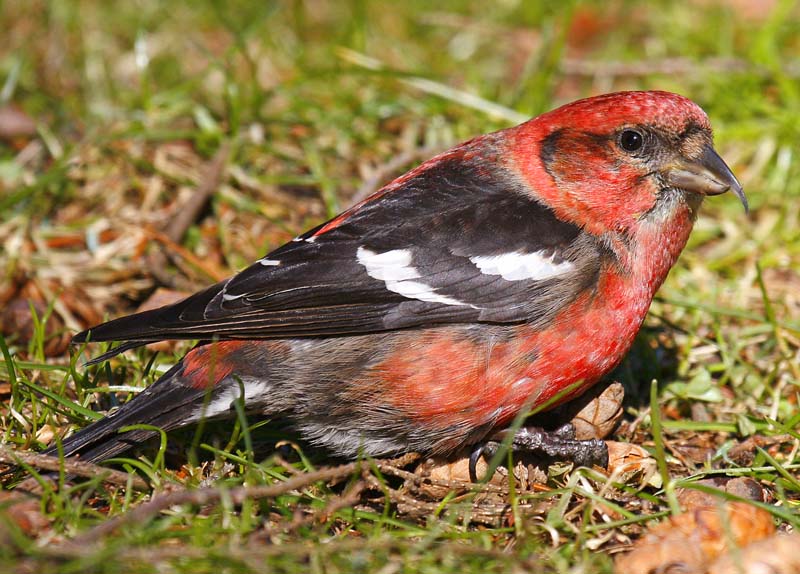
The Two-barred Crossbill is a bird in the finch family Fringillidae and the order Passeriformes. It breeds in Alaska, Canada, the northernmost United States, and across the Palearctic into northeastern Europe. It is distinguished by its crossed bill and two prominent white wing-bars.
Written 26 November 2026 from the sources listed below. Each statement was checked against the passage it cites; statements that could not be supported were removed.
Appearance
The Two-barred Crossbill has short legs, a forked tail, a crossed bill, and two prominent white wing-bars. It also has white tips to its tertials.[1][2]
Males of the nominate subspecies have bright raspberry-red foreheads, crowns, napes, and upperparts. Their scapulars are black or blackish brown with pink edges, and their upper tail coverts are black with white fringes.[3][4][5]
Females have greenish-yellow heads and upperparts instead of the pink coloration found in males. Adult males are brighter and pinker red than males of other crossbill species.[6][7]
Adults measure 14.5–17 cm in length and weigh 25–40 g.[8][9]
Habitat
The Two-barred Crossbill breeds in coniferous forests and nests in conifers. Its nests are usually positioned against the trunk of a conifer.[10][11][12]
Diet
The Two-barred Crossbill specializes in feeding on conifer cones and has a strong preference for larch cones. In Eurosiberia, it feeds on Siberian larch and Dahurian larch, while in North America it feeds on Tamarack larch.[13][14][15][16]
It also consumes rowan berries. In North America, its diet additionally includes eastern hemlock and white spruce cones.[17][18]
Behaviour
The Two-barred Crossbill uses its specialized bill to extract seeds from conifer cones. It is mainly resident but sometimes moves south when its food supply fails.[19][20]
The American subspecies appears to wander more frequently than the Eurosiberian subspecies. Outside the breeding season, the species forms flocks that often include other crossbill species.[21][22]
The Two-barred Crossbill is a rare visitor to western Europe, generally arriving during irruptions of red crossbills. Its call is weaker and higher-pitched than the call of the red crossbill.[23][24]
Reproduction and life cycle
The Two-barred Crossbill lays clutches of three to four eggs. Females construct nests primarily from conifer twigs, with nests positioned 2–20 m above the ground.[25][26][27]
Females incubate the eggs for 14–15 days, and both parents feed the chicks. Young birds leave the nest after 22–24 days.[28][29][30]
Young birds remain with their parents for up to six weeks after fledging.[31]
Similar species
The red or common crossbill is the principal species with which the Two-barred Crossbill may be confused. Within its Palearctic range, it has a smaller head and bill than the parrot crossbill and Scottish crossbill.[32][33]
The Two-barred Crossbill differs from the Hispaniolan crossbill in having less dark plumage and a less stout bill.[34]
Classification of the Two-barred Crossbill
| Kingdom | Animalia |
|---|---|
| Phylum | Chordata |
| Subphylum | Vertebrata |
| Infraphylum | Gnathostomata |
| Parvphylum | Osteichthyes |
| Megaclass | Tetrapoda |
| Class | Aves (Bird) |
| Order | Passeriformes (Passerine) |
| Family | Fringillidae (Finch) |
| Genus | Loxia (Crossbill) |
| Species | Loxia leucoptera J. F. Gmelin, 1789 |
Where the Two-barred Crossbill is found
Checklists and occurrence records place Loxia leucoptera in 33 countries across Asia and North America. GBIF holds 313,984 georeferenced records of it.
Countries
- Aland Islands 70
- Austria 9
- Belarus 10
- Belgium 69
- Bermuda 50
- Canada 157,610
- China 197
- Czechia 3
- Denmark 3,597
- Dominican Republic 4
- Estonia 210
- Faroe Islands 9
- Finland 3,845
- France 28
- Germany 66
- Greenland 4
- Hungary 4
- Iceland 37
- Japan 49
- Latvia 6
- Lithuania 6
- Mongolia 28
- Norway 10,024
- Poland 88
- Portugal 10
- Romania 3
- Russia 682
- Saint Pierre and Miquelon 208
- Sweden 42,428
- The Netherlands 1,610
- Ukraine 28
- United Kingdom 666
- United States 92,326
Regions and cities with the most records
- Quebec, Canada 59,837
- Alaska, United States 28,933
- Ontario, Canada 23,615
- Alberta, Canada 22,084
- British Columbia, Canada 11,485
- Minnesota, United States 11,120
- Yukon, Canada 8,652
- Newfoundland and Labrador, Canada 7,813
- Wisconsin, United States 7,075
- Michigan, United States 6,920
- Maine, United States 6,443
- Nova Scotia, Canada 5,957
- Calgary, Canada 5,540
- Rimouski, Canada 4,996
- Anchorage, United States 4,616
- Manitoba, Canada 4,534
- Västra Götaland, Sweden 4,495
- Skåne, Sweden 4,482
- New York, United States 4,318
- Saskatchewan, Canada 4,088
- L'Ancienne-Lorette, Canada 4,002
- Neufchâtel-Est–Lebourgneuf, Canada 3,998
- Stockholm, Sweden 3,850
- Uppsala, Sweden 3,824
- New Brunswick, Canada 3,570
- New Hampshire, United States 3,455
- Québec, Canada 3,449
- Massachusetts, United States 3,323
- Västerbotten, Sweden 3,225
- Lévis, Canada 3,078
- Whitehorse, Canada 2,931
- Uppsala, Sweden 2,525
- Mount Pearl, Canada 2,488
- St. John's, Canada 2,472
- Paradise, Canada 2,457
- Norrbotten, Sweden 2,443
Range as the checklists state it
Europe & Northern Asia (excluding China)
North America
Southern Asia
A number beside a place is its count of GBIF occurrence records. A place without a number comes from a checklist alone. Records show where a species has been observed or collected, which can include escapes and vagrants.
Common names
English
- Two-barred Crossbill
- White-winged Crossbill
Names in 48 other languages
- Arabic
- متقاطع المنقار أبيض الجناح, متقاطع المنقار ذو الخطين, هزار أبيض الجناح
- Belarusian
- Белакрылы крыжадзюб
- Breton
- Beg-kroaz divrezenn
- Bulgarian
- Белокрила кръсточовка
- Catalan
- trencapinyes d'ala blanca
- Chinese
- 白翅交嘴雀
- Croatian
- bjelokrili krstokljun
- Czech
- křivka bělokřídlá
- Danish
- Hvidvinget Korsnæb
- Dutch
- Witbandkruisbek
- Esperanto
- Rubanda krucbekulo, blankflugila krucbekulo
- Estonian
- vööt-käbilind
- Faroese
- vongblikut krossnev
- Finnish
- kirjosiipikäpylintu
- French
- Bec-croisé leucoptère, bec-croisé bifascié, beccroisé bifascié
- German
- Bindenkreuzschnabel
- Hebrew
- צלוב-מקור לבן-כנף
- Hungarian
- szalagos keresztcsőrű
- Icelandic
- Víxlnefur
- Irish
- Crosghob báneiteach, Crosghob stríoceiteach
- Italian
- Crociere fasciato
- Japanese
- ナキイスカ
- Kazakh
- Аққанатты қайшауыз
- Korean
- 흰죽지솔잣새
- Latvian
- Baltsvītru krustknābis, balstsvītru krustknābis
- Lithuanian
- margasparnis kryžiasnapis
- Mongolian
- Тольт солбинхушуут
- Northern Sami
- Girjebáhcatloddi, girjeruossanjunni
- Norwegian
- båndkorsnebb
- Norwegian Nynorsk
- bandkrossnebb
- Polish
- krzyżodziób modrzewiowy
- Portuguese
- Cruza-bico-franjado, cruza-bico-d'asa-branca, cruza-bico-listado
- Romanian
- Forfecuţă bălţată
- Russian
- Белокрылый клест, Белокрылый клёст
- Serbian
- Belokrili krstokljun
- Slovak
- krivonos bielokrídly
- Slovenian
- beloperuti krivokljun
- Spanish
- Piquituerto aliblanco
- Swedish
- amerikansk bändelkorsnäbb, bändelkorsnäbb
- Turkish
- Ak Kanatlı Çaprazgaga
- Ukrainian
- шишкар білокрилий
- Welsh
- Croesbig Adeinwen, Croesbigau Adeinwen, gylfingroes adeinwyn
- chm
- Ош шылдыран важыкнер
- chv
- Шур ҫунатлӑ кукӑрсӑмса
- glv
- Gob cam skian-vane
- ipk
- Siyyuum kipifaruq
- sah
- Тиит ымыыта
- udm
- Тӧдьы бурдо кайсы
Synonyms
3 other scientific names have been used for this species and are now treated as synonyms of Loxia leucoptera.
- Loxia amurensis Dubois
- Loxia elegans Homeyer
- Loxorynchus albipennis Morris, FO, 1837
Subspecies and varieties
- Loxia leucoptera bifasciata (Two-barred Crossbill) subspecies
- Loxia leucoptera leucoptera (White-winged Crossbill) subspecies
Related species
-
 Red CrossbillLoxia curvirostra
-
 Scottish CrossbillLoxia scotica
-
 Parrot CrossbillLoxia pytyopsittacus
-
 Cassia CrossbillLoxia sinesciuris
-
 Hispaniolan CrossbillLoxia megaplaga
- Loxia bicolor
- Loxia butyracea
- Loxia cana
Compare
Questions and answers
What is the scientific name of the Two-barred Crossbill?
The scientific name of the Two-barred Crossbill is Loxia leucoptera. Written with its author, the full name is Loxia leucoptera J. F. Gmelin, 1789.
Which family does the Two-barred Crossbill belong to?
Loxia leucoptera belongs to the family Fringillidae, in the order Passeriformes and the class Aves.
Where is the Two-barred Crossbill found?
Checklists and occurrence records place Loxia leucoptera in 33 countries, including Canada, United States, Sweden, Norway, Finland and Denmark.
What is the conservation status of the Two-barred Crossbill?
The IUCN Red List category recorded for Loxia leucoptera is Least Concern (LC).
What other names does the Two-barred Crossbill have?
Loxia leucoptera is also known in English as White-winged Crossbill.
What type of bird is a crossbill?
The Two-barred Crossbill is a bird in the finch family Fringillidae and the order Passeriformes.[35]
What are some interesting facts about the crossbill bird?
The Two-barred Crossbill has a crossed bill, two prominent white wing-bars, and a forked tail. It specializes in feeding on conifer cones and has a strong preference for larch cones.[1][13][14]
Sources
Passages the profile rests on
- The species has short legs, a forked tail, a crossed bill, and two prominent white wing-bars. Source passage: “It has short legs, a forked tail, a crossed bill and two prominent white wing-bars.” — English Wikipedia
- The species has white tips to its tertials. Source passage: “There are also white tips to the tertials.” — English Wikipedia
- Males of the nominate subspecies have bright raspberry-red foreheads, crowns, napes, and upperparts. Source passage: “The male of the nominate subspecies has forehead, crown, nape and upper-parts bright raspberry-red.” — English Wikipedia
- The scapulars of males are black or blackish brown with pink edges. Source passage: “The scapulars are black or blackish brown with pink edges.” — English Wikipedia
- The upper tail coverts are black with white fringes. Source passage: “The upper tail coverts are black with white fringes.” — English Wikipedia
- Females have greenish-yellow heads and upperparts instead of the pink coloration found in males. Source passage: “The female lacks the pink and instead has greenish-yellow head and upperparts.” — English Wikipedia
- Adult males are brighter and pinker red than males of other crossbill species. Source passage: “The adult male is also a somewhat brighter (pinker) red than other male crossbills.” — English Wikipedia
- Adults measure 14.5–17 cm in length. Source passage: “The two-barred crossbill is 14.5–17 cm (5.7–6.7 in) in length” — English Wikipedia
- Adults weigh 25–40 g. Source passage: “weighs 25–40 g (0.88–1.41 oz).” — English Wikipedia
- The species breeds in coniferous forests. Source passage: “It breeds in the coniferous forests of North America and the Palearctic.” — English Wikipedia
- The species nests in conifers. Source passage: “It nests in conifers, laying 3–5 eggs.” — English Wikipedia
- Its nests are usually positioned against the trunk of a conifer. Source passage: “usually against the trunk of a conifer.” — English Wikipedia
- The species specializes in feeding on conifer cones. Source passage: “They are specialist feeders on conifer cones” — English Wikipedia
- The species has a strong preference for larch cones. Source passage: “The two-barred crossbill has a strong preference for larch (Larix)” — English Wikipedia
- In Eurosiberia, the species feeds on Siberian larch and Dahurian larch. Source passage: “in Eurosiberia using Siberian larch (Larix sibirica) and Dahurian larch (L. gmelinii)” — English Wikipedia
- In North America, the species feeds on Tamarack larch. Source passage: “in North America Tamarack larch (L. laricina).” — English Wikipedia
- The species also consumes rowan berries. Source passage: “It will also take rowan (Sorbus) berries” — English Wikipedia
- In North America, the species also feeds on eastern hemlock and white spruce cones. Source passage: “in North America, also eastern hemlock (Tsuga canadensis) and white spruce (Picea glauca) cones.” — English Wikipedia
- The species uses its specialized bill to extract seeds from conifer cones. Source passage: “the unusual bill shape is an adaptation to assist the extraction of the seeds from the cone.” — English Wikipedia
- The species is mainly resident but sometimes moves south when its food supply fails. Source passage: “This crossbill is mainly resident, but will irregularly irrupt south if its food source fails.” — English Wikipedia
- The American subspecies appears to wander more frequently than the Eurosiberian subspecies. Source passage: “The American race seems to wander more frequently than the Eurosiberian subspecies.” — English Wikipedia
- Outside the breeding season, the species forms flocks that often include other crossbill species. Source passage: “This species will form flocks outside the breeding season, often mixed with other crossbills.” — English Wikipedia
- The species is a rare visitor to western Europe, generally arriving during irruptions of red crossbills. Source passage: “It is a rare visitor to western Europe, usually arriving with an irruption of red crossbills.” — English Wikipedia
- Its call is weaker and higher-pitched than the call of the red crossbill. Source passage: “The chip call is weaker and higher than that of the red crossbill.” — English Wikipedia
- The species lays clutches of three to four eggs. Source passage: “The clutch of 3–4 eggs is incubated by the female for 14–15 days.” — English Wikipedia
- Nests are positioned 2–20 m above the ground. Source passage: “The nest is placed 2–20 m (6 ft 7 in – 65 ft 7 in) above the ground” — English Wikipedia
- Females construct the nests primarily from conifer twigs. Source passage: “The nest is built by the female and mainly consists of conifer twigs.” — English Wikipedia
- Females incubate the eggs for 14–15 days. Source passage: “The clutch of 3–4 eggs is incubated by the female for 14–15 days.” — English Wikipedia
- Both parents feed the chicks. Source passage: “The chicks are fed by both parents.” — English Wikipedia
- Young birds leave the nest after 22–24 days. Source passage: “They fledge after 22–24 days” — English Wikipedia
- Young birds remain with their parents for up to six weeks after fledging. Source passage: “but then remain with their parents for up to 6 weeks.” — English Wikipedia
- The red or common crossbill is the principal species with which the two-barred crossbill may be confused. Source passage: “the main confusion between species both there and in North America is with the red or common crossbill.” — English Wikipedia
- The two-barred crossbill has a smaller head and bill than the parrot crossbill and Scottish crossbill within its Palearctic range. Source passage: “Within its Palearctic range, this species is smaller-headed and smaller-billed than the parrot crossbill and Scottish crossbill” — English Wikipedia
- The two-barred crossbill differs from the Hispaniolan crossbill in having less dark plumage and a less stout bill. Source passage: “differs from the two-barred crossbill in darker plumage, a stouter bill” — English Wikipedia
- The species is classified in the finch family Fringillidae. Source passage: “The two-barred crossbill or white-winged crossbill (Loxia leucoptera) is a small passerine bird in the finch family Fringillidae.” — English Wikipedia
- The species breeds in Alaska, Canada, and the northernmost United States. Source passage: “This bird breeds in the coniferous forests of Alaska, Canada, the northernmost United States” — English Wikipedia
- The species' breeding distribution extends across the Palearctic into northeastern Europe. Source passage: “and across the Palearctic extending into northeast Europe.” — English Wikipedia
Data
- Catalogue of Life, 2026-10-16 XR cc by
- Global Biodiversity Information Facility CC BY 4.0
- Wikidata CC0
- GeoNames CC BY 4.0
- Wikimedia Commons per image; credit shown with each image
- Within the Catalogue of Life, this name comes from The Integrated Taxonomic Information System cc0
References
- Syst. Nat. 1 pt 2 p. 844 where the name was published
- Banks, R. C., R. W. McDiarmid, and A. L. Gardner. (1987). Checklist of Vertebrates of the United States, the U.S. Territories, and Canada. Resource Publication, No. 166.
- Gill, Frank, & and Minturn Wright. (2006). Birds of the World: Recommended English Names.
This species in other databases
- Catalogue of Life 3W8WT
- Wikidata Q331190
- iNaturalist 10423
- WoRMS urn:lsid:marinespecies.org:taxname:1484471
- Avibase whwcro
Page built on 28 November 2026. See how the catalog is made and all sources and licences.
Cite this page
ScientificNames.org. (2026). Loxia leucoptera (Two-barred Crossbill). Retrieved November 28, 2026, from https://scientificnames.org/species/loxia-leucoptera
“Loxia leucoptera (Two-barred Crossbill).” ScientificNames.org, 2026, scientificnames.org/species/loxia-leucoptera. Accessed 28 Nov. 2026.
ScientificNames.org. “Loxia leucoptera (Two-barred Crossbill).” Accessed November 28, 2026. https://scientificnames.org/species/loxia-leucoptera.
@misc{scientificnames_loxia_leucoptera_two_barred_crossbill,
  author = {{ScientificNames.org}},
  title = {Loxia leucoptera (Two-barred Crossbill)},
  year = {2026},
  url = {https://scientificnames.org/species/loxia-leucoptera},
  note = {Accessed 2026-11-28}
}