Species · Birds
Parrot Crossbill Loxia pytyopsittacus
The scientific name of the Parrot Crossbill is Loxia pytyopsittacus. It is a species of bird in the family Fringillidae (finch), order Passeriformes. The name dates from 1793.
- Scientific name
- Loxia pytyopsittacus von Borkhausen, 1793
- Common name
- Parrot Crossbill
- Genus
- Loxia
- Family
- Fringillidae (Finch)
- Order
- Passeriformes
- Class
- Aves
- Red List category
- LC Least Concern
- Recorded in
- 18 countries
- Name status
- accepted in the Catalogue of Life

Overview
Loxia pytyopsittacus breeds in pine forests in northern and northeastern Europe. It is distinguished by its relatively large head and thick, heavy bill compared with other crossbill species.
Written 26 November 2026 from the sources listed below. Each statement was checked against the passage it cites; statements that could not be supported were removed.
Appearance
The Parrot Crossbill measures 16–18 cm in body length and has a wingspan of 27–31 cm. Its body mass ranges from 44 to 58.2 g, with an average of approximately 53 g.[1][2][3][4]
The species has a bulky body, a relatively large head and a bull-necked appearance. Its bill is deep, heavy and thicker than those of related crossbill species, while its crossed tips are often difficult to see.[5][6][7][8][9][10]
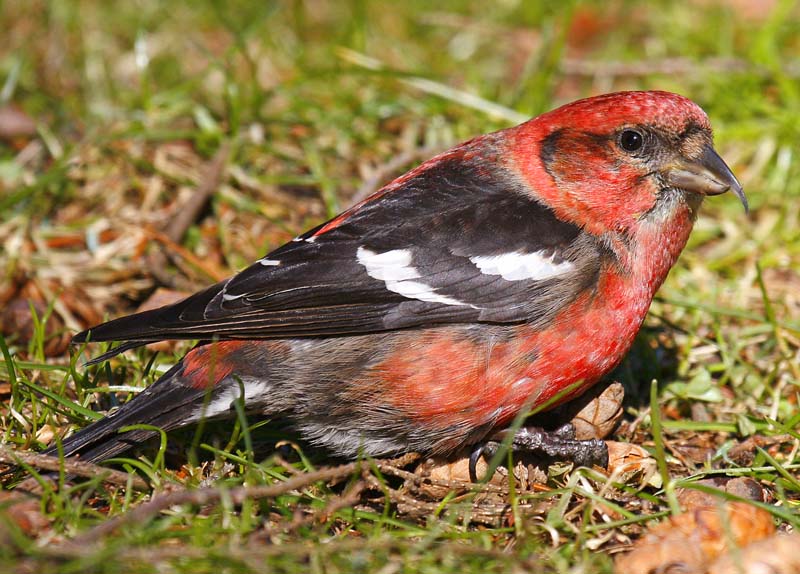
Adult males are generally red or orange, while adult females are generally green or yellow. Plumage varies, and females and juvenile birds are greenish.[11][12][13]
The species has an unusual bill shape adapted to extracting seeds from cones.[14]
Habitat
The Parrot Crossbill breeds in pine forests in northern and northeastern Europe. Its breeding distribution extends across northwestern Europe into western Russia. A small population occurs in Scotland.[15][16][17]
Diet
The Parrot Crossbill specialises in feeding on conifer cones. Scots pine cones are a specialised food source for the species.[18][19]
Behaviour
The Parrot Crossbill is mainly resident but can migrate south and west when its food supply fails. Outside the breeding season, individuals form flocks that may include other crossbill species.[20][21][22]
Its deep, hard choop or tyuup call is considered a useful identification feature.[23]
Similar species
The Parrot Crossbill is difficult to distinguish from red crossbills and Scottish crossbills using plumage. Its overall appearance is otherwise identical to that of the red crossbill.[24][25]
The Parrot Crossbill occurs alongside red crossbills and Scottish crossbills in Scotland.[26]
Conservation
The Parrot Crossbill was most recently assessed for the IUCN Red List in 2020.[27]
Classification of the Parrot Crossbill
| Kingdom | Animalia |
|---|---|
| Phylum | Chordata |
| Subphylum | Vertebrata |
| Infraphylum | Gnathostomata |
| Parvphylum | Osteichthyes |
| Megaclass | Tetrapoda |
| Class | Aves (Bird) |
| Order | Passeriformes (Passerine) |
| Family | Fringillidae (Finch) |
| Genus | Loxia (Crossbill) |
| Species | Loxia pytyopsittacus von Borkhausen, 1793 |
Where the Parrot Crossbill is found
Checklists and occurrence records place Loxia pytyopsittacus in 18 countries. GBIF holds 144,099 georeferenced records of it.
Countries
- Aland Islands 452
- Austria 5
- Belgium 983
- Denmark 9,616
- Estonia 1,072
- Finland 14,159
- France 80
- Germany 340
- Iceland 4
- Latvia 73
- Lithuania 23
- Norway 22,142
- Poland 113
- Russia 407
- Sweden 86,111
- The Netherlands 7,604
- Ukraine 7
- United Kingdom 908
Regions and cities with the most records
- Stockholm, Sweden 9,626
- Västra Götaland, Sweden 8,024
- Västerbotten, Sweden 6,718
- Skåne, Sweden 6,481
- Kalmar, Sweden 6,194
- Uppsala, Sweden 5,764
- Dalarna, Sweden 3,809
- Jönköping, Sweden 3,502
- Norrbotten, Sweden 3,483
- Capital Region, Denmark 3,465
- Gotland, Sweden 3,417
- Södermanland, Sweden 3,142
- Gävleborg, Sweden 3,033
- Örebro, Sweden 2,962
- Västmanland, Sweden 2,955
- Lapland, Finland 2,510
- Värmland, Sweden 2,480
- Rogaland, Norway 2,356
- Telemark, Norway 2,312
- Trångsund, Sweden 2,282
- Halland, Sweden 2,149
- Umeå, Sweden 2,043
- Jämtland, Sweden 2,038
- Nacka, Sweden 1,968
- Haninge, Sweden 1,948
- Östergötland, Sweden 1,921
- Danderyd, Sweden 1,901
- Sollentuna, Sweden 1,893
- Stockholm, Sweden 1,889
- Sundbyberg, Sweden 1,790
- Kronoberg, Sweden 1,762
- Solna, Sweden 1,758
- Täby, Sweden 1,758
- Uppsala, Sweden 1,751
- Gustavsberg, Sweden 1,672
- Zealand, Denmark 1,663
1 more country has a few records outside this range
These countries hold a few records of Loxia pytyopsittacus but lie outside the range the checklists give for it. Such records are often zoo or garden specimens, museum material or vagrants, so the species is not counted as occurring there.
Range as the checklists state it
Europe & Northern Asia (excluding China)
A number beside a place is its count of GBIF occurrence records. A place without a number comes from a checklist alone. Records show where a species has been observed or collected, which can include escapes and vagrants.
Common names
English
- Parrot Crossbill
Names in 42 other languages
- Arabic
- متقاطع المنقار الببغائي, هزار ببغائي
- Belarusian
- Крыжадзюб-сасновік, Сасновы крыжадзюб
- Breton
- Beg-kroaz peroked
- Bulgarian
- Дебелоклюна кръсточовка
- Catalan
- trencapinyes becgròs
- Chinese
- 鸚交嘴雀, 鹦交嘴雀
- Croatian
- veliki krstokljun
- Czech
- křivka velká
- Danish
- Stor Korsnæb
- Dutch
- Grote Kruisbek
- Esperanto
- Granda krucbekulo, papaga krucbekulo
- Estonian
- männi-käbilind
- Faroese
- Stórt krossnev
- Finnish
- isokäpylintu
- French
- Bec-croisé perroquet, beccroisé perroquet
- German
- Kiefernkreuzschnabel
- Hebrew
- צלוב-מקור תוכיי
- Hungarian
- nagy keresztcsőrű
- Icelandic
- Pánefur
- Irish
- Crosghob giúise
- Italian
- Crociere delle pinete
- Japanese
- ハシブトイスカ
- Latvian
- priežu krustknābis
- Lithuanian
- pušinis kryžiasnapis
- Northern Sami
- Beahcebáhcatloddi, beahceruossanjunni
- Norwegian
- furukorsnebb
- Norwegian Nynorsk
- furukrossnebb
- Polish
- krzyżodziób sosnowy
- Portuguese
- cruza-bico-papagaio
- Romanian
- Forfecar
- Russian
- Клест-сосновик, Клёст-сосновик
- Serbian
- Borov krstokljun
- Slovak
- krivonos sosnový
- Slovenian
- veliki krivokljun
- Spanish
- Piquituerto lorito
- Swedish
- större korsnäbb
- Turkish
- Koca Başlı Çaprazgaga
- Ukrainian
- шишкар сосновий
- Welsh
- gylfingroes parotaidd
- chv
- Хыр кукӑрсӑмси
- glv
- Gob cam mooar
- rue
- Сосновик
Synonyms
5 other scientific names have been used for this species and are now treated as synonyms of Loxia pytyopsittacus.
- Crucirostra subpityopsittacus Brehm, CL, 1827
- Loxia curvirostra major Bechstein, JM, 1794
- Loxia curvirostra romanus Burg, G, 1920
- Loxia pityopsittacus estiae Härms, M; Piiper, VJ, 1922
- Loxia pytyopsittacus norwegica Laubmann, AL, 1927
Related species
-
 Red CrossbillLoxia curvirostra
-
 Scottish CrossbillLoxia scotica
-
 Two-barred CrossbillLoxia leucoptera
-
 Cassia CrossbillLoxia sinesciuris
-
 Hispaniolan CrossbillLoxia megaplaga
- Loxia bicolor
- Loxia butyracea
- Loxia cana
Compare
Questions and answers
What is the scientific name of the Parrot Crossbill?
The scientific name of the Parrot Crossbill is Loxia pytyopsittacus. Written with its author, the full name is Loxia pytyopsittacus von Borkhausen, 1793.
Which family does the Parrot Crossbill belong to?
Loxia pytyopsittacus belongs to the family Fringillidae, in the order Passeriformes and the class Aves.
Where is the Parrot Crossbill found?
Checklists and occurrence records place Loxia pytyopsittacus in 18 countries, including Sweden, Norway, Finland, Denmark, The Netherlands and Estonia.
What is the conservation status of the Parrot Crossbill?
The IUCN Red List category recorded for Loxia pytyopsittacus is Least Concern (LC).
Sources
Passages the profile rests on
- The species measures 16–18 cm in body length. Source passage: “measuring 16 to 18 cm (6.3 to 7.1 in) long” — English Wikipedia
- Its wingspan measures 27–31 cm. Source passage: “spanning 27 to 31 cm (11 to 12 in) across the wings.” — English Wikipedia
- Its body mass ranges from 44 to 58.2 g. Source passage: “weighing from 44 to 58.2 g (1.55 to 2.05 oz)” — English Wikipedia
- Its average body mass is approximately 53 g. Source passage: “with an average of 53 g (1.9 oz).” — English Wikipedia
- The species has a relatively large head and bill compared with other crossbill species. Source passage: “The head and bill are larger than in either of the other species.” — English Wikipedia
- Its bill is thicker than those of related crossbill species. Source passage: “The bill is thicker than those of its relatives” — English Wikipedia
- Its crossed bill tips are often difficult to see. Source passage: “the crossed tips are often not readily apparent.” — English Wikipedia
- The species has a bulky body shape. Source passage: “It is quite bulky and heavy” — English Wikipedia
- The species has a bull-necked and big-headed appearance. Source passage: “Bull-necked, big-headed crossbill” — ebird.org
- Its bill is deep and heavy. Source passage: “with a deep and heavy bill” — ebird.org
- Adult males are generally red or orange, although their plumage varies. Source passage: “Adult males tend to be red or orange in colour, and females green or yellow, but there is much variation.” — English Wikipedia
- Adult females are generally green or yellow, although their plumage varies. Source passage: “Adult males tend to be red or orange in colour, and females green or yellow, but there is much variation.” — English Wikipedia
- Females and juvenile birds are greenish. Source passage: “females and juveniles greenish.” — ebird.org
- Its unusual bill shape is adapted to extracting seeds from cones. Source passage: “the unusual bill shape is an adaptation to assist the extraction of the seeds from the cone.” — English Wikipedia
- The species breeds in pine forests in northern and northeastern Europe. Source passage: “It breeds in pine forests in northern and northeastern Europe.” — English Wikipedia
- Its breeding distribution extends across northwestern Europe into western Russia. Source passage: “This bird breeds in the pine forests of northwest Europe and into western Russia.” — English Wikipedia
- A small population occurs in Scotland. Source passage: “There is also a small population in Scotland” — English Wikipedia
- The species specialises in feeding on conifer cones. Source passage: “They are specialist feeders on conifer cones” — English Wikipedia
- Scots pine cones are a specialised food source for the species. Source passage: “The parrot crossbill is a specialist feeder on the cones of Scots pine.” — English Wikipedia
- The species is mainly resident. Source passage: “This crossbill is mainly resident” — English Wikipedia
- It can migrate south and west when its food supply fails. Source passage: “but will migrate south and west if its food source fails.” — English Wikipedia
- Outside the breeding season, individuals form flocks that may include other crossbill species. Source passage: “Parrot crossbills will form flocks outside the breeding season, often mixed with other crossbills.” — English Wikipedia
- Its deep, hard choop or tyuup call is considered a useful identification feature. Source passage: “The deeper, harder choop or tyuup call is probably the best indicator.” — English Wikipedia
- The species is difficult to distinguish from red crossbills and Scottish crossbills using plumage. Source passage: “This species is difficult to separate from red and Scottish crossbills, and plumage distinctions are negligible.” — English Wikipedia
- Its overall appearance is otherwise identical to that of the red crossbill. Source passage: “otherwise identical to Red Crossbill.” — ebird.org
- The species occurs alongside red crossbills and Scottish crossbills in Scotland. Source passage: “There is also a small population in Scotland, adding to the difficulty of distinguishing it from the sympatric red crossbill and the endemic Scottish crossbill.” — English Wikipedia
- The species was most recently assessed for the IUCN Red List in 2020. Source passage: “Parrot Crossbill Loxia pytyopsittacus has most recently been assessed for The IUCN Red List of Threatened Species in 2020.” — iucnredlist.org
Data
- Catalogue of Life, 2026-10-16 XR cc by
- Global Biodiversity Information Facility CC BY 4.0
- Wikidata CC0
- GeoNames CC BY 4.0
- Wikimedia Commons per image; credit shown with each image
- Within the Catalogue of Life, this name comes from The Integrated Taxonomic Information System cc0
References
- Rheinisches Magazin 1 p. 139 where the name was published
- Gill, Frank, & and Minturn Wright. (2006). Birds of the World: Recommended English Names.
This species in other databases
Page built on 26 November 2026. See how the catalog is made and all sources and licences.
Cite this page
ScientificNames.org. (2026). Loxia pytyopsittacus (Parrot Crossbill). Retrieved November 26, 2026, from https://scientificnames.org/species/loxia-pytyopsittacus
“Loxia pytyopsittacus (Parrot Crossbill).” ScientificNames.org, 2026, scientificnames.org/species/loxia-pytyopsittacus. Accessed 26 Nov. 2026.
ScientificNames.org. “Loxia pytyopsittacus (Parrot Crossbill).” Accessed November 26, 2026. https://scientificnames.org/species/loxia-pytyopsittacus.
@misc{scientificnames_loxia_pytyopsittacus_parrot_crossbill,
  author = {{ScientificNames.org}},
  title = {Loxia pytyopsittacus (Parrot Crossbill)},
  year = {2026},
  url = {https://scientificnames.org/species/loxia-pytyopsittacus},
  note = {Accessed 2026-11-26}
}