Species · Fishes
Rainwater Killifish Lucania parva
The scientific name of the Rainwater Killifish is Lucania parva. It is a species of fish in the family Fundulidae (fundulines), order Cyprinodontiformes. The name dates from 1855.
- Scientific name
- Lucania parva (Baird & Girard, 1855)
- Common name
- Rainwater Killifish
- Genus
- Lucania
- Family
- Fundulidae (Fundulines)
- Order
- Cyprinodontiformes
- Class
- Teleostei
- Red List category
- LC Least Concern
- Environment
- brackish, freshwater, marine
- Recorded in
- 2 countries
- Name status
- accepted in the Catalogue of Life

Overview
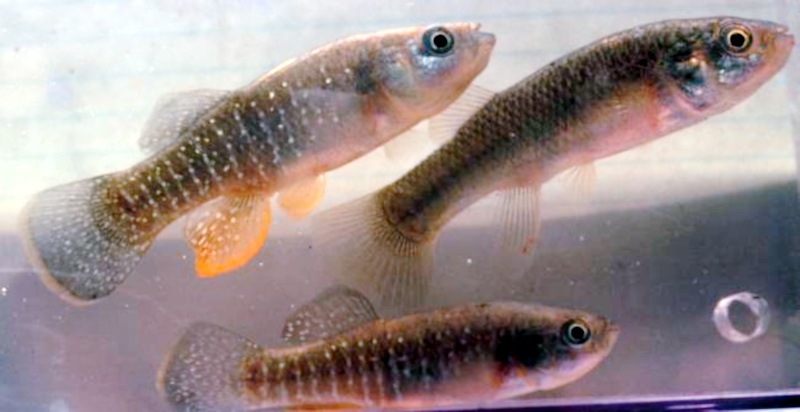
The Rainwater Killifish is a fish with a silvery body, yellow flashes, and diamond-shaped scales. It commonly occurs in freshwater and brackish estuarine environments, with a distribution from Cape Cod, Massachusetts, to Tampico, Mexico, and additional inland and Yucatán Peninsula occurrences. It can reach a total length of 7 centimetres.
Written 26 November 2026 from the sources listed below. Each statement was checked against the passage it cites; statements that could not be supported were removed.
Appearance
The Rainwater Killifish has a silvery body with yellow flashes and diamond-shaped scales. It can reach a total length of 7 centimetres.[1][2]
Habitat
The species commonly occurs in large numbers in freshwater and brackish estuarine environments.[3]
Its distribution extends from Cape Cod, Massachusetts, to Tampico, Mexico, with additional reported occurrences on the Yucatán Peninsula. It also occurs inland in parts of New Mexico, Texas, and Mexico, and a collection record documents its occurrence in Solano County, California.[4][5][6]
In southern Biscayne Bay, Florida, submerged aquatic vegetation was the strongest potential limiting habitat variable influencing the species' density. The study examined density and size in relation to salinity, salinity variation, submerged aquatic vegetation, temperature, and depth.[7][8]
Decreases in mean salinity and salinity variation may increase Rainwater Killifish densities in southern Biscayne Bay.[9]
Diet
The Rainwater Killifish feeds on various aquatic invertebrates.[10]
Behaviour
Rainwater Killifish densities in the southern Biscayne Bay study were generally higher during wet seasons and lower during dry seasons, although this pattern depended on the year.[11]
Conservation
The study concluded that the Rainwater Killifish is not an ideal indicator species for salinity conditions modified by the Comprehensive Everglades Restoration Plan because of its high stress tolerance and extreme density variability.[12]
The study recommended continuing to track Rainwater Killifish populations as Everglades restoration activities proceed.[13]
Classification of the Rainwater Killifish
| Kingdom | Animalia |
|---|---|
| Phylum | Chordata |
| Subphylum | Vertebrata |
| Infraphylum | Gnathostomata |
| Parvphylum | Osteichthyes |
| Gigaclass | Actinopterygii |
| Superclass | Actinopteri |
| Class | Teleostei (Teleost) |
| Order | Cyprinodontiformes |
| Family | Fundulidae (Fundulines) |
| Genus | Lucania (Brightfin Killifishes) |
| Species | Lucania parva (Baird & Girard, 1855) |
Where the Rainwater Killifish is found
Checklists and occurrence records place Lucania parva in 2 countries. GBIF holds 30,723 georeferenced records of it.
Countries
Regions and cities with the most records
- Florida, United States 8,041
- Coconut Grove, United States 7,875
- Coral Gables, United States 7,817
- Coral Terrace, United States 7,109
- Flagami, United States 6,971
- Little Havana, United States 6,877
- Miami, United States 6,433
- Allapattah, United States 6,332
- Brownsville, United States 6,332
- Miami Beach, United States 6,332
- West Little River, United States 6,329
- Hialeah, United States 6,328
- Pinewood, United States 6,326
- Golden Glades, United States 6,325
- North Miami, United States 6,325
- Opa-locka, United States 6,322
- Westchester, United States 5,700
- North Miami Beach, United States 5,685
- Hialeah Gardens, United States 5,575
- Hallandale Beach, United States 5,547
- Aventura, United States 5,546
- Carol City, United States 5,546
- Ives Estates, United States 5,546
- Miami Gardens, United States 5,546
- Norland, United States 5,546
- Ojus, United States 5,546
- Sunny Isles Beach, United States 5,546
- West Park, United States 5,546
- Miami Lakes, United States 5,545
- Cutler, United States 4,247
- Palmetto Bay, United States 4,246
- Cutler Bay, United States 4,244
- Cutler Ridge, United States 4,244
- South Miami Heights, United States 4,243
- Leisure City, United States 4,239
- Princeton, United States 4,235
A number beside a place is its count of GBIF occurrence records. A place without a number comes from a checklist alone. Records show where a species has been observed or collected, which can include escapes and vagrants.
Common names
English
- Rainwater Killifish
Names in 6 other languages
- Chinese
- 雨點盧氏鮰
- Czech
- lukánie dešťová
- Mandarin Chinese
- 雨点卢氏鮰
- Russian
- Дождеводная лукания
- Spanish
- sardinilla de lluvia
- Thai
- ปลาคิลลิฟิชน้ำฝน
Synonyms
3 other scientific names have been used for this species and are now treated as synonyms of Lucania parva.
- Cyprinodon parvus Baird & Girard, 1855
- Limia venusta Girard, 1858
- Lucania affinis Girard, 1859
Related species
-
 Bluefin KillifishLucania goodei
-
 Cuatrocienegas KillifishLucania interioris
-
 MummichogFundulus heteroclitus
-
 Banded KillifishFundulus diaphanus
-
 Blackstripe TopminnowFundulus notatus
-
 Gulf KillifishFundulus grandis
-
 Golden TopminnowFundulus chrysotus
-
 Striped KillifishFundulus majalis
Compare
Questions and answers
What is the scientific name of the Rainwater Killifish?
The scientific name of the Rainwater Killifish is Lucania parva. Written with its author, the full name is Lucania parva (Baird & Girard, 1855).
Which family does the Rainwater Killifish belong to?
Lucania parva belongs to the family Fundulidae, in the order Cyprinodontiformes and the class Teleostei.
Where is the Rainwater Killifish found?
Checklists and occurrence records place Lucania parva in 2 countries: United States and Mexico.
What is the conservation status of the Rainwater Killifish?
The IUCN Red List category recorded for Lucania parva is Least Concern (LC).
What do killifish eat?
The Rainwater Killifish feeds on various aquatic invertebrates.[10]
Sources
Passages the profile rests on
- The rainwater killifish has a silvery body with yellow flashes and diamond-shaped scales. Source passage: “a small silvery fish with yellow flashes and diamond shaped scales” — English Wikipedia
- The rainwater killifish can reach a total length of 7 centimetres. Source passage: “It can reach up to 7 centimetres (2.8 in) total length.” — English Wikipedia
- The species commonly occurs in large numbers in freshwater and brackish estuarine environments. Source passage: “commonly found in large numbers in fresh to brackish estuarine environments” — English Wikipedia
- The species is distributed from Cape Cod, Massachusetts, to Tampico, Mexico, with additional reported occurrences on the Yucatán Peninsula. Source passage: “widespread from Cape Cod, Massachusetts, through to Tampico, Mexico, with occurrences reported on the Yucatán peninsula.” — English Wikipedia
- The rainwater killifish also occurs inland in parts of New Mexico, Texas, and Mexico. Source passage: “inland in parts of New Mexico, Texas and Mexico.” — English Wikipedia
- A collection record documents the occurrence of the rainwater killifish in Solano County, California. Source passage: “Common Name, Rainwater Killifish ; State, CA ; County, Solano.” — nas.er.usgs.gov
- In southern Biscayne Bay, Florida, submerged aquatic vegetation was the strongest potential limiting habitat variable influencing rainwater killifish density in the study. Source passage: “SAV was the strongest influencing, and (potentially) most limiting, habitat variable on killifish density” — repository.library.noaa.gov
- The southern Biscayne Bay study examined rainwater killifish density and size in relation to salinity, salinity variation, submerged aquatic vegetation, temperature, and depth. Source passage: “relations with salinity, salinity variation, submerged aquatic vegetation (SAV), temperature, and depth.” — repository.library.noaa.gov
- Decreases in mean salinity and salinity variation may increase rainwater killifish densities in southern Biscayne Bay. Source passage: “decreases in mean salinity and salinity variation may result in higher killifish densities in our study domain.” — repository.library.noaa.gov
- The rainwater killifish feeds on various aquatic invertebrates. Source passage: “It feeds on various aquatic invertebrates.” — English Wikipedia
- Rainwater killifish densities in the southern Biscayne Bay study were generally higher during wet seasons and lower during dry seasons, although this pattern depended on the year. Source passage: “high densities were associated with the wet season and low densities with the dry, although this depended on year.” — repository.library.noaa.gov
- The study concluded that the rainwater killifish is not an ideal indicator species for salinity conditions modified by the Comprehensive Everglades Restoration Plan because of its high stress tolerance and extreme density variability. Source passage: “Owing to its high stress ‐tolerance and extreme variability in density, L. parva is not an ideal indicator species of CERP‐modified salinity conditions” — repository.library.noaa.gov
- The study recommended continuing to track rainwater killifish populations as Everglades restoration activities proceed. Source passage: “but warrants tracking as restoration activities ensue.” — repository.library.noaa.gov
Data
- Catalogue of Life, 2026-10-16 XR cc by
- Global Biodiversity Information Facility CC BY 4.0
- Wikidata CC0
- GeoNames CC BY 4.0
- Wikimedia Commons per image; credit shown with each image
- Within the Catalogue of Life, this name comes from World Register of Marine Species cc by
References
- Girard, 1855 where the name was published
This species in other databases
- Catalogue of Life 6QPBT
- Wikidata Q3455573
- iNaturalist 104824
- WoRMS urn:lsid:marinespecies.org:taxname:159310
- ITIS 165679
Page built on 26 November 2026. See how the catalog is made and all sources and licences.
Cite this page
ScientificNames.org. (2026). Lucania parva (Rainwater Killifish). Retrieved November 26, 2026, from https://scientificnames.org/species/lucania-parva
“Lucania parva (Rainwater Killifish).” ScientificNames.org, 2026, scientificnames.org/species/lucania-parva. Accessed 26 Nov. 2026.
ScientificNames.org. “Lucania parva (Rainwater Killifish).” Accessed November 26, 2026. https://scientificnames.org/species/lucania-parva.
@misc{scientificnames_lucania_parva_rainwater_killifish,
  author = {{ScientificNames.org}},
  title = {Lucania parva (Rainwater Killifish)},
  year = {2026},
  url = {https://scientificnames.org/species/lucania-parva},
  note = {Accessed 2026-11-26}
}