Species · Fishes
Pikehead Luciocephalus pulcher
The scientific name of the Pikehead is Luciocephalus pulcher. It is a species of fish in the family Osphronemidae (gourami), order Anabantiformes. The name dates from 1830.
- Scientific name
- Luciocephalus pulcher (Gray, 1830)
- Common name
- Pikehead
- Genus
- Luciocephalus
- Family
- Osphronemidae (Gourami)
- Order
- Anabantiformes
- Class
- Teleostei
- Red List category
- LC Least Concern
- Environment
- freshwater
- Recorded in
- 5 countries
- Name status
- accepted in the Catalogue of Life

Overview
Luciocephalus pulcher inhabits flooded forests, streams, and peat swamps, particularly where vegetation is plentiful. It is a specialized ambush predator that can extend its jaw to approximately one-third of its body length when attacking prey.
Written 26 November 2026 from the sources listed below. Each statement was checked against the passage it cites; statements that could not be supported were removed.
Appearance
Pikehead has a yellowish-brown body marked with dark brown longitudinal bands and stripes. It can reach a standard length of 20 centimetres.[1][2]
Habitat
Pikehead inhabits flooded forests, streams, and peat swamps, particularly where vegetation is plentiful.[3]
Diet
Pikehead is a specialized predator that typically preys on smaller fish. It can prey on fish that are almost half its own length.[4][5]
Behaviour
Pikehead is a specialized ambush predator that spends most of its time motionless near plants or other cover while waiting for prey. When attacking, it can extend its jaw to approximately one-third of its body length.[6][7]
Reproduction and life cycle
Pikehead is a paternal mouthbrooder.[8]
Uses
Pikehead occurs in the aquarium trade. It is notoriously difficult to maintain in aquariums and requires extremely soft, acidic water.[9][10][11]
It seldom accepts dead foods in aquarium conditions.[12]
Classification of the Pikehead
| Kingdom | Animalia |
|---|---|
| Phylum | Chordata |
| Subphylum | Vertebrata |
| Infraphylum | Gnathostomata |
| Parvphylum | Osteichthyes |
| Gigaclass | Actinopterygii |
| Superclass | Actinopteri |
| Class | Teleostei (Teleost) |
| Order | Anabantiformes |
| Suborder | Anabantoidei |
| Family | Osphronemidae (Gourami) |
| Subfamily | Luciocephalinae |
| Genus | Luciocephalus (Pikeheads) |
| Species | Luciocephalus pulcher (Gray, 1830) |
Where the Pikehead is found
Checklists and occurrence records place Luciocephalus pulcher in 5 countries. GBIF holds 177 georeferenced records of it.
Countries
Regions and cities with the most records
- Jambi, Indonesia 11
- Johor, Malaysia 9
- Narathiwat, Thailand 9
- Jambi City, Indonesia 8
- Riau, Indonesia 7
- Su-ngai Kolok, Thailand 7
- Johor Bahru, Malaysia 6
- Kampung Larkin Lama, Malaysia 6
- Pahang, Malaysia 6
- Perling, Malaysia 6
- Pelentong, Malaysia 5
- Selangor, Malaysia 5
- Taman Permas Jaya, Malaysia 5
- Bandar Seri Alam, Malaysia 4
- Bukit Indah, Malaysia 4
- Horizon Hills, Malaysia 4
- Kampung Kangkar Teberau, Malaysia 4
- Setia Tropika, Malaysia 4
- Bandar Putra Kulai, Malaysia 3
- Johor Jaya, Malaysia 3
- Kampung Batu Empat, Malaysia 3
- Kelantan, Malaysia 3
- Kempas, Malaysia 3
- Kota Tinggi, Malaysia 3
- Kulai, Malaysia 3
- Mukim Pulai, Malaysia 3
- Pasir Mas, Malaysia 3
- Taman Senai, Malaysia 3
A number beside a place is its count of GBIF occurrence records. A place without a number comes from a checklist alone. Records show where a species has been observed or collected, which can include escapes and vagrants.
Common names
English
- Pikehead
- Crocodile Pikehead
- Crocodile Pikehead Gourami
Names in 10 other languages
- Chinese
- 美麗梭頭鱸
- Czech
- štikohlavec půvabný
- Danish
- Geddehoved
- German
- Hechtkopf
- Japanese
- トガリガシラ
- Polish
- Szczupakogłów
- Portuguese
- Gourami-crocodilo-do-norte
- Russian
- Красивый щукоголов
- Thai
- ปลาช่อนเข็ม
- Ukrainian
- Щукоголов звичайний
Synonyms
One other scientific name has been used for this species and is now treated as a synonym of Luciocephalus pulcher.
- Diplopterus pulcher Gray, 1830
Related species
- Peppermint PikeheadLuciocephalus aura
-
 Siamese Fighting FishBetta splendens
-
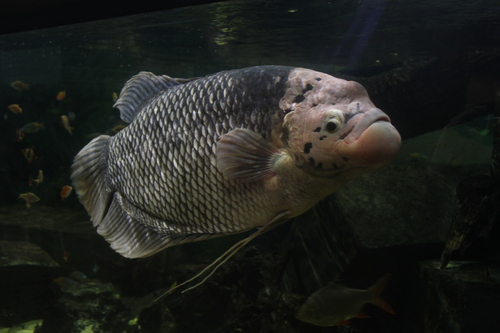 Giant GouramiOsphronemus goramy
-
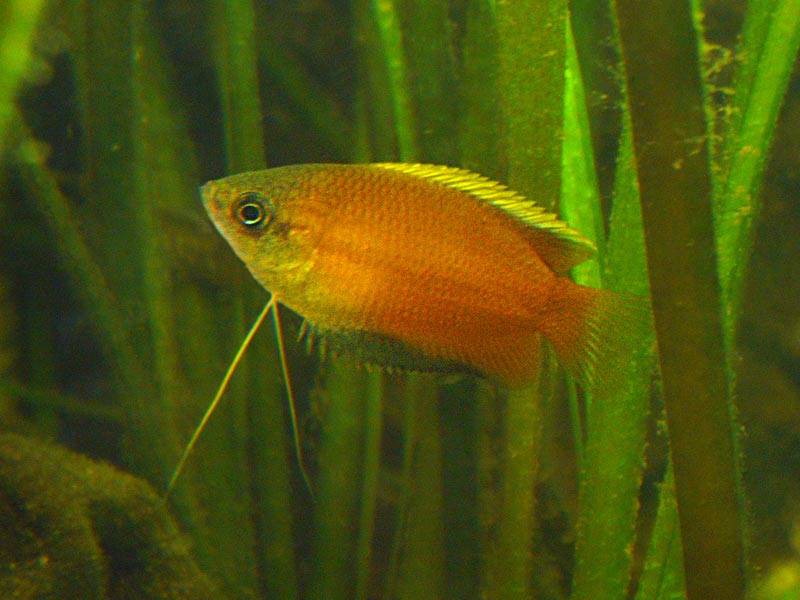 Honey GouramiTrichogaster chuna
-
 Paradise FishMacropodus opercularis
-
 Dwarf GouramiTrichogaster lalius
-
 Three Spot GouramiTrichopodus trichopterus
-
 Pearl GouramiTrichopodus leerii
Compare
Questions and answers
What is the scientific name of the Pikehead?
The scientific name of the Pikehead is Luciocephalus pulcher. Written with its author, the full name is Luciocephalus pulcher (Gray, 1830).
Which family does the Pikehead belong to?
Luciocephalus pulcher belongs to the family Osphronemidae, in the order Anabantiformes and the class Teleostei.
Where is the Pikehead found?
Checklists and occurrence records place Luciocephalus pulcher in 5 countries: Indonesia, Malaysia, Brunei, Singapore and Thailand.
What is the conservation status of the Pikehead?
The IUCN Red List category recorded for Luciocephalus pulcher is Least Concern (LC).
What other names does the Pikehead have?
Luciocephalus pulcher is also known in English as Crocodile Pikehead and Crocodile Pikehead Gourami.
How big do peppermint pikeheads get?
Pikehead can reach a standard length of 20 centimetres.[2]
Sources
Passages the profile rests on
- The species has a yellowish-brown body marked with dark brown longitudinal bands and stripes. Source passage: “It is a yellowish-brown fish with dark brown longitudinal bands and stripes” — English Wikipedia
- The species can reach a standard length of 20 centimetres. Source passage: “can reach a length of 20 centimetres (7.9 in) SL.” — English Wikipedia
- The species inhabits flooded forests, streams, and peat swamps, particularly where vegetation is plentiful. Source passage: “flooded forests, streams, and peat swamps, especially in areas with plentiful vegetation.” — English Wikipedia
- The species is a specialized predator that typically preys on smaller fish. Source passage: “when it does attack a potential meal (usually a smaller fish)” — English Wikipedia
- The species can prey on fish that are almost half its own length. Source passage: “allowing it to successfully prey upon fishes almost half of its own length.” — English Wikipedia
- The species is a specialized ambush predator that spends most of its time motionless near plants or other cover while waiting for prey. Source passage: “it is a highly specialized ambush predator that spends most of its time lying motionless near plants or other cover for potential prey to approach” — English Wikipedia
- The species can extend its jaw to approximately one-third of its body length when attacking prey. Source passage: “it is able to extend its jaw to about one-third of its body length” — English Wikipedia
- The species is a paternal mouthbrooder. Source passage: “it is a mouthbrooder (in this case a paternal mouthbrooder).” — English Wikipedia
- The species occurs in the aquarium trade. Source passage: “It can also be found in the aquarium trade” — English Wikipedia
- The species is notoriously difficult to maintain in aquariums. Source passage: “where it is notoriously difficult to keep;” — English Wikipedia
- The species requires extremely soft, acidic water in aquarium conditions. Source passage: “they require extremely soft, acidic water” — English Wikipedia
- The species seldom accepts dead foods in aquarium conditions. Source passage: “and seldom eat dead foods.” — English Wikipedia
Data
- Catalogue of Life, 2026-10-16 XR cc by
- Global Biodiversity Information Facility CC BY 4.0
- Wikidata CC0
- GeoNames CC BY 4.0
- Wikimedia Commons per image; credit shown with each image
- Within the Catalogue of Life, this name comes from World Register of Marine Species cc by
References
- Gray, J. E. (1830 - 35) Illustrations of Indian zoology; chiefly selected from the collection of Major-General Hardwicke, F. R. S. Vol. 1 (1830 - 1832) & Vol. 2 (1832 - 1835). Treuttel & Richter, London & Parbury, Allen and Co., London, 2 pp. & 2 pp. where the name was published
This species in other databases
- Catalogue of Life 3WCLY
- Wikidata Q5246252
- iNaturalist 618893
- WoRMS urn:lsid:marinespecies.org:taxname:1418110
- ITIS 172684
Page built on 28 November 2026. See how the catalog is made and all sources and licences.
Cite this page
ScientificNames.org. (2026). Luciocephalus pulcher (Pikehead). Retrieved November 28, 2026, from https://scientificnames.org/species/luciocephalus-pulcher
“Luciocephalus pulcher (Pikehead).” ScientificNames.org, 2026, scientificnames.org/species/luciocephalus-pulcher. Accessed 28 Nov. 2026.
ScientificNames.org. “Luciocephalus pulcher (Pikehead).” Accessed November 28, 2026. https://scientificnames.org/species/luciocephalus-pulcher.
@misc{scientificnames_luciocephalus_pulcher_pikehead,
  author = {{ScientificNames.org}},
  title = {Luciocephalus pulcher (Pikehead)},
  year = {2026},
  url = {https://scientificnames.org/species/luciocephalus-pulcher},
  note = {Accessed 2026-11-28}
}