Species · Fishes
Three Spot Gourami Trichopodus trichopterus
The scientific name of the Three Spot Gourami is Trichopodus trichopterus. It is a species of fish in the family Osphronemidae (gourami), order Anabantiformes. The name dates from 1770.
- Scientific name
- Trichopodus trichopterus (Pallas, 1770)
- Common name
- Three Spot Gourami
- Genus
- Trichopodus
- Family
- Osphronemidae (Gourami)
- Order
- Anabantiformes
- Class
- Teleostei
- Red List category
- LC Least Concern
- Environment
- freshwater
- Recorded in
- 15 countries
- Name status
- accepted in the Catalogue of Life

Overview
Three Spot Gourami is a fish farmed and popular in the aquarium trade. The species is native to southeastern Asia and inhabits standing or slow-moving freshwater environments. It has two spots on each side of its body, with the eye counted as the third spot.
Written 26 November 2026 from the sources listed below. Each statement was checked against the passage it cites; statements that could not be supported were removed.
Appearance
The species has two spots on each side of its body, with the eye counted as the third spot. Its black spots are vivid in healthy individuals but become less distinct with age.[1][2]
Male individuals have a long, pointed dorsal fin and a pointed anal fin. Females generally have shorter, rounded dorsal and anal fins.[3][4]
The lavender or amethyst variety has purple coloration and results from crossing blue and golden varieties.[5]
Habitat
The species inhabits standing or slow-moving freshwater environments, including marshes, swamps, canals, and lowland wetlands.[6][7]
During the flood season, the species moves from permanent water bodies into seasonally flooded areas, including forests in the middle and lower Mekong. During the dry season, it returns to permanent water bodies.[8][9]
The species is native to southeastern Asia, including Yunnan in China, mainland Southeast Asia, and the Indonesian islands of Java, Borneo, and Sumatra. It has been introduced to the Philippines, India, Sulawesi, and southwestern Trinidad.[10][11]
Diet
The species is omnivorous and feeds on zooplankton, crustaceans, and insect larvae. It requires both algae-based and animal-based foods.[12][13]
Suitable foods include algae-based flakes, freeze-dried bloodworms, tubifex worms, and brine shrimp. Mosquito larvae and daphnia are beneficial live foods.[14][15]
Behaviour
Male individuals can be territorial toward other males and may aggressively nip the fins of other aquarium fish. They may show aggression toward aquarium species with long, flowing fins, including guppies, goldfish, and bettas.[16][17][18]
Female individuals generally keep to themselves, although they sometimes bother other fish. Individuals raised together in pairs can coexist in aquariums when sufficient swimming space is available.[19][20]
The species is described as a hardy fish for aquarium keeping.[21]
Reproduction and life cycle
Before spawning, the male attracts the female by swimming back and forth, spreading his fins, and raising his tail. The male constructs a bubble nest for the eggs and aggressively protects it.[22][23]
A female can lay up to 800 eggs in a spawning event. The male may become aggressive toward the female after spawning, so females are often transferred to a separate aquarium.[24][25]
The male guards the eggs and fry but is normally removed after the fry become free-swimming. Frequent water changes during the third week after hatching are used to support fry health while the labyrinth organ develops.[26][27]
Uses
The species has minor commercial importance as a food fish within its native range. It is farmed and is popular in the aquarium trade.[28][29]
Similar species
The species is also known by the common names blue gourami and opaline gourami. In Malaysia, it is also called the two-spot gourami.[30][31]
Classification of the Three Spot Gourami
| Kingdom | Animalia |
|---|---|
| Phylum | Chordata |
| Subphylum | Vertebrata |
| Infraphylum | Gnathostomata |
| Parvphylum | Osteichthyes |
| Gigaclass | Actinopterygii |
| Superclass | Actinopteri |
| Class | Teleostei (Teleost) |
| Order | Anabantiformes |
| Suborder | Anabantoidei |
| Family | Osphronemidae (Gourami) |
| Subfamily | Trichogastrinae |
| Genus | Trichopodus |
| Species | Trichopodus trichopterus (Pallas, 1770) |
Where the Three Spot Gourami is found
Checklists and occurrence records place Trichopodus trichopterus in 15 countries. GBIF holds 1,943 georeferenced records of it.
Countries
- Bangladesh 16
- Cambodia 121
- China 16
- India 50
- Indonesia 527
- Japan 5
- Laos 114
- Malaysia 101
- Myanmar 9
- Philippines 60
- Singapore 65
- Sri Lanka 6
- Taiwan 249
- Thailand 430
- Vietnam 174
Regions and cities with the most records
- Taiwan, Taiwan 140
- Chaozhou, Taiwan 109
- Ang Mo Kio New Town, Singapore 51
- Marsiling, Singapore 51
- Sembawang Estate, Singapore 51
- Sungai Simpang, Singapore 51
- Woodlands, Singapore 51
- Yio Chu Kang, Singapore 51
- Yishun New Town, Singapore 51
- Bukit Timah, Singapore 50
- Novena, Singapore 50
- Anak Bukit, Singapore 49
- Bukit Panjang New Town, Singapore 49
- Choa Chu Kang New Town, Singapore 49
- Keat Hong Village, Singapore 49
- Sengkang New Town, Singapore 49
- Teck Whye, Singapore 49
- Yew Tee, Singapore 49
- Johor Bahru, Malaysia 48
- Kampung Larkin Lama, Malaysia 48
- Kampung Pasir Gudang Baru, Malaysia 48
- Taman Permas Jaya, Malaysia 48
- Boon Lay, Singapore 47
- Jurong East, Singapore 47
- Jurong Town, Singapore 47
- Jurong West, Singapore 47
- Masai, Malaysia 47
- Queenstown Estate, Singapore 47
- Perling, Malaysia 46
- Horizon Hills, Malaysia 45
- Iskandar Puteri, Malaysia 45
- Bangkok, Thailand 44
- Donggang, Taiwan 44
- Din Daeng, Thailand 43
- Dusit, Thailand 43
- Huai Khwang, Thailand 43
9 more countries have a few records outside this range
These countries hold a few records of Trichopodus trichopterus but lie outside the range the checklists give for it. Such records are often zoo or garden specimens, museum material or vagrants, so the species is not counted as occurring there.
A number beside a place is its count of GBIF occurrence records. A place without a number comes from a checklist alone. Records show where a species has been observed or collected, which can include escapes and vagrants.
Common names
English
- Three Spot Gourami
- Three-spot Gourami
Names in 3 other languages
- French
- Gourami bleu
- Thai
- Pla Gradee
- lao
- Pa Sadird
Synonyms
13 other scientific names have been used for this species and are now treated as synonyms of Trichopodus trichopterus.
- Colisa maculatus Swainson, 1839
- Labrus trichopterus Pallas, 1770
- Labrvs trichoptervs Pallas, 1770
- Osphromenus insulatus Seale, 1910
- Osphromenus siamensis Günther, 1861
- Osphromenus trichopterus (Pallas, 1770)
- Osphronemus insulatus Seale, 1910
- Stethochaetus biguttatus Gronow, 1854
- Trichogaster sumatranus Ladiges, 1934
- Trichogaster trichopterus (Pallas, 1770)
- Trichopus pallasii Shaw, 1803
- Trichopus sepat Bleeker, 1845
- Trichopus trichopterus (Pallas, 1770)
Related species
-
 Pearl GouramiTrichopodus leerii
- False-eye GouramiTrichopodus poptae
- Trichopodus cantoris
- Snake-skin GouramiTrichopodus pectoralis
-
 Moonlight GouramiTrichopodus microlepis
-
 Siamese Fighting FishBetta splendens
-
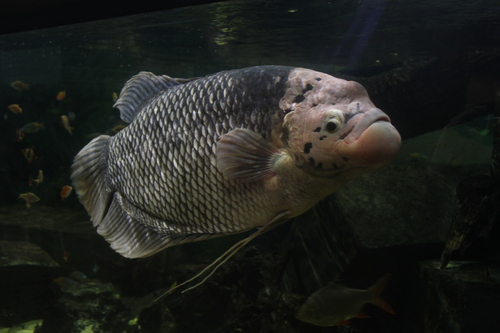 Giant GouramiOsphronemus goramy
-
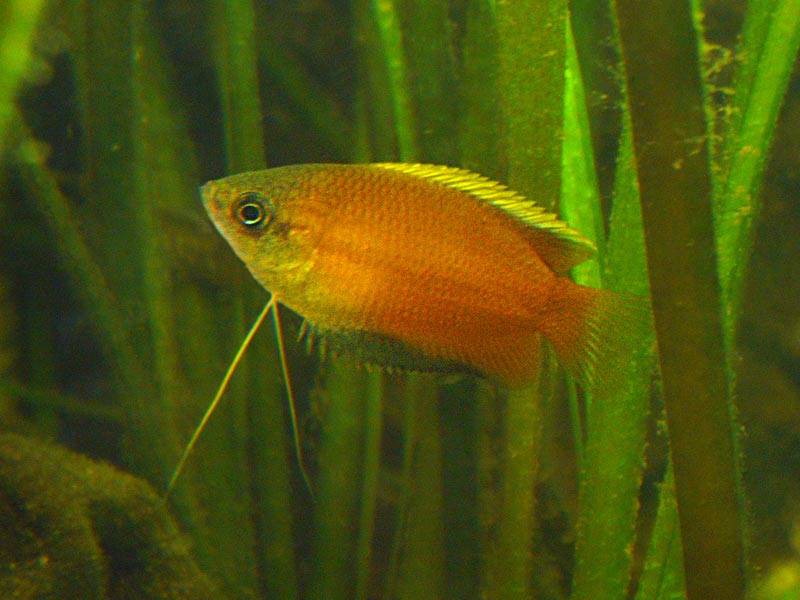 Honey GouramiTrichogaster chuna
Compare
Questions and answers
What is the scientific name of the Three Spot Gourami?
The scientific name of the Three Spot Gourami is Trichopodus trichopterus. Written with its author, the full name is Trichopodus trichopterus (Pallas, 1770).
Which family does the Three Spot Gourami belong to?
Trichopodus trichopterus belongs to the family Osphronemidae, in the order Anabantiformes and the class Teleostei.
Where is the Three Spot Gourami found?
Checklists and occurrence records place Trichopodus trichopterus in 15 countries, including Indonesia, Thailand, Taiwan, Vietnam, Cambodia and Laos.
What is the conservation status of the Three Spot Gourami?
The IUCN Red List category recorded for Trichopodus trichopterus is Least Concern (LC).
What other names does the Three Spot Gourami have?
Trichopodus trichopterus is also known in English as Three-spot Gourami.
How big do 3 spot gouramis get?
The Three Spot Gourami reaches a maximum reported standard length of 15 cm.[32]
Are 3 spot gourami aggressive?
Male Three Spot Gouramis can be territorial toward other males and may nip the fins of other aquarium fish. They may also show aggression toward fish with long, flowing fins, including guppies, goldfish, and bettas. Females generally keep to themselves, although they sometimes bother other fish.[16][17][18][19]
Can 3 spot gourami live together?
Individuals raised together in pairs can coexist in aquariums when sufficient swimming space is available.[20]
Sources
Passages the profile rests on
- The species has two spots on each side of its body, with the eye counted as the third spot. Source passage: “This gourami gets its name from the two spots along each side of its body in line with the eye, considered the third spot.” — English Wikipedia
- The black spots on healthy individuals are vivid but become less distinct with age. Source passage: “Healthy fish have two vivid black spots on each side of their bodies, but these fade with age.” — English Wikipedia
- The male has a long, pointed dorsal fin and a pointed anal fin. Source passage: “In the male, the dorsal fin is long and pointed and the anal fin is pointed” — English Wikipedia
- The female generally has shorter, rounded dorsal and anal fins. Source passage: “while the female's are shorter and rounded.” — English Wikipedia
- The lavender or amethyst variety has purple coloration and results from crossing blue and golden varieties. Source passage: “lavender (or amethyst) (the result of crossing a blue and golden, having a purple coloration).” — English Wikipedia
- The species inhabits standing or slow-moving freshwater environments. Source passage: “Three spot gourami are native to standing or slow-moving freshwater habitats in southeastern Asia” — English Wikipedia
- The species occurs in marshes, swamps, canals, and lowland wetlands. Source passage: “These fish live in marshes, swamps, canals, and lowland wetlands.” — English Wikipedia
- During the flood season, the species moves from permanent water bodies into seasonally flooded areas, including forests in the middle and lower Mekong. Source passage: “They migrate during the flood season from permanent water bodies to flooded areas, such as seasonally flooded forests in the middle and lower Mekong.” — English Wikipedia
- During the dry season, the species returns to permanent water bodies. Source passage: “During the dry season, they return to these permanent water bodies.” — English Wikipedia
- The species is native to southeastern Asia, including Yunnan in China, mainland Southeast Asia, and the Indonesian islands of Java, Borneo, and Sumatra. Source passage: “ranging from Yunnan (China), through mainland southeast Asia (Cambodia, Laos, Malaysia, Myanmar, Singapore, Thailand and Vietnam) to Indonesia (Java, Borneo and Sumatra).” — English Wikipedia
- The species has been introduced to the Philippines, India, Sulawesi, and southwestern Trinidad. Source passage: “They have been widely introduced outside their native range, such as the Philippines, India, Sulawesi, and southwestern Trinidad.” — English Wikipedia
- The species feeds on zooplankton, crustaceans, and insect larvae. Source passage: “These fish feed on zooplankton, crustaceans, and insect larvae.” — English Wikipedia
- The species is omnivorous and requires both algae-based and animal-based foods. Source passage: “The three spot gourami is an omnivore and requires both algae-based and meaty foods.” — English Wikipedia
- Suitable foods for the species include algae-based flakes, freeze-dried bloodworms, tubifex worms, and brine shrimp. Source passage: “An algae-based flake food, along with freeze-dried bloodworms, tubifex worms, and brine shrimp provide these fish with the proper nutrition.” — English Wikipedia
- Mosquito larvae and daphnia are beneficial live foods for the species. Source passage: “Live foods such as mosquito larvae and daphnia are also beneficial.” — English Wikipedia
- Male individuals can be territorial toward other males. Source passage: “While males can be territorial with each other, they become timid around other, more aggressive fish.” — English Wikipedia
- Male individuals may aggressively nip the fins of other aquarium fish. Source passage: “Male gouramis are known to be very aggressive; they may also be fin nippers and generally may bother other fish in the tank.” — English Wikipedia
- Male individuals may show aggression toward aquarium species with long, flowing fins, including guppies, goldfish, and bettas. Source passage: “They often show aggression toward species with long, flowing fins such as male guppies, goldfish, and bettas” — English Wikipedia
- Female individuals generally keep to themselves, although they sometimes bother other fish. Source passage: “Female gourami sometimes bother other fish, but usually keep to themselves.” — English Wikipedia
- Individuals raised together in pairs can coexist in aquariums when sufficient swimming space is available. Source passage: “three spot gouramis that have been brought up together in pairs (usually females, especially if they are siblings) and that have stable personalities, can successfully cohabit with each other, provided there is enough room to swim.” — English Wikipedia
- The species is described as a hardy fish for aquarium keeping. Source passage: “The three spot gourami is a hardy fish.” — English Wikipedia
- The male constructs a bubble nest for the eggs and aggressively protects it. Source passage: “The male builds a bubble nest for the eggs, which he protects aggressively.” — English Wikipedia
- The male attracts the female before spawning by swimming back and forth, spreading his fins, and raising his tail. Source passage: “The male builds a bubble nest and then begins to entice the female by swimming back and forth, flaring his fins and raising his tail.” — English Wikipedia
- A female can lay up to 800 eggs in a spawning event. Source passage: “The female may lay up to 800 eggs.” — English Wikipedia
- The male may become aggressive toward the female after spawning, so females are often transferred to a separate aquarium. Source passage: “After spawning, the females often are removed to a separate aquarium as the male may become aggressive toward her.” — English Wikipedia
- The male guards the eggs and fry but is normally removed after the fry become free-swimming. Source passage: “The male protects the eggs and fry, but normally is removed after they become free-swimming.” — English Wikipedia
- Frequent water changes during the third week after hatching are used to support fry health while the labyrinth organ develops. Source passage: “After hatching, frequent water changes, especially during the third week, are used to ensure the health of the fry, as this is when the labyrinth organ is developing.” — English Wikipedia
- The species has minor commercial importance as a food fish within its native range. Source passage: “This species is of minor commercial importance as a food fish in its native range” — English Wikipedia
- The species is farmed and is popular in the aquarium trade. Source passage: “and is also farmed. It is also popular in the aquarium trade.” — English Wikipedia
- The species is also known by the common names blue gourami and opaline gourami. Source passage: “also known as the opaline gourami, blue gourami, and gold gourami” — English Wikipedia
- The species is also called the two-spot gourami in Malaysia. Source passage: “or "two-spot gourami" (in Malaysia).” — English Wikipedia
- The species reaches a maximum reported standard length of 15 cm. Source passage: “The species reaches 15 cm (5.9 inches) in standard length.” — English Wikipedia
Data
- Catalogue of Life, 2026-10-16 XR cc by
- Global Biodiversity Information Facility CC BY 4.0
- Wikidata CC0
- GeoNames CC BY 4.0
- Wikimedia Commons per image; credit shown with each image
- Within the Catalogue of Life, this name comes from World Register of Marine Species cc by
References
- Eden, S. (1984) Some freshwater aquarium fishes of Brunei. The Brunei Museum Journal, 5 (4), 181 - 202. where the name was published
This species in other databases
- Catalogue of Life 7D4QX
- Wikidata Q10866107
- WoRMS urn:lsid:marinespecies.org:taxname:955902
- ITIS 172634-172635
Page built on 28 November 2026. See how the catalog is made and all sources and licences.
Cite this page
ScientificNames.org. (2026). Trichopodus trichopterus (Three Spot Gourami). Retrieved November 28, 2026, from https://scientificnames.org/species/trichopodus-trichopterus
“Trichopodus trichopterus (Three Spot Gourami).” ScientificNames.org, 2026, scientificnames.org/species/trichopodus-trichopterus. Accessed 28 Nov. 2026.
ScientificNames.org. “Trichopodus trichopterus (Three Spot Gourami).” Accessed November 28, 2026. https://scientificnames.org/species/trichopodus-trichopterus.
@misc{scientificnames_trichopodus_trichopterus_three_spot_gourami,
  author = {{ScientificNames.org}},
  title = {Trichopodus trichopterus (Three Spot Gourami)},
  year = {2026},
  url = {https://scientificnames.org/species/trichopodus-trichopterus},
  note = {Accessed 2026-11-28}
}