Species · Birds
Malayan Eared Nightjar Lyncornis temminckii
The scientific name of the Malayan Eared Nightjar is Lyncornis temminckii. It is a species of bird in the family Caprimulgidae (nightjar), order Caprimulgiformes. The name dates from 1838.
- Scientific name
- Lyncornis temminckii Gould, 1838
- Common name
- Malayan Eared Nightjar
- Genus
- Lyncornis
- Family
- Caprimulgidae (Nightjar)
- Order
- Caprimulgiformes
- Class
- Aves
- Red List category
- LC Least Concern
- Recorded in
- 5 countries
- Name status
- accepted in the Catalogue of Life
Overview
The Malayan Eared Nightjar is a bird in the family Caprimulgidae and the order Caprimulgiformes. It occurs across Southeast Asia, including Malaysia, Sumatra, Borneo, Thailand, Indonesia and Singapore, with a small population in southern Myanmar. It is distinguished by ear-tufts at the rear of its crown and brown, black and grey plumage patterns.
Written 27 November 2026 from the sources listed below. Each statement was checked against the passage it cites; statements that could not be supported were removed.
Appearance
The Malayan Eared Nightjar has distinctive ear-tufts at the rear of its crown. Its plumage includes brown, black and grey patterns that provide camouflage, and it has a white throat patch or a white spot on its lower throat.[1][2][3]
Newly hatched chicks have yellowish down feathers that are darker on the crown and nape. They have pale bills and dark brown legs and feet.[4][5]
Habitat
The Malayan Eared Nightjar prefers lowland forests, forest edges and dense subtropical and tropical forests. It has been recorded from sea level to elevations of 1,065 metres.[6][7]
In Malaysia, it inhabits tall hardwood forests, alluvial forests, grasslands, swamplands and dense rainforests. In Sumatra, it occurs in both primary and secondary forests.[8][9]
The species occurs across Southeast Asia, including Malaysia, Sumatra, Borneo, Thailand, Indonesia and Singapore. It is found in both Peninsular Malaysia and Malaysian Borneo, and a small population occurs in southern Myanmar.[10][11][12]
Diet
The Malayan Eared Nightjar feeds primarily on flying insects, including beetles and moths. Its diet also includes ground-dwelling, aquatic and arboreal insects.[13][14]
Behaviour
During dusk, individuals may fly at elevations exceeding 1,000 metres, holding their wings vertically in a V formation.[15][16]
Individuals hunt insects by landing on trees, posts or dead branches. They also hunt insects over streams near forests, and forest clearings are among their insect-foraging locations.[17][18][19]
The species commonly produces a whistled call resembling 'tut-wee-ow', usually while flying. Its vocalisations also include whistles, hoots and churring sounds.[20][21]
Reproduction and life cycle
The estimated breeding season in the Malay Peninsula extends from January to July. In Sumatra, the estimated breeding season occurs during October and November.[22][23]
The species lays its eggs directly on leaf litter rather than constructing nests. Eggs are generally laid beneath trees or bushes.[24][25]
The usual clutch consists of one egg, although two-egg clutches have also been recorded. The eggs are elliptical and white with grey and brown speckles, measuring approximately 34.4–34.5 by 25.5–27.8 mm.[26][27][28]
Chicks are altricial but can walk shortly after hatching.[29]
Conservation
The Malayan Eared Nightjar was classified as Least Concern on the IUCN Red List as of 2016. Its estimated extent of occurrence is up to 2,950,000 square kilometres, but its overall population size has not been quantified.[30][31][32]
Its population is declining in Thailand, where it has become uncommon in southern regions. Habitat fragmentation and deforestation are identified as causes of population decline in Thailand.[33][34]
Similar species
The great eared nightjar (Lyncornis macrotis) is the sister species of the Malayan Eared Nightjar.[35]
Classification of the Malayan Eared Nightjar
| Kingdom | Animalia |
|---|---|
| Phylum | Chordata |
| Subphylum | Vertebrata |
| Infraphylum | Gnathostomata |
| Parvphylum | Osteichthyes |
| Megaclass | Tetrapoda |
| Class | Aves (Bird) |
| Order | Caprimulgiformes (Nightjar) |
| Family | Caprimulgidae (Nightjar) |
| Genus | Lyncornis (Eared Nightjars) |
| Species | Lyncornis temminckii Gould, 1838 |
Where the Malayan Eared Nightjar is found
Checklists and occurrence records place Lyncornis temminckii in 5 countries across Asia. GBIF holds 2,172 georeferenced records of it.
Countries
Regions and cities with the most records
- Johor, Malaysia 456
- Pahang, Malaysia 394
- Kampung Batu Empat, Malaysia 319
- Kota Tinggi, Malaysia 318
- Lampung, Indonesia 250
- Sarawak, Malaysia 185
- Selangor, Malaysia 184
- Raub, Malaysia 164
- Kuala Kubu Baharu, Malaysia 162
- Sabah, Malaysia 94
- Kampung Sungai Kajang, Malaysia 87
- Kampung Tanjung Karang, Malaysia 87
- Kuala Selangor, Malaysia 85
- Kampung Pasir Gudang Baru, Malaysia 77
- Masai, Malaysia 77
- Taman Permas Jaya, Malaysia 77
- Anak Bukit, Singapore 76
- Ang Mo Kio New Town, Singapore 76
- Bandar Seri Alam, Malaysia 76
- Bukit Panjang New Town, Singapore 76
- Bukit Timah, Singapore 76
- Choa Chu Kang New Town, Singapore 76
- Johor Bahru, Malaysia 76
- Jurong East, Singapore 76
- Jurong Town, Singapore 76
- Jurong West, Singapore 76
- Keat Hong Village, Singapore 76
- Marsiling, Singapore 76
- Matilda Estate, Singapore 76
- Pasir Gudang, Malaysia 76
- Punggol, Singapore 76
- Sembawang Estate, Singapore 76
- Sengkang New Town, Singapore 76
- Sungai Simpang, Singapore 76
- Teck Whye, Singapore 76
- Woodlands, Singapore 76
Range as the checklists state it
Southern Asia
A number beside a place is its count of GBIF occurrence records. A place without a number comes from a checklist alone. Records show where a species has been observed or collected, which can include escapes and vagrants.
Common names
English
- Malayan Eared Nightjar
- Malay Eared-nightjar
- Malaysian Eared Nightjar
- Malaysian Eared-Nightjar
- Malaysian Nightjar
Names in 29 other languages
- Catalan
- enganyapastors de Temminck
- Chinese
- 馬來毛腿夜鷹, 马来毛腿夜鹰
- Croatian
- ogličasti leganj
- Czech
- lelek Temminckův
- Danish
- Malajhornnatravn, Malay Hornnatravn
- Dutch
- Temmincks Nachtzwaluw
- Esperanto
- malazia kaprimulgo
- Estonian
- malai kõrvuksorr
- Finnish
- malakankorvakehrääjä
- French
- Engoulevent de Temminck
- German
- Temmincknachtschwalbe
- Hungarian
- maláj lappantyú
- Indonesian
- Taktarau melayu
- Italian
- Succiacapre orecchiuto di Malesia
- Japanese
- ミミヨタカ
- Lithuanian
- Teminko Pietų Azijos lėlys
- Norwegian
- malaynattravn
- Persian
- شبگرد گوشدار مالزیایی
- Polish
- rogatnik uszaty
- Portuguese
- noitibó-malaio, noitibó-orelhudo-malaio
- Russian
- Малайский рогатень, Малайский южноазиатский козодой
- Serbian
- Malezijski leganj
- Slovak
- nočnár malajský
- Spanish
- Chotacabras de Temminck
- Swedish
- malajisk öronnattskärra, malajöronnattskärra
- Thai
- นกตบยุงพันธุ์มลายู
- Turkish
- Temminck Çobanaldatanı
- Ukrainian
- ночнар малазійський
- Welsh
- Troellwr clustiog Malaysia
Synonyms
3 other scientific names have been used for this species and are now treated as synonyms of Lyncornis temminckii.
- Eurostopodus temminckii (Gould, 1838)
- Lyncornis collaris Gould, J, 1838
- Lyncornis imberbis Gould, J, 1838
Related species
-
 Great Eared NightjarLyncornis macrotis
-
 Pennant-winged NightjarCaprimulgus vexillarius
-
 Eastern Whip-poor-willAntrostomus vociferus
-
 European NightjarCaprimulgus europaeus
-
 Common NighthawkChordeiles minor
-
 Standard-winged NightjarCaprimulgus longipennis
-
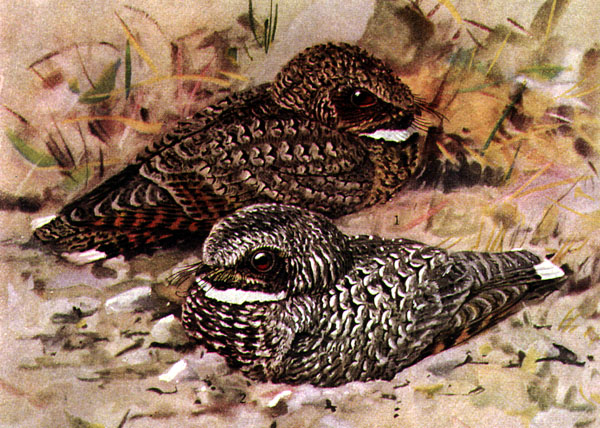 Common PoorwillPhalaenoptilus nuttallii
-
 Chuck-will's-widowAntrostomus carolinensis
Compare
Questions and answers
What is the scientific name of the Malayan Eared Nightjar?
The scientific name of the Malayan Eared Nightjar is Lyncornis temminckii. Written with its author, the full name is Lyncornis temminckii Gould, 1838.
Which family does the Malayan Eared Nightjar belong to?
Lyncornis temminckii belongs to the family Caprimulgidae, in the order Caprimulgiformes and the class Aves.
Where is the Malayan Eared Nightjar found?
Checklists and occurrence records place Lyncornis temminckii in 5 countries: Malaysia, Indonesia, Singapore, Thailand and Brunei.
What is the conservation status of the Malayan Eared Nightjar?
The IUCN Red List category recorded for Lyncornis temminckii is Least Concern (LC).
What other names does the Malayan Eared Nightjar have?
Lyncornis temminckii is also known in English as Malay Eared-nightjar, Malaysian Eared Nightjar, Malaysian Eared-Nightjar and Malaysian Nightjar.
Sources
Passages the profile rests on
- The species has distinctive ear-tufts at the rear of its crown. Source passage: “possessing characteristic ear-tufts at the rear of their crown” — English Wikipedia
- Its plumage includes brown, black and grey patterns that provide camouflage. Source passage: “Their plumage is cryptically coloured, with deep patterns of browns, black and greys to aid them with camouflaging into the night” — English Wikipedia
- The species has a white throat patch or a white spot on its lower throat. Source passage: “a white throat patch or white spot on their lower throat” — English Wikipedia
- Newly hatched chicks have yellowish down feathers that are darker on the crown and nape. Source passage: “Upon hatching, chicks are covered in yellowish down feathers which is darker on their crown and nape.” — English Wikipedia
- Chicks have pale bills and dark brown legs and feet. Source passage: “They have pale bills and their legs and feet are dark brown as chicks.” — English Wikipedia
- The species prefers lowland forests, forest edges and dense subtropical and tropical forests. Source passage: “Malayan eared nightjars prefer lowland forests, forest edges and dense subtropical and tropical forests.” — English Wikipedia
- The species has been recorded from sea level to elevations of 1,065 metres. Source passage: “have been recorded from sea-level to 1065 meters.” — English Wikipedia
- In Malaysia, the species inhabits tall hardwood forests, alluvial forests, grasslands, swamplands and dense rainforests. Source passage: “forests characterised by tall hardwood trees, alluvial forests, grassland, swamplands and dense rainforests.” — English Wikipedia
- In Sumatra, the species occurs in both primary and secondary forests. Source passage: “they occur in both primary and secondary forests.” — English Wikipedia
- The species occurs across Southeast Asia, including Malaysia, Sumatra, Borneo, Thailand, Indonesia and Singapore. Source passage: “primarily occurring in Malaysia, Sumatra, Borneo, Thailand, Indonesia and Singapore.” — English Wikipedia
- The species occurs in both Peninsular Malaysia and Malaysian Borneo. Source passage: “where they are found both in the Peninsula and Malaysian Borneo” — English Wikipedia
- A small population occurs in southern Myanmar. Source passage: “and a small population exists in Southern Myanmar.” — English Wikipedia
- The species feeds primarily on flying insects, including beetles and moths. Source passage: “The species feed primarily on flying insects like beetles and moths” — English Wikipedia
- Its diet also includes ground-dwelling, aquatic and arboreal insects. Source passage: “but also on ground-dwelling, aquatic and arboreal insects.” — English Wikipedia
- During dusk, individuals may fly at elevations exceeding 1,000 metres. Source passage: “during dusk, they tend to fly high in the air at elevations above 1000 meters” — English Wikipedia
- During dusk flights, individuals hold their wings vertically in a V formation. Source passage: “and hold their wings vertically in a V formation.” — English Wikipedia
- Individuals hunt insects by landing on trees, posts or dead branches. Source passage: “landing on trees, posts or dead branches to snatch and hunt insects.” — English Wikipedia
- The species hunts insects over streams near forests. Source passage: “Malayan eared nightjars also hunt for insects over bodies of water, such as streams near forests.” — English Wikipedia
- Forest clearings are among the species' insect-foraging locations. Source passage: “They are also found to utilise forest clearings (areas in a forest with no trees or bushes) as hunting grounds” — English Wikipedia
- The species commonly produces a whistled call resembling 'tut-wee-ow', usually while flying. Source passage: “their more common call is a whistled "tut-wee-ow" which is usually delivered in flight.” — English Wikipedia
- Its vocalisations include whistles, hoots and churring sounds. Source passage: “They can undergo complex communication via whistles, hoots and churring sounds.” — English Wikipedia
- The estimated breeding season in the Malay Peninsula extends from January to July. Source passage: “they are estimated to occur during the months of January to July within the Malay Peninsula” — English Wikipedia
- In Sumatra, the estimated breeding season occurs during October and November. Source passage: “but later months of October to November in Sumatra.” — English Wikipedia
- The species lays its eggs directly on leaf litter rather than constructing nests. Source passage: “They do not construct nests and instead lay their eggs on leaf-litter directly onto the ground” — English Wikipedia
- Eggs are generally laid beneath trees or bushes. Source passage: “typically underneath trees or bushes.” — English Wikipedia
- The usual clutch consists of one egg, although two-egg clutches have also been recorded. Source passage: “usually only one egg is laid as with most nightjars, but there have been recordings of two eggs being laid” — English Wikipedia
- The eggs are elliptical and white with grey and brown speckles. Source passage: “Their eggs are elliptical, white but speckled with grey and brown spots” — English Wikipedia
- Eggs measure approximately 34.4–34.5 by 25.5–27.8 mm. Source passage: “between 34.4-34.5 x 25.5-27.8 mm.” — English Wikipedia
- Chicks are altricial but can walk shortly after hatching. Source passage: “Their chicks are born altricial but can walk soon upon hatching.” — English Wikipedia
- The species was classified as Least Concern on the IUCN Red List as of 2016. Source passage: “As of 2016, the Malayan eared nightjar is listed as Least Concern as per the IUCN Red List” — English Wikipedia
- The species has an estimated extent of occurrence of up to 2,950,000 square kilometres. Source passage: “with the species occupying a huge extent of occurrence up to 2,950,000 km2.” — English Wikipedia
- The species' overall population size has not been quantified. Source passage: “Their population size has not been quantified” — English Wikipedia
- Its population is declining in Thailand, where it has become uncommon in southern regions. Source passage: “its population is declining in Thailand, where the bird used to be dispersed throughout, but is now uncommon to southern regions of the country” — English Wikipedia
- Habitat fragmentation and deforestation are identified as causes of population decline in Thailand. Source passage: “due to habitat fragmentation and deforestation.” — English Wikipedia
- Its sister species is the great eared nightjar (Lyncornis macrotis). Source passage: “its sister species, the great eared nightjar (Lyncornis macrotis)” — English Wikipedia
Data
- Catalogue of Life, 2026-10-16 XR cc by
- Global Biodiversity Information Facility CC BY 4.0
- Wikidata CC0
- GeoNames CC BY 4.0
- Within the Catalogue of Life, this name comes from The Integrated Taxonomic Information System cc0
This species in other databases
Page built on 27 November 2026. See how the catalog is made and all sources and licences.
Cite this page
ScientificNames.org. (2026). Lyncornis temminckii (Malayan Eared Nightjar). Retrieved November 27, 2026, from https://scientificnames.org/species/lyncornis-temminckii
“Lyncornis temminckii (Malayan Eared Nightjar).” ScientificNames.org, 2026, scientificnames.org/species/lyncornis-temminckii. Accessed 27 Nov. 2026.
ScientificNames.org. “Lyncornis temminckii (Malayan Eared Nightjar).” Accessed November 27, 2026. https://scientificnames.org/species/lyncornis-temminckii.
@misc{scientificnames_lyncornis_temminckii_malayan_eared_nightjar,
  author = {{ScientificNames.org}},
  title = {Lyncornis temminckii (Malayan Eared Nightjar)},
  year = {2026},
  url = {https://scientificnames.org/species/lyncornis-temminckii},
  note = {Accessed 2026-11-27}
}