Species · Insects
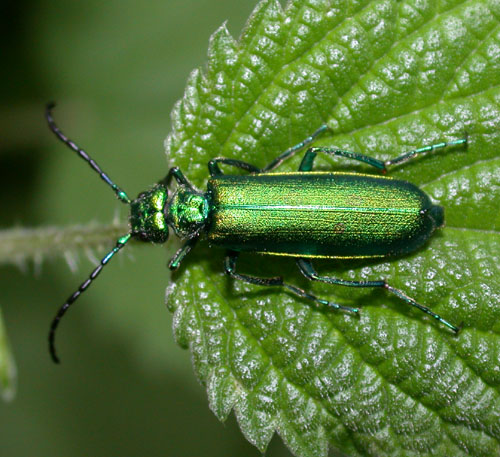
Neck-spotted Blister Beetle Lytta lecontei
The scientific name of the Neck-spotted Blister Beetle is Lytta lecontei. It is a species of insect in the family Meloidae (blister beetle), order Coleoptera. The name dates from 1890.
- Scientific name
- Lytta lecontei Heyden, 1890
- Common name
- Neck-spotted Blister Beetle
- Genus
- Lytta
- Family
- Meloidae (Blister Beetle)
- Order
- Coleoptera
- Class
- Insecta
- Recorded in
- 1 country
- Name status
- accepted in the Catalogue of Life
Overview
Lytta lecontei is a species of blister beetle in the family Meloidae. It is found in Central America and North America.
Classification of the Neck-spotted Blister Beetle
| Kingdom | Animalia |
|---|---|
| Phylum | Arthropoda |
| Subphylum | Hexapoda |
| Class | Insecta (Insect) |
| Order | Coleoptera (Beetle) |
| Suborder | Polyphaga |
| Series | Cucujiformia |
| Superfamily | Tenebrionoidea |
| Family | Meloidae (Blister Beetle) |
| Subfamily | Meloinae |
| Tribe | Lyttini |
| Genus | Lytta |
| Species | Lytta lecontei Heyden, 1890 |
This name was added to the Catalogue of Life from a contributing dataset by automated merging and has not yet been reviewed by its editors.
Where the Neck-spotted Blister Beetle is found
Checklists and occurrence records place Lytta lecontei in 1 country across North America. GBIF holds 58 georeferenced records of it.
Countries
Regions and cities with the most records
- Texas, United States 49
- Austin, United States 12
- Hutto, United States 7
- Taylor, United States 7
- Pflugerville, United States 5
- Allen, United States 4
- Brushy Creek, United States 4
- Celina, United States 4
- Frisco, United States 4
- McKinney, United States 4
- New Braunfels, United States 4
- Prosper, United States 4
- Round Rock, United States 4
- Cibolo, United States 3
- Converse, United States 3
- Georgetown, United States 3
- Live Oak, United States 3
- Schertz, United States 3
- Universal City, United States 3
Range as the checklists state it
Middle America
North America
A number beside a place is its count of GBIF occurrence records. A place without a number comes from a checklist alone. Records show where a species has been observed or collected, which can include escapes and vagrants.
Common names
English
- Neck-spotted Blister Beetle
Related species
-
 Spanish FlyLytta vesicatoria
-
 Master Blister BeetleLytta magister
-
 Nuttall's Blister BeetleLytta nuttalli
-
 Say Blister BeetleLytta sayi
-
 Brassy Blister BeetleLytta aenea
-
 Green Blister BeetleLytta stygica
-
 Red-eared Blister BeetleLytta auriculata
- Lytta melaena
Compare
Questions and answers
What is the scientific name of the Neck-spotted Blister Beetle?
The scientific name of the Neck-spotted Blister Beetle is Lytta lecontei. Written with its author, the full name is Lytta lecontei Heyden, 1890.
Which family does the Neck-spotted Blister Beetle belong to?
Lytta lecontei belongs to the family Meloidae, in the order Coleoptera and the class Insecta.
Where is the Neck-spotted Blister Beetle found?
Checklists and occurrence records place Lytta lecontei in 1 country: United States.
Sources
Data
- Catalogue of Life, 2026-10-16 XR cc by
- Global Biodiversity Information Facility CC BY 4.0
- Wikidata CC0
- English Wikipedia CC BY-SA 4.0
- GeoNames CC BY 4.0
- Within the Catalogue of Life, this name comes from The Integrated Taxonomic Information System cc0
References
- Selander, Richard B. (1960). Bionomics, Systematics, and Phylogeny of Lytta, a Genus of Blister Beetles (Coleoptera, Meloidae). Illinois Biological Monographs, No. 28.
This species in other databases
Page built on 28 November 2026. See how the catalog is made and all sources and licences.
Cite this page
ScientificNames.org. (2026). Lytta lecontei (Neck-spotted Blister Beetle). Retrieved November 28, 2026, from https://scientificnames.org/species/lytta-lecontei
“Lytta lecontei (Neck-spotted Blister Beetle).” ScientificNames.org, 2026, scientificnames.org/species/lytta-lecontei. Accessed 28 Nov. 2026.
ScientificNames.org. “Lytta lecontei (Neck-spotted Blister Beetle).” Accessed November 28, 2026. https://scientificnames.org/species/lytta-lecontei.
@misc{scientificnames_lytta_lecontei_neck_spotted_blister_beetle,
  author = {{ScientificNames.org}},
  title = {Lytta lecontei (Neck-spotted Blister Beetle)},
  year = {2026},
  url = {https://scientificnames.org/species/lytta-lecontei},
  note = {Accessed 2026-11-28}
}