Species · Amphibians
Climbing Mantella Mantella laevigata
The scientific name of the Climbing Mantella is Mantella laevigata. It is a species of amphibian in the family Mantellidae (madagascar frogs), order Anura. The name dates from 1913.
- Scientific name
- Mantella laevigata Methuen & Hewitt, 1913
- Common name
- Climbing Mantella
- Genus
- Mantella
- Family
- Mantellidae (Madagascar Frogs)
- Order
- Anura
- Class
- Amphibia
- Red List category
- LC Least Concern
- Recorded in
- 1 country
- Name status
- accepted in the Catalogue of Life

Overview
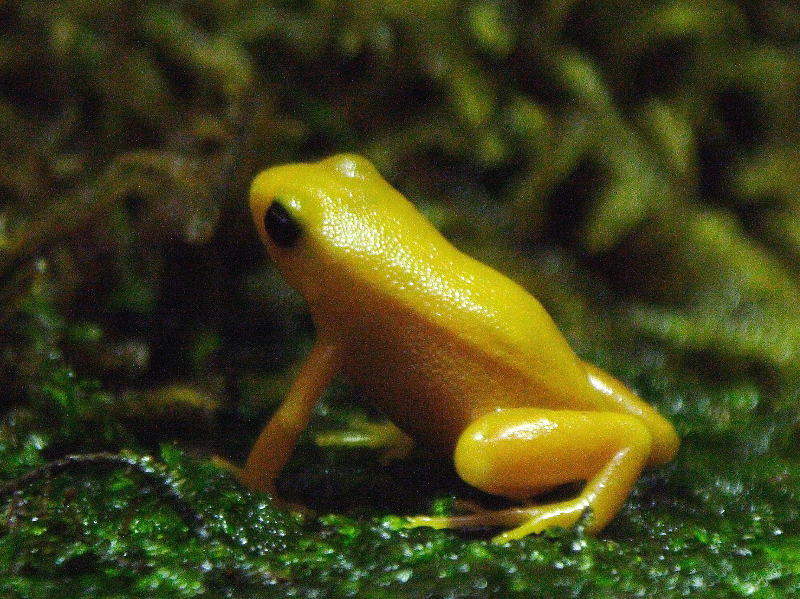
Mantella laevigata inhabits lowland rainforests and bamboo groves in northeastern coastal Madagascar. It has a bright yellow or pale green anterior back, black eyes and limbs, blue spots, and toxic skin secretions.
Written 27 November 2026 from the sources listed below. Each statement was checked against the passage it cites; statements that could not be supported were removed.
Appearance
The Climbing Mantella has a bright yellow or pale green anterior back, black arms, legs, abdomen and posterior, and blue spots on its limbs. Its eyes are completely black.[1][2]
Its fingers and toes have discs at their tips and are webbed. Its aposematic coloration is associated with warning predators about its toxic secretions.[3][4]
Adult individuals measure 24–30 millimetres in length and weigh between 1.2 and 2.0 grams. Males are slightly smaller than females.[5][6][7]
Habitat
The Climbing Mantella inhabits lowland rainforests and bamboo groves in northeastern coastal Madagascar. Individuals spend considerable time in trees and bamboo forests but also seek locations with a water source.[8][9]
The species can occupy environments with relative humidity between 80% and 100% and tolerate temperatures ranging from 17 to 30 °C. Its most suitable temperature range is 20–26 °C.[10][11][12]
Adults have been recorded on the forest floor and climbing trees to heights of 4 metres.[13]
Diet
The Climbing Mantella consumes ants, insect larvae, mites and other insects. It does not specialize exclusively in ants and consumes prey readily available in leaf litter.[14][15]
Ants account for approximately 84% of its diet during the dry season and 35% during the wet season. More than half of the ants consumed belong to the genus Pheidole.[16][17]
Individuals consume approximately 44% more food by absolute volume during the dry season than during the wet season. Their diet is more diverse during the wet season.[18][19]
Tadpoles consume fertilized and unfertilized eggs produced by their own species. They ignore mosquitoes and other small arthropod larvae.[20][21]
Behaviour
The Climbing Mantella is diurnal. Males defend territories of approximately two square metres.[22][23]
Male territorial conflicts involve wrestling, chasing and leaping and can last from 10 seconds to more than 1.5 hours. Males use two-tone calls to advertise their territories to females.[24][25][26]
Conservation
The IUCN Red List classified the Climbing Mantella as Least Concern in 2016. It was previously classified as Near Threatened in 2004 and 2008.[27][28]
The species is endemic to Madagascar, with a distribution that includes the northeastern coastal region. Recorded protected areas include Mananara-Nord National Park, Marojejy National Park, Masoala National Park, Nosy Mangabe Special Reserve and Betampona Natural Reserve.[29][30][31]
The population is suspected to be decreasing. Deforestation associated with cattle grazing, agriculture and urban development threatens its natural habitat outside protected reserves.[32][33]
International pet trade currently does not represent a serious threat to the species' population.[34]
Uses
The Climbing Mantella obtains defensive lipophilic alkaloids from dietary arthropods and stores them in skin glands. Researchers identified 41 different potent alkaloids in its skin.[35][36]
Captive individuals lose their toxicity over time. Skin alkaloid profiles show seasonal differences in the abundance of certain alkaloids, although the assortment of identified alkaloids remains similar between seasons.[37][38]
Classification of the Climbing Mantella
| Kingdom | Animalia |
|---|---|
| Phylum | Chordata |
| Subphylum | Vertebrata |
| Infraphylum | Gnathostomata |
| Parvphylum | Osteichthyes |
| Megaclass | Tetrapoda |
| Class | Amphibia (Amphibians) |
| Order | Anura (Frogs) |
| Family | Mantellidae (Madagascar Frogs) |
| Subfamily | Mantellinae |
| Genus | Mantella (Golden Frogs) |
| Species | Mantella laevigata Methuen & Hewitt, 1913 |
Where the Climbing Mantella is found
Checklists and occurrence records place Mantella laevigata in 1 country. GBIF holds 231 georeferenced records of it.
Countries
Regions and cities with the most records
A number beside a place is its count of GBIF occurrence records. A place without a number comes from a checklist alone. Records show where a species has been observed or collected, which can include escapes and vagrants.
Common names
English
- Climbing Mantella
- Arboreal Mantella
- Folohy Golden Frog
- Green-backed Mantella
Names in 3 other languages
- Czech
- mantela širokoprstá
- German
- Bambusbuntfröschchen, Folohy-Buntfröschchen, Kletterfröschchen
- Russian
- Древесная мантелла
Related species
-
 Golden MantellaMantella aurantiaca
-
 Baron's MantellaMantella baroni
-
 Blue-legged MantellaMantella expectata
-
 Green MantellaMantella viridis
-
 Madagascan MantellaMantella madagascariensis
-
 Brown MantellaMantella betsileo
-
 Black-eared MantellaMantella milotympanum
-
 Cowan's MantellaMantella cowanii
Compare
Questions and answers
What is the scientific name of the Climbing Mantella?
The scientific name of the Climbing Mantella is Mantella laevigata. Written with its author, the full name is Mantella laevigata Methuen & Hewitt, 1913.
Which family does the Climbing Mantella belong to?
Mantella laevigata belongs to the family Mantellidae, in the order Anura and the class Amphibia.
Where is the Climbing Mantella found?
Checklists and occurrence records place Mantella laevigata in 1 country: Madagascar.
What is the conservation status of the Climbing Mantella?
The IUCN Red List category recorded for Mantella laevigata is Least Concern (LC).
What other names does the Climbing Mantella have?
Mantella laevigata is also known in English as Arboreal Mantella, Folohy Golden Frog and Green-backed Mantella.
Sources
Passages the profile rests on
- The species has a bright yellow or pale green anterior back, black arms, legs, abdomen and posterior, and blue spots on its limbs. Source passage: “The anterior portion of its back is bright yellow or pale green. The arms, legs, abdomen, and posterior are black, with blue spots on the limbs.” — English Wikipedia
- Its eyes are completely black. Source passage: “Its eyes are completely black.” — English Wikipedia
- Its fingers and toes have discs at their tips and are webbed. Source passage: “The climbing mantella has discs at the tip of its fingers and toes, which are webbed.” — English Wikipedia
- The species exhibits aposematic coloration associated with warning predators about its toxic secretions. Source passage: “Like others in the Mantella genus, the climbing mantella has aposematic coloration, which warns predators of its toxic secretions.” — English Wikipedia
- Adult individuals measure 24–30 millimetres in length. Source passage: “adult climbing mantella range from 24–30 millimetres (0.94–1.18 in)” — English Wikipedia
- Adults weigh between 1.2 and 2.0 grams. Source passage: “weigh 1.2–2.0 grams (0.042–0.071 oz).” — English Wikipedia
- Males are slightly smaller than females. Source passage: “The males are slightly smaller than the females” — English Wikipedia
- The species inhabits lowland rainforests and bamboo groves in northeastern coastal Madagascar. Source passage: “The climbing mantella is found in the northeast coastal region of Madagascar in lowland rainforests and bamboo groves.” — English Wikipedia
- Individuals spend considerable time in trees and bamboo forests but also seek locations with a water source. Source passage: “Although it spends a significant amount of time in trees or bamboo forests, this frog species is not fully arboreal and actively seeks areas with a water source.” — English Wikipedia
- The species can occupy environments with relative humidity between 80% and 100%. Source passage: “The favorable humidity level is 80% to 100%.” — English Wikipedia
- The species can tolerate temperatures ranging from 17 to 30 °C. Source passage: “Climbing mantella can withstand a 17–30 °C (63–86 °F) temperature range” — English Wikipedia
- Its most suitable temperature range is 20–26 °C. Source passage: “However, the most suitable temperature level is 20–26 °C (68–79 °F).” — English Wikipedia
- Adults have been recorded on the forest floor and climbing trees to heights of 4 metres. Source passage: “Adults were found on the forest floor, climbing up to 4 m on trees” — amphibiaweb.org
- The species consumes ants, insect larvae, mites and other insects. Source passage: “Climbing mantella eat ants, insect larvae, mites, and other insects.” — English Wikipedia
- The species does not specialize exclusively in ants and consumes prey readily available in leaf litter. Source passage: “Climbing mantella do not seem to prefer a specific type of prey and consume whatever is readily available in leaf litter.” — English Wikipedia
- Ants account for approximately 84% of its diet during the dry season and 35% during the wet season. Source passage: “Ants comprise approximately 84% of the frog's diet during the dry season, but only 35% during the wet season.” — English Wikipedia
- More than half of the ants consumed by the species belong to the genus Pheidole. Source passage: “Over half of all consumed ants were of the genus Pheidole.” — English Wikipedia
- Individuals consume approximately 44% more food by absolute volume during the dry season than during the wet season. Source passage: “During the dry season, climbing mantella consume approximately 44% more in absolute volume compared to the wet season.” — English Wikipedia
- Its diet is more diverse during the wet season than during the dry season. Source passage: “We found that frog diet differed between the wet and dry seasons, where frogs had a more diverse diet in the wet season and consumed a higher percentage of ants in the dry season.” — pmc.ncbi.nlm.nih.gov
- Its tadpoles consume fertilized and unfertilized eggs produced by their own species. Source passage: “Climbing mantella tadpoles will consume unfertilized or fertilized eggs of their own species.” — English Wikipedia
- Its tadpoles ignore mosquitoes and other small arthropod larvae. Source passage: “Tadpoles are only known to consume conspecific eggs, and ignore mosquitoes or other small arthropod larvae.” — English Wikipedia
- The species is diurnal. Source passage: “The climbing mantella (Mantella laevigata) is a species of diurnal poison frog” — English Wikipedia
- Males defend territories of approximately two square metres. Source passage: “Males are highly territorial, claiming a given area of approximately 2 square metres (22 sq ft).” — English Wikipedia
- Male territorial conflicts involve wrestling, chasing and leaping. Source passage: “Fighting bouts over territory take the form of wrestling, chasing, and leaping.” — English Wikipedia
- Male territorial conflicts can last from 10 seconds to more than 1.5 hours. Source passage: “These conflicts last anywhere from 10 seconds to over 1.5 hours.” — English Wikipedia
- Males use two-tone calls to advertise their territories to females. Source passage: “Female frogs will approach male frogs who advertise their territory with a two-tone call.” — English Wikipedia
- The IUCN Red List classified the species as Least Concern in 2016. Source passage: “The International Union for Conservation of Nature Red List of Threatened Species (IUCN Red List) listed the climbing mantella as least concern in 2016” — English Wikipedia
- The species was previously classified as Near Threatened in 2004 and 2008. Source passage: “The IUCN Red List previously listed it as near-threatened in 2004 and 2008.” — English Wikipedia
- The species is endemic to Madagascar. Source passage: “It is endemic to Madagascar.” — inaturalist.org
- Its distribution includes the northeastern coastal region of Madagascar. Source passage: “The climbing mantella is found in the northeast coastal region of Madagascar” — English Wikipedia
- Recorded protected areas include Mananara-Nord National Park, Marojejy National Park, Masoala National Park, Nosy Mangabe Special Reserve and Betampona Natural Reserve. Source passage: “including Mananara-Nord National Park, Marojejy National Park, Masoala National Park, Nosy Mangabe Special Reserve, and Betampona Natural Reserve.” — English Wikipedia
- The species' population is suspected to be decreasing. Source passage: “Despite its listing, the climbing mantella population is suspected to be decreasing.” — English Wikipedia
- Deforestation associated with cattle grazing, agriculture and urban development threatens its natural habitat outside protected reserves. Source passage: “Greater demand for cattle grazing areas, farmland, and space to build cities may jeopardize the climbing mantella's natural habitat.” — English Wikipedia
- International pet trade currently does not represent a serious threat to the species' population. Source passage: “Currently, the international pet trade levels for this frog species do not present a serious threat to the population” — English Wikipedia
- The species obtains defensive lipophilic alkaloids from dietary arthropods and stores them in skin glands. Source passage: “Dendrobatid and mantellid poison frogs do not produce alkaloids themselves, but rather sequester them from their diet of leaf litter arthropods [7]. Alkaloids are stored in specialized skin granular glands” — pmc.ncbi.nlm.nih.gov
- Researchers identified 41 different potent alkaloids in the species' skin. Source passage: “41 different potent alkaloids have been found in climbing mantellas' skin.” — English Wikipedia
- Captive individuals lose their toxicity over time. Source passage: “Captive frogs lose their toxicity over time” — English Wikipedia
- The species' skin alkaloid profiles show seasonal differences in the abundance of certain alkaloids, although the assortment of identified alkaloids remains similar between seasons. Source passage: “Although the assortment of identified alkaloids was similar across seasons, we detected significant differences in the abundance of certain alkaloids” — pmc.ncbi.nlm.nih.gov
Data
- Catalogue of Life, 2026-10-16 XR cc by
- Global Biodiversity Information Facility CC BY 4.0
- Wikidata CC0
- GeoNames CC BY 4.0
- Wikimedia Commons per image; credit shown with each image
- Within the Catalogue of Life, this name comes from The Integrated Taxonomic Information System cc0
This species in other databases
Page built on 27 November 2026. See how the catalog is made and all sources and licences.
Cite this page
ScientificNames.org. (2026). Mantella laevigata (Climbing Mantella). Retrieved November 27, 2026, from https://scientificnames.org/species/mantella-laevigata
“Mantella laevigata (Climbing Mantella).” ScientificNames.org, 2026, scientificnames.org/species/mantella-laevigata. Accessed 27 Nov. 2026.
ScientificNames.org. “Mantella laevigata (Climbing Mantella).” Accessed November 27, 2026. https://scientificnames.org/species/mantella-laevigata.
@misc{scientificnames_mantella_laevigata_climbing_mantella,
  author = {{ScientificNames.org}},
  title = {Mantella laevigata (Climbing Mantella)},
  year = {2026},
  url = {https://scientificnames.org/species/mantella-laevigata},
  note = {Accessed 2026-11-27}
}