Species · Birds
Jobi Manucode Manucodia jobiensis
The scientific name of the Jobi Manucode is Manucodia jobiensis. It is a species of bird in the family Paradisaeidae (bird-of-paradise), order Passeriformes. The name dates from 1876.
- Scientific name
- Manucodia jobiensis Salvadori, 1876
- Common name
- Jobi Manucode
- Genus
- Manucodia
- Family
- Paradisaeidae (Bird-of-paradise)
- Order
- Passeriformes
- Class
- Aves
- Red List category
- LC Least Concern
- Recorded in
- 3 countries
- Name status
- accepted in the Catalogue of Life
Overview
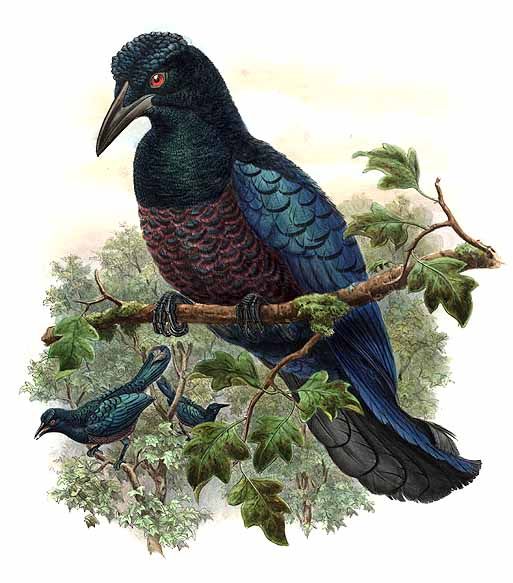
The Jobi Manucode is a crow-like bird-of-paradise. It inhabits lowland forests on Jobi Island and in northern New Guinea, and has been recorded on Yapen Island near Keranui village in Papua, Indonesia. It has greenish-blue, black and purple-glossed plumage, with short, bluish and lightly crinkled upper breast and neck feathers.
Written 26 November 2026 from the sources listed below. Each statement was checked against the passage it cites; statements that could not be supported were removed.
Appearance
The Jobi Manucode has greenish-blue, black and purple-glossed plumage. Its upper breast and neck feathers are short, bluish and lightly crinkled.[1][2]
Males and females have similar appearances, although females are slightly smaller and duller. The species reaches a maximum length of 34 cm.[3][4]
Habitat
The Jobi Manucode inhabits lowland forests. It occurs on Jobi Island and in northern New Guinea, and has been recorded on Yapen Island near Keranui village in Papua, Indonesia.[5][6][7]
Diet
The Jobi Manucode feeds mainly on fruits and arthropods.[8]
Behaviour
The Jobi Manucode is monogamous.[9]
Similar species
The Jobi Manucode resembles the crinkle-collared manucode. It differs in its neck feathers and shorter tail.[10][11]
Conservation
The Jobi Manucode is classified as Least Concern on the IUCN Red List. It was assessed in 2018.[12][13]
Its geographic range is very large and does not approach the Vulnerable threshold under the range-size criterion. The species is listed in Appendix II of CITES.[14][15]
Classification of the Jobi Manucode
| Kingdom | Animalia |
|---|---|
| Phylum | Chordata |
| Subphylum | Vertebrata |
| Infraphylum | Gnathostomata |
| Parvphylum | Osteichthyes |
| Megaclass | Tetrapoda |
| Class | Aves (Bird) |
| Order | Passeriformes (Passerine) |
| Family | Paradisaeidae (Bird-of-paradise) |
| Genus | Manucodia (Manucode) |
| Species | Manucodia jobiensis Salvadori, 1876 |
Where the Jobi Manucode is found
Checklists and occurrence records place Manucodia jobiensis in 3 countries across Oceania. GBIF holds 200 georeferenced records of it.
Countries
Regions and cities with the most records
- Papua, Indonesia 130
- East Sepik Province, Papua New Guinea 16
- Madang Province, Papua New Guinea 7
- Abepura, Indonesia 6
- Sandaun Province, Papua New Guinea 6
- Sentani, Indonesia 5
- Jayapura, Indonesia 3
- Madang, Papua New Guinea 3
Range as the checklists state it
Australia
A number beside a place is its count of GBIF occurrence records. A place without a number comes from a checklist alone. Records show where a species has been observed or collected, which can include escapes and vagrants.
Common names
English
- Jobi Manucode
Names in 28 other languages
- Arabic
- مانوكود جوبي
- Bulgarian
- Япенска манукодия
- Catalan
- ocell del paradís de l'illa Yapen
- Chinese
- 綠色輝天堂鳥, 绿辉极乐鸟
- Croatian
- ljubičasta rajska ptica
- Czech
- rajka jobienská
- Danish
- Jobimanukode
- Dutch
- Jobiparadijskraai
- Esperanto
- jobia paradizeo
- Estonian
- sarnas-paradiisihakk
- Finnish
- lyhytpyrstömanukki
- French
- Paradisier de Jobi
- German
- Jobi-Paradiesrähe, Jobiparadieskrähe
- Hungarian
- jobi paradicsommadár
- Indonesian
- Manukodia jobi
- Italian
- Manucodia di Jobi
- Japanese
- コテリカラスフウチョウ
- Lithuanian
- karčiuotoji manukodija
- Norwegian
- purpurparadisfugl
- Polish
- fałdowron lśniący
- Portuguese
- ave-do-paraíso-de-jobi, manucódio-de-jóbi
- Russian
- Гривистая манукодия
- Slovak
- rajka tupozobá
- Spanish
- Ave del paraíso de la Jobi, Ave-del-paraíso de la Jobi
- Swedish
- jobimanukod
- Turkish
- Jobi Manukotu
- Ukrainian
- манукодія мала
- Welsh
- aderyn paradwys Japen
Synonyms
One other scientific name has been used for this species and is now treated as a synonym of Manucodia jobiensis.
- Manucodia jobiensis jobiensis Salvadori, AT, 1876
Related species
-
 Curl-crested ManucodeManucodia comrii
-
 Glossy-mantled ManucodeManucodia ater
-
 Crinkle-collared ManucodeManucodia chalybatus
- Tagula ManucodeManucodia alter
-
 Raggiana Bird-of-paradiseParadisaea raggiana
-
 Wilson's Bird-of-paradiseDiphyllodes respublica
-
 Vogelkop LophorinaLophorina superba
-
 Greater Bird-of-paradiseParadisaea apoda
Compare
Questions and answers
What is the scientific name of the Jobi Manucode?
The scientific name of the Jobi Manucode is Manucodia jobiensis. Written with its author, the full name is Manucodia jobiensis Salvadori, 1876.
Which family does the Jobi Manucode belong to?
Manucodia jobiensis belongs to the family Paradisaeidae, in the order Passeriformes and the class Aves.
Where is the Jobi Manucode found?
Checklists and occurrence records place Manucodia jobiensis in 3 countries: Indonesia, Papua New Guinea and Australia.
What is the conservation status of the Jobi Manucode?
The IUCN Red List category recorded for Manucodia jobiensis is Least Concern (LC).
Sources
Passages the profile rests on
- The Jobi manucode has greenish-blue, black and purple-glossed plumage. Source passage: “greenish blue, black and purple-glossed” — English Wikipedia
- Its upper breast and neck feathers are short, bluish and lightly crinkled. Source passage: “lightly crinkled bluish short upper breast and neck feathers.” — English Wikipedia
- Males and females have similar appearances, although females are slightly smaller and duller. Source passage: “Both sexes are similar in appearance, however the female is slightly smaller and duller.” — English Wikipedia
- The Jobi manucode reaches a maximum length of 34 cm. Source passage: “up to 34 cm (13 in) long” — English Wikipedia
- The species inhabits lowland forests. Source passage: “distributed in lowland forests” — English Wikipedia
- The species occurs on Jobi Island and in northern New Guinea. Source passage: “The Jobi manucode is distributed in lowland forests of Jobi Island and northern New Guinea.” — English Wikipedia
- The species has been recorded on Yapen Island near Keranui village in Papua, Indonesia. Source passage: “21 June 2011. Yapen Island, near Keranui village, Papua, Indonesia” — ebird.org
- The Jobi manucode feeds mainly on fruits and arthropods. Source passage: “The diet consists mainly of fruits and arthropods.” — English Wikipedia
- The Jobi manucode is monogamous. Source passage: “Like other manucodes, it is monogamous.” — English Wikipedia
- The Jobi manucode resembles the crinkle-collared manucode. Source passage: “This species resembles the crinkle-collared manucode in appearance” — English Wikipedia
- The Jobi manucode differs from the crinkle-collared manucode in its neck feathers and shorter tail. Source passage: “distinguished by its neck feathers and by having a shorter tail than the latter species.” — English Wikipedia
- The Jobi manucode is classified as Least Concern on the IUCN Red List. Source passage: “the Jobi manucode is evaluated as Least Concern on the IUCN Red List of Threatened Species.” — English Wikipedia
- The Jobi manucode was assessed for the IUCN Red List in 2018. Source passage: “Jobi Manucode Manucodia jobiensis has most recently been assessed for The IUCN Red List of Threatened Species in 2018.” — iucnredlist.org
- The Jobi manucode has a very large geographic range that does not approach the Vulnerable threshold under the range-size criterion. Source passage: “This species has a very large range, and hence does not approach the thresholds for Vulnerable under the range size criterion” — datazone.birdlife.org
- The species is listed in Appendix II of CITES. Source passage: “It is listed on Appendix II of CITES.” — English Wikipedia
Data
- Catalogue of Life, 2026-10-16 XR cc by
- Global Biodiversity Information Facility CC BY 4.0
- Wikidata CC0
- GeoNames CC BY 4.0
- Within the Catalogue of Life, this name comes from The Integrated Taxonomic Information System cc0
References
- Salvadori, & Adelardo Tommaso. (1876). Descrizione di cinquantotto nuove specie di uccelli, ed osservazioni intorno ad altre poco note, della Nuova Guinea e di altre Isole Papuane, raccolte dal D.r Odoardo Beccari e dai cacciatori del Sig. A. A. Bruijn. Annali Del Museo Civico Di Storia Naturale Di Genova, Vol. 7. where the name was published
- Gill, Frank, & and Minturn Wright. (2006). Birds of the World: Recommended English Names.
This species in other databases
Page built on 29 November 2026. See how the catalog is made and all sources and licences.
Cite this page
ScientificNames.org. (2026). Manucodia jobiensis (Jobi Manucode). Retrieved November 29, 2026, from https://scientificnames.org/species/manucodia-jobiensis
“Manucodia jobiensis (Jobi Manucode).” ScientificNames.org, 2026, scientificnames.org/species/manucodia-jobiensis. Accessed 29 Nov. 2026.
ScientificNames.org. “Manucodia jobiensis (Jobi Manucode).” Accessed November 29, 2026. https://scientificnames.org/species/manucodia-jobiensis.
@misc{scientificnames_manucodia_jobiensis_jobi_manucode,
  author = {{ScientificNames.org}},
  title = {Manucodia jobiensis (Jobi Manucode)},
  year = {2026},
  url = {https://scientificnames.org/species/manucodia-jobiensis},
  note = {Accessed 2026-11-29}
}