Species · Spiders and other arachnids
Coastal Peacock Spider Maratus speciosus
The scientific name of the Coastal Peacock Spider is Maratus speciosus. It is a species of arachnid in the family Salticidae (jumping spider), order Araneae. The name dates from 1874.
- Scientific name
- Maratus speciosus (O. Pickard-Cambridge, 1874)
- Common name
- Coastal Peacock Spider
- Genus
- Maratus
- Family
- Salticidae (Jumping Spider)
- Order
- Araneae
- Class
- Arachnida
- Recorded in
- 1 country
- Name status
- accepted in the Catalogue of Life

Overview
Maratus speciosus inhabits vegetation growing on coastal sand dunes in southwestern Western Australia. Males display a colourful opisthosomal plate and bright orange setae during courtship.
Written 26 November 2026 from the sources listed below. Each statement was checked against the passage it cites; statements that could not be supported were removed.
Habitat
The Coastal Peacock Spider inhabits vegetation growing on coastal sand dunes in southwestern Western Australia. It is known from southwestern Western Australia and is native to Australia.[1][2][3]
Diet
The Coastal Peacock Spider feeds on insects.[4]
Behaviour
The Coastal Peacock Spider is diurnal and hunts by actively moving through its environment. It uses keen vision and jumping movements to travel and detect distant prey.[5][6]
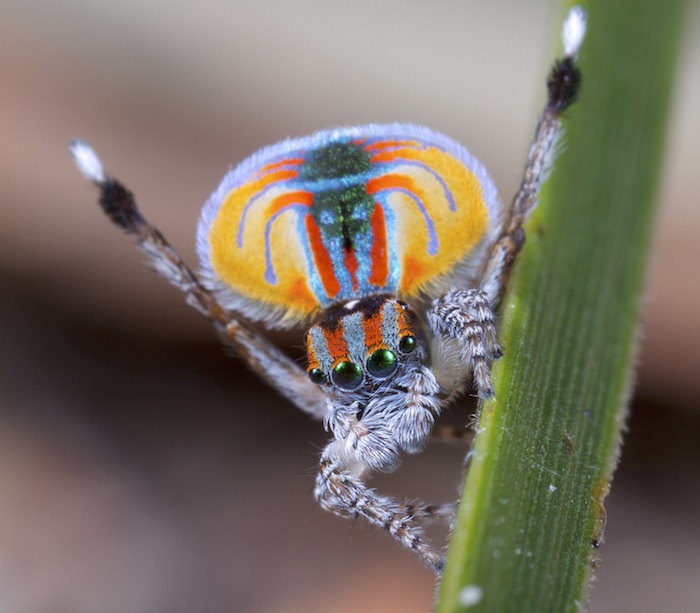
During courtship displays, males raise their third pair of legs and their abdomen. They beat their front and back body halves together, generating vibrations that travel through the ground.[7][8]
Females detect the ground vibrations produced by displaying males.[9]
Appearance
Males display a colourful opisthosomal plate during courtship. Bright orange setae along both edges of the opisthosoma become visible during these displays.[10][11]
Both males and females measure approximately 5 mm in body length.[12]
Classification of the Coastal Peacock Spider
| Kingdom | Animalia |
|---|---|
| Phylum | Arthropoda |
| Subphylum | Chelicerata |
| Class | Arachnida (Arachnid) |
| Order | Araneae (Spider) |
| Family | Salticidae (Jumping Spider) |
| Genus | Maratus (Peacock Spiders) |
| Species | Maratus speciosus (O. Pickard-Cambridge, 1874) |
Where the Coastal Peacock Spider is found
Checklists and occurrence records place Maratus speciosus in 1 country across Oceania. GBIF holds 154 georeferenced records of it.
Countries
Regions and cities with the most records
- Western Australia, Australia 131
- Perth, Australia 45
- Kwinana, Australia 22
- Rockingham, Australia 15
- Mandurah, Australia 13
- Bunbury, Australia 5
- Busselton, Australia 4
Range as the checklists state it
Australia (Western Australia)
A number beside a place is its count of GBIF occurrence records. A place without a number comes from a checklist alone. Records show where a species has been observed or collected, which can include escapes and vagrants.
Common names
English
- Coastal Peacock Spider
Synonyms
4 other scientific names have been used for this species and are now treated as synonyms of Maratus speciosus.
- Habrocestum speciosum Keyserling, 1883
- Saitis speciosus (O. Pickard-Cambridge, 1874)
- Saitis speciosus Simon, 1901
- Salticus speciosus O. Pickard-Cambridge, 1874
Related species
-
 Flying Peacock SpiderMaratus volans
- SparklemuffinMaratus jactatus
-
 White-banded House Jumping SpiderMaratus griseus
-
 Maratus pavonis
-
 Bat Peacock SpiderMaratus vespertilio
- SkeletorusMaratus sceletus
-
 Seashore JumperMaratus marinus
-
 Unusual Peacock SpiderMaratus anomalus
Compare
Questions and answers
What is the scientific name of the Coastal Peacock Spider?
The scientific name of the Coastal Peacock Spider is Maratus speciosus. Written with its author, the full name is Maratus speciosus (O. Pickard-Cambridge, 1874).
Which family does the Coastal Peacock Spider belong to?
Maratus speciosus belongs to the family Salticidae, in the order Araneae and the class Arachnida.
Where is the Coastal Peacock Spider found?
Checklists and occurrence records place Maratus speciosus in 1 country: Australia.
What habitat do peacock spiders live in?
The Coastal Peacock Spider inhabits vegetation growing on coastal sand dunes in southwestern Western Australia.[1]
What does the peacock spider eat?
The Coastal Peacock Spider feeds on insects.[4]
Sources
Passages the profile rests on
- The species inhabits vegetation growing on coastal sand dunes in southwestern Western Australia. Source passage: “They are only known to inhabit the vegetation of the coastal sand dunes of southwestern Western Australia.” — English Wikipedia
- The species is known from southwestern Western Australia. Source passage: “of southwestern Western Australia.” — English Wikipedia
- The species is native to Australia. Source passage: “is an Australian species of jumping spider” — inaturalist.org
- The species feeds on insects. Source passage: “they feed on insects.” — English Wikipedia
- The species is diurnal and hunts by actively moving through its environment. Source passage: “This organism is known as diurnal cursorial hunters” — English Wikipedia
- The species uses keen vision and jumping movements to travel and detect distant prey. Source passage: “they rely on their keen vision and jumping actions to help them travel and spot prey at far distances.” — English Wikipedia
- Males raise their third pair of legs and their abdomen during courtship displays. Source passage: “they raise their third pair of legs and their abdomen” — English Wikipedia
- Males beat their front and back body halves together during courtship, generating vibrations that travel through the ground. Source passage: “males beat their front and back body halves together, sending vibrations that travel through the ground” — English Wikipedia
- Females detect the ground vibrations produced by displaying males. Source passage: “which the females pick up” — English Wikipedia
- Males have bright orange setae along both edges of the opisthosoma that become visible during courtship displays. Source passage: “the males of this species have a set of bright orange hairs (setae) along both edges of the opisthosoma which only become visible during this display.” — English Wikipedia
- Males display a colourful opisthosomal plate during courtship. Source passage: “presenting their colourful opisthosomal plate to potential female partners.” — English Wikipedia
- Both males and females measure approximately 5 mm in body length. Source passage: “both sexes measuring about 5 mm in body length” — English Wikipedia
Data
- Catalogue of Life, 2026-10-16 XR cc by
- Global Biodiversity Information Facility CC BY 4.0
- Wikidata CC0
- GeoNames CC BY 4.0
- Wikimedia Commons per image; credit shown with each image
- Within the Catalogue of Life, this name comes from The World Spider Catalog cc by
References
- Pickard-Cambridge, O. (1874c). On some new genera and species of Araneidea. Annals and Magazine of Natural History (4) 14(81): 169-183, pl. 17. doi: <a href="https://doi.org/10.1080/00222937408680951" target="_blank">10.1080/00222937408680951 Link where the name was published
This species in other databases
Page built on 29 November 2026. See how the catalog is made and all sources and licences.
Cite this page
ScientificNames.org. (2026). Maratus speciosus (Coastal Peacock Spider). Retrieved November 29, 2026, from https://scientificnames.org/species/maratus-speciosus
“Maratus speciosus (Coastal Peacock Spider).” ScientificNames.org, 2026, scientificnames.org/species/maratus-speciosus. Accessed 29 Nov. 2026.
ScientificNames.org. “Maratus speciosus (Coastal Peacock Spider).” Accessed November 29, 2026. https://scientificnames.org/species/maratus-speciosus.
@misc{scientificnames_maratus_speciosus_coastal_peacock_spider,
  author = {{ScientificNames.org}},
  title = {Maratus speciosus (Coastal Peacock Spider)},
  year = {2026},
  url = {https://scientificnames.org/species/maratus-speciosus},
  note = {Accessed 2026-11-29}
}