Species · Molluscs
Giant Ramshorn Snail Marisa cornuarietis
The scientific name of the Giant Ramshorn Snail is Marisa cornuarietis. It is a species of mollusc in the family Ampullariidae (apple snail), order Architaenioglossa. The name dates from 1758.
- Scientific name
- Marisa cornuarietis (Linnaeus, 1758)
- Common name
- Giant Ramshorn Snail
- Genus
- Marisa
- Family
- Ampullariidae (Apple Snail)
- Order
- Architaenioglossa
- Class
- Gastropoda
- Red List category
- LC Least Concern
- Environment
- freshwater
- Recorded in
- 22 countries
- Name status
- accepted in the Catalogue of Life

Overview
The giant ramshorn snail inhabits shallow freshwater environments, including swamps, rivers, canals, lakes, and irrigation systems. Adults have flattened spiral shells with 3.5–4 whorls and shell diameters of approximately 40–50 mm.
Written 26 November 2026 from the sources listed below. Each statement was checked against the passage it cites; statements that could not be supported were removed.
Appearance
Adults have flattened spiral shells with 3.5–4 whorls. Juveniles have elevated shell spires and globose shells.[1][2]
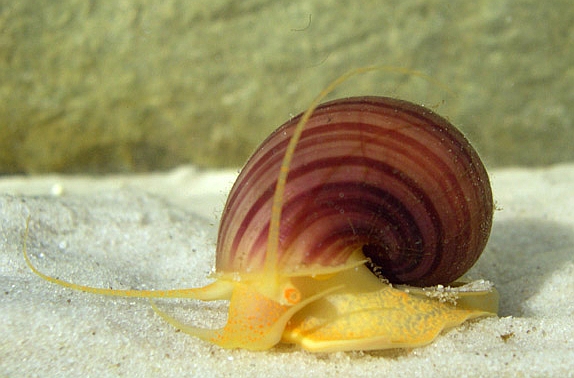
Shells bear transverse growth lines and can have dark yellow, brownish, or black spiral bands. Shell coloration ranges from pale to darker red or brown, and shells are often striped.[3][4][5]
Some individuals have dark coloration on one side of the shell and yellow coloration on the other. A golden-yellow mutant form is commonly sold in the aquarium trade.[6][7]
Adult shell diameters are approximately 40–50 mm. Adult shells measure approximately 48–56 mm in height or length and 22 mm in width, and females tend to be larger than males.[8][9][10]
Habitat
The giant ramshorn snail inhabits shallow waters with dense vegetation. Its habitats include swamps, rivers, canals, lakes, and irrigation systems.[11][12]
The species prefers still or slow-moving freshwater. It can tolerate salinities of approximately 4.3 PSU.[13][14]
The species can tolerate exposure to air for 30–120 days depending on humidity.[15]
Diet
The giant ramshorn snail feeds primarily on living and decaying aquatic plants. Its diet also includes algae, dead fish, and other snails.[16][17]
Aquatic plants consumed by the species include Najas, Myriophyllum, Elodea, and Cabomba. It also consumes filamentous algae growing on rocks.[18][19]
Recorded terrestrial plant foods include tomatoes, carrots, lettuce, and rice. The species also consumes egg masses and juveniles of other snails.[20][21]
Juveniles grow fastest when supplied with lettuce at high feeding frequencies.[22]
Behaviour
The giant ramshorn snail has both gills and a lung for respiration. It can disperse along the shores of brackish lagoons.[23][24]
Reproduction and life cycle
The giant ramshorn snail has separate male and female individuals. Fertilization occurs internally.[25][26]
Females lay eggs in gelatinous, transparent masses below the water surface. Eggs are deposited in disk-shaped clutches attached to substrates.[27][28]
Newly hatched individuals resemble miniature snails.[29]
Uses
The giant ramshorn snail is traded as an ornamental snail for freshwater aquariums.[30]
The species has been used as a biological control agent against Biomphalaria snails. It has also been introduced in some African locations to control snails that host trematode parasites causing schistosomiasis.[31][32]
The species has been investigated as a potential aquatic weed-control agent in Puerto Rico and Florida.[33]
Similar species
The giant ramshorn snail is not closely related to true ramshorn snails in the family Planorbidae.[34]
Classification of the Giant Ramshorn Snail
| Kingdom | Animalia |
|---|---|
| Phylum | Mollusca |
| Class | Gastropoda (Gastropod) |
| Subclass | Caenogastropoda |
| Order | Architaenioglossa |
| Superfamily | Ampullarioidea |
| Family | Ampullariidae (Apple Snail) |
| Subfamily | Pomaceinae |
| Genus | Marisa (Giant Ramshorn Snails) |
| Species | Marisa cornuarietis (Linnaeus, 1758) |
Where the Giant Ramshorn Snail is found
Checklists and occurrence records place Marisa cornuarietis in 22 countries. GBIF holds 1,011 georeferenced records of it.
Countries
- Argentina 5
- Bolivia 7
- Brazil 42
- Colombia 99
- Costa Rica 4
- Cuba 8
- Dominican Republic 22
- French Guiana 3
- Grenada 11
- Guadeloupe 17
- Guyana 3
- Jamaica 5
- Martinique 5
- Mexico 5
- Panama 5
- Puerto Rico 59
- Saint Barthelemy 3
- Saint Martin 3
- Suriname 5
- Trinidad and Tobago 197
- United States 421
- Venezuela 82
Regions and cities with the most records
- Florida, United States 297
- Glenvar Heights, United States 85
- Coconut Grove, United States 83
- Flagami, United States 83
- Sunset, United States 83
- Coral Gables, United States 82
- Fountainebleau, United States 82
- Westchester, United States 82
- Kendall, United States 80
- Pinecrest, United States 80
- University Park, United States 80
- Coral Terrace, United States 79
- Sweetwater, United States 78
- Kendale Lakes, United States 76
- Palmetto Bay, United States 76
- Three Lakes, United States 76
- Tamiami, United States 75
- Country Walk, United States 74
- Little Havana, United States 74
- Miami Lakes, United States 74
- The Crossings, United States 74
- Kendall West, United States 73
- The Hammocks, United States 72
- Richmond West, United States 71
- Hialeah Gardens, United States 69
- Hialeah, United States 68
- Country Club, United States 67
- Doral, United States 67
- Cutler, United States 65
- Opa-locka, United States 64
- Texas, United States 64
- West Little River, United States 64
- Davie, United States 61
- Lauderhill, United States 61
- Plantation, United States 61
- Brownsville, United States 60
2 more countries have a few records outside this range
These countries hold a few records of Marisa cornuarietis but lie outside the range the checklists give for it. Such records are often zoo or garden specimens, museum material or vagrants, so the species is not counted as occurring there.
A number beside a place is its count of GBIF occurrence records. A place without a number comes from a checklist alone. Records show where a species has been observed or collected, which can include escapes and vagrants.
Common names
English
- Giant Ramshorn Snail
- Colombian Ramshorn Apple Snail
- Goldenhorn Marisa
- Giant Rams-horn
Names in 9 other languages
- Chinese
- 大羊角螺
- Czech
- ampulárka okružáková
- Dutch
- Grote posthorenappelslak
- French
- Marise corne-de-bélier
- German
- Gestreifte Posthornschnecke, Kolumbianische Deckel-Tellerschnecke, Paradiesschnecke, Südamerikanisches Posthorn
- Russian
- роговая мариса
- Spanish
- Caracol cuerno gigante de borrego
- Swedish
- skiväppelsnäcka
- Thai
- หอยแรมส์ฮอร์นยักษ์
Synonyms
11 other scientific names have been used for this species and are now treated as synonyms of Marisa cornuarietis.
- Ampullaria (Ceratodes) chiquitensis A. d'Orbigny, 1838
- Ampullaria (Marisa) cornuarietis (Linnaeus, 1758)
- Ampullaria cornuarietis (Linnaeus, 1758)
- Ampullaria knorrii R. A. Philippi, 1852
- Ampullaria rotula Mousson, 1869
- Ceratodes fasciatus Guilding, 1828
- Ceratodes rotula Mousson, 1873
- Helix cornuarietis Linnaeus, 1758
- Marisa cornuarietis var. swifti Guppy, 1866
- Marisa rotula (Mousson, 1869)
- Planorbis contrarius O. F. Müller, 1774
Related species
- Marisa planogyra
-
 Channeled Apple SnailPomacea canaliculata
-
 Golden Mystery SnailPomacea bridgesii
-
 Giant ApplesnailPomacea maculata
-
 Mystery SnailPomacea diffusa
-
 Florida ApplesnailPomacea paludosa
-
 Common Indian Apple SnailPila globosa
- Western PilaPila occidentalis
Compare
Questions and answers
What is the scientific name of the Giant Ramshorn Snail?
The scientific name of the Giant Ramshorn Snail is Marisa cornuarietis. Written with its author, the full name is Marisa cornuarietis (Linnaeus, 1758).
Which family does the Giant Ramshorn Snail belong to?
Marisa cornuarietis belongs to the family Ampullariidae, in the order Architaenioglossa and the class Gastropoda.
Where is the Giant Ramshorn Snail found?
Checklists and occurrence records place Marisa cornuarietis in 22 countries, including United States, Trinidad and Tobago, Colombia, Venezuela, Puerto Rico and Brazil.
What is the conservation status of the Giant Ramshorn Snail?
The IUCN Red List category recorded for Marisa cornuarietis is Least Concern (LC).
What other names does the Giant Ramshorn Snail have?
Marisa cornuarietis is also known in English as Colombian Ramshorn Apple Snail, Goldenhorn Marisa and Giant Rams-horn.
How big do giant ramshorn snails get?
Adult shell diameters are approximately 40–50 mm. Adult shells measure approximately 48–56 mm in height or length and 22 mm in width. Females tend to be larger than males.[8][9][10]
Sources
Passages the profile rests on
- Adults have flattened spiral shells with 3.5–4 whorls. Source passage: “Adults have a planorboid (flattened spiral, with the spire not protruding) shell of 3.5-4 whorls.” — invasions.si.edu
- Juveniles have elevated shell spires and globose shells. Source passage: “Young snails do have an elevated spire, and a globose shape.” — invasions.si.edu
- Shells bear transverse growth lines. Source passage: “The shells are marked with transverse growth lines.” — invasions.si.edu
- Shell coloration can include dark yellow, brownish, or black spiral bands. Source passage: “Individuals can have dark-yellow, brownish, or black spiral bands.” — invasions.si.edu
- Shell coloration ranges from pale to darker red or brown, and shells are often striped. Source passage: “The shell color varies from pale to darker red or brown or more vivid shades of those colors, and is fairly often striped.” — English Wikipedia
- Some individuals have dark coloration on one side of the shell and yellow coloration on the other. Source passage: “The banding pattern is unequal, so sometimes, these snails have one side dark and the other yellow.” — invasions.si.edu
- A golden-yellow mutant form is commonly sold in the aquarium trade. Source passage: “A golden-yellow mutant form is commonly sold in the aquarium trade.” — invasions.si.edu
- Adult shell diameters are approximately 40–50 mm. Source passage: “adults: 40–50 mm in shell diameter” — pmc.ncbi.nlm.nih.gov
- Adult shells measure approximately 48–56 mm in height or length and 22 mm in width. Source passage: “Adult shells are 48-56 mm high or long, and about 22 mm wide.” — invasions.si.edu
- Females tend to be larger than males. Source passage: “females tend to be larger than males.” — invasions.si.edu
- The species inhabits shallow waters with dense vegetation. Source passage: “It is found in shallow waters with dense vegetation” — invasions.si.edu
- Its habitats include swamps, rivers, canals, lakes, and irrigation systems. Source passage: “including swamps, rivers, canals, lakes, and irrigation systems” — invasions.si.edu
- The species prefers still or slow-moving freshwater. Source passage: “This snail prefers still or slow-moving fresh water” — English Wikipedia
- The species can tolerate salinities of approximately 4.3 PSU. Source passage: “tolerates salinity up to about 4.3 PSU” — invasions.si.edu
- The species can tolerate exposure to air for 30–120 days depending on humidity. Source passage: “can tolerate 30-120 days of air exposure, depending on humidity” — invasions.si.edu
- The species feeds primarily on living and decaying aquatic plants. Source passage: “feed primarily on living and decaying aquatic plants” — pmc.ncbi.nlm.nih.gov
- Its diet includes aquatic plants, algae, dead fish, and other snails. Source passage: “This species eats aquatic plants, algae, dead fish and snails.” — English Wikipedia
- The species consumes aquatic plants including Najas, Myriophyllum, Elodea, and Cabomba. Source passage: “including Najas, Myriophyllum, Elodea, Cabomba” — invasions.si.edu
- The species also consumes filamentous algae growing on rocks. Source passage: “filamentous algae growing on rocks” — invasions.si.edu
- Its recorded terrestrial plant foods include tomatoes, carrots, lettuce, and rice. Source passage: “terrestrial plants such as tomatoes, carrots, lettuce and rice.” — invasions.si.edu
- The species consumes egg masses and juveniles of other snails. Source passage: “this snail feeds on egg masses and juveniles of other snails” — invasions.si.edu
- Juveniles grow fastest when supplied with lettuce at high feeding frequencies. Source passage: “The most rapid growth rates occurred in the high-frequency lettuce treatments” — pmc.ncbi.nlm.nih.gov
- The species has both gills and a lung for respiration. Source passage: “This species has gills as well as a lung” — English Wikipedia
- The species can disperse along the shores of brackish lagoons. Source passage: “This snail is known to disperse along the shores of brackish lagoons” — invasions.si.edu
- The species has separate male and female individuals. Source passage: “Marisa cornuarietis has separate sexes” — invasions.si.edu
- Fertilization occurs internally. Source passage: “Fertilization is internal” — invasions.si.edu
- Females lay eggs in gelatinous, transparent masses below the water surface. Source passage: “eggs are laid in gelatinous transparent masses, below the water surfaces” — invasions.si.edu
- Eggs are deposited in disk-shaped clutches attached to substrates. Source passage: “it lays eggs in characteristic disk-shape clutches, adhering to various substrates.” — English Wikipedia
- Newly hatched individuals resemble miniature snails. Source passage: “Its young hatch as miniature snails” — invasions.si.edu
- The species is traded as an ornamental snail for freshwater aquariums. Source passage: “It is a part of ornamental pet trade for freshwater aquaria.” — English Wikipedia
- The species has been used as a biological control agent against Biomphalaria snails. Source passage: “Marisa cornuarietis is used as a biological control to reduce the number of Biomphalaria snails” — English Wikipedia
- The species has been introduced in some African locations to control snails that host trematode parasites causing schistosomiasis. Source passage: “It has been intentionally introduced in areas of Africa as biocontrol of snail species which host trematode parasites causing schistosomiasis in humans.” — invasions.si.edu
- The species has been investigated as a potential aquatic weed-control agent in Puerto Rico and Florida. Source passage: “It has been investigated as a potential weed control agent in both Puerto Rico and Florida” — pmc.ncbi.nlm.nih.gov
- The species is not closely related to true ramshorn snails in the family Planorbidae. Source passage: “they are not at all closely related to true ramshorn snails in the family Planorbidae.” — English Wikipedia
Data
- Catalogue of Life, 2026-10-16 XR cc by
- Global Biodiversity Information Facility CC BY 4.0
- Wikidata CC0
- GeoNames CC BY 4.0
- Wikimedia Commons per image; credit shown with each image
- Within the Catalogue of Life, this name comes from World Register of Marine Species cc by
This species in other databases
Page built on 28 November 2026. See how the catalog is made and all sources and licences.
Cite this page
ScientificNames.org. (2026). Marisa cornuarietis (Giant Ramshorn Snail). Retrieved November 28, 2026, from https://scientificnames.org/species/marisa-cornuarietis
“Marisa cornuarietis (Giant Ramshorn Snail).” ScientificNames.org, 2026, scientificnames.org/species/marisa-cornuarietis. Accessed 28 Nov. 2026.
ScientificNames.org. “Marisa cornuarietis (Giant Ramshorn Snail).” Accessed November 28, 2026. https://scientificnames.org/species/marisa-cornuarietis.
@misc{scientificnames_marisa_cornuarietis_giant_ramshorn_snail,
  author = {{ScientificNames.org}},
  title = {Marisa cornuarietis (Giant Ramshorn Snail)},
  year = {2026},
  url = {https://scientificnames.org/species/marisa-cornuarietis},
  note = {Accessed 2026-11-28}
}