Species · Fishes
Humpback Anglerfish Melanocetus johnsonii
The scientific name of the Humpback Anglerfish is Melanocetus johnsonii. It is a species of fish in the family Melanocetidae (blackdevils), order Lophiiformes. The name dates from 1864.
- Scientific name
- Melanocetus johnsonii Günther, 1864
- Common name
- Humpback Anglerfish
- Genus
- Melanocetus
- Family
- Melanocetidae (Blackdevils)
- Order
- Lophiiformes
- Class
- Teleostei
- Red List category
- LC Least Concern
- Environment
- marine
- Recorded in
- 43 countries
- Name status
- accepted in the Catalogue of Life
Overview
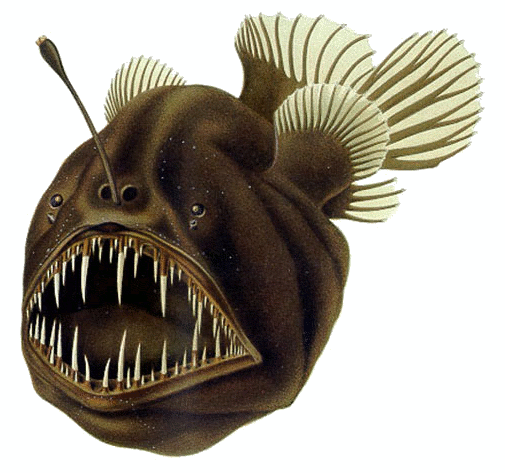
Melanocetus johnsonii inhabits mesopelagic and bathypelagic ocean zones and is most commonly found at depths between 200 and 1,500 metres. Females have a bulb-shaped lure on the snout, while males are slender and lack a lure.
Written 26 November 2026 from the sources listed below. Each statement was checked against the passage it cites; statements that could not be supported were removed.
Appearance
The Humpback Anglerfish has a soft body with dark brown or black coloration. It lacks pelvic fins and body scales.[1][2]
Females have short, rounded bodies, large heads, nearly vertical mouths and long pointed teeth. Their small eyes are located beneath the skin.[3][4]
Females have a short dorsal-fin spine bearing a bulb-shaped lure on the snout. Males are slender and lack the lure present in females.[5][6]
Habitat
The species inhabits mesopelagic and bathypelagic ocean zones and is most commonly found at depths between 200 and 1,500 metres. Approximately 65% of recorded specimens were collected at depths of 1,000 metres or less below the surface.[7][8][9]
The species occurs in temperate and tropical waters across all oceans. It has been recorded in both the South China Sea and East China Sea.[10][11]
A specimen was recorded in Antarctic waters in the Ross Sea in 2014. The species has also been recorded near Father Charles Canyon in British Columbia.[12][13]
In Australian waters, the species is known from central and southern New South Wales and near Norfolk Island. It occurs at mesopelagic depths in tropical and temperate waters there.[14][15]
Diet
The species is capable of consuming prey larger than itself. Females can consume meals weighing more than their own body weight.[16][17]
One recorded specimen weighing 8.8 grams had three snipe eels weighing a combined 12.3 grams in its stomach.[18]
Behaviour
Individuals use a sit-and-wait strategy to ambush prey. Females use their bioluminescent esca to attract prey.[19][20]
The species' bioluminescence is produced by Enterovibrio escacola bacteria associated with its esca.[21]
The fish has a low metabolic rate compared with other organisms living at similar depths. It can regulate aerobic metabolism by adjusting oxygen consumption.[22][23]
The species can survive in hypoxic or anaerobic conditions for extended periods. Individuals live solitarily and are widely separated in the deep sea.[24][25]
Reproduction and life cycle
Males use highly developed sensory organs to follow female scent in deep-sea water. They temporarily attach to females using a denticular apparatus before releasing sperm.[26][27]
Males detach from females after mating and can search for additional mates. The species reproduces through external fertilization.[28][29]
Females release eggs into the water, after which males release sperm to fertilize them. Both sexes can reach sexual maturity without the presence of the opposite sex.[30][31]
Similar species
Melanocetus rossi resembles Melanocetus johnsonii in numerous morphological characteristics. Melanocetus johnsonii can be distinguished by its black pigmentation on the upper body exterior.[32][33]
Conservation
The species is classified as Least Concern on the IUCN Red List. It is not hunted by humans as a food source.[34][35]
Individuals may be caught unintentionally as bycatch during trawling.[36]
Classification of the Humpback Anglerfish
| Kingdom | Animalia |
|---|---|
| Phylum | Chordata |
| Subphylum | Vertebrata |
| Infraphylum | Gnathostomata |
| Parvphylum | Osteichthyes |
| Gigaclass | Actinopterygii |
| Superclass | Actinopteri |
| Class | Teleostei (Teleost) |
| Order | Lophiiformes (Anglerfish) |
| Suborder | Ceratioidei |
| Family | Melanocetidae (Blackdevils) |
| Genus | Melanocetus (Black Seadevil) |
| Species | Melanocetus johnsonii Günther, 1864 |
Where the Humpback Anglerfish is found
Checklists and occurrence records place Melanocetus johnsonii in 43 countries. GBIF holds 943 georeferenced records of it.
Countries
- Angola 8
- Australia 129
- Bermuda 22
- Brazil 13
- Cabo Verde 44
- Canada 30
- Cocos Islands 9
- Colombia 4
- Costa Rica 6
- French Polynesia 7
- Gambia 4
- Greenland 11
- Guatemala 9
- India 5
- Indonesia 31
- Japan 8
- Kiribati 4
- Madagascar 4
- Maldives 3
- Mauritania 14
- Mexico 40
- Morocco 10
- Namibia 22
- New Caledonia 3
- New Zealand 52
- Nicaragua 16
- Norfolk Island 3
- Panama 5
- Papua New Guinea 7
- Peru 29
- Philippines 20
- Portugal 34
- Saint Helena 17
- Senegal 3
- Seychelles 3
- Somalia 4
- South Africa 31
- Spain 22
- Sri Lanka 6
- Taiwan 4
- United States 198
- United States Minor Outlying Islands 4
- Western Sahara 45
Regions and cities with the most records
- West Island, Cocos Islands 9
- Makakilo / Kapolei / Honokai Hale, United States 5
- Caniço, Portugal 3
- Câmara de Lobos, Portugal 3
- Funchal, Portugal 3
- Santo António, Portugal 3
- São Martinho, Portugal 3
1 more country has a few records outside this range
These countries hold a few records of Melanocetus johnsonii but lie outside the range the checklists give for it. Such records are often zoo or garden specimens, museum material or vagrants, so the species is not counted as occurring there.
A number beside a place is its count of GBIF occurrence records. A place without a number comes from a checklist alone. Records show where a species has been observed or collected, which can include escapes and vagrants.
Common names
English
- Humpback Anglerfish
- Blackdevil
- Humpback Blackdevil
- Johnson's Black Anglerfish
- Angler Fish
Names in 12 other languages
- Asturian
- diañu prietu
- Chinese
- 深海鮟鱇, 約氏黑犀魚, 約氏黑鮟鱇
- Czech
- velkotlamec Johnsonův
- Danish
- Johnsons klumpangler
- Dutch
- Johnsons hengelvis
- German
- Buckliger Anglerfisch
- Italian
- Diavolo nero di Johnson, Melanoceto di Johnson
- Japanese
- Perikan-ankô, ペリカンアンコウ
- Mandarin Chinese
- 约氏黑鲸鮟鱇
- Portuguese
- Peixe-diabo-de-Johnson
- Russian
- Меланоцет Джонсона, Черный удильщик Джонсона, Чёрный удильщик Джонсона
- Spanish
- Pez diablo de Johnson, negro
Synonyms
13 other scientific names have been used for this species and are now treated as synonyms of Melanocetus johnsonii.
- Centrocetus spinulosus Regan & Trewavas, 1932
- Melanocetus cirrifer Regan & Trewavas, 1932
- Melanocetus ferox Regan, 1926
- Melanocetus johnsoni Günther, 1864
- Melanocetus krechi Brauer, 1902
- Melanocetus megalodontis Beebe & Crane, 1947
- Melanocetus rotundatus Gilchrist, 1903
- Melanocoetus rotundatus Gilchrist, 1903
- Xenoceratias braueri Koefoed, 1944
- Xenoceratias brevirostris Regan & Trewavas, 1932
- Xenoceratias heterorhynchus Regan & Trewavas, 1932
- Xenoceratias laevis Regan & Trewavas, 1932
- Xenoceratias micracanthus Regan & Trewavas, 1932
Related species
-
 Murray's Abyssal AnglerfishMelanocetus murrayi
- Melanocetus rossi
-
 Melanocetus eustalus
- Melanocetus niger
- Melanocetus polyactis
Compare
Questions and answers
What is the scientific name of the Humpback Anglerfish?
The scientific name of the Humpback Anglerfish is Melanocetus johnsonii. Written with its author, the full name is Melanocetus johnsonii Günther, 1864.
Which family does the Humpback Anglerfish belong to?
Melanocetus johnsonii belongs to the family Melanocetidae, in the order Lophiiformes and the class Teleostei.
Where is the Humpback Anglerfish found?
Checklists and occurrence records place Melanocetus johnsonii in 43 countries, including United States, Australia, New Zealand, Western Sahara, Cabo Verde and Mexico.
What is the conservation status of the Humpback Anglerfish?
The IUCN Red List category recorded for Melanocetus johnsonii is Least Concern (LC).
What other names does the Humpback Anglerfish have?
Melanocetus johnsonii is also known in English as Blackdevil, Humpback Blackdevil, Johnson's Black Anglerfish and Angler Fish.
Are humpback anglerfish endangered?
The Humpback Anglerfish is classified as Least Concern on the IUCN Red List.[34]
What do humpback anglerfish eat?
The species can consume prey larger than itself. One recorded specimen had three snipe eels weighing a combined 12.3 grams in its stomach.[16][18]
Where do humpback anglerfish live?
They occur in temperate and tropical waters across all oceans, inhabiting mesopelagic and bathypelagic ocean zones.[7][10]
Sources
Passages the profile rests on
- The fish has a soft body with dark brown or black coloration. Source passage: “M. johnsonii is a black soft-bodied anglerfish that is dark brown or black in color.” — English Wikipedia
- The species lacks pelvic fins and body scales. Source passage: “The Humpback Blackdevil is a soft-bodied fish that lacks scales and pelvic fins.” — australian.museum
- Females have short, rounded bodies, large heads, nearly vertical mouths and long pointed teeth. Source passage: “Female humpback anglerfish have short, globular bodies, large heads with a widened mouth that is nearly vertical, and long pointed teeth capable of eating prey larger than themselves.” — English Wikipedia
- Females possess small eyes located beneath the skin. Source passage: “Female M. johnsonii have small, subcutaneous eyes that may suggest their lack of dependency on visual sight for feeding and reproduction.” — English Wikipedia
- Females have a short dorsal-fin spine bearing a bulb-shaped lure on the snout. Source passage: “Like all other anglerfish, females have a short dorsal fin spine (illicium) with a bulbous luring apparatus (esca) on the snout.” — English Wikipedia
- Males are slender and lack the lure present in females. Source passage: “Males, however, are slender fish that lack a lure and only grow to 2.9 cm.” — australian.museum
- The species inhabits mesopelagic and bathypelagic ocean zones. Source passage: “M. johnsonii inhabits the mesopelagic and bathypelagic zones” — English Wikipedia
- The species is most commonly found at depths between 200 and 1,500 metres. Source passage: “and is found most commonly at depths between 200 and 1,500 metres (660 and 4,920 ft).” — English Wikipedia
- Approximately 65% of recorded specimens were collected at depths of 1,000 metres or less below the surface. Source passage: “65% of recorded specimens were collected at depths of or above 1,000 metres (3,300 ft) below the surface of the water.” — English Wikipedia
- The species occurs in temperate and tropical waters across all oceans. Source passage: “The species had been known to be widely distributed in the temperate and tropical ranges of all oceans” — English Wikipedia
- The species has been recorded in both the South China Sea and East China Sea. Source passage: “as well as in the South China Sea and the East China Sea.” — English Wikipedia
- A specimen was recorded in Antarctic waters in the Ross Sea in 2014. Source passage: “in 2014 when the first specimen of M. johnsonii in Antarctic waters was obtained from the stomach of an Antarctic toothfish in the Ross Sea.” — English Wikipedia
- The species has been recorded near Father Charles Canyon in British Columbia. Source passage: “An individual specimen of M. johnsonii was found near Father Charles Canyon in British Columbia” — English Wikipedia
- In Australian waters, the species is known from central and southern New South Wales and near Norfolk Island. Source passage: “In Australia it is known from off central to southern New South Wales and near Norfolk Island.” — australian.museum
- In Australian waters, the species occurs at mesopelagic depths in tropical and temperate waters. Source passage: “It occurs at mesopelagic depths in tropical and temperate waters worldwide.” — australian.museum
- The species is capable of consuming prey larger than itself. Source passage: “long pointed teeth capable of eating prey larger than themselves.” — English Wikipedia
- Females can consume meals weighing more than their own body weight. Source passage: “Their stomachs are highly distensible and expand easily, allowing them to consume meals weighing more than themselves.” — English Wikipedia
- One recorded specimen weighing 8.8 grams had three snipe eels weighing a combined 12.3 grams in its stomach. Source passage: “One M. johnsonii individual weighing 8.8 grams was retrieved using a trawl, and the specimen was found to have three snipe eels totaling 12.3 grams in its stomach.” — English Wikipedia
- Individuals use a sit-and-wait strategy to ambush prey. Source passage: “M. johnsonii are ambush predators, meaning that they use a sit-and-wait predation strategy.” — English Wikipedia
- Females use their bioluminescent esca to attract prey. Source passage: “Females use the bulbous esca as a bioluminescent lure to attract prey.” — English Wikipedia
- The species' bioluminescence is produced by Enterovibrio escacola bacteria associated with its esca. Source passage: “The bioluminescence of M. johnsonii is caused by symbiont Enterovibrio escacola bacteria on the esca.” — English Wikipedia
- The fish has a low metabolic rate compared with other organisms living at similar depths. Source passage: “Individuals of M. johnsonii have a low metabolic rate, even compared to organisms living at similar depths.” — English Wikipedia
- The species can regulate aerobic metabolism by adjusting oxygen consumption. Source passage: “Researchers found that M. johnsonii is able to regulate its aerobic metabolism by adjusting its oxygen consumption” — English Wikipedia
- The species can survive in hypoxic or anaerobic conditions for extended periods. Source passage: “allowing it to live in hypoxic or anaerobic conditions for long periods of time.” — English Wikipedia
- Individuals live solitarily and are widely separated in the deep sea. Source passage: “because they live solitarily and far apart from each other in the deep sea.” — English Wikipedia
- Males use highly developed sensory organs to follow female scent in deep-sea water. Source passage: “Males have highly developed sensory organs that allow them to trace the scent of a female as it is minimally disrupted in the still waters of the deep sea.” — English Wikipedia
- Males temporarily attach to females using a denticular apparatus before releasing sperm. Source passage: “M. johnsonii males only temporarily attach onto the larger M. johnsonii female using a unique denticular apparatus before releasing their sperm.” — English Wikipedia
- Males detach from females after mating and can search for additional mates. Source passage: “Once this process is complete, males detach from the females to find other mates.” — English Wikipedia
- The species reproduces through external fertilization. Source passage: “The reproduction of black anglerfish is carried out by external fertilization;” — English Wikipedia
- Females release eggs into the water, after which males release sperm to fertilize them. Source passage: “females release eggs into the water and males then immediately exert their sperm to capture and fertilize the eggs.” — English Wikipedia
- Both sexes can reach sexual maturity without the presence of the opposite sex. Source passage: “both M. johnsonii males and females are able to reach sexual maturity without the presence of the other sex.” — English Wikipedia
- Melanocetus rossi resembles M. johnsonii in numerous morphological characteristics. Source passage: “there are many similarities in the morphological characteristics of M. johnsonii and M. rossi” — English Wikipedia
- Melanocetus johnsonii can be distinguished from M. rossi by its black pigmentation on the upper body exterior. Source passage: “M. johnsonii has black pigmentation on its upper body exterior while M. rossi does not.” — English Wikipedia
- The species is classified as Least Concern on the IUCN Red List. Source passage: “M. johnsonii was classified as a "Least Concern" species on IUCN Red List of Threatened Species.” — English Wikipedia
- The species is not hunted by humans as a food source. Source passage: “It is not a food source for humans and, therefore, is not hunted by humans.” — English Wikipedia
- Individuals may be caught unintentionally as bycatch during trawling. Source passage: “However, individuals may be collected as bycatch with trawling” — English Wikipedia
Data
- Catalogue of Life, 2026-10-16 XR cc by
- Global Biodiversity Information Facility CC BY 4.0
- Wikidata CC0
- GeoNames CC BY 4.0
- Wikimedia Commons per image; credit shown with each image
- Within the Catalogue of Life, this name comes from World Register of Marine Species cc by
References
- Günther, A. (1864). On a new genus of pediculate fish from the Sea of Madeira. Proceedings of the Zoological Society of London 1864, (pt 2) (art. 6): 301–303, Pl. 25. Also as a separate, pp. 1–2. where the name was published
This species in other databases
- Catalogue of Life 3Z86X
- Wikidata Q535212
- iNaturalist 64212
- WoRMS urn:lsid:marinespecies.org:taxname:126556
- ITIS 622873
Page built on 27 November 2026. See how the catalog is made and all sources and licences.
Cite this page
ScientificNames.org. (2026). Melanocetus johnsonii (Humpback Anglerfish). Retrieved November 27, 2026, from https://scientificnames.org/species/melanocetus-johnsonii
“Melanocetus johnsonii (Humpback Anglerfish).” ScientificNames.org, 2026, scientificnames.org/species/melanocetus-johnsonii. Accessed 27 Nov. 2026.
ScientificNames.org. “Melanocetus johnsonii (Humpback Anglerfish).” Accessed November 27, 2026. https://scientificnames.org/species/melanocetus-johnsonii.
@misc{scientificnames_melanocetus_johnsonii_humpback_anglerfish,
  author = {{ScientificNames.org}},
  title = {Melanocetus johnsonii (Humpback Anglerfish)},
  year = {2026},
  url = {https://scientificnames.org/species/melanocetus-johnsonii},
  note = {Accessed 2026-11-27}
}