Species · Fishes
Murray's Abyssal Anglerfish Melanocetus murrayi
The scientific name of the Murray's Abyssal Anglerfish is Melanocetus murrayi. It is a species of fish in the family Melanocetidae (blackdevils), order Lophiiformes. The name dates from 1887.
- Scientific name
- Melanocetus murrayi Günther, 1887
- Common name
- Murray's Abyssal Anglerfish
- Genus
- Melanocetus
- Family
- Melanocetidae (Blackdevils)
- Order
- Lophiiformes
- Class
- Teleostei
- Red List category
- LC Least Concern
- Environment
- marine
- Recorded in
- 14 countries
- Name status
- accepted in the Catalogue of Life

Overview
Murray's abyssal anglerfish is a fish in the family Melanocetidae, order Lophiiformes and class Teleostei. It inhabits tropical to temperate parts of the world's oceans and occurs at depths exceeding 2,000 m. It is distinguished by a long modified dorsal spine bearing a bioluminescent lure.
Written 26 November 2026 from the sources listed below. Each statement was checked against the passage it cites; statements that could not be supported were removed.
Appearance
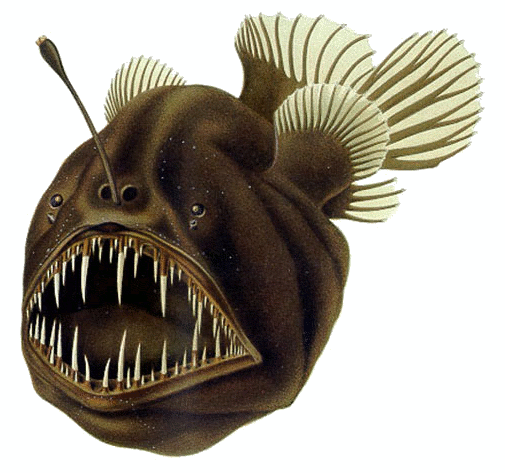
Females have a large oblique mouth, jaws with long depressible fangs, and small nostrils raised on a prominence. The width between the eyes measures between two-fifths and four-sevenths of the head width, while the lower jaw measures between two-fifths and one-half of the fish's total length.[1][2][3]
The species has a long modified dorsal spine called an illicium that serves as a lure. The bioluminescent esca at its tip is oval and sometimes has a raised crest at the back, and the illicium measures between one-quarter and one-third of the fish's length.[4][5][6]
The second dorsal fin has 12–14 soft rays, the anal fin has 3–4 rays, and the pectoral fin has 15–18 rays. The caudal fin has nine rays.[7][8][9][10]
Females grow to approximately 13.5 cm in length, while males grow to approximately 2.8 cm.[11][12]
Habitat
Murray's abyssal anglerfish inhabits tropical to temperate parts of the world's oceans. It has been recorded from the surface to depths exceeding 2,000 m, although most recorded individuals have been recovered from depths greater than 1,500 m.[13][14][15][16]
The species has a cosmopolitan distribution between approximately 64°N and 43°S.[17]
Behaviour
The species is sometimes caught incidentally during deep-sea trawling.[18]
Conservation
Murray's abyssal anglerfish is classified as Least Concern by the International Union for Conservation of Nature. No particular threats to the species have been identified.[19][20]
Classification of the Murray's Abyssal Anglerfish
| Kingdom | Animalia |
|---|---|
| Phylum | Chordata |
| Subphylum | Vertebrata |
| Infraphylum | Gnathostomata |
| Parvphylum | Osteichthyes |
| Gigaclass | Actinopterygii |
| Superclass | Actinopteri |
| Class | Teleostei (Teleost) |
| Order | Lophiiformes (Anglerfish) |
| Suborder | Ceratioidei |
| Family | Melanocetidae (Blackdevils) |
| Genus | Melanocetus (Black Seadevil) |
| Species | Melanocetus murrayi Günther, 1887 |
Where the Murray's Abyssal Anglerfish is found
Checklists and occurrence records place Melanocetus murrayi in 14 countries. GBIF holds 198 georeferenced records of it.
Countries
- Australia 13
- Bahamas 26
- Bermuda 39
- Brazil 3
- Cabo Verde 8
- Canada 8
- Colombia 4
- Greenland 5
- Indonesia 8
- Japan 5
- Panama 3
- Taiwan 35
- United States 36
- Venezuela 5
Regions and cities with the most records
A number beside a place is its count of GBIF occurrence records. A place without a number comes from a checklist alone. Records show where a species has been observed or collected, which can include escapes and vagrants.
Common names
English
- Murray's Abyssal Anglerfish
- Abyssal Anglerfish
- Black Deep-sea Angler
- Deepsea Blackdevil
Names in 6 other languages
- Chinese
- 深海鮟鱇, 短柄黑犀魚, 短柄黑鮟鱇, 短炳黑角鮟鱇
- Czech
- velkotlamec Murrayův
- German
- Schwarzer Tiefseeangler
- Japanese
- ペリカンアンコウモドキ
- Portuguese
- Peixe-diabo-negro
- Russian
- Атлантический черный удильщик, Чёрный удильщик Маррея
Synonyms
10 other scientific names have been used for this species and are now treated as synonyms of Melanocetus murrayi.
- Melanocetus tumidus Parr, 1927
- Melanocetus vorax Brauer, 1902
- Rhynchoceratias acanthirostris Parr, 1927
- Rhynchoceratias latirhinus Parr, 1927
- Rhynchoceratias longipinnis Parr, 1930
- Rhynchoceratis latirhinus Parr, 1927
- Xenoceratias acanthirostris (Parr, 1927)
- Xenoceratias latirhinus (Parr, 1927)
- Xenoceratias longipinnis (Parr, 1930)
- Xenoceratias regani Koefoed, 1944
Related species
-
 Humpback AnglerfishMelanocetus johnsonii
- Melanocetus rossi
-
 Melanocetus eustalus
- Melanocetus niger
- Melanocetus polyactis
Compare
Questions and answers
What is the scientific name of the Murray's Abyssal Anglerfish?
The scientific name of the Murray's Abyssal Anglerfish is Melanocetus murrayi. Written with its author, the full name is Melanocetus murrayi Günther, 1887.
Which family does the Murray's Abyssal Anglerfish belong to?
Melanocetus murrayi belongs to the family Melanocetidae, in the order Lophiiformes and the class Teleostei.
Where is the Murray's Abyssal Anglerfish found?
Checklists and occurrence records place Melanocetus murrayi in 14 countries, including Bermuda, United States, Taiwan, Bahamas, Australia and Cabo Verde.
What is the conservation status of the Murray's Abyssal Anglerfish?
The IUCN Red List category recorded for Melanocetus murrayi is Least Concern (LC).
What other names does the Murray's Abyssal Anglerfish have?
Melanocetus murrayi is also known in English as Abyssal Anglerfish, Black Deep-sea Angler and Deepsea Blackdevil.
What is the scientific name of an anglerfish?
The scientific name of Murray's abyssal anglerfish is Melanocetus murrayi Günther, 1887.[21]
Sources
Passages the profile rests on
- Females have a large oblique mouth, jaws with long depressible fangs, and small nostrils raised on a prominence. Source passage: “the female M. murrayi has a large oblique mouth, jaws with long depressible fangs, small nostrils raised on a prominence” — English Wikipedia
- The width between the eyes measures between two-fifths and four-sevenths of the head width. Source passage: “the width between the eyes between 2/5 and 4/7 of the width of the head” — English Wikipedia
- The lower jaw measures between two-fifths and one-half of the fish's total length. Source passage: “the lower jaw being 2/5 to 1/2 the fish's length.” — English Wikipedia
- The species has a long modified dorsal spine called an illicium that serves as a lure. Source passage: “an illiceum (a long modified dorsal spine used as a lure)” — English Wikipedia
- The bioluminescent esca at the tip of the illicium is oval and sometimes has a raised crest at the back. Source passage: “The bioluminescent esca on the tip is oval, sometimes with a raised crest at the back.” — English Wikipedia
- The illicium measures between one-quarter and one-third of the fish's length. Source passage: “The illicium is 1/4 to 1/3 the length of the fish” — English Wikipedia
- The second dorsal fin has 12–14 soft rays. Source passage: “The second dorsal fin has 12 to 14 soft rays” — English Wikipedia
- The anal fin has 3–4 rays. Source passage: “the anal fin has 3 to 4” — English Wikipedia
- The pectoral fin has 15–18 rays. Source passage: “the pectoral fin 15 to 18” — English Wikipedia
- The caudal fin has nine rays. Source passage: “and the caudal fin 9.” — English Wikipedia
- Females grow to approximately 13.5 cm in length. Source passage: “Females grow to a length of about 13.5 cm (5 in)” — English Wikipedia
- Males grow to approximately 2.8 cm in length. Source passage: “and males to 2.8 cm (1.1 in).” — English Wikipedia
- The species inhabits tropical to temperate parts of the world's oceans. Source passage: “found in tropical to temperate parts of the world's oceans” — English Wikipedia
- The species occurs at depths exceeding 2,000 m. Source passage: “at depths down to over 2,000 m (6,600 ft).” — English Wikipedia
- The species has been recorded from the surface to depths exceeding 2,000 m. Source passage: “at depths from the surface down to over 2,000 m (6,600 ft)” — English Wikipedia
- Most recorded individuals have been recovered from depths greater than 1,500 m. Source passage: “although most of the individuals recovered have been at greater depths than 1,500 m (4,900 ft).” — English Wikipedia
- The species has a cosmopolitan distribution between approximately 64°N and 43°S. Source passage: “M. murrayi has a cosmopolitan distribution in tropical to temperate parts of the world's oceans, between about 64°N and 43°S” — English Wikipedia
- The species is sometimes caught incidentally during deep-sea trawling. Source passage: “This fish, sometimes caught as bycatch in deep sea trawling” — English Wikipedia
- The species is classified as Least Concern by the International Union for Conservation of Nature. Source passage: “the International Union for Conservation of Nature has rated its conservation status as being of "least concern".” — English Wikipedia
- No particular threats to the species have been identified. Source passage: “no particular threats to the species have been identified” — English Wikipedia
- The species was first scientifically described by Albert Günther in 1887. Source passage: “Melanocetus murrayi was first described by the German zoologist Albert Günther in 1887” — English Wikipedia
- Records include more than 300 female specimens and four free-swimming males. Source passage: “known from records of over three hundred female fish and four free-swimming males.” — English Wikipedia
- The species appears to be uncommon. Source passage: “the fish appears to be an uncommon species.” — English Wikipedia
Data
- Catalogue of Life, 2026-10-16 XR cc by
- Global Biodiversity Information Facility CC BY 4.0
- Wikidata CC0
- GeoNames CC BY 4.0
- Wikimedia Commons per image; credit shown with each image
- Within the Catalogue of Life, this name comes from World Register of Marine Species cc by
References
- Günther, A. (1887). Report on the deep-sea fishes collected by H. M. S. Challenger during the years 1873-76. Report on the Scientific Results of the Voyage of H.M.S. Challenger during the Years 1873–76. Zoology, 22 (part 57): i–lxv, 1–268, pl. 1–73. https://doi.org/10.5962/bhl.title.15693 Link where the name was published
This species in other databases
- Catalogue of Life 3Z872
- Wikidata Q3153080
- iNaturalist 459411
- WoRMS urn:lsid:marinespecies.org:taxname:126557
- ITIS 164614
Page built on 26 November 2026. See how the catalog is made and all sources and licences.
Cite this page
ScientificNames.org. (2026). Melanocetus murrayi (Murray's Abyssal Anglerfish). Retrieved November 26, 2026, from https://scientificnames.org/species/melanocetus-murrayi
“Melanocetus murrayi (Murray's Abyssal Anglerfish).” ScientificNames.org, 2026, scientificnames.org/species/melanocetus-murrayi. Accessed 26 Nov. 2026.
ScientificNames.org. “Melanocetus murrayi (Murray's Abyssal Anglerfish).” Accessed November 26, 2026. https://scientificnames.org/species/melanocetus-murrayi.
@misc{scientificnames_melanocetus_murrayi_murrays_abyssal_anglerfish,
  author = {{ScientificNames.org}},
  title = {Melanocetus murrayi (Murray's Abyssal Anglerfish)},
  year = {2026},
  url = {https://scientificnames.org/species/melanocetus-murrayi},
  note = {Accessed 2026-11-26}
}