Comparison
Cockchafer vs Hercules Beetle
Cockchafer (Melolontha melolontha) and Hercules Beetle (Dynastes (Dynastes) hercules) both belong to the family Scarabaeidae (dung beetles) and part ways below it.
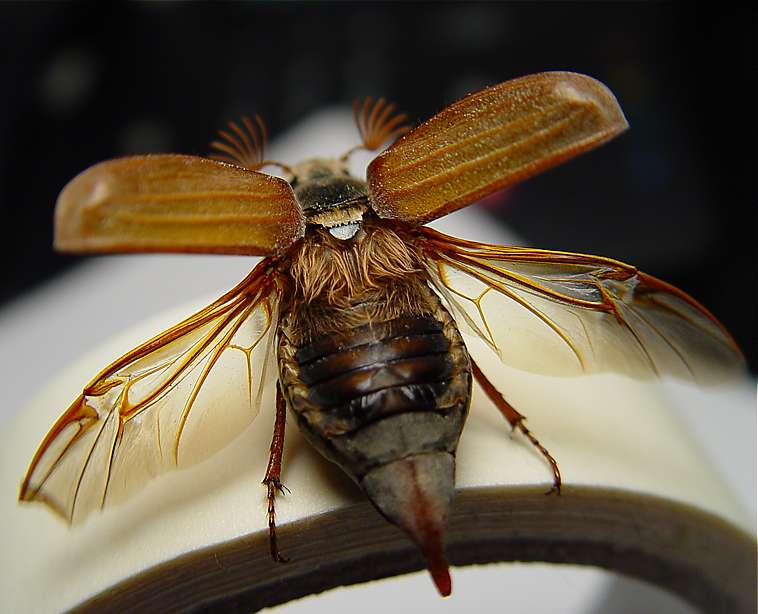


How they differ
The Cockchafer (Melolontha melolontha) can be identified by the male's seven flattened, leaf-shaped antenna extensions, compared with six in females. The Hercules beetle (Dynastes (Dynastes) hercules) can be identified by the male's two horns, black body, and olive-green elytra, while females usually have entirely black elytra.
| Cockchafer | Hercules Beetle | |
|---|---|---|
| Appearance | Male Cockchafers have larger, fan-shaped antennae than females, and their larvae have white bodies, black abdominal extremities, and curved C-shaped postures. | Male Hercules beetles have two horns, one on the head and a larger one on the pronotum; their elytra become darker as environmental humidity increases. |
| Behaviour | Male Cockchafers generally swarm during mating season and use plant-released green leaf volatiles to locate females feeding on leaves. | Adult Hercules beetles are nocturnal, forage for fruit at night, and hide or burrow in leaf litter during the daytime. |
| Diet | Adult Cockchafers feed on leaves of deciduous trees and shrubs, while larvae feed on plant roots, including grasses, cereals, and potato roots. | Adult Hercules beetles consume fresh and decaying fruit as well as tree sap, while larvae feed on rotting wood. |
| Habitat | The Cockchafer occurs particularly in temperate European regions with soil conditions suitable for larval development. | The Hercules beetle inhabits mountainous and lowland rain forests. |
| Reproduction | Female Cockchafers begin laying eggs approximately two to three weeks after adult emergence and can lay between 60 and 80 eggs. | Female Hercules beetles have an average period of 30 days between copulation and egg-laying and can lay as many as 100 eggs on the ground or on dead wood. |
| Etymology | The scientific name Melolontha derives from the Ancient Greek word mēlolónthē, meaning cockchafer. | The Hercules beetle is named after the mythological hero Hercules because of its exceptional strength. |
Written from the checked facts listed further down. Statements that the sources did not support were removed.
Side by side
| Cockchafer | Hercules Beetle | |
|---|---|---|
| Scientific name | Melolontha melolontha (Linnaeus, 1758) | Dynastes (Dynastes) hercules (Linnaeus, 1758) |
| English name | Cockchafer | Hercules Beetle |
| Group | Insects | Insects |
| Class | Insecta Insect | Insecta Insect |
| Order | Coleoptera Beetle | Coleoptera Beetle |
| Family | Scarabaeidae Dung Beetles | Scarabaeidae Dung Beetles |
| Genus | Melolontha May Bugs | Dynastes |
| Named in | 1758 | 1758 |
| Countries on record | 41 countries | 18 countries |
| GBIF occurrence records | 51,302 records | 596 records |
Rows where the two agree are shown in grey.
Where each is found
Only Cockchafer (41)
- Albania
- Austria
- Belarus
- Belgium
- Bosnia and Herzegovina
- Bulgaria
- Croatia
- Czechia
- Denmark
- Estonia
- Finland
- France
- Germany
- Greece
- Guernsey
- Hungary
- Ireland
- Isle of Man
- Italy
- Jersey
- Latvia
- Liechtenstein
- Lithuania
- Luxembourg
- Moldova
- Montenegro
- North Macedonia
- Poland
- Portugal
- Romania
- Russia
- Serbia
- Slovakia
- Slovenia
- Spain
- Sweden
- Switzerland
- The Netherlands
- Turkey
- Ukraine
- United Kingdom
Only Hercules Beetle (18)
- Belize
- Bolivia
- Brazil
- Colombia
- Costa Rica
- Dominica
- Ecuador
- El Salvador
- Guadeloupe
- Guatemala
- Honduras
- Martinique
- Nicaragua
- Panama
- Peru
- Saint Lucia
- Trinidad and Tobago
- Venezuela
From Catalogue of Life checklists and GBIF occurrence records. A country missing from a list means no record is held, which is not proof of absence.
Checked facts
| Cockchafer | Hercules Beetle | |
|---|---|---|
| Appearance |
|
|
| Size |
|
|
| Habitat |
|
|
| Diet |
|
|
| Behaviour |
|
|
| Reproduction |
|
|
| Distribution |
| No checked fact yet |
| Conservation |
| No checked fact yet |
| Uses |
|
|
| Similar species |
| No checked fact yet |
| Name origin |
|
|
In brief
Cockchafer
The species is native to Europe and has also been reported in Turkey and the Caucasus region. Adult males have seven flattened, leaf-shaped antenna extensions, while females have six. Full profile
Hercules Beetle
The species inhabits mountainous and lowland rain forests. Male Hercules beetles are distinguished by two horns, one on the head and a larger one on the pronotum. Full profile
Compare something else
Page built on 24 November 2026 from the data on the two species pages, where every source is listed.
Cite this page
ScientificNames.org. (2026). Cockchafer vs Hercules Beetle. Retrieved November 24, 2026, from https://scientificnames.org/compare/cockchafer-vs-hercules-beetle
“Cockchafer vs Hercules Beetle.” ScientificNames.org, 2026, scientificnames.org/compare/cockchafer-vs-hercules-beetle. Accessed 24 Nov. 2026.
ScientificNames.org. “Cockchafer vs Hercules Beetle.” Accessed November 24, 2026. https://scientificnames.org/compare/cockchafer-vs-hercules-beetle.
@misc{scientificnames_cockchafer_vs_hercules_beetle,
  author = {{ScientificNames.org}},
  title = {Cockchafer vs Hercules Beetle},
  year = {2026},
  url = {https://scientificnames.org/compare/cockchafer-vs-hercules-beetle},
  note = {Accessed 2026-11-24}
}