Species · Reptiles
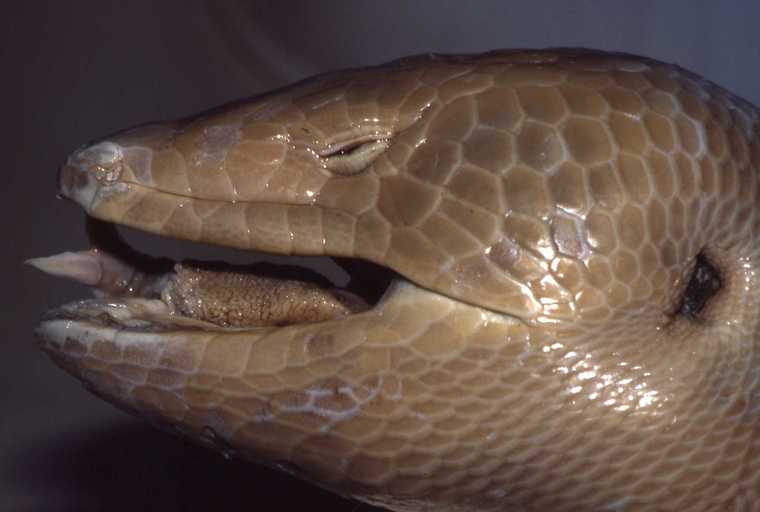
O'Shaughnessy's Galliwasp Mesoamericus bilobatus
The scientific name of the O'Shaughnessy's Galliwasp is Mesoamericus bilobatus. It is a species of reptile in the family Diploglossidae (neotropical forest lizards), order Squamata. The name dates from 1874.
- Scientific name
- Mesoamericus bilobatus (O'Shaughnessy, 1874)
- Common name
- O'Shaughnessy's Galliwasp
- Genus
- Mesoamericus
- Family
- Diploglossidae (Neotropical Forest Lizards)
- Order
- Squamata
- Class
- Reptilia
- Recorded in
- 3 countries
- Name status
- accepted in the Catalogue of Life
Overview
O'Shaughnessy's Galliwasp is a reptile in the family Diploglossidae, order Squamata, and class Reptilia. It occurs in Costa Rica, Nicaragua, and Panama. Its claws are mostly concealed within large, compressed scales.
Written 27 November 2026 from the sources listed below. Each statement was checked against the passage it cites; statements that could not be supported were removed.
Appearance
Its claws are mostly concealed within large, compressed scales.[1]
Habitat
It primarily inhabits forests at elevations between 2 and 1,360 m.[2]
Behaviour
It is active during the day and lives primarily on land. It also exhibits semifossorial behaviour.[3][4][5]
Reproduction and life cycle
It reproduces by laying eggs.[6]
Conservation
It was most recently assessed for the IUCN Red List in 2012.[7]
Classification of the O'Shaughnessy's Galliwasp
| Kingdom | Animalia |
|---|---|
| Phylum | Chordata |
| Subphylum | Vertebrata |
| Infraphylum | Gnathostomata |
| Parvphylum | Osteichthyes |
| Megaclass | Tetrapoda |
| Class | Reptilia (Reptile) |
| Order | Squamata (Snakes) |
| Suborder | Autarchoglossa |
| Family | Diploglossidae (Neotropical Forest Lizards) |
| Genus | Mesoamericus |
| Species | Mesoamericus bilobatus (O'Shaughnessy, 1874) |
Where the O'Shaughnessy's Galliwasp is found
Checklists and occurrence records place Mesoamericus bilobatus in 3 countries across North America. GBIF holds 198 georeferenced records of it.
Countries
Regions and cities with the most records
- Cartago Province, Costa Rica 79
- Limón Province, Costa Rica 22
- Alajuela Province, Costa Rica 17
- Heredia Province, Costa Rica 9
- Guanacaste Province, Costa Rica 7
- Quesada, Costa Rica 7
- Bocas del Toro Province, Panama 6
- Siquirres, Costa Rica 6
- San José, Costa Rica 5
- Veraguas Province, Panama 5
- San Isidro, Costa Rica 4
Range as the checklists state it
Costa Rica, Panama, Nicaragua
Middle America
A number beside a place is its count of GBIF occurrence records. A place without a number comes from a checklist alone. Records show where a species has been observed or collected, which can include escapes and vagrants.
Common names
English
- O'Shaughnessy's Galliwasp
- O’Shaughnessy's Galliwasp
Names in 3 other languages
- German
- O'Shaughnessys Gallwespenschleiche
- Italian
- Diploglosso di O'Shaughnessy
- Spanish
- Escorpion Verde, Escorpión verde
Synonyms
2 other scientific names have been used for this species and are now treated as synonyms of Mesoamericus bilobatus.
- Celestus bilobatus O'Shaughnessy, 1874
- Diploglossus bilobatus (O'Shaughnessy, 1874)
Related species
-
 Jamaican Giant GalliwaspCelestus occiduus
-
 Brazilian GalliwaspDiploglossus lessonae
- Montserrat GalliwaspDiploglossus montisserrati
- Mountain Forest GalliwaspAdvenus montisilvestris
-
 Dotted GalliwaspDiploglossus millepunctatus
-
 Striped Worm LizardOphiodes striatus
- Blue-tailed GalliwaspCelestus duquesneyi
-
 Banded GalliwaspDiploglossus fasciatus
Compare
Questions and answers
What is the scientific name of the O'Shaughnessy's Galliwasp?
The scientific name of the O'Shaughnessy's Galliwasp is Mesoamericus bilobatus. Written with its author, the full name is Mesoamericus bilobatus (O'Shaughnessy, 1874).
Which family does the O'Shaughnessy's Galliwasp belong to?
Mesoamericus bilobatus belongs to the family Diploglossidae, in the order Squamata and the class Reptilia.
Where is the O'Shaughnessy's Galliwasp found?
Checklists and occurrence records place Mesoamericus bilobatus in 3 countries: Costa Rica, Panama and Nicaragua.
What other names does the O'Shaughnessy's Galliwasp have?
Mesoamericus bilobatus is also known in English as O’Shaughnessy's Galliwasp.
Sources
Passages the profile rests on
- Mesoamericus bilobatus has claws that are mostly concealed within large, compressed scales. Source passage: “claws nearly entirely concealed in a large compressed sheath formed of a larger supero-lateral and a smaller inferior scale” — English Wikipedia
- Mesoamericus bilobatus primarily inhabits forests at elevations between 2 and 1,360 m. Source passage: “The preferred natural habitat of M. bilobatus is forest, at altitudes of 2–1,360 m (6.6–4,461.9 ft).” — English Wikipedia
- Mesoamericus bilobatus is active during the day. Source passage: “M. bilobatus is diurnal, terrestrial, and semifossorial.” — English Wikipedia
- Mesoamericus bilobatus lives primarily on land. Source passage: “M. bilobatus is diurnal, terrestrial, and semifossorial.” — English Wikipedia
- Mesoamericus bilobatus exhibits semifossorial behaviour. Source passage: “M. bilobatus is diurnal, terrestrial, and semifossorial.” — English Wikipedia
- Mesoamericus bilobatus reproduces by laying eggs. Source passage: “M. bilobatus is oviparous.” — English Wikipedia
- Mesoamericus bilobatus was most recently assessed for the IUCN Red List in 2012. Source passage: “O'Shaughnessy's Galliwasp Mesoamericus bilobatus has most recently been assessed for The IUCN Red List of Threatened Species in 2012.” — iucnredlist.org
Data
- Catalogue of Life, 2026-10-16 XR cc by
- Global Biodiversity Information Facility CC BY 4.0
- Wikidata CC0
- GeoNames CC BY 4.0
- Within the Catalogue of Life, this name comes from The Reptile Database cc by
References
- O’Shaughnessy, A.W.E. (1874). Description of a new species of lizard of the genus Celestus. Ann. Mag. Nat. Hist. (4) 14: 257-258.
- Bocourt, M. E. (1874). Etudes sur les Reptiles. Mission Scientifique au Mexique et dans l’Amérique Centrale. Recherches Zoologiques.Vol. 3 (sect. 1). Imprimerie Impériale, Paris.
- Günther, A. C. L. G. (1885). Reptilia and Batrachia. Biologia Centrali-Américana. Taylor, & Francis, London, 326 Pp. [Published in Parts from 1885-1902; Reprint by the SSAR 1987].
- Boulenger, G. A. (1885). Catalogue of the lizards in the British Museum (Natural History). Vol. 2, Second edition. London, Xiii+497 Pp.
- Taylor, E. H. (1956). A review of the lizards of Costa Rica. Univ. Kansas Sci. Bull. 38 (Part 1): 3-322.
- Peters, James A. & Donoso-Barros, Roberto. (1970). Catalogue of the Neotropical Squamata: Part II. Lizards and Amphisbaenians. Bull. US Natl. Mus. 297: 293 Pp.
- Myers, C. W. (1973). Anguid lizards of the genus Diploglossus in Panamá, with the description of a new species. American Museum Novitates (2523): 1-20.
- Kronauer, D. (1999). Anmerkungen zur Herpetofauna Costa Ricas. Elaphe 7 (4): 76-77 [Erratum in Elaphe 8 (1): 29].
- Köhler, G. (2000). Reptilien und Amphibien Mittelamerikas, Bd 1: Krokodile, Schildkröten, Echsen. Herpeton Verlag, Offenbach, 158 Pp.
- Savage, J. M. (2002). The Amphibians and Reptiles of Costa Rica: A Herpetofauna Between Two Continents, Between Two Seas. University of Chicago Press, 934 Pp. [Review in Copeia 2003 (1): 205].
- Köhler, G.; Quintana, A.Z.; Buitrago, F. & Diethert H. (2004). New and noteworthy records of amphibians and reptiles from Nicaragua. Salamandra 40 (1): 15-24.
- Santos-Barrera, Georgina; Jesus Pacheco, Fernando Mendoza-Quijano, Federico Bolaños,Gerardo Cháves , Gretchen C. Daily, Paul R. Ehrlich & Gerardo Ceballos. (2008). Diversity, natural history and conservation of amphibians and reptiles from the San Vito Region, southwestern Costa Rica. Rev. Biol. Trop. 56 (2): 755-778.
- Köhler, G. (2008). Reptiles of Central America. 2nd Ed. Herpeton-Verlag, 400 Pp.
- Lotzkat, S., L. Stadler, A. Carrizo, A. Hertz & G. Köhler. (2010). Notes on the eastenmost population of Diploglossus bilobatus (Squamata: Anguidae) in Veraguas, Panama. Salamandra 46 (1): 59-62.
- Köhler, Gunther, Joseph Vargas, Johannes J. Köhler and Milan Vesel´y. (2013). Noteworthy distributional records of amphibians and reptiles from Costa Rica. Herpetological Review 44 (2): 280-283.
- Arias, E., & Federico Bolaños. (2014). A checklist of the amphibians and reptiles of San Isidro de Dota, Reserva Forestal Los Santos, Costa Rica. Check List 10 (4): 870-877.
- Sunyer, & Javier. (2014). An updated checklist of the amphibians and reptiles of Nicaragua. Mesoamerican Herpetology 1 (2): 186–202.
- Rovito, S. M., & Thomas James Devitt, S. C. D. (2015). First survey of the amphibians and reptiles of the Nectandra Cloud Forest Reserve, Alajuela, Costa Rica. Check List 11 (2): 1570.
- Hilje B, Chaves G, Klank J, Timmerman F, Feltham J, Gillingwater S, Piraino T, & Rojas E. (2020). Amphibians and Reptiles of the Tirimbina Biological Reserve: a baseline for conservation, research and environmental education in a lowland tropical wet forest in Costa Rica. Check List 16(6): 1633-1655.
- SCHOOLS, MOLLY, & BLAIR HEDGES, S. (2021). Phylogenetics, classification, and biogeography of the Neotropical forest lizards (Squamata, Diploglossidae). Zootaxa 4974 (2): 201–257.
- Sunyer, Javier & José́ Gabriel Martínez-Fonseca. (2023). An updated country checklist to the amphibians and reptiles of Nicaragua. Revista Nicaragüense de Biodiversidad (100): 1-25.
- Barrio-Amorós, Cesar Luis, Michelle Quiroz, Cristian Porras-Ramírez, Rene Villanueva-Maldonado, Alejandro Estrada-García, & Abel Batista. (2023). Amphibians and reptiles encountered during an expedition to Panama. Reptiles & Amphibians 30 (1): E18359.
- Sasa, M., Arias, E., & Chaves, G. (2025). Annotated list of amphibians and reptiles of Costa Rica: The role of the Museum of Zoology in cataloging the country’s herpetological diversity. Revista de Biología Tropical, 73(S2): E64536-E64536.
This species in other databases
Page built on 28 November 2026. See how the catalog is made and all sources and licences.
Cite this page
ScientificNames.org. (2026). Mesoamericus bilobatus (O'Shaughnessy's Galliwasp). Retrieved November 28, 2026, from https://scientificnames.org/species/mesoamericus-bilobatus
“Mesoamericus bilobatus (O'Shaughnessy's Galliwasp).” ScientificNames.org, 2026, scientificnames.org/species/mesoamericus-bilobatus. Accessed 28 Nov. 2026.
ScientificNames.org. “Mesoamericus bilobatus (O'Shaughnessy's Galliwasp).” Accessed November 28, 2026. https://scientificnames.org/species/mesoamericus-bilobatus.
@misc{scientificnames_mesoamericus_bilobatus_oshaughnessys_galliwasp,
  author = {{ScientificNames.org}},
  title = {Mesoamericus bilobatus (O'Shaughnessy's Galliwasp)},
  year = {2026},
  url = {https://scientificnames.org/species/mesoamericus-bilobatus},
  note = {Accessed 2026-11-28}
}