Species · Birds
Pied Falconet Microhierax melanoleucos
The scientific name of the Pied Falconet is Microhierax melanoleucos. It is a species of bird in the family Falconidae (falcons), order Falconiformes. The name dates from 1843.
- Scientific name
- Microhierax melanoleucos (Blyth, 1843)
- Common name
- Pied Falconet
- Genus
- Microhierax
- Family
- Falconidae (Falcons)
- Order
- Falconiformes
- Class
- Aves
- Red List category
- LC Least Concern
- Recorded in
- 5 countries
- Name status
- accepted in the Catalogue of Life

Overview
The Pied Falconet occurs in Bangladesh, Bhutan, China, Hong Kong, India, Laos, and Vietnam. It is distinguished from other members of its genus by its white thighs and absence of chestnut coloration.
Written 26 November 2026 from the sources listed below. Each statement was checked against the passage it cites; statements that could not be supported were removed.
Appearance
The Pied Falconet has predominantly black and white plumage. It measures between 7 and 7.5 inches in length and weighs between 55 and 75 grams.[1][2][3]
Its white face has a black patch extending from the eyes to the ear coverts. The crown and other upper parts are entirely black.[4][5]
The primaries are black with white wing bars. The long tail has black upperparts and white bars underneath.[6][7]
The species does not exhibit sexual dimorphism. Juveniles strongly resemble adult males.[8][9]
The Pied Falconet has white thighs and lacks chestnut coloration, distinguishing it from other members of its genus.[10]
Habitat
The Pied Falconet inhabits temperate forests. It occurs along deciduous forest edges and in clearings in wooded foothills.[11][12]
The species also uses clearings in former cultivated land, including areas with banks and streams.[13]
Diet
Insects make up most of the Pied Falconet's diet. It also eats small mammals, reptiles, and birds.[14][15]
Behaviour
Pied Falconets commonly perch on treetops and occasionally fly away to capture prey. They capture prey in flight or remove it from surrounding foliage.[16][17]
The species can capture prey as large as itself or slightly larger.[18]
The Pied Falconet is resident rather than migratory and generally remains in the same area for most of the year.[19][20]
Its vocalizations include shrill, high-pitched screams and chattering whistles.[21]
Pied Falconets have been observed in groups of five or six individuals. These observations have been cited as a possible indication of cooperative breeding.[22][23]
Reproduction and life cycle
The breeding season extends from March through May. Males initiate courtship by presenting leaves to females.[24][25]
Pied Falconets nest in old barbet or woodpecker cavities. They lay their eggs on a bed of leaves or grass, although some nesting cavities have been recorded containing insect remains instead of leaves.[26][27][28]
Females lay three to four white eggs.[29]
Conservation
The Pied Falconet is listed as a species of least concern. Its large home range and stable population size are given as reasons for this listing.[30][31]
BirdLife describes the species as having an extremely large geographic range. It does not approach the Vulnerable threshold under the range-size criterion.[32][33]
The Pied Falconet was most recently assessed for the IUCN Red List in 2025.[34]
Similar species
The Pied Falconet can be mistaken for the ashy woodswallow because of their similar appearance.[35]
Classification of the Pied Falconet
| Kingdom | Animalia |
|---|---|
| Phylum | Chordata |
| Subphylum | Vertebrata |
| Infraphylum | Gnathostomata |
| Parvphylum | Osteichthyes |
| Megaclass | Tetrapoda |
| Class | Aves (Bird) |
| Order | Falconiformes (Falcons) |
| Family | Falconidae (Falcons) |
| Subfamily | Falconinae |
| Genus | Microhierax (Falconets) |
| Species | Microhierax melanoleucos (Blyth, 1843) |
Where the Pied Falconet is found
Checklists and occurrence records place Microhierax melanoleucos in 5 countries across Asia. GBIF holds 2,247 georeferenced records of it.
Countries
Regions and cities with the most records
- Assam, India 847
- Digboi, India 472
- Margherita, India 459
- Jiangxi, China 449
- Nahorkatiya, India 438
- Duliajan, India 425
- Duliajan Oil Town, India 425
- Arunachal Pradesh, India 393
- Mākum, India 249
- Ninh Binh, Vietnam 246
- Thị Trấn Vân Du, Vietnam 177
- Nāmrup, India 93
- Yunnan, China 59
- Rangāpāra, India 37
- Mengman, China 31
- Yunjinghong, China 31
- Biswanath Chariali, India 30
- Fujian, China 21
- Mizoram, India 17
- Anhui, China 13
- Naharlagun, India 10
- Fuzhou, China 9
- Bolikhamsai, Laos 7
- Nagaland, India 7
- Thanh Hóa Province, Vietnam 6
- Tinsukia, India 6
- Dum Duma, India 5
- Zhemgang District, Bhutan 5
- Bà Nà, Vietnam 4
- Chumukedima, India 4
- Dhing, India 4
- Dimāpur, India 4
- Guwahati, India 4
- Khārupatia, India 4
- Kuda, India 4
- North Guwāhāti, India 4
Range as the checklists state it
Southern Asia
A number beside a place is its count of GBIF occurrence records. A place without a number comes from a checklist alone. Records show where a species has been observed or collected, which can include escapes and vagrants.
Common names
English
- Pied Falconet
Names in 27 other languages
- Arabic
- صقير أبقع, صقير مبرقش
- Catalan
- falconet blanc i negre
- Chinese
- 白腿小隼, 白腿小隼〔小隼〕
- Croatian
- crno-bijeli sokolić
- Czech
- sokolík černobílý
- Danish
- Sortkindet Pygmæfalk
- Dutch
- Bonte Dwergvalk
- Esperanto
- nigrablanka falketo
- Estonian
- hiina värbpistrik
- Finnish
- kantoninhaukkanen
- French
- Fauconnet noir et blanc
- German
- Elsterfälkchen
- Hungarian
- tarka verébsólyom
- Italian
- Falchetto bianconero
- Japanese
- シロハラヒメハヤブサ
- Lithuanian
- raibasis nykštukinis sakalas
- Norwegian
- sløyfefalkonett
- Polish
- sokolik srokaty
- Portuguese
- falconete-alvinegro
- Russian
- Сорочий карликовый сокол, Сорочий сокол-крошка
- Serbian
- Šareni patuljasti soko
- Slovak
- sokolík čiernolíci
- Spanish
- Falconete pío
- Swedish
- svartvit pygméfalk
- Turkish
- Alaca Cüce Doğan
- Ukrainian
- сокіл-карлик строкатий
- Vietnamese
- Cắt nhỏ bụng trắng
Synonyms
5 other scientific names have been used for this species and are now treated as synonyms of Microhierax melanoleucos.
- Ierax melanoleucos Blyth, 1843
- Microhierax chinensis David
- Microhierax melanoleucus (Blyth, 1843)
- Microhierax melanoleucus melanoleucus Collar & Andrew (1988)
- Microhierax melanoleucus melanoleucus Sibley & Monroe (1990, 1993)
Related species
-
 Black-thighed FalconetMicrohierax fringillarius
-
 Collared FalconetMicrohierax caerulescens
-
 Philippine FalconetMicrohierax erythrogenys
-
 White-fronted FalconetMicrohierax latifrons
-
 Peregrine FalconFalco peregrinus
-
 Common KestrelFalco tinnunculus
-
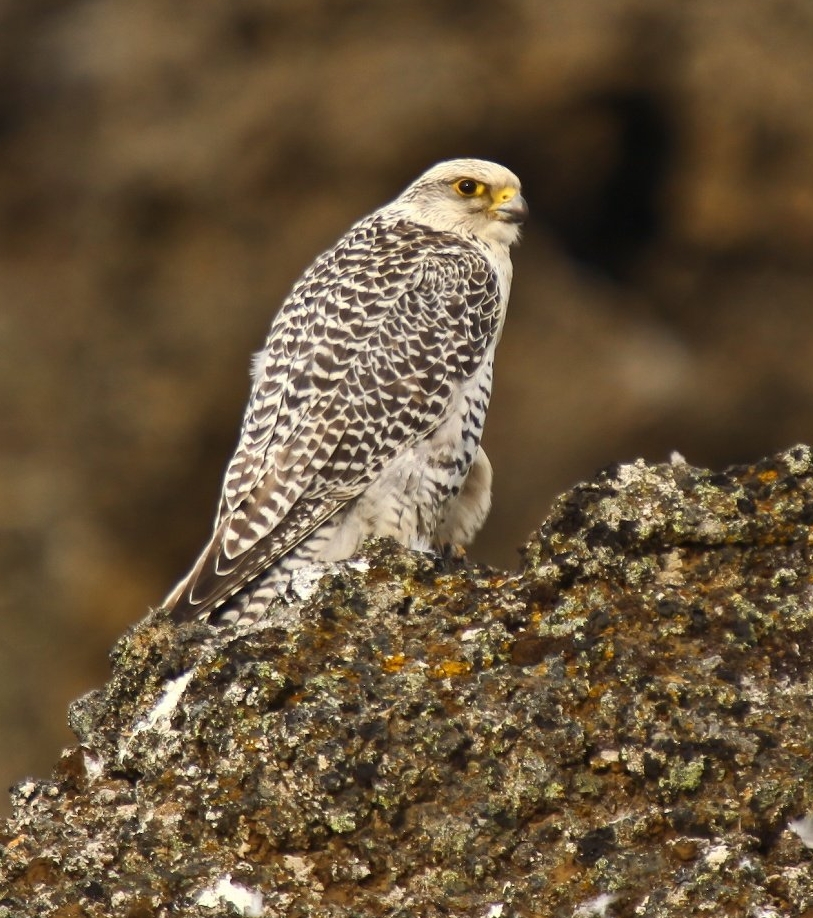 GyrfalconFalco rusticolus
-
 MerlinFalco columbarius
Compare
Questions and answers
What is the scientific name of the Pied Falconet?
The scientific name of the Pied Falconet is Microhierax melanoleucos. Written with its author, the full name is Microhierax melanoleucos (Blyth, 1843).
Which family does the Pied Falconet belong to?
Microhierax melanoleucos belongs to the family Falconidae, in the order Falconiformes and the class Aves.
Where is the Pied Falconet found?
Checklists and occurrence records place Microhierax melanoleucos in 5 countries: India, China, Vietnam, Laos and Bhutan.
What is the conservation status of the Pied Falconet?
The IUCN Red List category recorded for Microhierax melanoleucos is Least Concern (LC).
Sources
Passages the profile rests on
- The pied falconet has predominantly black and white plumage. Source passage: “The pied falconet is a small black and white raptor” — English Wikipedia
- The pied falconet measures between 7 and 7.5 inches in length. Source passage: “measuring between 7 and 7 ½ inches” — English Wikipedia
- The species weighs between 55 and 75 grams. Source passage: “weighing between 55 and 75 grams (2.6 oz).” — English Wikipedia
- The species has a white face with a black patch extending from the eyes to the ear coverts. Source passage: “Its face is white with a prominent black patch covering the eyes reaching to the ear coverts.” — English Wikipedia
- The crown and other upper parts of the pied falconet are entirely black. Source passage: “The upper parts, including the crown, are completely black.” — English Wikipedia
- The primaries are black and have white wing bars. Source passage: “The primaries are black with white wing bars.” — English Wikipedia
- The pied falconet has a long tail with black upperparts and white bars underneath. Source passage: “Its long tail has black upper parts and is black with white bars from below.” — English Wikipedia
- The species does not exhibit sexual dimorphism. Source passage: “The pied falconet displays no sexual dimorphism” — English Wikipedia
- Juvenile pied falconets strongly resemble adult males. Source passage: “the juveniles strongly resemble adult males.” — English Wikipedia
- The pied falconet can be distinguished from other members of its genus by its white thighs and absence of chestnut coloration. Source passage: “M. melanoleucos is distinguishable from these other members by its white thighs and the lack of chestnut coloration.” — English Wikipedia
- The species inhabits temperate forests. Source passage: “Its natural habitat is temperate forests.” — English Wikipedia
- The species occurs along deciduous forest edges and in clearings in wooded foothills. Source passage: “They are found in deciduous forest edges and clearings in wooded foothills.” — English Wikipedia
- The pied falconet uses clearings in former cultivated land, including areas with banks and streams. Source passage: “This species likes clearing such as old cultivation lands with banks and stream.” — English Wikipedia
- Insects make up most of the pied falconet's diet. Source passage: “Insects comprise most of the pied falconet's diet” — English Wikipedia
- The species also eats small mammals, reptiles, and birds. Source passage: “but it also includes small mammals, reptiles and birds.” — English Wikipedia
- Pied falconets commonly perch on treetops and occasionally fly away to capture prey. Source passage: “They are usually perched on tree tops while occasionally flying off to catch prey.” — English Wikipedia
- The pied falconet captures prey in flight or removes it from surrounding foliage. Source passage: “A falconet catches its prey while flying over it and catching it mid-flight or by plucking it out of the foliage of the surrounding trees.” — English Wikipedia
- Pied falconets can capture prey as large as themselves or slightly larger. Source passage: “allowing them to catch prey as big as themselves or slightly larger.” — English Wikipedia
- The pied falconet is a resident species rather than a migratory bird. Source passage: “These are not migratory birds, they are a resident species” — English Wikipedia
- The species generally remains in the same area for most of the year. Source passage: “staying in the same area for most of the year.” — English Wikipedia
- The pied falconet produces shrill, high-pitched screams and chattering whistles. Source passage: “This species produces a shrill, high pitched scream and chattering whistle.” — English Wikipedia
- Pied falconets have been observed in groups of five or six individuals. Source passage: “The pied falconet can be seen in groups of 5 or 6” — English Wikipedia
- Group observations have been cited as a possible indication that pied falconets breed cooperatively. Source passage: “which suggest that they may also breed cooperatively.” — English Wikipedia
- The pied falconet's breeding season extends from March through May. Source passage: “The pied falconet's breeding season is from March until May.” — English Wikipedia
- Male pied falconets initiate courtship by presenting leaves to females. Source passage: “the males will initiate interest in mating to a female by presenting leaves to them.” — English Wikipedia
- Pied falconets nest in old barbet or woodpecker cavities. Source passage: “These small raptors nest in old barbet or woodpecker holes” — English Wikipedia
- The species lays its eggs on a bed of leaves or grass. Source passage: “lay their eggs on a bed of leaves or grass.” — English Wikipedia
- Some pied falconet nesting cavities have been recorded containing insect remains instead of leaves. Source passage: “There have also been recordings of the nesting cavities being filled with insect remains instead of leaves.” — English Wikipedia
- Female pied falconets lay three to four white eggs. Source passage: “The females lay three to four eggs which are white in color.” — English Wikipedia
- The pied falconet is listed as a species of least concern. Source passage: “The species is listed as least concern” — English Wikipedia
- The species' large home range and stable population size are given as reasons for its least-concern listing. Source passage: “because of its large home range and stable population size.” — English Wikipedia
- BirdLife describes the pied falconet as having an extremely large geographic range. Source passage: “This species has an extremely large range” — datazone.birdlife.org
- BirdLife states that the pied falconet does not approach the Vulnerable threshold under the range-size criterion. Source passage: “does not approach the thresholds for Vulnerable under the range size criterion” — datazone.birdlife.org
- The pied falconet was most recently assessed for the IUCN Red List in 2025. Source passage: “Pied Falconet Microhierax melanoleucos has most recently been assessed for The IUCN Red List of Threatened Species in 2025.” — iucnredlist.org
- The pied falconet can be mistaken for the ashy woodswallow because of their similar appearance. Source passage: “They are sometimes mistaken for ashy woodswallow (Artamus fuscus)” — English Wikipedia
Data
- Catalogue of Life, 2026-10-16 XR cc by
- Global Biodiversity Information Facility CC BY 4.0
- Wikidata CC0
- GeoNames CC BY 4.0
- Wikimedia Commons per image; credit shown with each image
- Within the Catalogue of Life, this name comes from The Integrated Taxonomic Information System cc0
References
- Dickinson, Edward C., ed. (2003). The Howard and Moore Complete Checklist of the Birds of the World, 3rd Edition.
- Gill, Frank, & and Minturn Wright. (2006). Birds of the World: Recommended English Names.
- David, Normand, & and Michel Gosselin. (2011). Gender agreement of avian species names. Bulletin of the British Ornithologists’ Club, Vol. 122, No. 1.
- Dickinson, E. C., and J. V. Remsen Jr., eds. (2013). The Howard and Moore Complete Checklist of the Birds of the World, 4th Edition, Vol. 1 Non-Passerines.
This species in other databases
Page built on 29 November 2026. See how the catalog is made and all sources and licences.
Cite this page
ScientificNames.org. (2026). Microhierax melanoleucos (Pied Falconet). Retrieved November 29, 2026, from https://scientificnames.org/species/microhierax-melanoleucos
“Microhierax melanoleucos (Pied Falconet).” ScientificNames.org, 2026, scientificnames.org/species/microhierax-melanoleucos. Accessed 29 Nov. 2026.
ScientificNames.org. “Microhierax melanoleucos (Pied Falconet).” Accessed November 29, 2026. https://scientificnames.org/species/microhierax-melanoleucos.
@misc{scientificnames_microhierax_melanoleucos_pied_falconet,
  author = {{ScientificNames.org}},
  title = {Microhierax melanoleucos (Pied Falconet)},
  year = {2026},
  url = {https://scientificnames.org/species/microhierax-melanoleucos},
  note = {Accessed 2026-11-29}
}