Species · Spiders and other arachnids
Green Huntsman Spider Micrommata virescens
The scientific name of the Green Huntsman Spider is Micrommata virescens. It is a species of arachnid in the family Sparassidae (huntsman spider), order Araneae. The name dates from 1757.
- Scientific name
- Micrommata virescens (Clerck, 1757)
- Common name
- Green Huntsman Spider
- Genus
- Micrommata
- Family
- Sparassidae (Huntsman Spider)
- Order
- Araneae
- Class
- Arachnida
- Recorded in
- 46 countries
- Name status
- accepted in the Catalogue of Life

Overview
The Green Huntsman Spider belongs to the huntsman spiders in the family Sparassidae. It occurs along forest edges and in damp woodland clearings and rides. Female specimens have a bright green cephalothorax and a lighter green abdomen marked by a darker green median stripe.
Written 26 November 2026 from the sources listed below. Each statement was checked against the passage it cites; statements that could not be supported were removed.
Appearance
Female specimens have a bright green cephalothorax and long legs, with a lighter green abdomen marked by a darker green median stripe. Male specimens are dark green-olive with a narrower abdomen, red sides and a red to red-brown median stripe bordered in yellow.[1][2]
The spider has eight eyes arranged in two rows and surrounded by white hairs. Juveniles initially have a yellow-brown cephalothorax with dark marginal and median stripes, acquiring typical adult coloration after their final molt in the following spring.[3][4][5]
The green coloration results from the bilin micromatabilin and its conjugates, which occur in the haemolymph, interstitial tissues and yolk of oocytes.[6]
Female body length ranges from 12 to 16 millimetres. Male body length ranges from approximately 7 to 10 millimetres.[7][8]
Habitat
The species occurs along forest edges and in damp woodland clearings and rides. Within these habitats, it prefers grass and the lower branches of trees.[9][10][11]
Diet
The Green Huntsman Spider hunts insects in green vegetation.[12]
Behaviour
The species is mainly active during daylight hours and does not construct a web. It relies on camouflage while hunting in green vegetation.[13][14][15]
Its green coloration makes the spider difficult for predators to detect. Females guard their egg cocoons.[16][17]
Reproduction and life cycle
Females are fertile from May through September. During July, they enclose their egg sacs in several leaves stitched together.[18][19]
Eggs hatch approximately four weeks after the egg sac is formed. A typical hatch produces approximately 40 to 50 young spiders.[20][21]
Males die a few days after mating. The species takes approximately 18 months to reach maturity.[22][23]
Classification of the Green Huntsman Spider
| Kingdom | Animalia |
|---|---|
| Phylum | Arthropoda |
| Subphylum | Chelicerata |
| Class | Arachnida (Arachnid) |
| Order | Araneae (Spider) |
| Family | Sparassidae (Huntsman Spider) |
| Genus | Micrommata |
| Species | Micrommata virescens (Clerck, 1757) |
Where the Green Huntsman Spider is found
Checklists and occurrence records place Micrommata virescens in 46 countries across Asia and Europe. GBIF holds 15,116 georeferenced records of it.
Countries
- Aland Islands 5
- Albania 6
- Armenia 3
- Austria 1,205
- Belarus 4
- Belgium 185
- Bosnia and Herzegovina 8
- Bulgaria 43
- China 1
- Croatia 46
- Czechia 219
- Denmark 219
- Estonia 82
- Finland 623
- France 2,818
- Georgia 37
- Germany 2,000
- Greece 48
- Hungary 291
- Iran 1
- Israel 4
- Italy 850
- Japan 31
- Kazakhstan 53
- Latvia 13
- Lithuania 15
- Luxembourg 22
- Montenegro 9
- North Macedonia 4
- Norway 573
- Poland 344
- Portugal 27
- Romania 83
- Russia 1,608
- Serbia 26
- Slovakia 45
- Slovenia 53
- South Korea 31
- Spain 201
- Sweden 1,985
- Switzerland 609
- Syria
- The Netherlands 281
- Turkey 17
- Ukraine 243
- United Kingdom 145
Regions and cities with the most records
- Occitanie, France 763
- Bavaria, Germany 585
- Auvergne-Rhône-Alpes, France 442
- Baden-Wurttemberg, Germany 324
- Salzburg, Austria 301
- Saxony, Germany 264
- Lombardy, Italy 258
- Provence-Alpes-Côte d'Azur, France 237
- Kalmar, Sweden 214
- Tyrol, Austria 208
- Lower Saxony, Germany 202
- Salzburg, Austria 182
- Lower Austria, Austria 175
- Uppsala, Sweden 173
- Pays de la Loire, France 172
- Grand Est, France 170
- Freilassing, Germany 159
- Styria, Austria 158
- Östergötland, Sweden 156
- North Rhine-Westphalia, Germany 148
- Örebro, Sweden 148
- Västra Götaland, Sweden 147
- Centre-Val de Loire, France 138
- Bourgogne-Franche-Comté, France 137
- Hesse, Germany 135
- Stockholm, Sweden 135
- Île-de-France, France 132
- England, United Kingdom 126
- Moscow Oblast, Russia 126
- Gävleborg, Sweden 124
- Kursk Oblast, Russia 124
- Bad Reichenhall, Germany 115
- Upper Austria, Austria 111
- Skåne, Sweden 107
- Rheinland-Pfalz, Germany 104
- Södermanland, Sweden 103
1 more country has a few records outside this range
These countries hold a few records of Micrommata virescens but lie outside the range the checklists give for it. Such records are often zoo or garden specimens, museum material or vagrants, so the species is not counted as occurring there.
Range as the checklists state it
Europe, Turkey, Caucasus, Russia (Europe to Far East), Iran, Kazakhstan, Central Asia, China, Korea, Japan
Europe, Syria, Israel
Europe
France
A number beside a place is its count of GBIF occurrence records. A place without a number comes from a checklist alone. Records show where a species has been observed or collected, which can include escapes and vagrants.
Common names
English
- Green Huntsman Spider
- Green Spider
Names in 20 other languages
- Croatian
- Zeleni pauk lovac
- Czech
- maloočka smaragdová
- Danish
- Smaragdedderkop, Smaragdspindler
- Dutch
- Groene jachtspin
- Finnish
- Viherhämähäkki, viherjahdikki
- French
- Micrommata verte, Micrommate émeraude
- German
- Grüne Huschspinne
- Hungarian
- hunyópók
- Italian
- Ragno verde dei campi
- Japanese
- ツユグモ
- Korean
- 이슬거미
- Latvian
- Zaļais medniekzirneklis
- Lithuanian
- Paprastasis žaliavoris
- Norwegian Bokmål
- smaragdedderkopp
- Polish
- Spachacz zielonawy
- Portuguese
- Aranha-nómada-das-ervas-europeia
- Russian
- Микромата зеленоватая
- Slovak
- osemočko smaragdové
- Swedish
- grön bladspindel
- Thai
- แมงมุมพเนจรเขียวธรรมดา
Synonyms
29 other scientific names have been used for this species and are now treated as synonyms of Micrommata virescens.
- Aranea ornata Walckenaer, 1802
- Aranea rosea Olivier, 1789
- Aranea smaragdula Fabricius, 1793
- Aranea virescens Schrank, 1781
- Aranea viridissima De Geer, 1778
- Araneus roseus Clerck, 1757
- Araneus virescens Clerck, 1758
- Micrommata fulva (Simon, 1868)
- Micrommata ornate
- Micrommata rosea (Clerck, 1757)
- Micrommata rosea Simon, 1932
- Micrommata roseum Miller, 1971
- Micrommata roseum Fabricius, 1793
- Micrommata roseum ornata Simon, 1932
- Micrommata smaragdina Latreille, 1804b
- Micrommata smaragdula (Fabricius, 1793)
- Micrommata virescens ornata (Walckenaer, 1802)
- Micrommata virescens ornata Chyzer & Kulczynski, 1891
- Micrommata virescens valvulata Franganillo, 1913
- Micrommata viridissima (Degeer, 1778)
- Micrommata viridissima de Geer, 1778
- Micrommata viridissima Reimoser, 1931b
- Micrommata viridissima valvulata Franganillo, 1913
- Sparassus fulvus Simon, 1868
- Sparassus ornatus
- Sparassus roseus Walckenaer, 1805
- Sparassus smaragdinus
- Sparassus smaragdulus Walckenaer, 1805
- Sparassus virescens C. L. Koch, 1837b
Subspecies and varieties
- Micrommata virescens virescens subspecies
Related species
-
 Micrommata ligurina
- Micrommata aljibica
- Micrommata formosa
- Micrommata darlingi
- Micrommata biggi
- Micrommata diesenhoff
-
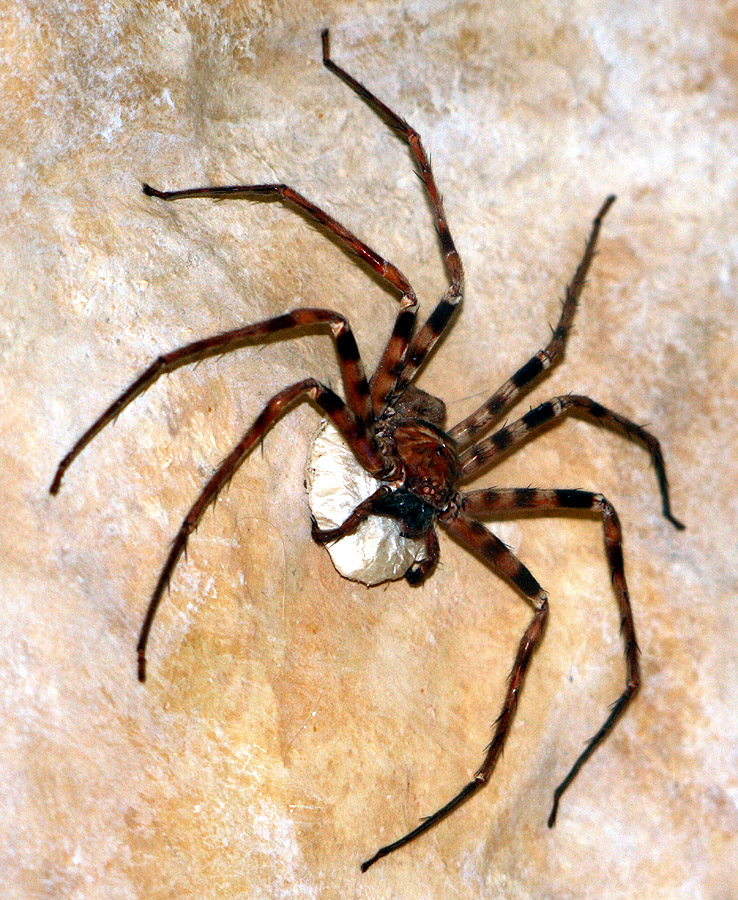 Giant Huntsman SpiderHeteropoda maxima
-
 Huntsman SpiderHeteropoda venatoria
Compare
Questions and answers
What is the scientific name of the Green Huntsman Spider?
The scientific name of the Green Huntsman Spider is Micrommata virescens. Written with its author, the full name is Micrommata virescens (Clerck, 1757).
Which family does the Green Huntsman Spider belong to?
Micrommata virescens belongs to the family Sparassidae, in the order Araneae and the class Arachnida.
Where is the Green Huntsman Spider found?
Checklists and occurrence records place Micrommata virescens in 46 countries, including France, Germany, Sweden, Russia, Austria and Italy.
What other names does the Green Huntsman Spider have?
Micrommata virescens is also known in English as Green Spider.
Sources
Passages the profile rests on
- Female specimens have a bright green cephalothorax and long legs, with a lighter green abdomen marked by a darker green median stripe. Source passage: “The cephalothorax and the long legs of the females are bright green, with a lighter green abdomen showing a darker green median stripe.” — English Wikipedia
- Male specimens are dark green-olive with a narrower abdomen, red sides and a red to red-brown median stripe bordered in yellow. Source passage: “Males are dark green-olive and have a narrower abdomen, with red sides and a red to red-brown median stripe bordered yellow.” — English Wikipedia
- The spider has eight eyes arranged in two rows and surrounded by white hairs. Source passage: “The eight eyes are arranged in two rows and surrounded by white hairs.” — English Wikipedia
- Juveniles initially have a yellow-brown cephalothorax with dark marginal and median stripes. Source passage: “Young spiders have a yellow-brown cephalothorax, with dark marginal and median stripes.” — English Wikipedia
- Juveniles acquire the typical adult coloration after their final molt in the following spring. Source passage: “Only after the last molting in the following spring the juveniles assume the typical coloration of the adults.” — English Wikipedia
- The green coloration results from the bilin micromatabilin and its conjugates occurring in the haemolymph, interstitial tissues and yolk of oocytes. Source passage: “The green coloration is due to the bilin micromatabilin and its conjugates in haemolymph, interstitial tissues and the yolk of oocytes.” — English Wikipedia
- Female body length ranges from 12 to 16 millimetres. Source passage: “In the females of Micrommata virescens, the body length can reach 12–16 millimetres (0.47–0.63 in)” — English Wikipedia
- Male body length ranges from approximately 7 to 10 millimetres. Source passage: “while in the males it is about 7–10 millimetres (0.28–0.39 in).” — English Wikipedia
- The species occurs along forest edges. Source passage: “These characteristic huntsman spiders can be found at the edges of forests” — English Wikipedia
- The species occurs in damp woodland clearings and rides. Source passage: “in damp woodland clearings and rides” — English Wikipedia
- Within its habitats, the species prefers grass and the lower branches of trees. Source passage: “where they prefer grass and the lower branches of trees.” — English Wikipedia
- The species hunts insects in green vegetation. Source passage: “hunt insects in green vegetation” — English Wikipedia
- The species is mainly active during daylight hours. Source passage: “These spiders are mainly diurnal.” — English Wikipedia
- The species does not construct a web. Source passage: “Like many other spiders, they do not build a web” — English Wikipedia
- The species relies on camouflage while hunting in green vegetation. Source passage: “hunt insects in green vegetation, where they rely on their camouflage.” — English Wikipedia
- Its green coloration makes the spider difficult for predators to detect. Source passage: “Their green color makes them very difficult to be detected by predators.” — English Wikipedia
- Females guard their egg cocoons. Source passage: “Cocoons are guarded by females.” — English Wikipedia
- Females are fertile from May through September. Source passage: “Females are fertile from May through to September.” — English Wikipedia
- Females enclose their egg sacs in several leaves stitched together during July. Source passage: “In July, the females enclose the egg-sac into a few leaves stitched together.” — English Wikipedia
- Eggs hatch approximately four weeks after the egg sac is formed. Source passage: “After about 4 weeks, eggs hatch” — English Wikipedia
- A typical hatch produces approximately 40 to 50 young spiders. Source passage: “about 40-50 young spiders.” — English Wikipedia
- Males die a few days after mating. Source passage: “A few days after mating, the males die.” — English Wikipedia
- The species takes approximately 18 months to reach maturity. Source passage: “They grow relatively slowly, taking 18 months to reach maturity.” — English Wikipedia
- The species belongs to the huntsman spiders in the family Sparassidae. Source passage: “is a species of huntsman spiders belonging to the family Sparassidae.” — English Wikipedia
Data
- Catalogue of Life, 2026-10-16 XR cc by
- Global Biodiversity Information Facility CC BY 4.0
- Wikidata CC0
- GeoNames CC BY 4.0
- Wikimedia Commons per image; credit shown with each image
- Within the Catalogue of Life, this name comes from The World Spider Catalog cc by
References
- Clerck, C. (1757). Aranei Svecici. Svenska spindlar, uti sina hufvud-slågter indelte samt under några och sextio särskildte arter beskrefne och med illuminerade figurer uplyste. Laurentius Salvius, Stockholmiae [= Stockholm], 154 pp. doi: <a href="https://doi.org/10.5962/bhl.title.119890" target="_blank">10.5962/bhl.title.119890 Link where the name was published
This species in other databases
Page built on 28 November 2026. See how the catalog is made and all sources and licences.
Cite this page
ScientificNames.org. (2026). Micrommata virescens (Green Huntsman Spider). Retrieved November 28, 2026, from https://scientificnames.org/species/micrommata-virescens
“Micrommata virescens (Green Huntsman Spider).” ScientificNames.org, 2026, scientificnames.org/species/micrommata-virescens. Accessed 28 Nov. 2026.
ScientificNames.org. “Micrommata virescens (Green Huntsman Spider).” Accessed November 28, 2026. https://scientificnames.org/species/micrommata-virescens.
@misc{scientificnames_micrommata_virescens_green_huntsman_spider,
  author = {{ScientificNames.org}},
  title = {Micrommata virescens (Green Huntsman Spider)},
  year = {2026},
  url = {https://scientificnames.org/species/micrommata-virescens},
  note = {Accessed 2026-11-28}
}