Species · Fishes
Shortfin Devil Ray Mobula kuhlii
The scientific name of the Shortfin Devil Ray is Mobula kuhlii. It is a species of fish in the family Mobulidae (mantas), order Myliobatiformes. The name dates from 1841.
- Scientific name
- Mobula kuhlii (Müller & Henle, 1841)
- Common name
- Shortfin Devil Ray
- Genus
- Mobula
- Family
- Mobulidae (Mantas)
- Order
- Myliobatiformes
- Class
- Elasmobranchii
- Red List category
- EN Endangered
- Environment
- marine
- Recorded in
- 14 countries
- Name status
- accepted in the Catalogue of Life

Overview
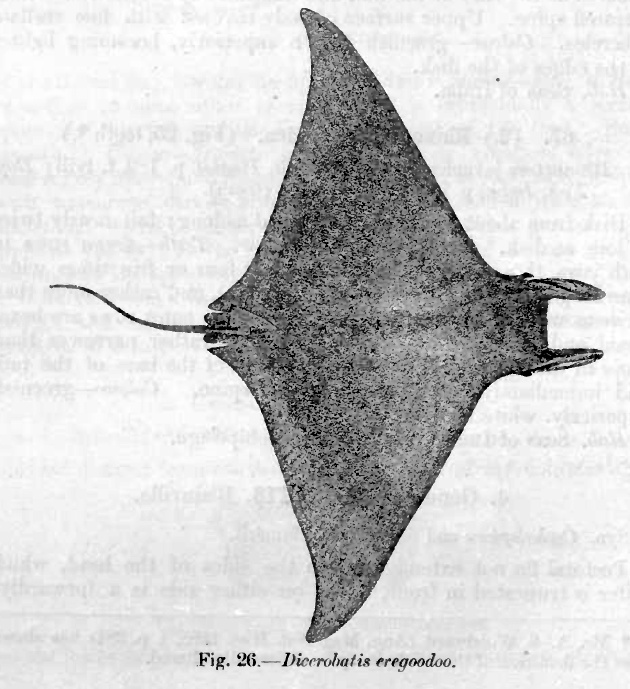
Mobula kuhlii has a wide, flattened body, large pectoral fins with curved tips and a tail shorter than its body.
Written 26 November 2026 from the sources listed below. Each statement was checked against the passage it cites; statements that could not be supported were removed.
Appearance
The Shortfin Devil Ray has a horizontally flattened body with a wide central disc and a short head bearing small cephalic fins. Its large pectoral fins have curved tips, and its dorsal fin has a white tip.[1][2][3]
Its dorsal surface is brown and lacks placoid scales, while its ventral surface is white. Its tail lacks a terminal spine and is shorter than its body.[4][5][6]
The species reaches a maximum width of 120 cm and a maximum reported weight of 30 kilograms.[7][8]
Habitat
Its western distribution includes South Africa, Mozambique, Tanzania and the Seychelles. Its eastern distribution extends to the Philippines and Indonesia, and its southern distribution reaches the northern coast of Australia.[9][10][11]
Diet
The Shortfin Devil Ray feeds on plankton. Small fish and squid are also possible food items.[12][13]
Behaviour
The Shortfin Devil Ray collects food by swimming with its mouth open. It filters food particles from the water using its gill rakers.[14][15]
Reproduction and life cycle
The Shortfin Devil Ray is ovoviviparous and has the lowest reproductive rate among elasmobranchs. A typical litter consists of one pup.[16][17][18]
Its gestation period ranges from one to three years.[19]
Conservation
The Shortfin Devil Ray is classified as endangered by the International Union for Conservation of Nature. Its most recent assessment for the IUCN Red List was in 2020.[20][21]
The species is affected by targeted fishing and inshore fisheries bycatch. Its low reproductive rate makes it vulnerable to overfishing.[22][23]
Targeted fisheries for this species operate in India, Sri Lanka and Thailand. It is also caught in Indonesia, particularly for its gill rakers.[24][25]
The species has a high to very high vulnerability score of 66 out of 100. Its estimated minimum population doubling time is between 4.5 and 14 years.[26][27]
Uses
The species' gill rakers are used in traditional Chinese medicine. Its flesh is used for human consumption.[28][29]
Its skin is dried and deep fried. Its cartilage is used as a filler in shark fin soup manufacture.[30][31]
Classification of the Shortfin Devil Ray
| Kingdom | Animalia |
|---|---|
| Phylum | Chordata |
| Subphylum | Vertebrata |
| Infraphylum | Gnathostomata |
| Parvphylum | Chondrichthyes |
| Class | Elasmobranchii |
| Subclass | Neoselachii |
| Infraclass | Batoidea |
| Order | Myliobatiformes |
| Family | Mobulidae (Mantas) |
| Genus | Mobula (Devil Rays) |
| Species | Mobula kuhlii (Müller & Henle, 1841) |
Where the Shortfin Devil Ray is found
Checklists and occurrence records place Mobula kuhlii in 14 countries. GBIF holds 140 georeferenced records of it.
Countries
- Australia 6
- India 5
- Indonesia 23
- Malaysia 4
- Maldives 18
- Mozambique 8
- Myanmar 13
- Oman 5
- Papua New Guinea 3
- Philippines 4
- Seychelles 8
- Solomon Islands 6
- South Africa 23
- Tanzania 14
Regions and cities with the most records
- Dar es Salaam, Tanzania 10
- Mwandege, Tanzania 10
- Selong, Indonesia 6
- Inhambane, Mozambique 4
- KwaZulu-Natal, South Africa 4
- Male, Maldives 3
- Scottburgh, South Africa 3
- eMkhomazi, South Africa 3
A number beside a place is its count of GBIF occurrence records. A place without a number comes from a checklist alone. Records show where a species has been observed or collected, which can include escapes and vagrants.
Common names
English
- Shortfin Devil Ray
- Diamond Fish
- Eregoodoo
- Kuhl's Devil Ray
- Lesser Devil Ray
- Longhorned Mobula
- Manta Ray
- Ox Ray
- Ox-ray
- Pigmy Devil Ray
- Pygmy Devil Ray
- Shorthorned Pygmy Devil Ray
- Smaller Devil Ray
- Whiptail Devil Ray
Names in 10 other languages
- Arabic
- حداية البحر, شفنين الشيطان القزم, شفنين الشيطان قصير الزعانف
- Czech
- manta Kuhlova, manta kambodžská
- Dutch
- Kortvinduivelsrog, Langvinduivelsrog
- French
- Petit Diable
- German
- Kuhls Teufelsrochen
- Italian
- Mobula pinna corta
- Lithuanian
- Ilgaragė mobulė, kulio mobulė
- Portuguese
- Manta-pigmeia
- Spanish
- Manta de aleta corta
- Thai
- ปลากระเบนราหูเขาสั้น
Synonyms
3 other scientific names have been used for this species and are now treated as synonyms of Mobula kuhlii.
- Cephaloptera kuhlii Müller & Henle, 1841
- Cephaloptera kuhlii Valenciennes, 1841
- Dicerobatis draco Günther, 1872
Related species
-
 Giant Oceanic Manta RayMobula birostris
-
 Devil FishMobula mobular
-
 Atlantic Manta RayMobula yarae
-
 Lesser Devil RayMobula hypostoma
-
 Sicklefin Devil RayMobula tarapacana
-
 Munk's Pygmy Devil RayMobula munkiana
-
 Bentfin Devil RayMobula thurstoni
-
 Pygmy DevilrayMobula eregoodootenkee
Compare
Questions and answers
What is the scientific name of the Shortfin Devil Ray?
The scientific name of the Shortfin Devil Ray is Mobula kuhlii. Written with its author, the full name is Mobula kuhlii (Müller & Henle, 1841).
Which family does the Shortfin Devil Ray belong to?
Mobula kuhlii belongs to the family Mobulidae, in the order Myliobatiformes and the class Elasmobranchii.
Where is the Shortfin Devil Ray found?
Checklists and occurrence records place Mobula kuhlii in 14 countries, including Indonesia, South Africa, Maldives, Tanzania, Myanmar and Mozambique.
What is the conservation status of the Shortfin Devil Ray?
The IUCN Red List category recorded for Mobula kuhlii is Endangered (EN).
What other names does the Shortfin Devil Ray have?
Mobula kuhlii is also known in English as Diamond Fish, Eregoodoo, Kuhl's Devil Ray, Lesser Devil Ray, Longhorned Mobula and Manta Ray.
Sources
Passages the profile rests on
- The species has a horizontally flattened body with a wide central disc and a short head bearing small cephalic fins. Source passage: “It is flattened horizontally with a wide central disc and the head is short with small cephalic fins.” — English Wikipedia
- Its large pectoral fins have curved tips. Source passage: “The large pectoral fins have curved tips” — English Wikipedia
- Its dorsal fin has a white tip. Source passage: “the dorsal fin has a white tip.” — English Wikipedia
- Its tail lacks a terminal spine and is shorter than its body. Source passage: “The tail is not tipped with a spine and is shorter than the body.” — English Wikipedia
- Its dorsal surface is brown and lacks placoid scales. Source passage: “The dorsal surface of this fish is brown and does not bear any placoid scales” — English Wikipedia
- Its ventral surface is white. Source passage: “the ventral surface is white.” — English Wikipedia
- The species reaches a maximum width of 120 cm. Source passage: “growing to a maximum width of 120 cm (47 in)” — English Wikipedia
- The species reaches a maximum reported weight of 30 kilograms. Source passage: “and a weight of 30 kilograms (66 lb).” — English Wikipedia
- Its western distribution includes South Africa, Mozambique, Tanzania and the Seychelles. Source passage: “It ranges from South Africa, Mozambique, Tanzania and the Seychelles in the west” — English Wikipedia
- Its eastern distribution extends to the Philippines and Indonesia. Source passage: “to the Philippines and Indonesia in the east” — English Wikipedia
- Its distribution extends southward to the northern coast of Australia. Source passage: “and southward to the northern coast of Australia.” — English Wikipedia
- The species feeds on plankton. Source passage: “The shortfin devil ray feeds on plankton” — English Wikipedia
- Small fish and squid are also possible food items. Source passage: “and possibly also on small fish and squid.” — English Wikipedia
- The species collects food by swimming with its mouth open. Source passage: “It gathers its food by swimming with its mouth open” — English Wikipedia
- The species filters food particles from water using its gill rakers. Source passage: “passing the water over its gill rakers which filter out the food particles.” — English Wikipedia
- The species is ovoviviparous. Source passage: “It is an ovoviviparous fish” — English Wikipedia
- The species has the lowest reproductive rate among elasmobranchs. Source passage: “has the lowest rate of reproduction of any of the elasmobranchs.” — English Wikipedia
- A typical litter consists of one pup. Source passage: “A litter usually consists of a single pup” — English Wikipedia
- The gestation period ranges from one to three years. Source passage: “the gestation period is one to three years.” — English Wikipedia
- The species is classified as endangered by the International Union for Conservation of Nature. Source passage: “The International Union for Conservation of Nature have classified the conservation status of this species as endangered.” — English Wikipedia
- The species was most recently assessed for the IUCN Red List in 2020 according to the supplied species assessment document. Source passage: “has most recently been assessed for The IUCN Red List of Threatened Species in 2020.” — iucnredlist.org
- The species is affected by both targeted fishing and inshore fisheries bycatch. Source passage: “the subject of both targeted and bycatch inshore fisheries.” — English Wikipedia
- Its low reproductive rate makes the species vulnerable to overfishing. Source passage: “It is vulnerable to over-fishing because of its low reproductive rate.” — English Wikipedia
- Targeted fisheries for this species operate in India, Sri Lanka and Thailand. Source passage: “Targeted fisheries occur in India, Sri Lanka and Thailand” — English Wikipedia
- The species is caught in Indonesia, particularly for its gill rakers. Source passage: “this ray is caught in Indonesia especially for its gill rakers.” — English Wikipedia
- The species has a high to very high vulnerability score of 66 out of 100. Source passage: “High to very high vulnerability (66 of 100).” — fishbase.se
- The estimated minimum population doubling time is between 4.5 and 14 years. Source passage: “Low, minimum population doubling time 4.5 - 14 years” — fishbase.se
- The species' gill rakers are used in traditional Chinese medicine. Source passage: “These are valuable because of their use in traditional Chinese medicine.” — English Wikipedia
- The flesh of the species is used for human consumption. Source passage: “The flesh is used for human consumption” — English Wikipedia
- The skin of the species is dried and deep fried. Source passage: “the skin is dried and deep fried” — English Wikipedia
- The cartilage of the species is used as a filler in shark fin soup manufacture. Source passage: “the cartilage is used as a filler in the manufacture of shark fin soup.” — English Wikipedia
Data
- Catalogue of Life, 2026-10-16 XR cc by
- Global Biodiversity Information Facility CC BY 4.0
- Wikidata CC0
- GeoNames CC BY 4.0
- Wikimedia Commons per image; credit shown with each image
- Within the Catalogue of Life, this name comes from World Register of Marine Species cc by
References
- M ʾ ller, J. & Henle, F. G. J. (1841) s. n. In: Systematische Beschreibung der Plagiostomen. Plagiostomen, Berlin, pp. 103 - 200. where the name was published
This species in other databases
- Catalogue of Life 73N5R
- Wikidata Q5015132
- iNaturalist 105922
- WoRMS urn:lsid:marinespecies.org:taxname:217436
- ITIS 564404
Page built on 26 November 2026. See how the catalog is made and all sources and licences.
Cite this page
ScientificNames.org. (2026). Mobula kuhlii (Shortfin Devil Ray). Retrieved November 26, 2026, from https://scientificnames.org/species/mobula-kuhlii
“Mobula kuhlii (Shortfin Devil Ray).” ScientificNames.org, 2026, scientificnames.org/species/mobula-kuhlii. Accessed 26 Nov. 2026.
ScientificNames.org. “Mobula kuhlii (Shortfin Devil Ray).” Accessed November 26, 2026. https://scientificnames.org/species/mobula-kuhlii.
@misc{scientificnames_mobula_kuhlii_shortfin_devil_ray,
  author = {{ScientificNames.org}},
  title = {Mobula kuhlii (Shortfin Devil Ray)},
  year = {2026},
  url = {https://scientificnames.org/species/mobula-kuhlii},
  note = {Accessed 2026-11-26}
}