Species · Fishes
Sicklefin Devil Ray Mobula tarapacana
The scientific name of the Sicklefin Devil Ray is Mobula tarapacana. It is a species of fish in the family Mobulidae (mantas), order Myliobatiformes. The name dates from 1892.
- Scientific name
- Mobula tarapacana (Philippi, 1892)
- Common name
- Sicklefin Devil Ray
- Genus
- Mobula
- Family
- Mobulidae (Mantas)
- Order
- Myliobatiformes
- Class
- Elasmobranchii
- Red List category
- CR Critically Endangered
- Environment
- marine
- Recorded in
- 15 countries
- Name status
- accepted in the Catalogue of Life

Overview
Mobula tarapacana occurs in the Atlantic, Pacific and Indian Oceans and has a circumtropical distribution. It is distinguished by its rectangular, box-shaped head and a pale patch behind the head.
Written 26 November 2026 from the sources listed below. Each statement was checked against the passage it cites; statements that could not be supported were removed.
Appearance
The sicklefin devil ray has a flat, disc-shaped body, a relatively narrow projecting head and a long neck. Its snout has a strongly concave front edge between the head horns, which are relatively short and have a width equal to approximately 60% of their length.[1][2][3][4]
Its large triangular pectoral fins curve strongly backwards, and a central ridge runs along its back. Its spiracle is an elongated longitudinal slit above the pectoral fin base, with a ridge above it.[5][6][7]
The species has a ventral mouth and teeth on both jaws. Its upper jaw has 94–135 tooth rows and its lower jaw has 107–153 tooth rows; the teeth are approximately hexagonal, with pitted tips and comb-like rear edges.[8][9][10]
Its gill filter plates are fused along their length and have broadly rounded end lobes. Its tail is relatively short, measuring less than half the disc width, and lacks a spine.[11][12]
The body is densely covered with minute, thick, needle-like denticles. Its back is brown to olive green, and it lacks a dark collar between its eyes.[13][14][15]
The front underside is white, while the rear portions of the pectoral fins are abruptly grey.[16]
The species can reach a disc width of approximately 3.7 metres and can weigh up to 400 kilograms.[17][18]
Habitat
The sicklefin devil ray inhabits tropical, subtropical and warm temperate ocean waters. It primarily inhabits offshore waters but occasionally occurs near coasts.[19][20]
It is primarily pelagic and also inhabits continental shelf areas and oceanic islands.[21]
The species occurs in the Atlantic, Pacific and Indian Oceans. Its range extends from the northeastern United States and the Caribbean to Japan, Australia, South Africa and the Maldives.[22][23]
It has a circumtropical distribution and occurs in the northern Gulf of Mexico and southeastern Caribbean.[24][25]
Diet
The sicklefin devil ray is a planktivorous filter feeder. Its diet includes zooplankton, copepods, krill and other small crustaceans, as well as pelagic crustaceans, pelagic fish eggs and bony fishes.[26][27][28]
Behaviour
The species feeds by swimming with its mouth open and filtering small organisms from the water through its gills. It typically feeds near the water surface, where plankton concentrations are highest.[29][30]
The sicklefin devil ray is known for leaping out of the water, sometimes landing on its back.[31]
The species has been recorded feeding at depths of up to 1,896 metres. Its deep dives commonly occur at night while it searches for prey.[32][33]
One deep-diving pattern involves reaching maximum depth and resurfacing after 60 to 90 minutes. A less frequent pattern involves descending to 1,000 metres for up to 11 hours.[34][35]
The species stays near warmer surface water for at least an hour before and after deep dives.[36]
Conservation
The sicklefin devil ray is classified as Critically Endangered. Its vulnerability score is 79 out of 100, and its minimum population doubling time is estimated to exceed 14 years.[37][38][39]
Gillnet and trawl fisheries are major threats because the species is caught as bycatch. It is also targeted for use in traditional Asian medicines.[40][41]
Classification of the Sicklefin Devil Ray
| Kingdom | Animalia |
|---|---|
| Phylum | Chordata |
| Subphylum | Vertebrata |
| Infraphylum | Gnathostomata |
| Parvphylum | Chondrichthyes |
| Class | Elasmobranchii |
| Subclass | Neoselachii |
| Infraclass | Batoidea |
| Order | Myliobatiformes |
| Family | Mobulidae (Mantas) |
| Genus | Mobula (Devil Rays) |
| Species | Mobula tarapacana (Philippi, 1892) |
Where the Sicklefin Devil Ray is found
Checklists and occurrence records place Mobula tarapacana in 15 countries. GBIF holds 504 georeferenced records of it.
Countries
- China 13
- India 25
- Indonesia 21
- Ivory Coast 5
- Japan 7
- Mexico 16
- Myanmar 6
- Philippines 25
- Portugal 68
- Reunion 4
- Saint Helena 15
- Singapore 3
- Spain 5
- Sri Lanka 3
- United States 288
Regions and cities with the most records
- Jamestown, Saint Helena 15
- Ponta Delgada, Portugal 15
- Selong, Indonesia 14
- Madhya Pradesh, India 11
- Abidjan, Ivory Coast 4
- Abobo, Ivory Coast 4
- Bingerville, Ivory Coast 4
- Koumassi, Ivory Coast 4
- Marcory, Ivory Coast 4
- Azores, Portugal 3
- Canary Islands, Spain 3
- Saint Helena, Saint Helena 3
5 more countries have a few records outside this range
These countries hold a few records of Mobula tarapacana but lie outside the range the checklists give for it. Such records are often zoo or garden specimens, museum material or vagrants, so the species is not counted as occurring there.
A number beside a place is its count of GBIF occurrence records. A place without a number comes from a checklist alone. Records show where a species has been observed or collected, which can include escapes and vagrants.
Common names
English
- Sicklefin Devil Ray
- Box Ray
- Chilean Devil Ray
- Devil Ray
- Greater Guinean Devil Ray
- Greater Guinean Mobula
- Spiny Mobula
Names in 17 other languages
- Afrikaans
- Gestekelde Mobula
- Chinese
- 台灣蝠魟, 智利蝠魟, 臺灣蝠魟, 褐背蝠鱝, 飛魴仔, 鷹魴
- Czech
- Manta poloměsíčit, manta chilská
- Danish
- Chilensk djævlerokke
- Dutch
- Sikkelvinduivelsrog
- Estonian
- Sirpuim-merisarvik
- Fijian
- Vai mataitalia
- Finnish
- tropiikinpaholaisrausku
- French
- Diable Géant De Guinée, Diable de mer chilien, Mante Chilienne, Mobula, Raie diable faucille
- German
- Sichelflossen-Teufelsrochen
- Italian
- Mobula cilena
- Japanese
- タイワンイトマキエイ, ヒメイトマキエイ
- Portuguese
- Jamanta, Jamanta-chilena, Manta-chilena
- Slovenian
- Srpastokrila manta
- Spanish
- Diabolo Gigante De Guinea, Manta Cornuada, Manta Raya, Raya Cornuda, Vaquetilla, manta cornuda
- Thai
- ปลากระเบนปีศาจหางเคียว, ปลากระเบนราหูครีบแหลม
- jav
- Pari Cawang
Synonyms
4 other scientific names have been used for this species and are now treated as synonyms of Mobula tarapacana.
- Cephaloptera tarapacana Philippi, 1892
- Mobula coilloti Cadenat & Rancurel, 1960
- Mobula formosana Teng, 1962
- Mobula tarapanaca (Philippi, 1892)
Related species
-
 Giant Oceanic Manta RayMobula birostris
-
 Devil FishMobula mobular
-
 Atlantic Manta RayMobula yarae
-
 Lesser Devil RayMobula hypostoma
-
 Munk's Pygmy Devil RayMobula munkiana
-
 Bentfin Devil RayMobula thurstoni
-
 Shortfin Devil RayMobula kuhlii
-
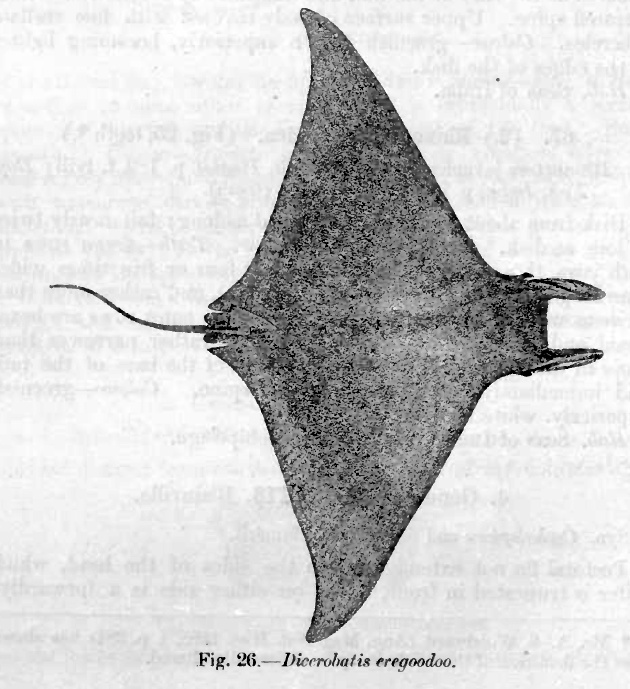 Pygmy DevilrayMobula eregoodootenkee
Compare
Questions and answers
What is the scientific name of the Sicklefin Devil Ray?
The scientific name of the Sicklefin Devil Ray is Mobula tarapacana. Written with its author, the full name is Mobula tarapacana (Philippi, 1892).
Which family does the Sicklefin Devil Ray belong to?
Mobula tarapacana belongs to the family Mobulidae, in the order Myliobatiformes and the class Elasmobranchii.
Where is the Sicklefin Devil Ray found?
Checklists and occurrence records place Mobula tarapacana in 15 countries, including United States, Portugal, India, Philippines, Indonesia and Mexico.
What is the conservation status of the Sicklefin Devil Ray?
The IUCN Red List category recorded for Mobula tarapacana is Critically Endangered (CR).
What other names does the Sicklefin Devil Ray have?
Mobula tarapacana is also known in English as Box Ray, Chilean Devil Ray, Devil Ray, Greater Guinean Devil Ray, Greater Guinean Mobula and Spiny Mobula.
Is devil ray endangered?
The sicklefin devil ray is classified as Critically Endangered.[37]
Sources
Passages the profile rests on
- The species has a flat, disc-shaped body. Source passage: “Their bodies are disc-shaped and are flat.” — English Wikipedia
- The species has a relatively narrow, projecting head and a long neck. Source passage: “Head projecting, relatively narrow, neck long;” — biogeodb.stri.si.edu
- The front edge of the snout between the head horns is strongly concave. Source passage: “front edge of snout between horns strongly concave;” — biogeodb.stri.si.edu
- Its head horns are relatively short, with a width equal to approximately 60% of their length. Source passage: “head horns relatively short (width 60% of length);” — biogeodb.stri.si.edu
- Its large triangular pectoral fins curve strongly backwards. Source passage: “large triangular "wings" (pectoral fin flaps) that are strongly curved backwards;” — biogeodb.stri.si.edu
- The species has a central ridge along its back. Source passage: “back with a central ridge;” — biogeodb.stri.si.edu
- Its spiracle is an elongated longitudinal slit above the pectoral fin base, with a ridge above it. Source passage: “spiracle an elongate longitudinal slit above base of pectoral, with a ridge above it;” — biogeodb.stri.si.edu
- The species has a ventral mouth and teeth on both jaws. Source passage: “mouth on underside of head; teeth on both jaws,” — biogeodb.stri.si.edu
- Its upper jaw has 94–135 tooth rows and its lower jaw has 107–153 tooth rows. Source passage: “94-135 upper rows, 107-153 lower rows,” — biogeodb.stri.si.edu
- Its teeth are approximately hexagonal, with pitted tips and comb-like rear edges. Source passage: “teeth ~hexagonal, with pitted tips and comblike rear edge;” — biogeodb.stri.si.edu
- Its gill filter plates are fused along their length and have broadly rounded end lobes. Source passage: “filter plates of gills fused along their length, with broadly rounded end lobes;” — biogeodb.stri.si.edu
- Its tail is relatively short, measuring less than half the disc width, and lacks a spine. Source passage: “tail relatively short (<1/2 disc width), scaly, without spine;” — biogeodb.stri.si.edu
- The body is densely covered with minute, thick, needle-like denticles. Source passage: “body densely covered with minute thick, needle-like denticles.” — biogeodb.stri.si.edu
- Its back is brown to olive green. Source passage: “Back brown to olivaceous green;” — biogeodb.stri.si.edu
- The species lacks a dark collar between its eyes. Source passage: “no dark collar between eyes;” — biogeodb.stri.si.edu
- The front underside is white, while the rear portions of the pectoral fins are abruptly grey. Source passage: “underside white at front and pectorals abruptly grey at rear.” — biogeodb.stri.si.edu
- The species can reach a disc width of approximately 3.7 metres. Source passage: “It can reach a disc width of up to 3.7 m (12 ft).” — English Wikipedia
- The species can weigh up to 400 kilograms. Source passage: “and a weight of 400 kg.” — biogeodb.stri.si.edu
- The species inhabits tropical, subtropical and warm temperate ocean waters. Source passage: “basking just below the surface in tropical, subtropical and warm temperate oceans” — English Wikipedia
- The species primarily inhabits offshore waters but occasionally occurs near coasts. Source passage: “mainly offshore, and occasionally appearing near the coast.” — English Wikipedia
- The species is primarily pelagic and also inhabits continental shelf areas and oceanic islands. Source passage: “They mostly are pelagic, swimming in the open ocean, but also inhabiting areas near continental shelves, and oceanic islands.” — English Wikipedia
- The species occurs in the Atlantic, Pacific and Indian Oceans. Source passage: “across the Atlantic, Pacific, and Indian Oceans.” — English Wikipedia
- Its range extends from the northeastern United States and the Caribbean to Japan, Australia, South Africa and the Maldives. Source passage: “from the northeastern United States and the Caribbean to Japan and Australia, and as far as South Africa and the Maldives.” — English Wikipedia
- The species has a circumtropical distribution. Source passage: “Circumtropical ( Indian + Pacific + Atlantic Oceans)” — biogeodb.stri.si.edu
- The species occurs in the northern Gulf of Mexico and southeastern Caribbean. Source passage: “the northern Gulf of Mexico and the SE Caribbean.” — biogeodb.stri.si.edu
- The species is a planktivorous filter feeder. Source passage: “The Chilean Devil Ray is a planktivorous filter feeder” — English Wikipedia
- Its diet includes zooplankton, copepods, krill and other small crustaceans. Source passage: “including zooplankton, copepods, krill, and other small crustaceans” — English Wikipedia
- The species also consumes pelagic crustaceans, pelagic fish eggs, zooplankton and bony fishes. Source passage: “Pelagic crustacea Data Pelagic fish eggs Zooplankton Bony fishes” — biogeodb.stri.si.edu
- The species feeds by swimming with its mouth open and filtering small organisms from the water through its gills. Source passage: “They swim with their mouths open to suck in water, which passes over their gills which traps the small organisms” — English Wikipedia
- The species typically feeds near the water surface, where plankton concentrations are highest. Source passage: “They typically feed near surface waters where the plankton concentrations are the highest.” — English Wikipedia
- The species is known for leaping out of the water, sometimes landing on its back. Source passage: “They can propel themselves multiple feet into the air, and sometimes land on their backs.” — English Wikipedia
- The species has been recorded feeding at depths of up to 1,896 metres. Source passage: “Mobula tarapacana have been discovered to feed at depths of up to 1,896 metres (6,220 ft)” — English Wikipedia
- Its deep dives commonly occur at night while it searches for prey. Source passage: “They make these deep water dives usually at night, when scavenging for prey.” — English Wikipedia
- One deep-diving pattern involves reaching maximum depth and resurfacing after 60 to 90 minutes. Source passage: “involves diving to the maximum depth and resurfacing after 60 to 90 minutes;” — English Wikipedia
- A less frequent diving pattern involves descending to 1,000 metres for up to 11 hours. Source passage: “involves diving up to 1,000 meters for a maximum of 11 hours.” — English Wikipedia
- The species stays near warmer surface water for at least an hour before and after deep dives. Source passage: “Rays stay near warmer surface water for at least an hour both before and after deep diving” — English Wikipedia
- The species is classified as Critically Endangered. Source passage: “Chilean Devil Rays are classified as Critically Endangered” — English Wikipedia
- The species has a very high vulnerability score of 79 out of 100. Source passage: “Very high vulnerability (79 of 100).” — fishbase.se
- The minimum population doubling time is estimated to exceed 14 years. Source passage: “Very Low, minimum population doubling time more than 14 years (Fec=1).” — fishbase.se
- Gillnet and trawl fisheries are identified as major threats because the species is caught as bycatch. Source passage: “One of their biggest threats is being bycatch in gill net and trawlfisheries” — English Wikipedia
- The species is also targeted for use in traditional Asian medicines. Source passage: “they are also targeted in the demand for traditional Asian medicines.” — English Wikipedia
Data
- Catalogue of Life, 2026-10-16 XR cc by
- Global Biodiversity Information Facility CC BY 4.0
- Wikidata CC0
- GeoNames CC BY 4.0
- Wikimedia Commons per image; credit shown with each image
- Within the Catalogue of Life, this name comes from World Register of Marine Species cc by
References
- Philippi, R. A. (1892) Algunos peces de Chile. Las rayas, Callorrhynchus i Orthagoriscus Chilenos. Anales del Museo Nacional de Chile, Primera Seccion, Zoologia, 3, 1 + 1 - 16 + 1. where the name was published
This species in other databases
- Catalogue of Life 6RMTP
- Wikidata Q3281177
- iNaturalist 105926
- WoRMS urn:lsid:marinespecies.org:taxname:105859
- ITIS 564407
Page built on 27 November 2026. See how the catalog is made and all sources and licences.
Cite this page
ScientificNames.org. (2026). Mobula tarapacana (Sicklefin Devil Ray). Retrieved November 27, 2026, from https://scientificnames.org/species/mobula-tarapacana
“Mobula tarapacana (Sicklefin Devil Ray).” ScientificNames.org, 2026, scientificnames.org/species/mobula-tarapacana. Accessed 27 Nov. 2026.
ScientificNames.org. “Mobula tarapacana (Sicklefin Devil Ray).” Accessed November 27, 2026. https://scientificnames.org/species/mobula-tarapacana.
@misc{scientificnames_mobula_tarapacana_sicklefin_devil_ray,
  author = {{ScientificNames.org}},
  title = {Mobula tarapacana (Sicklefin Devil Ray)},
  year = {2026},
  url = {https://scientificnames.org/species/mobula-tarapacana},
  note = {Accessed 2026-11-27}
}