Species · Flowering plants
Hua Mulberry Morus cathayana
The scientific name of the Hua Mulberry is Morus cathayana. It is a species of flowering plant in the family Moraceae (mulberry family), order Rosales.
- Scientific name
- Morus cathayana Hemsl.
- Common name
- Hua Mulberry
- Genus
- Morus
- Family
- Moraceae (Mulberry Family)
- Order
- Rosales
- Class
- Magnoliopsida
- Red List category
- LC Least Concern
- Recorded in
- 7 countries
- Name status
- accepted in the Catalogue of Life
Overview
Hua Mulberry is a deciduous tree belonging to the mulberry family Moraceae. It is native to China, Japan and Korea. Its berries are edible.
Written 26 November 2026 from the sources listed below. Each statement was checked against the passage it cites; statements that could not be supported were removed.
Appearance
Hua Mulberry is a deciduous tree that can reach a height of up to 15 metres.[1][2]
Habitat
Hua Mulberry is native to China, Japan and Korea.[3]
Reproduction and life cycle
Hua Mulberry flowers between May and June. It produces edible berries.[4][5]
Uses
The leaves of Hua Mulberry are used to make tea.[6]
Classification of the Hua Mulberry
| Kingdom | Plantae |
|---|---|
| Subkingdom | Pteridobiotina |
| Phylum | Tracheophyta |
| Class | Magnoliopsida |
| Order | Rosales |
| Family | Moraceae (Mulberry Family) |
| Tribe | Moreae |
| Genus | Morus (Mulberry) |
| Species | Morus cathayana Hemsl. |
Where the Hua Mulberry is found
Checklists and occurrence records place Morus cathayana in 7 countries across Asia. GBIF holds 1,027 georeferenced records of it.
Countries
Regions and cities with the most records
- Sichuan, China 98
- Hubei, China 80
- Zhejiang, China 69
- Okayama, Japan 56
- Niimi, Japan 36
- Chongqing, China 32
- Henan, China 32
- Hunan, China 32
- Jiangxi, China 32
- Shaanxi, China 28
- Takahashi, Japan 28
- Anhui, China 21
- Conglin, China 21
- Daguan, China 21
- Nanchuan, China 21
- Nanping, China 21
- Xinglong, China 21
- Yunnan, China 19
- Hiroshima, Japan 17
- Shimane, Japan 17
- Shōbara, Japan 12
- Jeollanam-do, South Korea 10
- Lichuan, China 10
- Jeollabuk-do, South Korea 9
- Jiangsu, China 9
- Pingwu County, China 9
- Songbai, China 9
- Maniwa, Japan 8
- Gecheng, China 7
- Hebei, China 7
- Enshi, China 6
- Gansu, China 6
- Longfeng, China 6
- Aioi, Japan 5
- Fujian, China 5
- Ibara, Japan 5
Range as the checklists state it
China (Anhui, Hebei, Henan, Hubei, Hunan, Jiangsu, Shaanxi, Shandong, Sichuan, Zhejiang); North Korea; South Korea; Japan (Honshu, Shikoku, Kyushu); India [c]; Laos; Vietnam
A number beside a place is its count of GBIF occurrence records. A place without a number comes from a checklist alone. Records show where a species has been observed or collected, which can include escapes and vagrants.
Common names
English
- Hua Mulberry
Names in 5 other languages
- Chinese
- 華桑
- Czech
- morušovník čínský
- Japanese
- ケグワ
- Korean
- 돌뽕나무
- Slovak
- moruša kathajská
Synonyms
5 other scientific names have been used for this species and are now treated as synonyms of Morus cathayana.
- Morus cathayana var. cathayana
- Morus cathayana var. japonica (Makino) Koidz.
- Morus chinlingensis C.L.Min
- Morus rubra var. japonica Makino
- Morus tiliifolia Makino
Subspecies and varieties
Related species
-
 White MulberryMorus alba
-
 Black MulberryMorus nigra
-
 Red MulberryMorus rubra
-
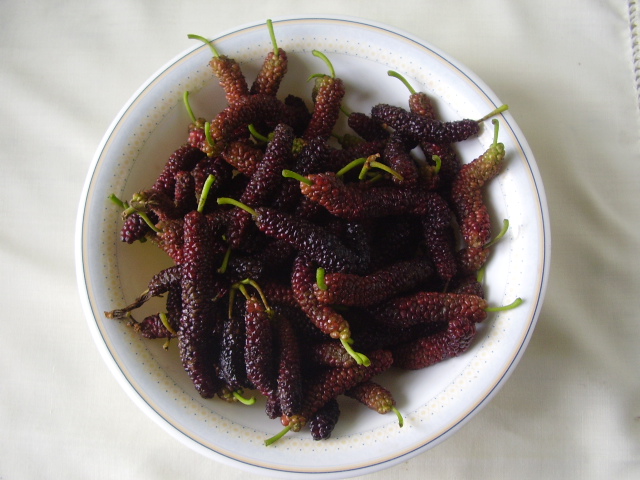 King White MulberryMorus macroura
-
 Indian MulberryMorus indica
- Mexican MulberryMorus celtidifolia
- Himalayan MulberryMorus serrata
- Texas MulberryMorus microphylla
Compare
Questions and answers
What is the scientific name of the Hua Mulberry?
The scientific name of the Hua Mulberry is Morus cathayana. Written with its author, the full name is Morus cathayana Hemsl..
Which family does the Hua Mulberry belong to?
Morus cathayana belongs to the family Moraceae, in the order Rosales and the class Magnoliopsida.
Where is the Hua Mulberry found?
Checklists and occurrence records place Morus cathayana in 7 countries, including China, Japan, South Korea, India, Laos and North Korea.
What is the conservation status of the Hua Mulberry?
The IUCN Red List category recorded for Morus cathayana is Least Concern (LC).
Sources
Passages the profile rests on
- Morus cathayana is a deciduous tree belonging to the mulberry family Moraceae. Source passage: “Morus cathayana or hua sang is a deciduous tree in the mulberry family Moraceae.” — English Wikipedia
- Morus cathayana can reach a height of up to 15 metres. Source passage: “The tree reaches a height of up to 15 metres (49 feet)” — English Wikipedia
- Morus cathayana is native to China, Japan and Korea. Source passage: “It is native to China, Japan and Korea.” — English Wikipedia
- Morus cathayana flowers between May and June. Source passage: “flowers from May to June.” — English Wikipedia
- Morus cathayana produces berries that are edible. Source passage: “It produces edible berries” — English Wikipedia
- The leaves of Morus cathayana are used to make tea. Source passage: “its leaves are made into a tea.” — English Wikipedia
Data
- Catalogue of Life, 2026-10-16 XR cc by
- Global Biodiversity Information Facility CC BY 4.0
- Wikidata CC0
- GeoNames CC BY 4.0
- Within the Catalogue of Life, this name comes from Synonymic Checklists of the Vascular Plants of the World cc by
References
- Hemsl. (1890). J. Linn. Soc., Bot. 26: 456 (1890). where the name was published
This species in other databases
- Catalogue of Life 44FQR
- Wikidata Q10905799
- iNaturalist 521646
- World Flora Online wfo-0001228795
- GRIN 461574
Page built on 27 November 2026. See how the catalog is made and all sources and licences.
Cite this page
ScientificNames.org. (2026). Morus cathayana (Hua Mulberry). Retrieved November 27, 2026, from https://scientificnames.org/species/morus-cathayana
“Morus cathayana (Hua Mulberry).” ScientificNames.org, 2026, scientificnames.org/species/morus-cathayana. Accessed 27 Nov. 2026.
ScientificNames.org. “Morus cathayana (Hua Mulberry).” Accessed November 27, 2026. https://scientificnames.org/species/morus-cathayana.
@misc{scientificnames_morus_cathayana_hua_mulberry,
  author = {{ScientificNames.org}},
  title = {Morus cathayana (Hua Mulberry)},
  year = {2026},
  url = {https://scientificnames.org/species/morus-cathayana},
  note = {Accessed 2026-11-27}
}