Species · Flowering plants
Black Mulberry Morus nigra
The scientific name of the Black Mulberry is Morus nigra. It is a species of flowering plant in the family Moraceae (mulberry family), order Rosales.
- Scientific name
- Morus nigra L.
- Common name
- Black Mulberry
- Genus
- Morus
- Family
- Moraceae (Mulberry Family)
- Order
- Rosales
- Class
- Magnoliopsida
- Recorded in
- 73 countries
- Name status
- accepted in the Catalogue of Life

Overview
Black Mulberry (Morus nigra L.) is a deciduous flowering tree in the family Moraceae, order Rosales and class Magnoliopsida. The species is considered probably native to western Asia and is cultivated across Europe, North Africa and parts of Asia. It is distinguished by its dark purple to almost black fruits and leaves with a uniformly hairy underside.
Written 26 November 2026 from the sources listed below. Each statement was checked against the passage it cites; statements that could not be supported were removed.
Appearance
Black Mulberry is a deciduous tree that can reach 10 metres in height. Its leaves generally measure 10–20 centimetres long and 6–10 centimetres wide, while leaves on vigorous shoots can reach 23 centimetres in length.[1][2][3][4][5]
The leaves have a downy underside and a rough upper surface covered with very short, stiff hairs. The uniformly hairy lower surface distinguishes the species from Morus alba.[6][7]
The ripe fruits are dark purple to almost black and consist of clusters of small drupes. They measure approximately 2.5 centimetres in diameter.[8][9][10]
Habitat
Black Mulberry can grow in almost all soil types except swampy, saline and acidic soils. Nutrient-rich soils with low acidity or neutral pH support good fruit and leaf production.[11][12]
Diet
The ripe fruits of Black Mulberry are edible.[13]
Behaviour
The fruits fall from the tree as soon as they ripen.[14]
Reproduction and life cycle
Existing Black Mulberry trees may have originated through vegetative propagation and apomictic seed formation. Some cultivated varieties are triploid.[15][16]
The cultivars Morus nigra 'Chelsea' and Morus nigra 'Jerusalem' are female and self-fertile.[17]
Conservation
Genetic research found no genetic diversity among more than 250 old Black Mulberry trees sampled in Turkey, Iran and Azerbaijan. The sampled trees were considered potentially clonal populations.[18][19]
Uses
Black Mulberry is cultivated for its edible fruits. In Persia, the fruits are used to prepare jams and sherbets.[20][21]
The fruits contain anthocyanins, flavonols and phenolic acids. The leaves contain flavonols including quercetin and kaempferol in glycosylated forms, as well as chlorogenic acid as a predominant phenolic acid.[22][23][24]
The bark, roots and twigs contain prenylated flavonoids, predominantly morusin.[25]
The tree can be planted for street shade and edible landscaping. It can also be planted to help reduce environmental and soil pollution.[26][27]
Similar species
Black Mulberry can be confused with black-fruited individuals of Morus alba. It can be distinguished by the uniformly hairy lower surface of its leaves.[28][7]
Classification of the Black Mulberry
| Kingdom | Plantae |
|---|---|
| Subkingdom | Pteridobiotina |
| Phylum | Tracheophyta |
| Class | Magnoliopsida |
| Order | Rosales |
| Family | Moraceae (Mulberry Family) |
| Tribe | Moreae |
| Genus | Morus (Mulberry) |
| Species | Morus nigra L. |
Where the Black Mulberry is found
Checklists and occurrence records place Morus nigra in 73 countries across Africa, Asia, Europe, North America and Oceania. GBIF holds 5,759 georeferenced records of it.
Countries where it is native or its origin is not stated
- Andorra 3
- Armenia 9
- Austria 39
- Belgium 89
- Brazil 651
- Bulgaria 15
- Croatia 15
- Cyprus 5
- Czechia 7
- Denmark 37
- Estonia 4
- Germany 317
- India 11
- Iran 10
- Ireland 8
- Israel 6
- Jersey 3
- Lebanon 11
- Luxembourg 3
- Moldova
- Poland 20
- Romania 477
- Russia 52
- Sweden 47
- Switzerland 51
- The Netherlands 34
- Turkey 102
Countries where it has been introduced
- Afghanistan 7
- Albania 2
- Algeria 12
- Australia 110
- Azerbaijan 4
- Bahrain
- Barbados 1
- China 36
- Costa Rica 1
- Cuba 6
- France 452
- Georgia 11
- Greece 76
- Guadeloupe 9
- Guernsey
- Hungary 11
- Iraq 7
- Italy 494
- Kazakhstan 34
- Kosovo
- Kyrgyzstan 6
- Libya 3
- Malta 2
- Martinique 4
- Mexico 15
- Montenegro
- Morocco 4
- North Macedonia
- Pakistan 16
- Portugal 57
- Puerto Rico 4
- Qatar
- Saudi Arabia
- Serbia 2
- Slovakia 41
- Slovenia 2
- Spain 853
- Tajikistan 1
- Tunisia 1
- Turkmenistan 1
- Ukraine 76
- United Kingdom 1,189
- United States 138
- Uzbekistan 43
- Vietnam 2
- Yemen
Regions and cities with the most records
- England, United Kingdom 1,110
- London, United Kingdom 375
- Camden Town, United Kingdom 373
- City of Westminster, United Kingdom 373
- Chalk Farm, United Kingdom 372
- Islington, United Kingdom 368
- Shepherds Bush, United Kingdom 367
- Fulham, United Kingdom 366
- Willesden, United Kingdom 366
- Archway, United Kingdom 363
- Highbury, United Kingdom 363
- Earlsfield, United Kingdom 361
- Harlesden, United Kingdom 361
- Streatham, United Kingdom 361
- Shadwell, United Kingdom 359
- Barnes, United Kingdom 358
- Cricklewood, United Kingdom 358
- Stepney, United Kingdom 356
- Golders Green, United Kingdom 354
- Acton, United Kingdom 353
- Muswell Hill, United Kingdom 351
- Harringay, United Kingdom 350
- Mitcham, United Kingdom 345
- Wood Green, United Kingdom 343
- Brockley, United Kingdom 342
- Finchley, United Kingdom 340
- Friern Barnet, United Kingdom 339
- Stratford, United Kingdom 338
- Tottenham, United Kingdom 335
- Morden, United Kingdom 334
- Wembley, United Kingdom 334
- Palmers Green, United Kingdom 332
- Richmond, United Kingdom 332
- West Ealing, United Kingdom 330
- Blackheath, United Kingdom 323
- Canning Town, United Kingdom 323
10 more countries have a few records outside this range
These countries hold a few records of Morus nigra but lie outside the range the checklists give for it. Such records are often zoo or garden specimens, museum material or vagrants, so the species is not counted as occurring there.
Range as the checklists state it
England [I] (England [I], Wales [I], Isles of Scilly [I]); Netherlands [I]; Germany [c]; Switzerland [c]; Austria [c]; Poland [c]; Slovakia [I]; Hungary [I]; Portugal [I]; Spain [I]; Baleares [c]; France [I]; Channel Isl. [I] (Guernsey [I]); Sardinia [I]; Italy [I]; Sicily [I]; Malta [I]; Slovenia [I]; Croatia [c]; Bosnia & Hercegovina [I]; Montenegro [I]; Serbia [I]; Kosovo [I]; North Macedonia [I]; Albania [I]; Bulgaria [c]; Greece [I]; European Russia [c]; Moldova [c]; Ukraine [I]; Crimea [I]; Morocco [I]; Algeria [I]; Tunisia [I]; Libya [I]; Madeira [I]; Canary Isl. [I] (Gran Canaria [I], Tenerife [I], Hierro [I], La Palma [I], La Gomera [I], Lanzarote [I], Fuerteventura [I]); St. Helena [c]; Kazakhstan [I]; Turkmenistan [I]; Uzbekistan [I]; Kyrgyzstan [I]; Tajikistan [I]; Georgia [Caucasus] [I]; Armenia [c]; Azerbaijan [I]; East Aegaean Isl. [I] (incl. Rhodos [I]); Iraq [I]; W-Iran; Afghanistan [I]; Saudi Arabia [I]; Bahrain [I]; Qatar [I]; Yemen [I]; China [I]; Pakistan [I]; India [c]; Vietnam [I]; Australia [I] (Queensland [I]); USA [I] (Kentucky [I], Louisiana [I], Ohio [I], Texas [I], West Virginia [I]); Mexico [I]; Costa Rica [I]; Cuba [I]; Puerto Rico [I]; Guadeloupe [I]; Martinique [I]; St. Lucia [I]; Barbados [I]
A number beside a place is its count of GBIF occurrence records. A place without a number comes from a checklist alone. Records show where a species has been observed or collected, which can include escapes and vagrants.
Common names
English
- Black Mulberry
- Persian Mulberry
Names in 33 other languages
- Afrikaans
- swartmoerbei
- Arabic
- tert, توت أسود, توت شامي
- Belarusian
- Шаўкоўніца чорная
- Bulgarian
- Черна черница
- Chinese
- hei sang, 蒙桑, 黑桑
- Czech
- morušovník černý
- Danish
- sort morbær
- Dutch
- Zwarte moerbei, Zwarte moerbeiboom
- Estonian
- must mooruspuu
- Finnish
- mustamulperi
- French
- mûrier noir
- German
- Schwarze Maulbeere, schwarzer Maulbeerbaum
- Greek
- Μαύρη μουριά
- Hebrew
- תות שחור
- Hungarian
- Fekete eperfa
- Italian
- Moro, gelso
- Japanese
- kuromi-guwa, クロミグワ
- Latvian
- Melnais zīdkoks
- Lithuanian
- Juodasis šilkmedis
- Persian
- شاهتوت
- Polish
- Morwa czarna
- Portuguese
- Amoreira negra, amoreira-negra, amoreira-preta
- Romanian
- Dud negru
- Russian
- šelkovica černaja, Шелковица черная, Шелковица чёрная
- Slovak
- moruša čierna
- Slovenian
- Črna murva
- Spanish
- Moral, moral negro, morera negra, morera negra asiática
- Swedish
- svart mullbär
- Thai
- หม่อนดำ
- Turkish
- karadut
- Ukrainian
- Шовковиця чорна
- Welsh
- Morwydd, Morwydden, Mwyarbren
- kur
- شاتوو
Synonyms
10 other scientific names have been used for this species and are now treated as synonyms of Morus nigra.
- Morus atrata Raf.
- Morus cretica Raf.
- Morus nigra var. dentata Ser.
- Morus nigra var. laciniata (Mill.) Moretti
- Morus nigra var. lobata Ser.
- Morus nigra var. microcarpa Risso
- Morus nigra var. scabra Moretti
- Morus petiolaris Raf.
- Morus siciliana Mill.
- Morus laciniata Mill. ambiguous synonym
Related species
-
 White MulberryMorus alba
-
 Red MulberryMorus rubra
-
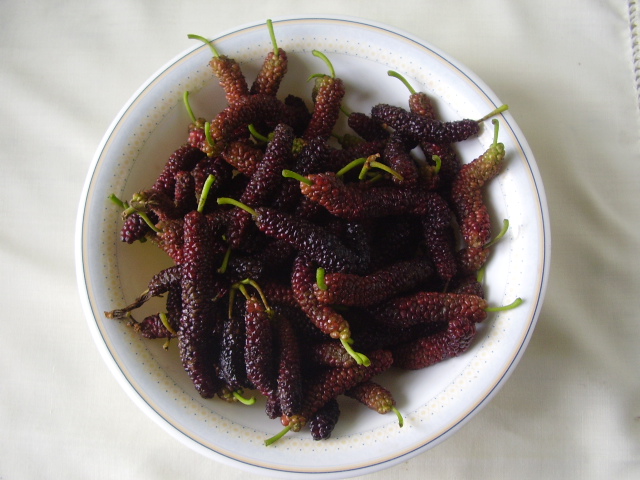 Long MulberryMorus macroura
-
 Indian MulberryMorus indica
- Texas MulberryMorus celtidifolia
- Himalayan MulberryMorus serrata
- Texas MulberryMorus microphylla
- Hua MulberryMorus cathayana
Compare
Questions and answers
What is the scientific name of the Black Mulberry?
The scientific name of the Black Mulberry is Morus nigra. Written with its author, the full name is Morus nigra L..
Which family does the Black Mulberry belong to?
Morus nigra belongs to the family Moraceae, in the order Rosales and the class Magnoliopsida.
Where is the Black Mulberry found?
Checklists and occurrence records place Morus nigra in 73 countries, including Brazil, Romania, Germany, Turkey, Belgium and Russia.
What other names does the Black Mulberry have?
Morus nigra is also known in English as Persian Mulberry.
Can humans eat black mulberries?
Yes. The ripe fruits of Black Mulberry are edible.[13]
Sources
Passages the profile rests on
- Morus nigra is a deciduous tree. Source passage: “Morus nigra is a deciduous tree” — English Wikipedia
- The tree can reach 10 metres in height. Source passage: “growing to 10 metres (33 feet) tall” — English Wikipedia
- Its leaves are generally 10–20 centimetres long. Source passage: “The leaves are 10–20 centimetres (4–8 inches) long” — English Wikipedia
- Its leaves are generally 6–10 centimetres wide. Source passage: “by 6–10 cm (2–4 in) broad” — English Wikipedia
- Leaves on vigorous shoots can reach 23 centimetres in length. Source passage: “up to 23 cm (9 in) long on vigorous shoots” — English Wikipedia
- The leaves have a downy underside and a rough upper surface covered with very short, stiff hairs. Source passage: “downy on the underside, the upper surface rough with very short, stiff hairs.” — English Wikipedia
- Morus nigra can be distinguished from Morus alba by the uniformly hairy lower surface of its leaves. Source passage: “Black mulberry may be distinguished from the white mulberry by the uniformly hairy lower surface of its leaves.” — English Wikipedia
- Its ripe fruits are dark purple to almost black. Source passage: “The fruit is a compound cluster of several small drupes that are dark purple, almost black when ripe” — English Wikipedia
- The fruit consists of clusters of small drupes. Source passage: “The fruit is a compound cluster of several small drupes” — English Wikipedia
- The ripe fruit measures approximately 2.5 centimetres in diameter. Source passage: “they are 2.5 cm (1 in) in diameter.” — English Wikipedia
- The species can grow in almost all soil types except swampy, saline and acidic soils. Source passage: “well adapted to grow in almost all types of soil, except swampy, saline or acidic soils” — pmc.ncbi.nlm.nih.gov
- Nutrient-rich soils with low acidity or neutral pH support good fruit and leaf production. Source passage: “Planting mulberry in nutrient-rich soils with a low acidic or neutral pH will result in the best yield in terms of leaf quality, but also fruit” — pmc.ncbi.nlm.nih.gov
- The ripe fruits are edible. Source passage: “The berries are edible when ripe” — English Wikipedia
- The fruits fall from the tree as soon as they ripen. Source passage: “The fruit falls as soon it ripens” — English Wikipedia
- Existing black mulberry trees may have originated through vegetative propagation and apomictic seed formation. Source passage: “This might be the result of propagation by cuttings and layering complemented by apomictic seed formation.” — English Wikipedia
- Some cultivated varieties of Morus nigra are triploid. Source passage: “many triploid varieties were also found (2n = (3x) = 42)” — pmc.ncbi.nlm.nih.gov
- The cultivars Morus nigra 'Chelsea' and Morus nigra 'Jerusalem' are female and self-fertile. Source passage: “Both cultivars are female (F) and self-fertile.” — English Wikipedia
- Genetic research found no genetic diversity among more than 250 old black mulberry trees sampled in Turkey, Iran and Azerbaijan. Source passage: “Research of genetic diversity of over 250 old black mulberry trees in Turkey, Iran and Azerbaijan has found no genetic diversity.” — English Wikipedia
- The sampled black mulberry trees were considered potentially clonal populations. Source passage: “This suggests that all existing black mulberry trees in the hypothesized area of origin and also elsewhere in the world are clones.” — English Wikipedia
- The species is cultivated for its edible fruits. Source passage: “The fruit is edible and the tree has long been cultivated for this property.” — English Wikipedia
- Black mulberry fruits are used to prepare jams and sherbets in Persia. Source passage: “Often, jams and sherbets are made from the fruit in Persia.” — English Wikipedia
- The fruits contain anthocyanins, flavonols and phenolic acids. Source passage: “In addition to anthocyanins (mainly cyanidin-3-O-glucoside), black mulberry fruits also contain flavonols and phenolic acids.” — pmc.ncbi.nlm.nih.gov
- The leaves contain flavonols including quercetin and kaempferol in glycosylated forms. Source passage: “The leaves are a rich source of flavonols, including quercetin and kaempferol in the glycosylated forms” — pmc.ncbi.nlm.nih.gov
- The leaves contain chlorogenic acid as a predominant phenolic acid. Source passage: “and chlorogenic acid as predominant phenolic acids.” — pmc.ncbi.nlm.nih.gov
- The bark, roots and twigs contain prenylated flavonoids, predominantly morusin. Source passage: “Mulberry bark roots and twigs are a source of prenylated flavonoids, predominantly morusin.” — pmc.ncbi.nlm.nih.gov
- The tree can be planted for street shade and edible landscaping. Source passage: “edible landscaping, street shade” — pmc.ncbi.nlm.nih.gov
- The species can be planted to help reduce environmental and soil pollution. Source passage: “reducing pollution in the environment and soil.” — pmc.ncbi.nlm.nih.gov
- Morus nigra can be confused with black-fruited individuals of Morus alba. Source passage: “particularly black-fruited individuals of the white mulberry.” — English Wikipedia
Data
- Catalogue of Life, 2026-10-16 XR cc by
- Global Biodiversity Information Facility CC BY 4.0
- Wikidata CC0
- GeoNames CC BY 4.0
- Wikimedia Commons per image; credit shown with each image
- Within the Catalogue of Life, this name comes from Synonymic Checklists of the Vascular Plants of the World cc by
References
- L. (1753). Sp. Pl. [Linnaeus] 2: 986 (1753). where the name was published
This species in other databases
- Catalogue of Life 44FTD
- Wikidata Q161040
- iNaturalist 126741
- World Flora Online wfo-0000447931
- GRIN 24619
Page built on 26 November 2026. See how the catalog is made and all sources and licences.
Cite this page
ScientificNames.org. (2026). Morus nigra (Black Mulberry). Retrieved November 26, 2026, from https://scientificnames.org/species/morus-nigra
“Morus nigra (Black Mulberry).” ScientificNames.org, 2026, scientificnames.org/species/morus-nigra. Accessed 26 Nov. 2026.
ScientificNames.org. “Morus nigra (Black Mulberry).” Accessed November 26, 2026. https://scientificnames.org/species/morus-nigra.
@misc{scientificnames_morus_nigra_black_mulberry,
  author = {{ScientificNames.org}},
  title = {Morus nigra (Black Mulberry)},
  year = {2026},
  url = {https://scientificnames.org/species/morus-nigra},
  note = {Accessed 2026-11-26}
}