Species · Birds
Northern Sooty Woodpecker Mulleripicus funebris
The scientific name of the Northern Sooty Woodpecker is Mulleripicus funebris. It is a species of bird in the family Picidae (woodpecker), order Piciformes. The name dates from 1826.
- Scientific name
- Mulleripicus funebris (Valenciennes, 1826)
- Common name
- Northern Sooty Woodpecker
- Genus
- Mulleripicus
- Family
- Picidae (Woodpecker)
- Order
- Piciformes
- Class
- Aves
- Red List category
- NT Near Threatened
- Recorded in
- 2 countries
- Name status
- accepted in the Catalogue of Life

Overview
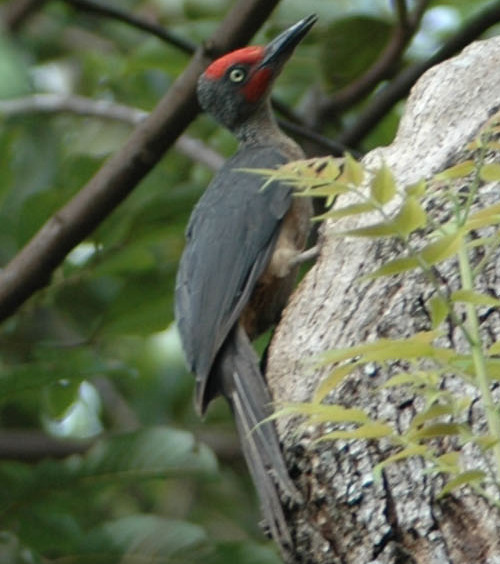
The Northern Sooty Woodpecker is a large woodpecker. It is endemic to Luzon, Marinduque, Catanduanes and the Polillo Islands in the Philippines. It has predominantly black plumage with fine speckling, pale eyes and a yellow bill, while adult males have a bright red face.
Written 27 November 2026 from the sources listed below. Each statement was checked against the passage it cites; statements that could not be supported were removed.
Habitat
The Northern Sooty Woodpecker inhabits tropical moist lowland forests, tropical moist montane forests and foothill forests on Luzon and neighboring islands. It occurs in primary forest and mature secondary forest, typically below 1,000 metres above sea level, but has been recorded at elevations reaching 1,600 metres above sea level.[1][2][3][4]
The nominate subspecies M. f. funebris occurs in central and southern Luzon and Catanduanes. M. f. parkesi occurs on the Polillo Islands, while M. f. mayri occurs in northern Luzon.[5][6][7]
Diet
The species is presumed to feed on invertebrates, including larvae found in dead wood.[8]
Behaviour
The Northern Sooty Woodpecker forages in the upper storeys of tall trees and also in the forest understorey, on tree trunks and on large limbs. It is typically encountered alone or in pairs.[9][10][11]
The species produces a loud whistle-like trill and a powerful drumroll consisting of accelerating knocks when pecking wood.[12][13]
Reproduction and life cycle
The reported breeding season extends from March to May. The species nests in holes in trees.[14][15]
Conservation
The IUCN has assessed the Northern Sooty Woodpecker as Near Threatened. Its population trend is decreasing, and habitat loss is identified as the main threat.[16][17][18]
The IUCN Red List assessment for the species was most recently conducted in 2024.[19]
Similar species
The Northern Sooty Woodpecker has darker gray plumage and smaller white spots on its neck and face than the Southern Sooty Woodpecker. It is larger than the Southern Sooty Woodpecker.[20][21]
The Northern and Southern Sooty Woodpeckers were formerly treated as subspecies of a single species called the Sooty Woodpecker. The IOC recognized them as distinct species in 2021.[22][23]
Mulleripicus funebris and M. fuliginosus were previously treated together as M. funebris.[24]
Appearance
The Northern Sooty Woodpecker has predominantly black plumage, fine speckling on its head and neck, pale eyes and a yellow bill. It has a long, pointed tail.[25][26][27]
Adult males have a bright red face, with burgundy markings extending across the entire face. Juveniles are browner and have more conspicuous spotting than adults.[28][29][30]
The Polillo Islands subspecies M. f. parkesi has less extensive red facial coloration that does not reach the forecrown. It is slightly larger than the nominate subspecies.[31][32]
The Northern Luzon subspecies M. f. mayri has a longer bill and tail and a yellowish-gray bill.[33]
Classification of the Northern Sooty Woodpecker
| Kingdom | Animalia |
|---|---|
| Phylum | Chordata |
| Subphylum | Vertebrata |
| Infraphylum | Gnathostomata |
| Parvphylum | Osteichthyes |
| Megaclass | Tetrapoda |
| Class | Aves (Bird) |
| Order | Piciformes (Woodpeckers) |
| Family | Picidae (Woodpecker) |
| Subfamily | Picinae |
| Genus | Mulleripicus (Large Asian Woodpeckers) |
| Species | Mulleripicus funebris (Valenciennes, 1826) |
Where the Northern Sooty Woodpecker is found
Checklists and occurrence records place Mulleripicus funebris in 2 countries across Asia. GBIF holds 1,832 georeferenced records of it.
Countries
Regions and cities with the most records
- Olongapo, Philippines 1,150
- Morong, Philippines 1,149
- Subic, Philippines 1,136
- Castillejos, Philippines 437
- Dinalupihan, Philippines 198
- Bislig, Philippines 44
- Recodo, Philippines 44
- Zamboanga, Philippines 44
- General Emilio Aguinaldo, Philippines 36
- Maragondon, Philippines 36
- Naic, Philippines 36
- Ternate, Philippines 36
- Pagbilao, Philippines 24
- Atimonan, Philippines 23
- Tagbina, Philippines 23
- Calauan, Philippines 20
- Del Remedio, Philippines 20
- San Pablo, Philippines 20
- Hinatuan, Philippines 18
- Hermosa, Philippines 17
- Nasugbu, Philippines 16
- Alaminos, Philippines 14
- Nagcarlan, Philippines 14
- Balanga, Philippines 13
- Bay, Philippines 11
- Cabuyao, Philippines 11
- Calamba, Philippines 11
- Los Baños, Philippines 11
- Lucban, Philippines 11
- Malvar, Philippines 11
- Mamatid, Philippines 11
- Santo Tomas, Philippines 11
- Tanauan, Philippines 11
- Victoria, Philippines 11
- Lilio, Philippines 10
- Majayjay, Philippines 10
Range as the checklists state it
Southern Asia
A number beside a place is its count of GBIF occurrence records. A place without a number comes from a checklist alone. Records show where a species has been observed or collected, which can include escapes and vagrants.
Common names
English
- Northern Sooty Woodpecker
- Northern Sooty-Woodpecker
- Sooty Woodpecker
Names in 25 other languages
- Arabic
- نقار الخشب الأسخم الشمالي
- Catalan
- picot fuliginós septentrional
- Chinese
- 乌啄木鸟, 北方烏黑啄木
- Croatian
- filipinska žuna
- Czech
- datel sazový
- Danish
- Sodfarvet Myrespætte
- Dutch
- Treurspecht, Zwarte Treurspecht
- Esperanto
- funebra pego
- Estonian
- filipiini suurrähn
- Finnish
- nokihelmitikka
- French
- Pic en deuil
- German
- Luzonspecht, Philippinen-Specht, Philippinenspecht
- Italian
- Picchio fuligginoso, Picchio fuligginoso settentrionale
- Japanese
- キタクロボウシゲラ
- Lithuanian
- filipininis pilkasis genys
- Norwegian
- sotspett
- Polish
- mohun czarniawy
- Portuguese
- pica-pau-filipino-nortenho, pica-troncos-enlutado
- Russian
- Филиппинская желна, Филиппинский мюллеров дятел
- Serbian
- Severni čađavi detlić
- Slovak
- klopár tmavý
- Spanish
- Picatroncos filipino, Picatroncos filipino norteño
- Swedish
- sorgspett
- Turkish
- Kuzey Filipin Ağaçkakanı
- Ukrainian
- торомба філіпінська
Synonyms
One other scientific name has been used for this species and is now treated as a synonym of Mulleripicus funebris.
- Picus funebris Valenciennes, A, 1826
Subspecies and varieties
- Mulleripicus funebris fuliginosus (Southern Sooty Woodpecker) subspecies
- Mulleripicus funebris funebris subspecies
- Mulleripicus funebris mayri subspecies
- Mulleripicus funebris parkesi subspecies
Related species
-
 Great Slaty WoodpeckerMulleripicus pulverulentus
-
 Ashy WoodpeckerMulleripicus fulvus
- Northern FlickerColaptes auratus
-
 Pileated WoodpeckerDryocopus pileatus
-
 Ivory-billed WoodpeckerCampephilus principalis
-
 Downy WoodpeckerDryobates pubescens
-
 Red-bellied WoodpeckerMelanerpes carolinus
-
 Great Spotted WoodpeckerDendrocopos major
Compare
Questions and answers
What is the scientific name of the Northern Sooty Woodpecker?
The scientific name of the Northern Sooty Woodpecker is Mulleripicus funebris. Written with its author, the full name is Mulleripicus funebris (Valenciennes, 1826).
Which family does the Northern Sooty Woodpecker belong to?
Mulleripicus funebris belongs to the family Picidae, in the order Piciformes and the class Aves.
Where is the Northern Sooty Woodpecker found?
Checklists and occurrence records place Mulleripicus funebris in 2 countries: Philippines and Indonesia.
What is the conservation status of the Northern Sooty Woodpecker?
The IUCN Red List category recorded for Mulleripicus funebris is Near Threatened (NT).
What other names does the Northern Sooty Woodpecker have?
Mulleripicus funebris is also known in English as Northern Sooty-Woodpecker and Sooty Woodpecker.
Sources
Passages the profile rests on
- The species inhabits tropical moist lowland forests and tropical moist montane forests. Source passage: “Its natural habitats are tropical moist lowland forests and tropical moist montane forests.” — English Wikipedia
- The species occurs in foothill forests on Luzon and neighboring islands. Source passage: “A large woodpecker of foothill forest on Luzon and neighboring islands.” — ebird.org
- The species occurs in primary forest and mature secondary forest, typically below 1,000 metres above sea level. Source passage: “Found in primary forest, mature secondary forest typically in below 1,000 masl” — English Wikipedia
- The species has been recorded at elevations reaching 1,600 metres above sea level. Source passage: “but has been seen as high as 1,600masl.” — English Wikipedia
- The nominate subspecies M. f. funebris occurs in central and southern Luzon and Catanduanes. Source passage: “M. f. funebris – Found on Central and Southern Luzon and Catanduanes” — English Wikipedia
- The subspecies M. f. parkesi occurs on the Polillo Islands. Source passage: “M. f. parkesi – Found on Polillo Islands” — English Wikipedia
- The subspecies M. f. mayri occurs in northern Luzon. Source passage: “M. f. mayri – Found on Northern Luzon” — English Wikipedia
- The species is presumed to feed on invertebrates, including larvae found in dead wood. Source passage: “it is presumed to feed on invertebrates including larvae feeding on dead wood.” — English Wikipedia
- The species forages in the upper storeys of tall trees. Source passage: “Forages in upper storeys in tall trees” — English Wikipedia
- The species also forages in the forest understorey, on tree trunks and on large limbs. Source passage: “but also goes down to the understorey, on tree trunks and large limbs.” — English Wikipedia
- The species is typically encountered alone or in pairs. Source passage: “It is typically found singly or as a pair.” — English Wikipedia
- The species produces a loud whistle-like trill. Source passage: “Its voice is described as a loud whistle like trill.” — English Wikipedia
- The species produces a powerful drumroll consisting of accelerating knocks when pecking wood. Source passage: “It also has a drumroll from pecking wood which is described as a powerful and accelerating series of knocks.” — English Wikipedia
- The reported breeding season extends from March to May. Source passage: “The breeding season is reported as March to May” — English Wikipedia
- The species nests in holes in trees. Source passage: “it nests in holes in trees.” — English Wikipedia
- The IUCN has assessed the Northern Sooty Woodpecker as Near Threatened. Source passage: “IUCN has assessed this bird as a near-threatened species” — English Wikipedia
- The species has a decreasing population trend. Source passage: “with the population said to be decreasing.” — English Wikipedia
- Habitat loss is identified as the main threat to the species. Source passage: “This species' main threat is habitat loss.” — English Wikipedia
- The IUCN Red List assessment for this species was most recently conducted in 2024. Source passage: “Northern Sooty Woodpecker Mulleripicus funebris has most recently been assessed for The IUCN Red List of Threatened Species in 2024.” — iucnredlist.org
- The species has darker gray plumage and smaller white spots on its neck and face than the Southern Sooty Woodpecker. Source passage: “The Northern sooty differs from the Southern sooty with its darker gray plumage, the male's burgundy markings over its entire face, smaller white spots on its neck and face” — English Wikipedia
- The Northern Sooty Woodpecker is larger than the Southern Sooty Woodpecker. Source passage: “and larger size in comparison to its Southern counterpart's light gray plumage” — English Wikipedia
- The Northern and Southern Sooty Woodpeckers were formerly treated as subspecies of a single species called the Sooty Woodpecker. Source passage: “Both the southern sooty woodpecker and the northern sooty woodpecker were previously considered to be subspecies of the same species, Mulleripicus funebris, known simply as the "sooty woodpecker".” — English Wikipedia
- The Northern and Southern Sooty Woodpeckers were recognized as distinct species by the IOC in 2021. Source passage: “They were split as distinct species by the IOC in 2021.” — English Wikipedia
- Mulleripicus funebris and M. fuliginosus were previously treated together as M. funebris. Source passage: “Mulleripicus funebris and M. fuliginosus (del Hoyo and Collar 2014) were previously lumped as M. funebris following Sibley and Monroe (1990, 1993). Taxonomic ...” — datazone.birdlife.org
- The species has predominantly black plumage with fine speckling on its head, pale eyes and a yellow bill. Source passage: “This species is primarily black with fine speckling on the head. It has pale eyes and an yellow bill.” — English Wikipedia
- The species has a long, pointed tail. Source passage: “Entirely black with a long pointed tail, fine speckling on the neck, pale eyes,” — ebird.org
- The species has fine speckling on its neck. Source passage: “fine speckling on the neck” — ebird.org
- Adult males have a bright red face, distinguishing them from females. Source passage: “This species exhibits sexual dimorphism in which the male has a bright red face.” — English Wikipedia
- Juveniles are browner and have more conspicuous spotting than adults. Source passage: “Juveniles are slightly more brown with more apparent spotting.” — English Wikipedia
- Males have burgundy markings extending across the entire face. Source passage: “the male's burgundy markings over its entire face” — English Wikipedia
- The Polillo Islands subspecies M. f. parkesi is slightly larger than the nominate subspecies. Source passage: “M. f. parkesi – Found on Polillo Islands; slightly larger, lesser extent of red on face not reaching the forecrown” — English Wikipedia
- The Polillo Islands subspecies has less extensive red facial coloration that does not reach the forecrown. Source passage: “lesser extent of red on face not reaching the forecrown” — English Wikipedia
- The Northern Luzon subspecies M. f. mayri has a longer bill and tail and a yellowish-gray bill. Source passage: “M. f. mayri – Found on Northern Luzon; longer bill and tail and yellowish gray bill” — English Wikipedia
Data
- Catalogue of Life, 2026-10-16 XR cc by
- Global Biodiversity Information Facility CC BY 4.0
- Wikidata CC0
- GeoNames CC BY 4.0
- Wikimedia Commons per image; credit shown with each image
- Within the Catalogue of Life, this name comes from The Integrated Taxonomic Information System cc0
References
- Gill, Frank, & and Minturn Wright. (2006). Birds of the World: Recommended English Names.
This species in other databases
Page built on 30 November 2026. See how the catalog is made and all sources and licences.
Cite this page
ScientificNames.org. (2026). Mulleripicus funebris (Northern Sooty Woodpecker). Retrieved November 30, 2026, from https://scientificnames.org/species/mulleripicus-funebris
“Mulleripicus funebris (Northern Sooty Woodpecker).” ScientificNames.org, 2026, scientificnames.org/species/mulleripicus-funebris. Accessed 30 Nov. 2026.
ScientificNames.org. “Mulleripicus funebris (Northern Sooty Woodpecker).” Accessed November 30, 2026. https://scientificnames.org/species/mulleripicus-funebris.
@misc{scientificnames_mulleripicus_funebris_northern_sooty_woodpecker,
  author = {{ScientificNames.org}},
  title = {Mulleripicus funebris (Northern Sooty Woodpecker)},
  year = {2026},
  url = {https://scientificnames.org/species/mulleripicus-funebris},
  note = {Accessed 2026-11-30}
}