Species · Birds
Great Slaty Woodpecker Mulleripicus pulverulentus
The scientific name of the Great Slaty Woodpecker is Mulleripicus pulverulentus. It is a species of bird in the family Picidae (woodpecker), order Piciformes. The name dates from 1826.
- Scientific name
- Mulleripicus pulverulentus (Temminck, 1826)
- Common name
- Great Slaty Woodpecker
- Genus
- Mulleripicus
- Family
- Picidae (Woodpecker)
- Order
- Piciformes
- Class
- Aves
- Red List category
- VU Vulnerable
- Recorded in
- 15 countries
- Name status
- accepted in the Catalogue of Life

Overview
Mulleripicus pulverulentus occurs across the Indian subcontinent and Southeast Asia. It is the largest confirmed living woodpecker species.
Written 26 November 2026 from the sources listed below. Each statement was checked against the passage it cites; statements that could not be supported were removed.
Appearance
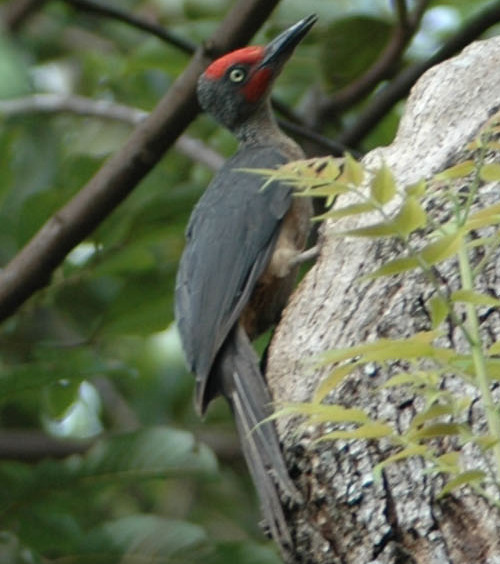
The Great Slaty Woodpecker has predominantly dark grey or blackish slate-grey plumage with small white spots on its head and neck. Its throat is paler grey to yellowish, and adult males have a small red moustache.[1][2][3]
It has a long, strong, chisel-tipped bill, an elongated neck and a long tail. A slight crest is occasionally visible.[4][5]
The species measures 45–55 cm in length and weighs between 360 and 563 g. One study reported an average body weight of 430 g.[6][7][8]
Its wing chord measures 21.5–25 cm, its tail 13.4–16.2 cm, its bill 6–6.5 cm and its tarsus 3.6–4.1 cm.[9][10][11][12]
Habitat
The Great Slaty Woodpecker primarily inhabits primary semi-open, moist deciduous and tropical evergreen forests. It occasionally enters adjacent secondary forests and clearings containing scattered tall trees.[13][14]
It locally prefers extensive stands of dipterocarp and teak trees. It also occurs in mature sal forests, swamp forests and mangroves containing tall mature trees.[15][16]
The species usually occurs below 600 m elevation but locally reaches 1,100 m and occasionally 2,000 m. In Nepal and India, it favours climax sal, broadleaved and sub-Himalayan moist deciduous forests.[17][18]
Diet
The Great Slaty Woodpecker feeds on social insects, including ants, termites, wood-boring beetles and stingless bees. Ants are generally favoured in its diet.[19][20]
It also regularly consumes insect larvae, while small fruits occasionally supplement its diet.[21][22]
Behaviour
The Great Slaty Woodpecker is usually observed in groups of three to six individuals. These groups generally comprise a breeding pair and their offspring from previous years.[23][24]
Females spend more time searching for food sources, whereas males spend more time opening them. The species usually forages on large branches and trunks of large living trees.[25][26]
Foraging groups generally do not remain in one area for long. The species forages by gleaning, probing, pecking, removing bark and hammering into wood, with gleaning being its most important method.[27][28][29]
The species frequently flies high above trees over long distances between feeding areas. Breeding pairs roost in separate tree holes and regularly call to maintain contact.[30][31]
The pair bond appears to last throughout life.[32]
Reproduction and life cycle
The Great Slaty Woodpecker occasionally raises nests cooperatively in groups. It nests in very large trees, with known nests recorded at heights of 9–45 m.[33][34][35]
Both parents participate in excavating the nest cavity, although the male reportedly performs most of the work. The cavity entrance is approximately 10 cm across.[36][37]
In Malaysia, the nesting season appears to extend from March through August. The species reportedly lays clutches of two to four eggs.[38][39]
Both parents incubate the eggs and feed and brood the young. Young birds probably remain with their parents until the following breeding season.[40][41]
Conservation
The Great Slaty Woodpecker was classified as Vulnerable on the IUCN Red List in 2010. It is classified as Endangered in Nepal's National Red List.[42][43]
The global population is declining because of forest-cover loss and logging of old-growth forests. The species experiences density reductions exceeding 80% in logged forests.[44][45]
In a western Nepal survey conducted from 2019 to 2021, researchers recorded 81 individuals across 14 transects. Of these, 66 were inside protected areas and 15 were outside them.[46][47]
Cavity trees used by the species in the western Nepal study had an average diameter at breast height of 61.26 cm. The estimated suitable habitat for the species in Nepal covers approximately 6,738 km².[48][49]
A significant portion of the species' suitable habitat in Nepal lies outside protected areas. Selective logging threatens its habitat in community forests and areas outside protected areas in Nepal.[50][51]
Uses
The Great Slaty Woodpecker is described as an indicator species and a facilitator of biodiversity through its cavity-excavating behaviour.[52]
Classification of the Great Slaty Woodpecker
| Kingdom | Animalia |
|---|---|
| Phylum | Chordata |
| Subphylum | Vertebrata |
| Infraphylum | Gnathostomata |
| Parvphylum | Osteichthyes |
| Megaclass | Tetrapoda |
| Class | Aves (Bird) |
| Order | Piciformes (Woodpeckers) |
| Family | Picidae (Woodpecker) |
| Subfamily | Picinae |
| Genus | Mulleripicus (Large Asian Woodpeckers) |
| Species | Mulleripicus pulverulentus (Temminck, 1826) |
Where the Great Slaty Woodpecker is found
Checklists and occurrence records place Mulleripicus pulverulentus in 15 countries across Asia. GBIF holds 9,871 georeferenced records of it.
Countries
- Bangladesh 27
- Bhutan 4
- Brunei 27
- Cambodia 1,275
- China 243
- India 1,955
- Indonesia 281
- Laos 13
- Malaysia 2,893
- Myanmar 127
- Nepal 356
- Philippines 575
- Singapore 151
- Thailand 1,639
- Vietnam 305
Regions and cities with the most records
- Uttarakhand, India 1,388
- Sabah, Malaysia 1,250
- Preah Vihear, Cambodia 1,024
- Phetchaburi, Thailand 807
- Pahang, Malaysia 770
- Rāmnagar, India 586
- Kedah, Malaysia 455
- Naini Tāl, India 345
- Assam, India 258
- Dong Nai, Vietnam 246
- Yunnan, China 224
- Johor, Malaysia 173
- Guwahati, India 171
- North Guwāhāti, India 171
- Ṭikāpur, Nepal 162
- Uttar Pradesh, India 153
- Kotdwāra, India 149
- Sandakan, Malaysia 148
- Yew Tee, Singapore 145
- Bukit Panjang New Town, Singapore 144
- Bukit Timah, Singapore 144
- Choa Chu Kang New Town, Singapore 144
- Keat Hong Village, Singapore 144
- Marsiling, Singapore 144
- Teck Whye, Singapore 144
- Woodlands, Singapore 144
- Anak Bukit, Singapore 143
- Johor Bahru, Malaysia 143
- Jurong East, Singapore 143
- Jurong Town, Singapore 143
- Queenstown Estate, Singapore 143
- Eunos, Singapore 142
- Jurong West, Singapore 142
- MacPherson, Singapore 142
- Marine Parade, Singapore 142
- Novena, Singapore 142
Range as the checklists state it
Southern Asia
A number beside a place is its count of GBIF occurrence records. A place without a number comes from a checklist alone. Records show where a species has been observed or collected, which can include escapes and vagrants.
Common names
English
- Great Slaty Woodpecker
Names in 29 other languages
- Arabic
- نقار الخشب الأسخم الكبير
- Catalan
- picot pissarrós
- Chinese
- 大灰啄木, 大灰啄木鳥, 大灰啄木鸟
- Croatian
- dugovrata žuna
- Czech
- datel břidlicový
- Danish
- Stor Myrespætte
- Dutch
- Poederspecht
- Esperanto
- ardeza pego
- Estonian
- hall-suurrähn
- Finnish
- isohelmitikka
- French
- Pic meunier
- German
- Puderspecht
- Hindi
- बड़ी स्लेट वुडपीकर
- Hungarian
- szürke púderharkály
- Indonesian
- Pelatuk kelabu-besar
- Italian
- Picchio ardesia, Picchio polveroso
- Japanese
- ボウシゲラ
- Lithuanian
- didysis pilkasis genys
- Norwegian
- skiferspett
- Polish
- mohun wielki
- Portuguese
- pica-pau-ardósia, pica-troncos-ardósia
- Russian
- Большой мюллеров дятел, Серая желна
- Slovak
- klopár bridlicový
- Spanish
- Picatroncos pizarroso
- Swedish
- skifferspett
- Thai
- นกหัวขวานใหญ่สีเทา
- Turkish
- Büyük Gri Ağaçkakan
- Ukrainian
- торомба велика
- Welsh
- cnocell lwyd fawr
Synonyms
2 other scientific names have been used for this species and are now treated as synonyms of Mulleripicus pulverulentus.
- Dryocopus pulverulentus Temminck, CJ, 1826
- Picus pulverulentus Temminck, CJ, 1826
Subspecies and varieties
- Mulleripicus pulverulentus harterti subspecies
- Mulleripicus pulverulentus mohun subspecies
- Mulleripicus pulverulentus pulverulentus subspecies
Related species
-
 Ashy WoodpeckerMulleripicus fulvus
-
 Northern Sooty WoodpeckerMulleripicus funebris
- Northern FlickerColaptes auratus
-
 Pileated WoodpeckerDryocopus pileatus
-
 Ivory-billed WoodpeckerCampephilus principalis
-
 Downy WoodpeckerDryobates pubescens
-
 Red-bellied WoodpeckerMelanerpes carolinus
-
 Great Spotted WoodpeckerDendrocopos major
Compare
Questions and answers
What is the scientific name of the Great Slaty Woodpecker?
The scientific name of the Great Slaty Woodpecker is Mulleripicus pulverulentus. Written with its author, the full name is Mulleripicus pulverulentus (Temminck, 1826).
Which family does the Great Slaty Woodpecker belong to?
Mulleripicus pulverulentus belongs to the family Picidae, in the order Piciformes and the class Aves.
Where is the Great Slaty Woodpecker found?
Checklists and occurrence records place Mulleripicus pulverulentus in 15 countries, including Malaysia, India, Thailand, Cambodia, Philippines and Nepal.
What is the conservation status of the Great Slaty Woodpecker?
The IUCN Red List category recorded for Mulleripicus pulverulentus is Vulnerable (VU).
Sources
Passages the profile rests on
- The species has predominantly dark grey or blackish slate-grey plumage with small white spots on its head and neck. Source passage: “The plumage is almost entirely dark grey or blackish slate-grey, overlaid with small white spots on the head and neck.” — English Wikipedia
- The species has a paler grey to yellowish throat. Source passage: “The throat is paler grey to yellowish” — English Wikipedia
- Adult males have a small red moustache. Source passage: “males have small red moustache.” — English Wikipedia
- The species has a long, strong, chisel-tipped bill, an elongated neck and a long tail. Source passage: “a very long, strong chisel-tipped bill, an elongated neck, and a long tail.” — English Wikipedia
- A slight crest is occasionally visible. Source passage: “A slight crest may occasionally be evident.” — English Wikipedia
- The species measures 45–55 cm in length. Source passage: “at 45–55 cm (18–22 in) long” — English Wikipedia
- The species weighs between 360 and 563 g. Source passage: “a weight of 360–563 g (0.794–1.241 lb)” — English Wikipedia
- The average body weight reported in one study was 430 g. Source passage: “The average weight was claimed in one study as 430 g (15 oz).” — English Wikipedia
- The species has a wing chord measuring 21.5–25 cm. Source passage: “the wing chord is 21.5 to 25 cm (8.5 to 9.8 in)” — English Wikipedia
- The species has a tail measuring 13.4–16.2 cm. Source passage: “the tail is 13.4 to 16.2 cm (5.3 to 6.4 in)” — English Wikipedia
- The species has a bill measuring 6–6.5 cm. Source passage: “the bill is 6 to 6.5 cm (2.4 to 2.6 in)” — English Wikipedia
- The species has a tarsus measuring 3.6–4.1 cm. Source passage: “the tarsus is 3.6 to 4.1 cm (1.4 to 1.6 in).” — English Wikipedia
- The species primarily inhabits primary semi-open, moist deciduous and tropical evergreen forests. Source passage: “areas of primary semi-open, moist deciduous and tropical evergreen forest” — English Wikipedia
- The species occasionally enters adjacent secondary forests and clearings containing scattered tall trees. Source passage: “can on occasion range into adjacent secondary forests, clearings with scattered tall trees” — English Wikipedia
- The species locally prefers extensive stands of dipterocarp and teak trees. Source passage: “prefers sprawling stands of dipterocarp and teak trees.” — English Wikipedia
- The species also occurs in mature sal forests, swamp forests and mangroves containing tall mature trees. Source passage: “Also found in mature sal forests, swamp forest and mangroves with tall, mature trees.” — English Wikipedia
- The species usually occurs below 600 m elevation but locally reaches 1,100 m and occasionally 2,000 m. Source passage: “The species usually occurs below an elevation of 600 m (2,000 ft), but also locally in montane areas of up to 1,100 m (3,600 ft), occasionally ranging up to 2,000 m (6,600 ft).” — English Wikipedia
- In Nepal and India, the species favours climax sal, broadleaved and sub-Himalayan moist deciduous forests. Source passage: “favouring climax Sal ( Shorea robusta ) and broadleaved and sub-Himalayan moist deciduous forests in Nepal and India” — pmc.ncbi.nlm.nih.gov
- The species feeds on social insects including ants, termites, wood-boring beetles and stingless bees. Source passage: “nests of social insects such as ants, termites, wood-boring beetles and stingless bees.” — English Wikipedia
- Ants are generally favoured in the species' diet. Source passage: “Ants seem to be generally favoured in the diet” — English Wikipedia
- The species also regularly consumes insect larvae. Source passage: “though larvae of other species may be eaten quite regularly as well.” — English Wikipedia
- Small fruits occasionally supplement the species' diet. Source passage: “Occasionally, small fruit may supplement the diet.” — English Wikipedia
- The species is usually observed in groups of three to six individuals. Source passage: “Great slaty woodpeckers are mostly seen in groups consisting of 3 to 6 individuals” — English Wikipedia
- Its groups generally comprise a breeding pair and their offspring from previous years. Source passage: “which consist of a breeding pair and their young from prior years.” — English Wikipedia
- Females spend more time searching for food sources, whereas males spend more time opening them. Source passage: “Females spend more time searching for feeding sources and males, which have slightly larger bills, spend more time opening the sources.” — English Wikipedia
- The species usually forages on large branches and trunks of large living trees. Source passage: “Preferred feeding sources are mostly found in large branches or trunks of large, living trees.” — English Wikipedia
- Foraging groups generally do not remain in one area for long. Source passage: “Usually, feeding groups of these woodpeckers do not linger in any given area for long.” — English Wikipedia
- The species forages by gleaning, probing, pecking, removing bark and hammering into wood. Source passage: “It forages by gleaning, probing, pecking, prising off bark and hammering with powerful and loud blows to excavate the wood.” — English Wikipedia
- Gleaning is the species' most important foraging method. Source passage: “Gleaning is the most important foraging method for the species” — English Wikipedia
- The species frequently flies high above trees over long distances between feeding areas. Source passage: “This species often flies high over the trees for long distances between successful foraging patches.” — English Wikipedia
- Breeding pairs roost in separate tree holes and regularly call to maintain contact. Source passage: “breeding pairs roost in separate tree holes but regularly call to stay in contact.” — English Wikipedia
- The pair bond appears to last throughout life. Source passage: “The pair bond appears to be lifelong.” — English Wikipedia
- The species occasionally raises nests cooperatively in groups. Source passage: “but at least occasionally nests are raised cooperatively by groups.” — English Wikipedia
- Known nests have been recorded at heights of 9–45 m in trees. Source passage: “Known nests, at anywhere from 9 to 45 m (30 to 148 ft) in height in the trees” — English Wikipedia
- The species nests in very large trees. Source passage: “are located in very large trees.” — English Wikipedia
- Both parents participate in excavating the nest cavity, although the male reportedly performs most of the work. Source passage: “both parents participate but reportedly the male does the majority of the work.” — English Wikipedia
- The nest cavity entrance is approximately 10 cm across. Source passage: “The nest hole entrance will be around 10 cm (3.9 in) across” — English Wikipedia
- In Malaysia, the nesting season appears to extend from March through August. Source passage: “The nesting season, in Malaysia at least, appears to be from March to August.” — English Wikipedia
- The species reportedly lays clutches of two to four eggs. Source passage: “The clutch reportedly consists of two to four eggs” — English Wikipedia
- Both parents incubate the eggs and feed and brood the young. Source passage: “which are incubated by both parents. Both parents also feed and generally brood the young.” — English Wikipedia
- Young birds probably remain with their parents until the following breeding season. Source passage: “The young great slaty woodpeckers probably stay with their parents until the next breeding season.” — English Wikipedia
- The species was classified as Vulnerable on the IUCN Red List in 2010. Source passage: “In 2010, the great slaty woodpecker was included in the IUCN Red List in the Vulnerable category.” — English Wikipedia
- The species is classified as Endangered in Nepal's National Red List. Source passage: “it is classified as “Vulnerable” on the IUCN Red List and “Endangered” in Nepal's National Red List” — pmc.ncbi.nlm.nih.gov
- The global population is declining because of forest-cover loss and logging of old-growth forests. Source passage: “The global population is in decline because of the loss of forest cover and logging of old-growth forest throughout its range” — English Wikipedia
- The species experiences density reductions exceeding 80% in logged forests. Source passage: “show density reductions of over 80% in logged forests.” — English Wikipedia
- In a western Nepal survey conducted from 2019 to 2021, researchers recorded 81 individuals across 14 transects. Source passage: “A total of 81 individuals were recorded across 14 transects” — pmc.ncbi.nlm.nih.gov
- In the western Nepal survey, 66 recorded individuals were inside protected areas and 15 were outside them. Source passage: “with 66 individuals within protected areas and 15 outside.” — pmc.ncbi.nlm.nih.gov
- Cavity trees used by the species in the western Nepal study had an average diameter at breast height of 61.26 cm. Source passage: “with an average DBH of 61.26 cm for cavity trees where woodpeckers excavated cavities.” — pmc.ncbi.nlm.nih.gov
- The estimated suitable habitat for the species in Nepal covers approximately 6,738 km². Source passage: “the total suitable habitat for the species in Nepal is approximately 6738 km2” — pmc.ncbi.nlm.nih.gov
- A significant portion of the species' suitable habitat in Nepal lies outside protected areas. Source passage: “with a significant portion located outside protected areas.” — pmc.ncbi.nlm.nih.gov
- Selective logging threatens the species' habitat in community forests and areas outside protected areas in Nepal. Source passage: “The habitat in community forests and outside protected areas is particularly vulnerable to selective logging” — pmc.ncbi.nlm.nih.gov
- The species is described as an indicator species and a facilitator of biodiversity through its cavity-excavating behaviour. Source passage: “serving as both an indicator species and a facilitator of biodiversity through its cavity-excavating behaviour” — pmc.ncbi.nlm.nih.gov
Data
- Catalogue of Life, 2026-10-16 XR cc by
- Global Biodiversity Information Facility CC BY 4.0
- Wikidata CC0
- GeoNames CC BY 4.0
- Wikimedia Commons per image; credit shown with each image
- Within the Catalogue of Life, this name comes from The Integrated Taxonomic Information System cc0
References
- Gill, Frank, & and Minturn Wright. (2006). Birds of the World: Recommended English Names.
This species in other databases
Page built on 28 November 2026. See how the catalog is made and all sources and licences.
Cite this page
ScientificNames.org. (2026). Mulleripicus pulverulentus (Great Slaty Woodpecker). Retrieved November 28, 2026, from https://scientificnames.org/species/mulleripicus-pulverulentus
“Mulleripicus pulverulentus (Great Slaty Woodpecker).” ScientificNames.org, 2026, scientificnames.org/species/mulleripicus-pulverulentus. Accessed 28 Nov. 2026.
ScientificNames.org. “Mulleripicus pulverulentus (Great Slaty Woodpecker).” Accessed November 28, 2026. https://scientificnames.org/species/mulleripicus-pulverulentus.
@misc{scientificnames_mulleripicus_pulverulentus_great_slaty_woodpecker,
  author = {{ScientificNames.org}},
  title = {Mulleripicus pulverulentus (Great Slaty Woodpecker)},
  year = {2026},
  url = {https://scientificnames.org/species/mulleripicus-pulverulentus},
  note = {Accessed 2026-11-28}
}