Species · Mammals
Fea's Muntjac Muntiacus feae
The scientific name of the Fea's Muntjac is Muntiacus feae. It is a species of mammal in the family Cervidae (deer), order Artiodactyla. The name dates from 1889.
- Scientific name
- Muntiacus feae (Thomas & Doria, 1889)
- Common name
- Fea's Muntjac
- Genus
- Muntiacus
- Family
- Cervidae (Deer)
- Order
- Artiodactyla
- Class
- Mammalia
- Red List category
- DD Data Deficient
- Recorded in
- 2 countries
- Name status
- accepted in the Catalogue of Life

Overview
Muntiacus feae is native to southern Myanmar and Thailand and occurs along the border between Myanmar and Thailand. It has a coat ranging from brown and dark orange to gray, black limbs and posterior tail, and relatively long tails fringed with white hair.
Written 26 November 2026 from the sources listed below. Each statement was checked against the passage it cites; statements that could not be supported were removed.
Appearance
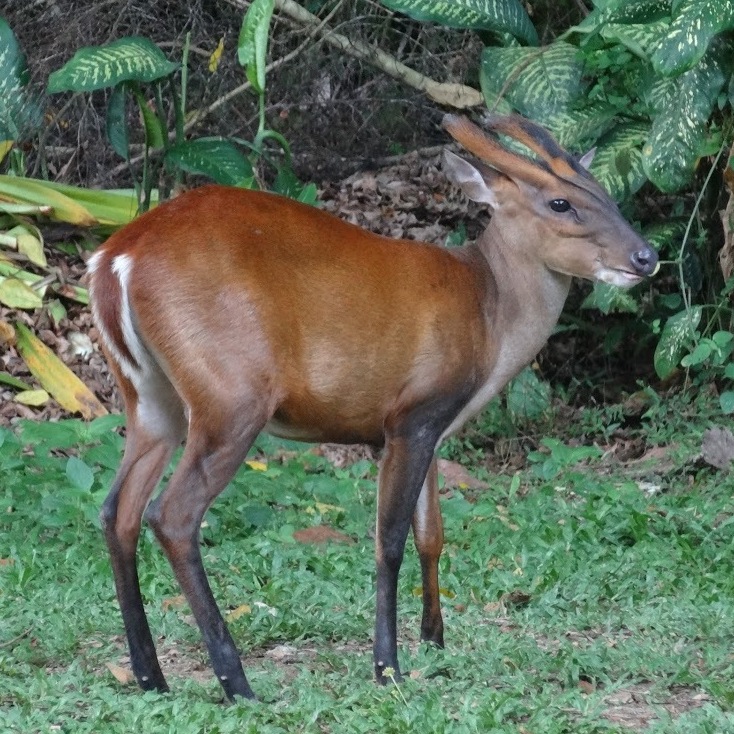
Fea's Muntjac has a coat that ranges from brown and dark orange to gray. Its limbs and posterior tail are black, and a light yellowish triangular marking extends from its forehead.[1][2][3]
Dark fur runs from its muzzle to the orbital glands beneath its eyes. Two black lines extend downward from its horns, and its relatively long tails are fringed with white hair.[4][5][6]
Its forehead has tufts of hair that may be lighter in color. Males have elongated antler pedicles that converge, with a black line running along the center of each.[7][8]
Male Fea's Muntjacs have tusk-like canine teeth measuring 1–2 cm in length.[9]
Habitat
Fea's Muntjacs predominantly inhabit evergreen forests and prefer moist subtropical forests. Their habitats also include teak forests.[10][11][12]
They occur at elevations below 1,500 meters and are more prevalent in wetter forests than in drier forests. They rarely leave dense vegetation to forage in fields.[13][14][15]
Diet
Fea's Muntjacs feed on fruits, leaves, herbs, bark, and mushrooms.[16][17]
Their diet may also include bird eggs, young birds, and small mammals.[18]
Behaviour
Fea's Muntjacs are generally solitary and nocturnal. Foraging occurs primarily at night.[19][20][21]
When startled, they escape through agile jumps along established trails. They produce barking sounds when startled by predators.[22][23]
Males may compete for females through antler sparring or fights using their canine teeth. They likely maintain territories that encompass several females.[24][25]
Reproduction and life cycle
Fea's Muntjacs likely reproduce throughout the year, although breeding may peak during winter. Females usually give birth to a single fawn.[26][27]
Newborn fawns are darkly colored and remain with their mothers until maturity. Males contribute little to raising offspring.[28][29]
Conservation
The IUCN classifies Fea's Muntjac as data deficient. The United States Fish and Wildlife Service listed the species as endangered in 1979.[30][31]
Populations in Myanmar face potential threats from subsistence hunting, logging, and conversion of forests into agricultural plantations. Palm oil and rubber plantations are specifically identified as threats to its habitat.[32][33]
Uses
Fea's Muntjacs likely provide meat and skins to people living within their range.[34]
Similar species
Fea's Muntjac is similar in size to the red muntjac. It is larger and lighter in color than the Gongshan muntjac.[35][36]
Classification of the Fea's Muntjac
| Kingdom | Animalia |
|---|---|
| Phylum | Chordata |
| Subphylum | Vertebrata |
| Infraphylum | Gnathostomata |
| Parvphylum | Osteichthyes |
| Megaclass | Tetrapoda |
| Class | Mammalia (Mammal) |
| Subclass | Theria |
| Infraclass | Eutheria |
| Order | Artiodactyla (Artiodactyls) |
| Family | Cervidae (Deer) |
| Subfamily | Cervinae |
| Tribe | Muntiacini (Muntjacs) |
| Genus | Muntiacus (Muntjac) |
| Species | Muntiacus feae (Thomas & Doria, 1889) |
Where the Fea's Muntjac is found
Checklists and occurrence records place Muntiacus feae in 2 countries across Asia. GBIF holds 23 georeferenced records of it.
Countries
Regions and cities with the most records
Range as the checklists state it
Southern Asia
A number beside a place is its count of GBIF occurrence records. A place without a number comes from a checklist alone. Records show where a species has been observed or collected, which can include escapes and vagrants.
Common names
English
- Fea's Muntjac
- Fea’s Muntjac
- Fea’s Barking Deer
Names in 17 other languages
- Arabic
- منتجق فيي
- Chinese
- 林麂, 菲氏麂
- Czech
- muntžak hnědý
- Dutch
- Fea's Muntjak
- Finnish
- Feanmuntjakki, thaimaanmuntjakki
- French
- Muntjac de Fea
- German
- Feas Muntjak, Tenasserim-Muntjak, Tenasserimmuntjak
- Hungarian
- Fea-muntyákszarvas
- Japanese
- トビイロホエジカ
- Korean
- 테나세림문착, 페아문착
- Norwegian Bokmål
- Feamuntjak, Thaimuntjak
- Polish
- Mundżak samotny
- Russian
- Мунтжак Феа
- Spanish
- Muntiaco de Tenasserim o de Fea, Muntíaco de Fea
- Thai
- เก้งดำ, เก้งหม้อ
- Turkish
- Fea munçağı
- Vietnamese
- Mang Fea
Synonyms
2 other scientific names have been used for this species and are now treated as synonyms of Muntiacus feae.
- Cervulus feae Thomas & Doria, 1889
- Muntiacus feai Tortonese in Grubb, 1977
Related species
-
 Reeves's MuntjacMuntiacus reevesi
-
 Southern Red MuntjacMuntiacus muntjak
-
 Giant MuntjacMuntiacus vuquangensis
-
 Northern Red MuntjacMuntiacus vaginalis
- Bornean Yellow MuntjacMuntiacus atherodes
- Leaf MuntjacMuntiacus putaoensis
-
 Hairy-fronted MuntjacMuntiacus crinifrons
- Truong Son MuntjacMuntiacus truongsonensis
Compare
Questions and answers
What is the scientific name of the Fea's Muntjac?
The scientific name of the Fea's Muntjac is Muntiacus feae. Written with its author, the full name is Muntiacus feae (Thomas & Doria, 1889).
Which family does the Fea's Muntjac belong to?
Muntiacus feae belongs to the family Cervidae, in the order Artiodactyla and the class Mammalia.
Where is the Fea's Muntjac found?
Checklists and occurrence records place Muntiacus feae in 2 countries: Thailand and Myanmar.
What is the conservation status of the Fea's Muntjac?
The IUCN Red List category recorded for Muntiacus feae is Data Deficient (DD).
What other names does the Fea's Muntjac have?
Muntiacus feae is also known in English as Fea’s Muntjac and Fea’s Barking Deer.
What does muntjac deer eat?
Fea's Muntjacs feed on fruits, leaves, herbs, bark, and mushrooms. Their diet may also include bird eggs, young birds, and small mammals.[16][17][18]
Are muntjac omnivores?
Fea's Muntjacs eat plant material, including fruits, leaves, herbs, bark, and mushrooms, and may also eat bird eggs, young birds, and small mammals.[16][17][18]
How rare are muntjac deer?
The IUCN classifies Fea's Muntjac as data deficient.[30]
Sources
Passages the profile rests on
- Fea's muntjac has a coat that ranges from brown and dark orange to gray. Source passage: “Fea's muntjac has a brown, dark orange, or gray coat.” — English Wikipedia
- Its limbs and posterior tail are black. Source passage: “The limbs and posterior tail are black.” — English Wikipedia
- A light yellowish triangular marking extends from its forehead. Source passage: “A lighter yellow-hued triangular patch extends down from the forehead” — English Wikipedia
- Dark fur runs from its muzzle to the orbital glands beneath its eyes. Source passage: “darker fur stretching from the muzzle to the orbital glands under the eyes.” — English Wikipedia
- Two black lines extend downward from its horns. Source passage: “Two black lines extend down from the horns.” — English Wikipedia
- The species has relatively long tails fringed with white hair. Source passage: “The relatively long tail is fringed with white hair.” — animaldiversity.org
- Its forehead has tufts of hair that may be lighter in color. Source passage: “Tufts of hair on the forehead may be lighter in color.” — animaldiversity.org
- Males have elongated antler pedicles that converge and have a black line running along the center of each. Source passage: “The elongated pedicles of males' antlers converge and each has a black line running up its center.” — animaldiversity.org
- Male Fea's muntjacs have tusk-like canine teeth measuring 1–2 cm in length. Source passage: “Males have tusk-like canines that are 1 to 2 cm long.” — animaldiversity.org
- Fea's muntjacs predominantly inhabit evergreen forests. Source passage: “The species seems to occur predominantly in evergreen forests” — English Wikipedia
- The species prefers moist subtropical forests. Source passage: “Fea's muntjacs are woodland dwellers, preferring moist sub-tropical forests.” — animaldiversity.org
- Its habitats include teak forests. Source passage: “They live in evergreen forests as well as teak forests” — animaldiversity.org
- Fea's muntjacs occur at elevations below 1,500 meters. Source passage: “They are found at elevations of less than 1500 meters.” — animaldiversity.org
- The species is more prevalent in wetter forests than in drier forests. Source passage: “more prevalent in wetter than in drier forests.” — English Wikipedia
- Fea's muntjacs rarely leave dense vegetation to forage in fields. Source passage: “rarely leave dense vegetation to forage in fields.” — animaldiversity.org
- Fea's muntjacs feed on fruits and leaves. Source passage: “It is known to feed on fruits and leaves” — English Wikipedia
- Their diet includes herbs, leaves, bark, mushrooms, and fruits. Source passage: “feeding on herbs and leaves, bark, mushrooms, fruits” — animaldiversity.org
- Their diet may also include bird eggs, young birds, and small mammals. Source passage: “and possibly even bird eggs, bird young, and small mammals.” — animaldiversity.org
- Fea's muntjacs are generally solitary animals. Source passage: “Limited evidence has suggested that Fea's muntjac is generally solitary.” — English Wikipedia
- The species is nocturnal. Source passage: “Muntiacus feae is solitary and nocturnal” — animaldiversity.org
- Foraging occurs primarily at night. Source passage: “Foraging occurs primarily at night” — animaldiversity.org
- When startled, Fea's muntjacs escape through agile jumps along established trails. Source passage: “When startled, Fea's muntjacs will flee in a series of agile jumps along known trails.” — animaldiversity.org
- Individuals produce barking sounds when startled by predators. Source passage: “Muntiacus feae individuals make barking noises when startled by predators” — animaldiversity.org
- Males may compete for females through antler sparring or fights using their canine teeth. Source passage: “Males may compete for access to females by sparring with antlers or fighting using their fang-like canines” — animaldiversity.org
- Males likely maintain territories that encompass several females. Source passage: “Males likely maintain territories that encompass those of several females” — animaldiversity.org
- Fea's muntjacs likely reproduce throughout the year, although breeding may peak during winter. Source passage: “Muntiacus feae likely breeds year-round as do other subtropical muntjacs, but breeding may be concentrated in winter months.” — animaldiversity.org
- Females usually give birth to a single fawn. Source passage: “M. feae females usually give birth to one fawn” — animaldiversity.org
- Newborn fawns are darkly colored and remain with their mothers until maturity. Source passage: “which is darkly colored and remains with the mother until it reaches maturity.” — animaldiversity.org
- Male Fea's muntjacs contribute little to raising offspring. Source passage: “Fathers have little to do with raising the young” — animaldiversity.org
- The IUCN classifies Fea's muntjac as data deficient. Source passage: “The IUCN lists the conservation status of Fea's muntjac as data deficient” — English Wikipedia
- The United States Fish and Wildlife Service listed the species as endangered in 1979. Source passage: “The United States Fish and Wildlife Service listed Muntiacus feae as endangered in 1979.” — animaldiversity.org
- Populations in Myanmar face potential threats from subsistence hunting, logging, and conversion of forests into agricultural plantations. Source passage: “those in Myanmar are more likely to be threatened by sustenance hunting, logging and the conversion of forest to agricultural land” — English Wikipedia
- Palm oil and rubber plantations are specifically identified as threats to its habitat in Myanmar. Source passage: “in particular palm oil and rubber plantations.” — English Wikipedia
- Fea's muntjacs likely provide meat and skins to people living within their range. Source passage: “almost certainly provide meat and skins to the people that live within its range.” — animaldiversity.org
- Fea's muntjac is similar in size to the red muntjac. Source passage: “It is similar in size to the red muntjac (Muntiacus vaginalis)” — English Wikipedia
- Fea's muntjac is larger and lighter in color than the Gongshan muntjac. Source passage: “It is larger and lighter in color than the Gongshan muntjac (Muntiacus gongshanensis)” — English Wikipedia
Data
- Catalogue of Life, 2026-10-16 XR cc by
- Global Biodiversity Information Facility CC BY 4.0
- Wikidata CC0
- GeoNames CC BY 4.0
- Wikimedia Commons per image; credit shown with each image
- Within the Catalogue of Life, this name comes from The Integrated Taxonomic Information System cc0
References
- Ann. Mus. Civ. Stor. Nat. Genova vol.27 p.92 where the name was published
- Fish and Wildlife Service, U. S. (1979). Final Endangered Status for 25 Foreign Species of Mammals and Birds. Federal Register, Vol. 44, No. 123.
- Wilson, Don E., and DeeAnn M. Reeder, eds. (1993). Mammal Species of the World: A Taxonomic and Geographic Reference, 2nd Ed., 3rd Printing.
- Wilson, Don E., and F. Russell Cole. (2000). Common Names of Mammals of the World.
- Wilson, Don E., and DeeAnn M. Reeder, eds. (2005). Mammal Species of the World: A Taxonomic and Geographic Reference, 3rd Ed., Vols. 1 & 2.
This species in other databases
Page built on 26 November 2026. See how the catalog is made and all sources and licences.
Cite this page
ScientificNames.org. (2026). Muntiacus feae (Fea's Muntjac). Retrieved November 26, 2026, from https://scientificnames.org/species/muntiacus-feae
“Muntiacus feae (Fea's Muntjac).” ScientificNames.org, 2026, scientificnames.org/species/muntiacus-feae. Accessed 26 Nov. 2026.
ScientificNames.org. “Muntiacus feae (Fea's Muntjac).” Accessed November 26, 2026. https://scientificnames.org/species/muntiacus-feae.
@misc{scientificnames_muntiacus_feae_feas_muntjac,
  author = {{ScientificNames.org}},
  title = {Muntiacus feae (Fea's Muntjac)},
  year = {2026},
  url = {https://scientificnames.org/species/muntiacus-feae},
  note = {Accessed 2026-11-26}
}