Species · Mammals
Leaf Muntjac Muntiacus putaoensis
The scientific name of the Leaf Muntjac is Muntiacus putaoensis. It is a species of mammal in the family Cervidae (deer), order Artiodactyla. The name dates from 1999.
- Scientific name
- Muntiacus putaoensis Amato, Egan & Rabinowitz, 1999
- Common name
- Leaf Muntjac
- Genus
- Muntiacus
- Family
- Cervidae (Deer)
- Order
- Artiodactyla
- Class
- Mammalia
- Red List category
- DD Data Deficient
- Recorded in
- 1 country
- Name status
- accepted in the Catalogue of Life
Overview
Muntiacus putaoensis inhabits mountainous forest regions in northern Myanmar, southeastern Tibet, India, and China.
Written 26 November 2026 from the sources listed below. Each statement was checked against the passage it cites; statements that could not be supported were removed.
Appearance
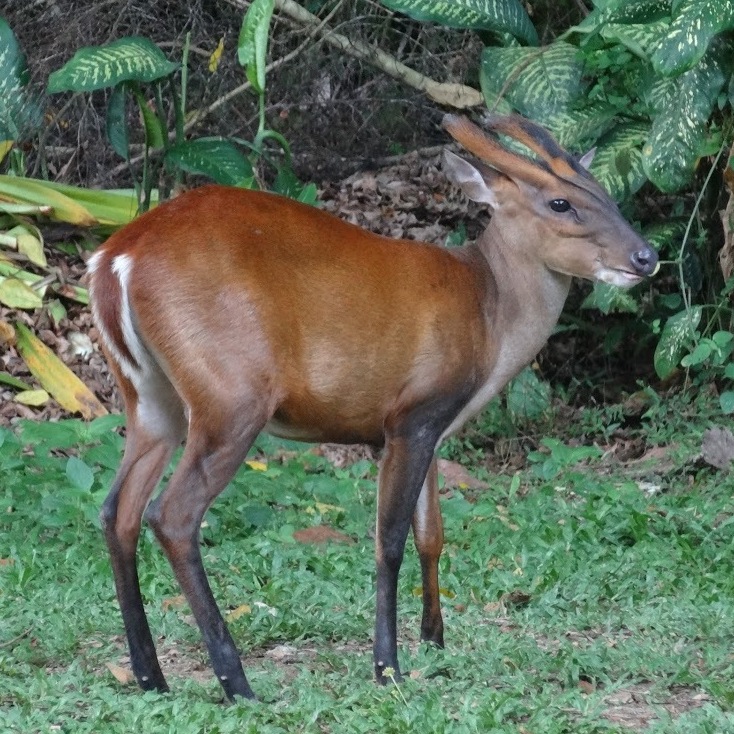
Adult Leaf Muntjacs generally have reddish-yellow fur, darker anterior legs, dark facial markings extending to the crown, and white fur on the underside. They have small, rounded ears averaging approximately 7.1 cm in length and a tuft of longer hair on the forehead.[1][2][3]
Fawns have chestnut-colored coats that gradually fade to the yellowish-brown coloration of adults. They lack the spots found on the fawns of common and Reeve's muntjacs.[4][5]
Both sexes possess enlarged canine teeth that form prominent tusks averaging approximately 2.4 cm in length. Males have single-tined, unbranched antlers measuring approximately 1–6 cm, with inward-curving pedicels that produce a narrow gap between the antlers.[6][7][8][9]
Leaf Muntjacs have prominent frontal glands and large pre-orbital fossae. Their skulls measure an average of 17.5 cm in length, with a maximum length of approximately 20 cm.[10][11]
Adults average approximately 50 cm in shoulder height, 12 kg in body mass, and 80 cm in head-body length. Their average tail length is approximately 10 cm, and they are among the smallest known species of muntjacs.[12][13][14][15][16]
Habitat
Leaf Muntjacs inhabit isolated mountainous forest regions, including tropical evergreen rainforests, subtropical hill forests, and warm and cool temperate rainforests. They have been recorded in forests at elevations ranging from approximately 800 to 3,000 m.[17][18][19]
In China, Leaf Muntjacs have been described in mid-temperate areas with high floral densities.[20]
Leaf Muntjacs occur in northern Myanmar and southeastern Tibet in the east trans-Himalayan region. They have been recorded in Arunachal Pradesh and reported in Namdapha Tiger Reserve, the Lohit and Changlang regions, and near Noklak in Nagaland, India, as well as along the western escarpment of Yunnan Province in China.[21][22][23][24][25]
The geographic range of the Leaf Muntjac remains incompletely determined.[26]
Diet
Leaf Muntjacs consume fruits and leaves.[27]
Behaviour
Leaf Muntjacs are generally solitary animals. They may be active during daylight hours, although their activity patterns have not been definitively established.[28][29]
Aggressive encounters may occur, as suggested by damaged ears and enlarged canine teeth in both sexes.[30]
Reproduction and life cycle
Leaf Muntjacs produce fawns throughout the year rather than following a regular birthing season. Pregnant and lactating females have been observed in early May.[31][32]
Fawns generally spend their first two months immobile. They reach adult height during their first year but may take several years to attain adult body weight.[33][34]
Conservation
The Leaf Muntjac is classified as Data Deficient on the IUCN Red List. Its populations have declined substantially because of heavy hunting, habitat loss, degradation of natural habitat, and hunting pressure.[35][36][37]
Similar species
Mitochondrial DNA analyses have identified Muntiacus vuquangensis as a close relative of the Leaf Muntjac. Analyses based on cytochrome b have identified Muntiacus truongsonensis as more closely related to the Leaf Muntjac than Muntiacus vuquangensis.[38][39]
Classification of the Leaf Muntjac
| Kingdom | Animalia |
|---|---|
| Phylum | Chordata |
| Subphylum | Vertebrata |
| Infraphylum | Gnathostomata |
| Parvphylum | Osteichthyes |
| Megaclass | Tetrapoda |
| Class | Mammalia (Mammal) |
| Subclass | Theria |
| Infraclass | Eutheria |
| Order | Artiodactyla (Artiodactyls) |
| Family | Cervidae (Deer) |
| Subfamily | Cervinae |
| Tribe | Muntiacini (Muntjacs) |
| Genus | Muntiacus (Muntjac) |
| Species | Muntiacus putaoensis Amato, Egan & Rabinowitz, 1999 |
Where the Leaf Muntjac is found
Checklists and occurrence records place Muntiacus putaoensis in 1 country across Asia. GBIF holds 10 georeferenced records of it.
Countries
Range as the checklists state it
Southern Asia
A number beside a place is its count of GBIF occurrence records. A place without a number comes from a checklist alone. Records show where a species has been observed or collected, which can include escapes and vagrants.
Common names
English
- Leaf Muntjac
- Leaf Deer
- Putao Muntjac
Names in 12 other languages
- Arabic
- أيل ورقي, منتجق بوتاو, منتجق ورقي
- Chinese
- 叶麂, 葉麂
- Czech
- muntžak listový
- French
- Muntjac de Putao
- German
- Burma-Muntjak, Burmamuntjak
- Hungarian
- Putao muntyákszarvas
- Japanese
- プタオホエジカ
- Korean
- 리프문착, 잎문착
- Norwegian Bokmål
- Løvhjort, Putaomuntjak
- Polish
- Mundżak liściowy
- Russian
- Мунтжак Путао
- Spanish
- Muntiaco de Putao, Muntíaco de Hukawng
Related species
-
 Reeves's MuntjacMuntiacus reevesi
-
 Southern Red MuntjacMuntiacus muntjak
-
 Giant MuntjacMuntiacus vuquangensis
-
 Northern Red MuntjacMuntiacus vaginalis
- Bornean Yellow MuntjacMuntiacus atherodes
-
 Fea's MuntjacMuntiacus feae
-
 Hairy-fronted MuntjacMuntiacus crinifrons
- Truong Son MuntjacMuntiacus truongsonensis
Compare
Questions and answers
What is the scientific name of the Leaf Muntjac?
The scientific name of the Leaf Muntjac is Muntiacus putaoensis. Written with its author, the full name is Muntiacus putaoensis Amato, Egan & Rabinowitz, 1999.
Which family does the Leaf Muntjac belong to?
Muntiacus putaoensis belongs to the family Cervidae, in the order Artiodactyla and the class Mammalia.
Where is the Leaf Muntjac found?
Checklists and occurrence records place Muntiacus putaoensis in 1 country: Myanmar.
What is the conservation status of the Leaf Muntjac?
The IUCN Red List category recorded for Muntiacus putaoensis is Data Deficient (DD).
What other names does the Leaf Muntjac have?
Muntiacus putaoensis is also known in English as Leaf Deer and Putao Muntjac.
What do muntjac deer eat?
Leaf Muntjacs consume fruits and leaves.[27]
Sources
Passages the profile rests on
- Adult leaf muntjacs generally have reddish-yellow fur, darker anterior legs, dark facial markings extending to the crown, and white fur on the underside. Source passage: “Generally, leaf deer are similar to common muntjacs , with reddish yellow pelage and a darkened anterior portion of their legs. They have dark facial markings that extend to the crown of their heads and have white ventral fur.” — animaldiversity.org
- Leaf muntjacs have small, rounded ears averaging approximately 7.1 cm in length. Source passage: “Leaf deer have small, rounded ears, with an average length of about 7.1 cm” — animaldiversity.org
- Leaf muntjacs have a tuft of longer hair on their foreheads. Source passage: “They have a patch of longer hair, forming a tuft in their forehead region.” — animaldiversity.org
- Leaf muntjac fawns have chestnut-colored coats that gradually fade to the yellowish-brown coloration of adults. Source passage: “As leaf deer fawns age, their pelage fades from a rich chestnut to the yellowish brown seen in adults.” — animaldiversity.org
- Leaf muntjac fawns lack the spots found on the fawns of common and Reeve's muntjacs. Source passage: “Leaf deer fawns are a rich chestnut color, but in contrast to common or Reeve's muntjacs , leaf deer fawns lack spots.” — animaldiversity.org
- Both male and female leaf muntjacs possess enlarged canine teeth that form prominent tusks. Source passage: “This species is characterized by short thin pedicles, small unbranched antlers, and relatively large preorbital fossa, with both males and females possessing canines” — pmc.ncbi.nlm.nih.gov
- Leaf muntjac tusks average approximately 2.4 cm in length. Source passage: “These tusks have an average length of 2.4 cm and are often damaged or scraped.” — animaldiversity.org
- Male leaf muntjacs have single-tined, unbranched antlers measuring approximately 1–6 cm. Source passage: “Male leaf deer antlers are relatively short, ranging from 1 to 6 cm and, consistent with other muntjacs, are grown on large pedicels.” — animaldiversity.org
- Male leaf muntjac antler pedicels curve inward, producing a narrow gap between the antlers. Source passage: “Contrary to other muntjacs, leaf deer pedicels curve inward, causing the gap between the pointed, single-tine antlers to be small.” — animaldiversity.org
- Leaf muntjacs have prominent frontal glands and large pre-orbital fossae. Source passage: “A feature of leaf deer that is not common to the entire genus is the presence of prominent frontal glands. Likewise, their skulls have large pre-orbital fossa.” — animaldiversity.org
- Leaf muntjacs have a maximum skull length of approximately 20 cm and an average skull length of 17.5 cm. Source passage: “Their maximum skull length is about 20 cm, with an average of 17.5 cm (± 0.39 cm).” — animaldiversity.org
- Adult leaf muntjacs average approximately 50 cm in shoulder height. Source passage: “standing an average of 50 cm at the shoulder” — animaldiversity.org
- Adult leaf muntjacs have an average body mass of approximately 12 kg. Source passage: “it is the smallest muntjac (mean adult body mass 12 kg)” — pmc.ncbi.nlm.nih.gov
- Adult leaf muntjacs have an average head-body length of approximately 80 cm. Source passage: “They have an average head-body length of 80 cm (± 3 cm)” — animaldiversity.org
- Adult leaf muntjacs have an average tail length of approximately 10 cm. Source passage: “and an average tail length of 10 cm (± 1.6 cm).” — animaldiversity.org
- Leaf muntjacs are among the smallest known species of muntjacs. Source passage: “Leaf deer are among the smallest known muntjacs.” — animaldiversity.org
- Leaf muntjacs inhabit isolated mountainous forest regions. Source passage: “Leaf deer occupy the forests of isolated mountainous regions.” — animaldiversity.org
- Leaf muntjacs inhabit tropical evergreen rainforests, subtropical hill forests, and warm and cool temperate rainforests. Source passage: “They inhabit a wide array of forest types including tropical evergreen rainforests, sub-tropical hill forests and warm and cool temperate rainforests.” — animaldiversity.org
- Leaf muntjacs have been recorded in forests at elevations ranging from approximately 800 to 3,000 m. Source passage: “Leaf deer have been observed at a range of elevations, from tropical evergreen forests at 800 m, to cool temperate rainforests at 3,000 m.” — animaldiversity.org
- In China, leaf muntjacs have been described in mid-temperate areas with high floral densities. Source passage: “In China, leaf deer have been described along the western escarpment of the Yunnan Province and in mid-temperate areas with high floral densities.” — animaldiversity.org
- Leaf muntjacs occur in northern Myanmar and southeastern Tibet in the east trans-Himalayan region. Source passage: “Muntiacus putaoensis is endemic to the east trans-Himalayan region (including northern Myanmar and southeastern Tibet, China)” — pmc.ncbi.nlm.nih.gov
- Leaf muntjacs have been recorded in Arunachal Pradesh, India. Source passage: “Its existence in India was first reported from the Lohit district in eastern Arunachal Pradesh.” — English Wikipedia
- Leaf muntjacs have been reported in Namdapha Tiger Reserve in India. Source passage: “In 2002, it was also reported to exist in Namdapha Tiger Reserve and eastern Arunachal Pradesh, India.” — English Wikipedia
- Leaf muntjacs have been reported in the Lohit and Changlang regions and near Noklak in Nagaland, India. Source passage: “It has also been noted from the Lohit and Changlang region and near Noklak in Nagaland.” — English Wikipedia
- Leaf muntjacs have been recorded along the western escarpment of Yunnan Province in China. Source passage: “In China, leaf deer have been described along the western escarpment of the Yunnan Province” — animaldiversity.org
- The geographic range of leaf muntjacs remains incompletely determined. Source passage: “It also indicates that the extent of its geographic range is still being determined.” — pmc.ncbi.nlm.nih.gov
- Leaf muntjacs consume fruits and leaves. Source passage: “Fruit and leaf traces upon autopsy indicates their diets contribute to local seed dispersal practices.” — English Wikipedia
- Leaf muntjacs are generally solitary animals. Source passage: “Leaf muntjacs are solitary.” — animaldiversity.org
- Leaf muntjacs may be active during daylight hours, although their activity patterns have not been definitively established. Source passage: “Indian muntjacs and Reeve's muntjacs show peaks of activity at dawn and dusk, but overall activity patterns suggest a diurnal habit. Given the similarity in habitat and feeding strategies, this activity pattern may apply to leaf muntjacs as well.” — animaldiversity.org
- Leaf muntjacs may experience aggressive encounters, as suggested by damaged ears and enlarged canine teeth in both sexes. Source passage: “Due to the size of their canines and their often damaged ears, it has been hypothesized that there are aggressive encounters among leaf deer.” — animaldiversity.org
- Leaf muntjacs produce fawns throughout the year rather than following a regular birthing season. Source passage: “Leaf deer do not exhibit a regular birthing pattern; rather, fawns are born during all months of the year.” — animaldiversity.org
- Pregnant and lactating female leaf muntjacs have been observed in early May. Source passage: “In particular, pregnant and lactating females have been observed in early May” — animaldiversity.org
- Leaf muntjac fawns generally spend their first two months immobile. Source passage: “Fawns have been observed moving with their mothers, but usually spend their first two months immobile.” — animaldiversity.org
- Leaf muntjac fawns reach adult height during their first year but may take several years to attain adult body weight. Source passage: “Leaf deer fawns reach adult height by the first year after birth, but may not reach adult weight for several years.” — animaldiversity.org
- The leaf muntjac is classified as Data Deficient on the IUCN Red List. Source passage: “This species is listed as data deficient (DD) in the IUCN Red List of Threatened species” — pmc.ncbi.nlm.nih.gov
- Leaf muntjac populations have declined because of heavy hunting and habitat loss. Source passage: “In recent years, population numbers have decreased due to heavy hunting and habitat loss” — pmc.ncbi.nlm.nih.gov
- Degradation of natural habitat and hunting pressure have caused a substantial decline in leaf muntjac populations. Source passage: “the population of the leaf muntjac has decreased dramatically in recent years due to considerable degradation of its natural habitat and heavy hunting pressure” — pmc.ncbi.nlm.nih.gov
- Mitochondrial DNA analyses have identified Muntiacus vuquangensis as a close relative of the leaf muntjac. Source passage: “Phylogenetic analyses (ML and BI) among the Muntiacus genus based on the sequenced of mitogenome and ND4L-ND4 supported M. putaoensis as a member of Muntiacus, most closely related to M. vuquangensis.” — pmc.ncbi.nlm.nih.gov
- Analyses based on cytochrome b have identified Muntiacus truongsonensis as more closely related to the leaf muntjac than Muntiacus vuquangensis. Source passage: “However, when analyses based on cyt b included two more muntjacs, M. truongsonensis was most closely related to M. putaoensis rather than M. vuquangensis” — pmc.ncbi.nlm.nih.gov
Data
- Catalogue of Life, 2026-10-16 XR cc by
- Global Biodiversity Information Facility CC BY 4.0
- Wikidata CC0
- GeoNames CC BY 4.0
- Within the Catalogue of Life, this name comes from The Integrated Taxonomic Information System cc0
References
- Anim. Conserv. vol.2 p.4 where the name was published
- Wilson, Don E., and DeeAnn M. Reeder, eds. (2005). Mammal Species of the World: A Taxonomic and Geographic Reference, 3rd Ed., Vols. 1 & 2.
- Wilson, D. E., and R. A. Mittermeier, eds. (2011). Handbook of the Mammals of the World, Vol. 2: Hoofed Mammals.
- Burgin, Connor J., Don E. Wilson, Russell A. Mittermeier, Anthony B. Rylands, et al. (2020). Illustrated Checklist of the Mammals of the World. Vol. 2. Eulipotyphla to Carnivora.
This species in other databases
Page built on 29 November 2026. See how the catalog is made and all sources and licences.
Cite this page
ScientificNames.org. (2026). Muntiacus putaoensis (Leaf Muntjac). Retrieved November 29, 2026, from https://scientificnames.org/species/muntiacus-putaoensis
“Muntiacus putaoensis (Leaf Muntjac).” ScientificNames.org, 2026, scientificnames.org/species/muntiacus-putaoensis. Accessed 29 Nov. 2026.
ScientificNames.org. “Muntiacus putaoensis (Leaf Muntjac).” Accessed November 29, 2026. https://scientificnames.org/species/muntiacus-putaoensis.
@misc{scientificnames_muntiacus_putaoensis_leaf_muntjac,
  author = {{ScientificNames.org}},
  title = {Muntiacus putaoensis (Leaf Muntjac)},
  year = {2026},
  url = {https://scientificnames.org/species/muntiacus-putaoensis},
  note = {Accessed 2026-11-29}
}