Species · Birds
Shining Flycatcher Myiagra alecto
The scientific name of the Shining Flycatcher is Myiagra alecto. It is a species of bird in the family Monarchidae (monarch flycatcher), order Passeriformes. The name dates from 1827.
- Scientific name
- Myiagra alecto (Temminck, 1827)
- Common name
- Shining Flycatcher
- Genus
- Myiagra
- Family
- Monarchidae (Monarch Flycatcher)
- Order
- Passeriformes
- Class
- Aves
- Red List category
- LC Least Concern
- Recorded in
- 3 countries
- Name status
- accepted in the Catalogue of Life

Overview
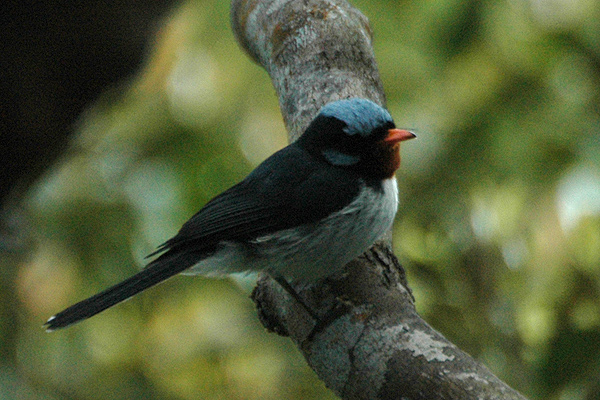
Myiagra alecto occurs in northern Australia and across the region extending from the Moluccas to the Bismarck Archipelago. Adult males have entirely glossy blue-black plumage, while adult females have chestnut upperparts, white underparts, and a black crown and face.
Written 26 November 2026 from the sources listed below. Each statement was checked against the passage it cites; statements that could not be supported were removed.
Appearance
The Shining Flycatcher has a slender body, a long tail and a fine bill.[1]
Adult males have entirely glossy blue-black plumage. Adult females have chestnut upperparts, white underparts, and a black crown and face.[2][3]
Habitat
The Shining Flycatcher inhabits subtropical or tropical moist lowland forests and subtropical or tropical mangrove forests.[4][5]
Behaviour
The Shining Flycatcher produces a clear whistled song described as “towhit-too-towhit.”[6]
Classification of the Shining Flycatcher
| Kingdom | Animalia |
|---|---|
| Phylum | Chordata |
| Subphylum | Vertebrata |
| Infraphylum | Gnathostomata |
| Parvphylum | Osteichthyes |
| Megaclass | Tetrapoda |
| Class | Aves (Bird) |
| Order | Passeriformes (Passerine) |
| Family | Monarchidae (Monarch Flycatcher) |
| Genus | Myiagra (Broadbills) |
| Species | Myiagra alecto (Temminck, 1827) |
Where the Shining Flycatcher is found
Checklists and occurrence records place Myiagra alecto in 3 countries across Oceania. GBIF holds 40,046 georeferenced records of it.
Countries
Regions and cities with the most records
- Northern Territory, Australia 16,471
- Queensland, Australia 14,741
- Palmerston, Australia 7,005
- Darwin, Australia 6,298
- Cairns, Australia 1,387
- Papua, Indonesia 824
- Western Australia, Australia 775
- Madang Province, Papua New Guinea 742
- Western Province, Papua New Guinea 538
- Townsville, Australia 498
- West New Britain Province, Papua New Guinea 315
- Madang, Papua New Guinea 242
- Milne Bay Province, Papua New Guinea 214
- Kimbe, Papua New Guinea 209
- Sorong, Indonesia 206
- Central Province, Papua New Guinea 161
- Brisbane, Australia 119
- Sunshine Coast, Australia 114
- Ternate, Indonesia 114
- Biak, Indonesia 103
- Caloundra, Australia 99
- Sentani, Indonesia 92
- New Ireland, Papua New Guinea 91
- New South Wales, Australia 83
- Bundaberg, Australia 81
- Narangba, Australia 81
- Maluku, Indonesia 78
- Abepura, Indonesia 66
- East Sepik Province, Papua New Guinea 52
- Manus Province, Papua New Guinea 50
- Mackay, Australia 46
- Sofifi, Indonesia 39
- Port Moresby, Papua New Guinea 35
- East New Britain Province, Papua New Guinea 34
- Oro Province, Papua New Guinea 34
- Gold Coast, Australia 28
1 more country has a few records outside this range
These countries hold a few records of Myiagra alecto but lie outside the range the checklists give for it. Such records are often zoo or garden specimens, museum material or vagrants, so the species is not counted as occurring there.
Range as the checklists state it
Australia
A number beside a place is its count of GBIF occurrence records. A place without a number comes from a checklist alone. Records show where a species has been observed or collected, which can include escapes and vagrants.
Common names
English
- Shining Flycatcher
Names in 23 other languages
- Catalan
- monarca esplèndid
- Chinese
- 華麗闊嘴鶲, 辉阔嘴鹟
- Croatian
- blistavokapi monarh
- Czech
- muchálek zářivý
- Danish
- Glansmonark
- Dutch
- Zwarte Monarch
- Esperanto
- glacea monarko
- Finnish
- mangrovemonarkki
- French
- Monarque luisant
- German
- Glanzmonarch
- Hungarian
- fénylő császárlégykapó
- Indonesian
- Sikatan kilap
- Italian
- Pigliamosche splendente
- Japanese
- テリヒラハシ
- Lithuanian
- paprastoji miagra
- Polish
- muszarka jednobarwna
- Portuguese
- monarca-reluzente, papa-moscas-reluzente
- Russian
- Блестящая миагра, Блестящий монарх
- Slovak
- monarch lesklý
- Spanish
- Monarca reluciente
- Turkish
- Kuzguni Monark
- Ukrainian
- міагра блискучопера
- Welsh
- brenin gloyw
Synonyms
3 other scientific names have been used for this species and are now treated as synonyms of Myiagra alecto.
- Drymophila alecto Temminck, 1827
- Monarcha alecto Temminck, CJ, 1827
- Piezorhynchus alecto Temminck, CJ, 1827
Subspecies and varieties
- Myiagra alecto alecto subspecies
- Myiagra alecto chalybeocephala subspecies
- Myiagra alecto longirostris (Tanimbar Shining Flycatcher) subspecies
- Myiagra alecto lucida subspecies
- Myiagra alecto manumudari (Manam Shining Flycatcher) subspecies
- Myiagra alecto melvillensis (Northwestern Shining Flycatcher) subspecies
- Myiagra alecto rufolateralis subspecies
- Myiagra alecto wardelli (Eastern Shining Flycatcher) subspecies
Related species
-
 Guam FlycatcherMyiagra freycineti
- Restless FlycatcherMyiagra inquieta
-
 Leaden FlycatcherMyiagra rubecula
-
 Satin FlycatcherMyiagra cyanoleuca
-
 Broad-billed FlycatcherMyiagra ruficollis
-
 Paperbark FlycatcherMyiagra nana
-
 Vanikoro FlycatcherMyiagra vanikorensis
-
 Azure-crested FlycatcherMyiagra azureocapilla
Compare
Questions and answers
What is the scientific name of the Shining Flycatcher?
The scientific name of the Shining Flycatcher is Myiagra alecto. Written with its author, the full name is Myiagra alecto (Temminck, 1827).
Which family does the Shining Flycatcher belong to?
Myiagra alecto belongs to the family Monarchidae, in the order Passeriformes and the class Aves.
Where is the Shining Flycatcher found?
Checklists and occurrence records place Myiagra alecto in 3 countries: Australia, Indonesia and Papua New Guinea.
What is the conservation status of the Shining Flycatcher?
The IUCN Red List category recorded for Myiagra alecto is Least Concern (LC).
Sources
Passages the profile rests on
- The Shining Flycatcher has a slender body, a long tail and a fine bill. Source passage: “A long-tailed, slender songbird with fine bill.” — English Wikipedia
- Adult males have entirely glossy blue-black plumage. Source passage: “Male entirely glossy blue-black.” — English Wikipedia
- Adult females have chestnut upperparts, white underparts, and a black crown and face. Source passage: “Female a rich chestnut above, white below, with black crown and face” — English Wikipedia
- The species inhabits subtropical or tropical moist lowland forests. Source passage: “Its natural habitats are subtropical or tropical moist lowland forest” — English Wikipedia
- The species inhabits subtropical or tropical mangrove forests. Source passage: “and subtropical or tropical mangrove forest.” — English Wikipedia
- The species produces a clear whistled song described as “towhit-too-towhit.” Source passage: “Song a clear whistled "towhit-too-towhit."” — English Wikipedia
Data
- Catalogue of Life, 2026-10-16 XR cc by
- Global Biodiversity Information Facility CC BY 4.0
- Wikidata CC0
- GeoNames CC BY 4.0
- Wikimedia Commons per image; credit shown with each image
- Within the Catalogue of Life, this name comes from The Integrated Taxonomic Information System cc0
References
- Gill, Frank, & and Minturn Wright. (2006). Birds of the World: Recommended English Names.
This species in other databases
Page built on 27 November 2026. See how the catalog is made and all sources and licences.
Cite this page
ScientificNames.org. (2026). Myiagra alecto (Shining Flycatcher). Retrieved November 27, 2026, from https://scientificnames.org/species/myiagra-alecto
“Myiagra alecto (Shining Flycatcher).” ScientificNames.org, 2026, scientificnames.org/species/myiagra-alecto. Accessed 27 Nov. 2026.
ScientificNames.org. “Myiagra alecto (Shining Flycatcher).” Accessed November 27, 2026. https://scientificnames.org/species/myiagra-alecto.
@misc{scientificnames_myiagra_alecto_shining_flycatcher,
  author = {{ScientificNames.org}},
  title = {Myiagra alecto (Shining Flycatcher)},
  year = {2026},
  url = {https://scientificnames.org/species/myiagra-alecto},
  note = {Accessed 2026-11-27}
}