Species · Birds
Leaden Flycatcher Myiagra rubecula
The scientific name of the Leaden Flycatcher is Myiagra rubecula. It is a species of bird in the family Monarchidae (monarch flycatcher), order Passeriformes. The name dates from 1801.
- Scientific name
- Myiagra rubecula (Latham, 1801)
- Common name
- Leaden Flycatcher
- Genus
- Myiagra
- Family
- Monarchidae (Monarch Flycatcher)
- Order
- Passeriformes
- Class
- Aves
- Red List category
- LC Least Concern
- Recorded in
- 2 countries
- Name status
- accepted in the Catalogue of Life

Overview
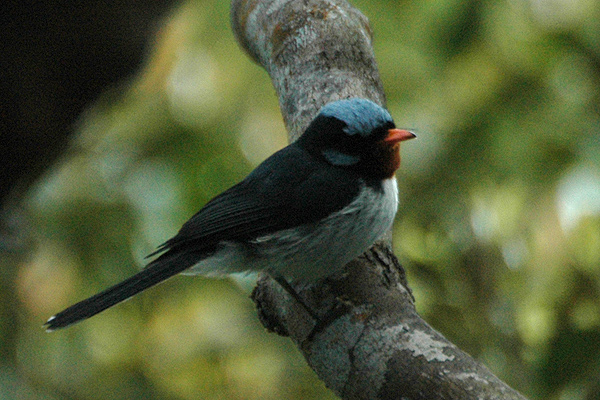
Myiagra rubecula inhabits mangroves, eucalypt woodland, sclerophyll forest, rainforest margins and coastal scrub in its range. Males have lustrous azure upperparts and white underparts, while females have leaden-coloured upperparts and a rufous throat and breast.
Written 26 November 2026 from the sources listed below. Each statement was checked against the passage it cites; statements that could not be supported were removed.
Appearance
The male has lustrous azure upperparts, a white breast and belly, and darker grey lores than the rest of its head. It also has a blue-grey bib with a convex lower edge.[1][2][3][4]
The female has a leaden-coloured head, mantle and back, an orange-tan throat and breast, and a white belly. Juveniles resemble adult females but have paler wing edges.[5][6][7]
The species has shiny lead-grey plumage with a brownish tinge on its wings, a bluish-black bill, black legs and a dark brown iris.[8][9]
It measures between 14.5 and 16 cm in length and weighs approximately 10–15 g.[10][11]
Habitat
The species inhabits subtropical or tropical mangrove forests in the northern parts of its range and eucalypt woodland in southern and inland parts. Its preferred habitats also include sclerophyll forest, rainforest margins and coastal scrub.[12][13][14][15][16][17]
Diet
The Leaden Flycatcher is insectivorous.[18]
Behaviour
The species is highly active and agile. It hops between branches while foraging and catches insects in flight.[19][20][21]
It is highly migratory within its geographical range.[22]
Reproduction and life cycle
The breeding season extends from September to February, and the species raises one brood per season. It lays two or three eggs per clutch.[23][24][25]
The nest is a deep cup made from bark strips and dry grass woven together with spider webs, and decorated with lichen. It is generally positioned on a small branch of a sizeable tree, away from the trunk, at a height of 5–10 m above the ground.[26][27][28][29][30]
The eggs are white with bluish, greyish or lavender tints and dark grey-brown spots. They measure approximately 17 mm by 14 mm and have an unusually swollen oval shape.[31][32][33]
Both sexes incubate the eggs and brood the chicks, although the female performs slightly more of these duties and incubates the eggs at night. Only 23% of nests successfully produce a fledged chick.[34][35][36][37]
The species is parasitised by the brush cuckoo (Cacomantis variolosus).[38]
Conservation
The number of mature individuals is unknown.[39]
Classification of the Leaden Flycatcher
| Kingdom | Animalia |
|---|---|
| Phylum | Chordata |
| Subphylum | Vertebrata |
| Infraphylum | Gnathostomata |
| Parvphylum | Osteichthyes |
| Megaclass | Tetrapoda |
| Class | Aves (Bird) |
| Order | Passeriformes (Passerine) |
| Family | Monarchidae (Monarch Flycatcher) |
| Genus | Myiagra (Broadbills) |
| Species | Myiagra rubecula (Latham, 1801) |
Where the Leaden Flycatcher is found
Checklists and occurrence records place Myiagra rubecula in 2 countries across Oceania. GBIF holds 192,822 georeferenced records of it.
Countries
Regions and cities with the most records
- Queensland, Australia 104,108
- New South Wales, Australia 46,664
- Brisbane, Australia 16,102
- Northern Territory, Australia 14,720
- Australian Capital Territory, Australia 10,445
- Canberra, Australia 9,629
- Capalaba, Australia 8,740
- Townsville, Australia 8,385
- Narangba, Australia 8,199
- Tuggeranong, Australia 7,683
- Victoria, Australia 7,428
- Cairns, Australia 6,136
- Logan City, Australia 4,752
- Palmerston, Australia 2,746
- Western Australia, Australia 2,686
- Darwin, Australia 2,510
- Sunshine Coast, Australia 2,450
- Hornsby, Australia 2,168
- Toowoomba, Australia 1,927
- Port Macquarie, Australia 1,632
- Sydney, Australia 1,617
- Hervey Bay, Australia 1,582
- Gold Coast, Australia 1,571
- Parramatta, Australia 1,483
- Caloundra, Australia 1,383
- Bundaberg, Australia 1,379
- Mackay, Australia 1,293
- Maitland, Australia 1,060
- Armidale, Australia 735
- Liverpool, Australia 684
- Gladstone, Australia 661
- Central Coast, Australia 631
- Newcastle, Australia 495
- Cessnock, Australia 464
- Maryborough, Australia 385
- Central Province, Papua New Guinea 374
1 more country has a few records outside this range
These countries hold a few records of Myiagra rubecula but lie outside the range the checklists give for it. Such records are often zoo or garden specimens, museum material or vagrants, so the species is not counted as occurring there.
Range as the checklists state it
Australia
A number beside a place is its count of GBIF occurrence records. A place without a number comes from a checklist alone. Records show where a species has been observed or collected, which can include escapes and vagrants.
Common names
English
- Leaden Flycatcher
Names in 25 other languages
- Catalan
- monarca plumbi
- Chinese
- 鉛灰闊嘴鶲, 铅灰阔嘴鹟
- Croatian
- olovasti monarh
- Czech
- muchálek olověnobarvý
- Danish
- Blygrå Monark
- Dutch
- Zilvermonarch
- Esperanto
- plumba monarko
- Finnish
- lyijymonarkki
- French
- Monarque rougegorge
- German
- Silber-Monarch, Silbermonarch
- Indonesian
- Sikatan kelam
- Italian
- Pigliamosche piombato
- Japanese
- ナマリイロヒラハシ, ナマリイロヒラハシ [namariirohirahashi]
- Lithuanian
- sidabrauodegė miagra
- Norwegian
- blymonark
- Polish
- muszarka blada
- Portuguese
- monarca-plúmbeo, papa-moscas-plúmbeo
- Russian
- Серебристая миагра
- Serbian
- Olovna muharica
- Slovak
- monarch volavý
- Spanish
- Monarca plomizo
- Swedish
- Blygrå flugsnappare, blågrå monark
- Turkish
- Kurşuni Monark
- Ukrainian
- міагра сріблиста
- Welsh
- brenin llwydlas
Synonyms
3 other scientific names have been used for this species and are now treated as synonyms of Myiagra rubecula.
- Myiagra rubecoloides Vigors & Horsfield, 1827
- Myiagra rubeculoides Horsfield, T; Vigors, NA, 1827
- Todus rubecula Latham, 1801
Subspecies and varieties
- Myiagra rubecula concinna (Northwestern Leaden Flycatcher) subspecies
- Myiagra rubecula okyri (Cape York Leaden Flycatcher) subspecies
- Myiagra rubecula papuana (Papuan Leaden Flycatcher) subspecies
- Myiagra rubecula rubecula (Southeastern Leaden Flycatcher) subspecies
- Myiagra rubecula sciurorum subspecies
- Myiagra rubecula yorki (Eastern Leaden Flycatcher) subspecies
Related species
-
 Guam FlycatcherMyiagra freycineti
- Restless FlycatcherMyiagra inquieta
-
 Satin FlycatcherMyiagra cyanoleuca
-
 Shining FlycatcherMyiagra alecto
-
 Broad-billed FlycatcherMyiagra ruficollis
-
 Paperbark FlycatcherMyiagra nana
-
 Vanikoro FlycatcherMyiagra vanikorensis
-
 Azure-crested FlycatcherMyiagra azureocapilla
Compare
Questions and answers
What is the scientific name of the Leaden Flycatcher?
The scientific name of the Leaden Flycatcher is Myiagra rubecula. Written with its author, the full name is Myiagra rubecula (Latham, 1801).
Which family does the Leaden Flycatcher belong to?
Myiagra rubecula belongs to the family Monarchidae, in the order Passeriformes and the class Aves.
Where is the Leaden Flycatcher found?
Checklists and occurrence records place Myiagra rubecula in 2 countries: Australia and Papua New Guinea.
What is the conservation status of the Leaden Flycatcher?
The IUCN Red List category recorded for Myiagra rubecula is Least Concern (LC).
Sources
Passages the profile rests on
- The male has lustrous azure upperparts and white underparts. Source passage: “the male is lustrous azure with white underparts” — English Wikipedia
- The male has darker grey lores than the rest of its head. Source passage: “The male has darker grey lores” — English Wikipedia
- The male has a white breast and belly. Source passage: “and a white breast and belly” — English Wikipedia
- Males have a blue-grey bib with a convex lower edge. Source passage: “with a blue-gray bib with convex lower edge” — ebird.org
- The female has leaden-coloured head, mantle and back, with a rufous throat and breast. Source passage: “the female possesses leaden head, mantle and back and rufous throat and breast.” — English Wikipedia
- The female has an orange-tan throat and breast and a white belly. Source passage: “the female has an orange-tan throat and breast with a white belly.” — English Wikipedia
- Juveniles resemble adult females but have paler wing edges. Source passage: “The juvenile resembles the adult female, but with paler wing-edges.” — English Wikipedia
- The species has shiny lead-grey plumage with a brownish tinge on its wings. Source passage: “It is a shiny lead-grey in colour with a brownish tinge to the wings” — English Wikipedia
- The species has a bluish-black bill, black legs and dark brown iris. Source passage: “a bluish black bill, black legs and dark brown iris.” — English Wikipedia
- The species measures between 14.5 and 16 cm in length. Source passage: “The leaden flycatcher is 14.5–16 cm (6-6½ in) long” — English Wikipedia
- The species weighs approximately 10–15 g. Source passage: “weighs around 10–15 g.” — English Wikipedia
- The species inhabits subtropical or tropical mangrove forests in the northern parts of its range. Source passage: “Its natural habitat is subtropical or tropical mangrove forests in the northern parts of its range” — English Wikipedia
- The species inhabits eucalypt woodland in southern and inland parts of its range. Source passage: “in the south and inland it is eucalypt woodland.” — English Wikipedia
- Preferred habitats include sclerophyll forest. Source passage: “Sclerophyll forest, rainforest margins, mangroves and coastal scrub are the preferred habitats.” — English Wikipedia
- Preferred habitats include rainforest margins. Source passage: “Sclerophyll forest, rainforest margins, mangroves and coastal scrub are the preferred habitats.” — English Wikipedia
- Preferred habitats include mangroves. Source passage: “Sclerophyll forest, rainforest margins, mangroves and coastal scrub are the preferred habitats.” — English Wikipedia
- Preferred habitats include coastal scrub. Source passage: “Sclerophyll forest, rainforest margins, mangroves and coastal scrub are the preferred habitats.” — English Wikipedia
- The species is insectivorous. Source passage: “the leaden flycatcher is insectivorous.” — English Wikipedia
- The species is highly active and agile. Source passage: “A very active and agile bird” — English Wikipedia
- The species hops between branches while foraging. Source passage: “it hops between branches” — English Wikipedia
- The species catches insects in flight. Source passage: “catches insects in flight.” — English Wikipedia
- The species is highly migratory within its geographical range. Source passage: “It is highly migratory within this range.” — English Wikipedia
- The breeding season extends from September to February. Source passage: “Breeding season is September to February” — English Wikipedia
- The species raises one brood per breeding season. Source passage: “with one brood raised.” — English Wikipedia
- The species lays two or three eggs per clutch. Source passage: “Two or three white eggs tinted bluish, greyish or lavender” — English Wikipedia
- The nest is a deep cup constructed from bark strips and dry grass. Source passage: “The nest is a deep cup made of strips of bark and dry grass” — English Wikipedia
- The nest materials are woven together using spider webs. Source passage: “woven together with spider webs” — English Wikipedia
- The nest is decorated with lichen. Source passage: “and decorated with lichen” — English Wikipedia
- The nest is generally positioned on a small branch of a sizeable tree, away from its trunk. Source passage: “generally sited on a small branch well away from the trunk of a sizeable tree” — English Wikipedia
- The nest is generally located 5–10 m above the ground. Source passage: “some 5–10 m above the ground.” — English Wikipedia
- The eggs are white with bluish, greyish or lavender tints and dark grey-brown spots. Source passage: “Two or three white eggs tinted bluish, greyish or lavender and splotched with dark grey-brown” — English Wikipedia
- The eggs measure approximately 17 mm by 14 mm. Source passage: “measuring 17 mm x 14 mm.” — English Wikipedia
- The eggs have an unusually swollen oval shape. Source passage: “They have an unusual swollen oval shape.” — English Wikipedia
- Both sexes incubate the eggs and brood the chicks. Source passage: “Both sexes incubate the eggs and brood the chicks” — English Wikipedia
- The female performs slightly more incubation and brooding duties than the male. Source passage: “although the female undertakes slightly more of the duties” — English Wikipedia
- The female incubates the eggs at night. Source passage: “and also incubates at night.” — English Wikipedia
- Only 23% of nests successfully produce a fledged chick. Source passage: “only 23% of nests successfully fledging a chick.” — English Wikipedia
- The species is parasitised by the brush cuckoo (Cacomantis variolosus). Source passage: “The species is parasitised by the brush cuckoo (Cacomantis variolosus).” — English Wikipedia
- The number of mature individuals is unknown. Source passage: “Number of mature individuals Unknown” — datazone.birdlife.org
Data
- Catalogue of Life, 2026-10-16 XR cc by
- Global Biodiversity Information Facility CC BY 4.0
- Wikidata CC0
- GeoNames CC BY 4.0
- Wikimedia Commons per image; credit shown with each image
- Within the Catalogue of Life, this name comes from The Integrated Taxonomic Information System cc0
References
- Gill, Frank, & and Minturn Wright. (2006). Birds of the World: Recommended English Names.
This species in other databases
Page built on 28 November 2026. See how the catalog is made and all sources and licences.
Cite this page
ScientificNames.org. (2026). Myiagra rubecula (Leaden Flycatcher). Retrieved November 28, 2026, from https://scientificnames.org/species/myiagra-rubecula
“Myiagra rubecula (Leaden Flycatcher).” ScientificNames.org, 2026, scientificnames.org/species/myiagra-rubecula. Accessed 28 Nov. 2026.
ScientificNames.org. “Myiagra rubecula (Leaden Flycatcher).” Accessed November 28, 2026. https://scientificnames.org/species/myiagra-rubecula.
@misc{scientificnames_myiagra_rubecula_leaden_flycatcher,
  author = {{ScientificNames.org}},
  title = {Myiagra rubecula (Leaden Flycatcher)},
  year = {2026},
  url = {https://scientificnames.org/species/myiagra-rubecula},
  note = {Accessed 2026-11-28}
}